
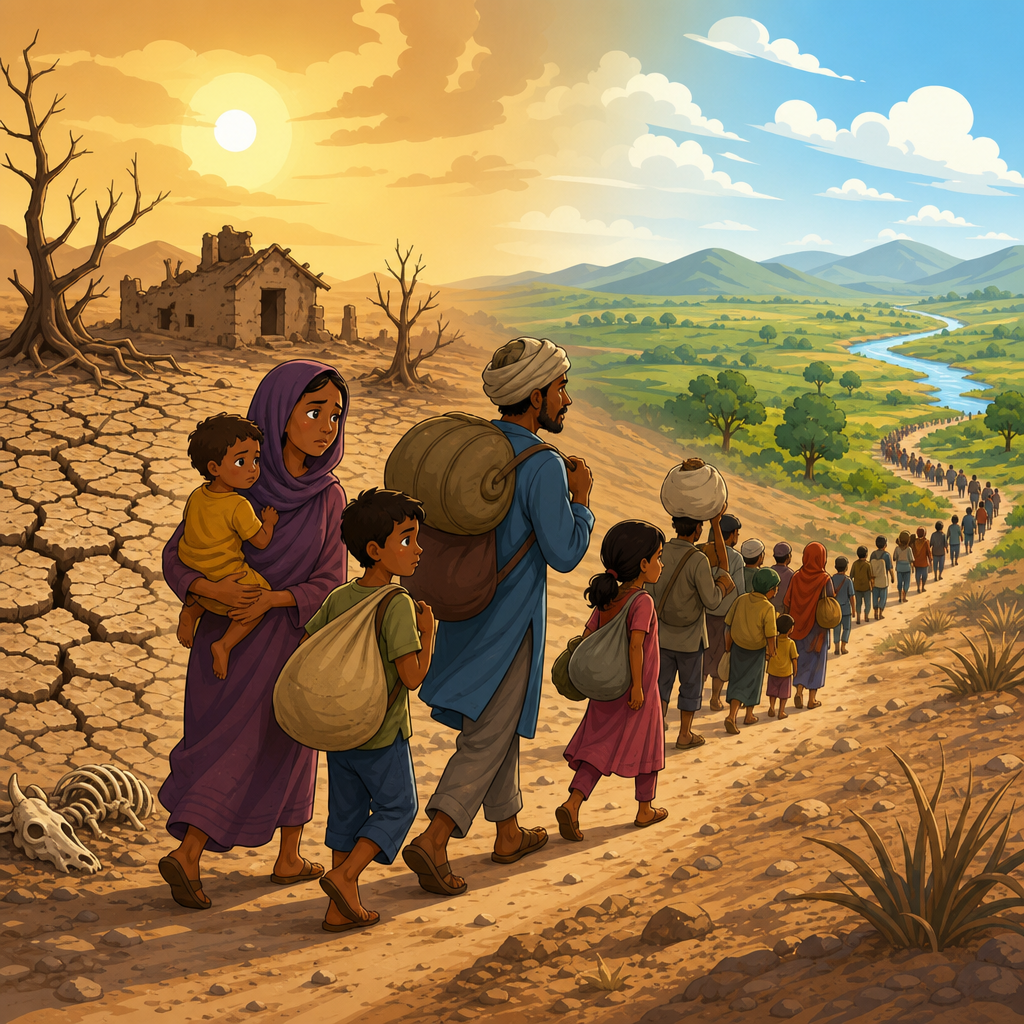
Drought and famine as drivers of mass migration sit at the center of climate-induced migration, a pattern I have seen repeatedly in disaster reporting, humanitarian assessments, and regional risk analysis. Drought is a prolonged period of below-average precipitation that disrupts water supplies, agriculture, and ecosystems. Famine is the most severe form of food insecurity, defined through measurable thresholds of malnutrition, mortality, and lack of access to food. Mass migration refers to large-scale population movement, whether across borders or within a country, driven by threats to survival, livelihoods, or security. When rain fails, crops wither, livestock die, food prices spike, debt grows, and families begin making hard choices about who leaves, where they go, and whether they can ever return.
This topic matters because climate-induced migration is not a future possibility; it is an active feature of the global risk landscape. The World Bank has warned that without strong climate and development action, tens of millions of people could become internal climate migrants by 2050 across several world regions. The Internal Displacement Monitoring Centre regularly documents disaster displacement in the millions each year, with drought often acting less like a sudden trigger and more like a slow-burning accelerant. For readers exploring environmental disasters, this hub explains how drought and famine push movement, which populations are most exposed, how governments and aid agencies assess risk, and what responses actually reduce forced migration rather than merely managing it after the fact.
How drought turns environmental stress into migration pressure
Drought drives migration through a chain of impacts that begins with water stress and ends in household displacement. In rain-fed farming systems, one failed rainy season can reduce yields; two or three can erase savings, increase borrowing, and trigger distress sales of animals, tools, or land use rights. Pastoral communities face a parallel crisis when grazing areas fail and surface water disappears. At that point, migration is rarely a first choice. People usually try adaptation before movement: switching crops, reducing meals, taking informal work, sending one family member to a town, or relying on remittances. Migration becomes more likely when these coping mechanisms collapse.
In the Sahel and Horn of Africa, this pattern is well documented. During the 2011 Somalia famine, drought combined with conflict, weak market access, and restrictions on humanitarian aid to produce catastrophic displacement into Mogadishu, Kenya, and Ethiopia. In 2020 through 2023, consecutive poor rainy seasons in Somalia, Ethiopia, and Kenya devastated herds and pushed many rural households into camps or peri-urban settlements. Mexico’s Dry Corridor and Central America’s Dry Corridor show another version of the same process. Repeated crop losses in maize and beans have pushed rural workers toward cities and northward migration routes. Drought does not act alone, but it often creates the economic pressure that makes migration appear rational, necessary, and urgent.
Why famine causes rapid, often irreversible population movement
Famine is not simply hunger. Under the Integrated Food Security Phase Classification, famine is associated with extreme food consumption gaps, acute malnutrition, and elevated death rates. By the time conditions approach that level, households have exhausted most resilience options. They may have sold assets, taken high-interest debt, withdrawn children from school, reduced food intake for months, and traveled long distances for water. Migration under famine conditions is different from seasonal labor migration because it is more desperate, less planned, and more dangerous. People move with fewer resources, poorer health, and weaker social connections at destinations.
From field evidence across East Africa and Yemen, one consistent lesson is that famine-related migration is rarely orderly. Families split. Men may leave first to seek wages, but when food systems fully break down, women, children, and older relatives also move, often to overcrowded camps with inadequate sanitation and health services. Those camps can become long-term settlements, especially when farmland has been abandoned, livestock herds have collapsed, or insecurity blocks return. Famine therefore changes migration from a temporary coping strategy into a deeper demographic shift. It can depopulate rural zones, concentrate poverty at urban edges, and create long-lasting dependence on aid unless recovery includes livelihood rebuilding, water access, and market restoration.
The main pathways linking climate-induced migration, conflict, and urbanization
Climate-induced migration works through several interconnected pathways. The first is livelihood loss: reduced rainfall cuts crop yields and livestock productivity, shrinking income. The second is price transmission: local food shortages raise market prices, which harms both rural producers who had little to sell and urban consumers who spend a high share of income on staples. The third is resource competition, especially around wells, pasture, and river access. The fourth is state fragility, where weak institutions fail to provide drought relief, irrigation, agricultural extension, or social protection. The fifth is urban pull, because cities offer labor markets, aid distribution points, schools, and health facilities even when they are already overstretched.
I have found that public debate often oversimplifies this into “climate causes war” or “climate refugees flee directly because of weather.” Reality is more granular. Drought heightens risk in places already exposed to poverty, unequal land access, political exclusion, or violence. In Syria, the 2006 to 2010 drought is often cited as one factor that pushed rural households into cities before the civil war, though researchers rightly debate how much weight it deserves relative to governance failures and broader political grievances. The practical takeaway is clear: drought is best understood as a threat multiplier. It magnifies existing vulnerabilities, weakens local economies, and increases the odds that migration will be involuntary rather than strategic.
Who is most vulnerable and how displacement patterns differ
Not all households migrate in the same way. Landless laborers, smallholder farmers dependent on rain-fed agriculture, pastoralists, women-headed households, and communities in arid and semi-arid lands face the highest exposure. Mobility itself is unequal. The poorest people are often the least able to move far, because transport, documentation, rent deposits, and social contacts all cost money. That produces trapped populations: people in severe environmental stress who cannot safely migrate. Others move in stages, first to nearby towns, then to regional cities, and only later across borders if conditions do not improve.
Displacement patterns also vary by speed and destination. Slow-onset drought usually leads first to internal migration, especially rural-to-urban movement. Sudden famine deterioration can produce camp-based displacement and cross-border refuge-seeking. Gender matters throughout. Women and girls often face greater risks of exploitation, early marriage, and interrupted education during drought displacement. Pastoral mobility deserves special attention because it is frequently misread as disorder when it is actually a longstanding adaptation strategy. Restricting seasonal movement routes can worsen conflict and livelihood collapse. Effective policy starts by distinguishing voluntary adaptation, distress migration, planned relocation, and forced displacement, because each requires a different response.
What the evidence shows across major migration hotspots
Several regions illustrate how drought and famine drive mass migration under different political and ecological conditions. In the Horn of Africa, repeated La Niña-linked rainfall failures have combined with conflict and high food prices to push millions toward acute food insecurity. Somalia offers the starkest example because drought, weak governance, and armed conflict have repeatedly converged. In the Sahel, from Mali to Niger and Chad, water stress and pasture decline intersect with insecurity and fast population growth. In Afghanistan, drought has repeatedly displaced rural communities already burdened by conflict and economic collapse. In Central America’s Dry Corridor, recurring drought has undermined subsistence farming and contributed to mixed migration flows toward cities, neighboring countries, and the United States.
| Region | Main drought impact | Typical migration pattern | Key complicating factor |
|---|---|---|---|
| Horn of Africa | Livestock loss, crop failure, water scarcity | Rural displacement to camps and cities; some cross-border movement | Armed conflict and weak state capacity |
| Sahel | Pasture decline, harvest losses, food price shocks | Seasonal mobility shifting into distress migration | Insecurity and rapid demographic growth |
| Central America Dry Corridor | Repeated maize and bean losses | Rural-to-urban migration and northward mixed migration | Poverty, gang violence, limited rural credit |
| Afghanistan | Water scarcity and agricultural collapse | Internal displacement toward urban areas | Conflict and economic isolation |
These cases show why climate-induced migration should be treated as a system issue rather than a single-event disaster. Rainfall anomalies matter, but so do irrigation coverage, grain reserves, road access, conflict intensity, social protection, and remittance networks. Where governments maintain drought early warning, cash assistance, veterinary support, and market corridors, migration is more likely to remain planned and temporary. Where those systems fail, households move in crisis conditions, arrive in fragile urban neighborhoods, and face a second layer of risk from disease, unemployment, and unsafe shelter.
How risk is measured and what policymakers should watch
Serious analysis of drought and migration relies on established tools, not guesswork. Drought monitoring often uses the Standardized Precipitation Index, soil moisture anomalies, reservoir levels, vegetation indices from satellite data, and seasonal forecasts from agencies such as NOAA, WMO, and regional climate centers. Food insecurity is commonly tracked through the Integrated Food Security Phase Classification and Famine Early Warning Systems Network, which combine market prices, crop conditions, nutrition data, and conflict information. Displacement data comes from national authorities, UNHCR, IOM’s Displacement Tracking Matrix, and the Internal Displacement Monitoring Centre. When these indicators are viewed together, decision-makers can identify where livelihood stress is becoming migration pressure.
Three warning signs deserve special attention. First, repeated seasonal failure is more dangerous than a single poor harvest because it destroys recovery capacity. Second, livestock mortality is a major tipping point in pastoral areas because herds are both income and savings. Third, staple price inflation can push even non-farming households into crisis. Good policy links these indicators to action thresholds. For example, forecast-based financing can release cash before losses peak, allowing families to buy fodder, transport animals, or secure water. That is cheaper and more humane than waiting until famine conditions trigger emergency camps. For a sub-pillar hub on environmental disasters, this is the core lesson: early action prevents displacement more effectively than late relief.
What responses reduce forced migration instead of simply reacting to it
The most effective response to climate-induced migration is to reduce distress before movement becomes the only survival strategy. In practice, that means combining climate adaptation, disaster risk reduction, and social protection. Drought-resilient seeds, small-scale irrigation, watershed restoration, groundwater management, livestock insurance, and mobile veterinary services all help protect livelihoods. So do cash transfer programs that scale up during shocks, school feeding, public works, and grain reserve systems. None of these measures is sufficient on its own. The strongest results come from layered protection: climate information services tell farmers what is coming, finance helps them act, and functioning markets allow them to buy or sell without collapse.
Migration policy also needs to be more realistic. Some movement will continue even with strong adaptation, and that is not always a failure. Well-managed labor migration, remittances, and legal pathways can diversify income and reduce pressure on fragile ecosystems. Urban planning matters because many displaced people settle in secondary cities, not capital megacities. Municipalities need water networks, rental housing oversight, health services, and livelihood programs that include migrants rather than treating them as temporary anomalies. Planned relocation may be necessary in the most degraded areas, but it must protect land rights, consent, and cultural ties. If you are building out a broader climate-induced migration content cluster, related topics should include internal displacement, food insecurity, conflict, urban resilience, adaptation finance, and humanitarian early warning.
Drought and famine as drivers of mass migration reveal a simple truth: people move when staying becomes more dangerous than leaving. Climate-induced migration is not caused by rainfall alone, but drought and food crisis are among its strongest and most measurable drivers. They erode livelihoods, raise prices, intensify competition over water and land, and push families from adaptation into distress. The clearest pattern across Somalia, the Sahel, Afghanistan, and Central America is that migration risk rises fastest where environmental stress meets poverty, weak governance, and insecurity.
The most useful response is also the most practical. Track drought and food security indicators early, protect livelihoods before assets are lost, and plan for safe movement where movement is unavoidable. Governments, cities, aid agencies, and development lenders already have the tools: early warning systems, forecast-based finance, cash transfers, resilient agriculture, and better urban services. Used together, they can reduce forced displacement and preserve choice. If you are mapping the environmental disasters landscape, start here, then explore the connected issues of food insecurity, water scarcity, conflict, and internal displacement to understand the full climate migration picture.
Frequently Asked Questions
How do drought and famine lead to mass migration?
Drought and famine drive mass migration by steadily stripping away the conditions people need to survive where they are. A drought usually begins as an environmental shock: rainfall drops below normal levels for a prolonged period, rivers and reservoirs shrink, groundwater becomes harder to access, and soil moisture declines. For farming and pastoral communities, that means crop failures, livestock losses, and collapsing household income. As food production falls and water becomes scarce, local markets often destabilize. Prices for staple foods rise, wages fall, and families who were already vulnerable can no longer afford enough to eat.
Famine represents an even more severe stage of crisis. It is not simply “extreme hunger,” but a measurable breakdown in food access and public health, marked by acute malnutrition, elevated mortality, and severe shortages. At that point, migration is often no longer a choice made for opportunity; it becomes a survival strategy. Households may first send one member to look for work, food, or assistance elsewhere. If conditions continue to deteriorate, whole families may move to nearby towns, camps, border areas, or cities. In large-scale crises, these movements can become mass migration, especially when entire regions face repeated harvest failure and no realistic path to recovery.
It is also important to understand that people rarely move because of drought or famine alone. These pressures often interact with poverty, weak governance, conflict, debt, land degradation, and limited social safety nets. When families have no savings, no crop insurance, no functioning relief system, and no political protection, environmental stress turns much more quickly into displacement. In that sense, drought and famine are not isolated triggers; they are accelerants that expose deeper structural fragility and push migration from temporary coping to large-scale population movement.
What is the difference between drought, food insecurity, and famine in migration discussions?
These terms are closely related, but they do not mean the same thing, and the distinctions matter when discussing migration. Drought is a climatic condition: a prolonged period of below-average precipitation that reduces water availability and affects agriculture, livestock, and ecosystems. It can be meteorological, agricultural, or hydrological, depending on whether the focus is rainfall, soil moisture, or water systems such as rivers and reservoirs. Drought creates the environmental pressure that can disrupt livelihoods, especially in rain-fed farming areas.
Food insecurity is broader and refers to inadequate or uncertain access to sufficient, safe, and nutritious food. A household can be food insecure even if famine has not occurred. For example, families may be skipping meals, reducing dietary quality, selling productive assets, or taking on debt to buy basic staples. Food insecurity can range from moderate hardship to emergency conditions. It often develops before famine and can affect large populations over a long period, making it one of the key early warning indicators in migration risk analysis.
Famine is the most extreme end of the spectrum. It is a formal humanitarian classification tied to measurable thresholds involving acute food deprivation, high levels of malnutrition, and elevated death rates. In migration terms, this distinction matters because not every drought produces famine, and not every food crisis produces mass displacement at the same scale. Some communities adapt through irrigation, food assistance, trade, remittances, or migration by only part of the household. But when food insecurity intensifies into famine, the capacity to remain in place collapses rapidly. Understanding the difference helps explain why some droughts create hardship without mass exodus, while others trigger severe displacement across regions and borders.
Why do some drought-affected populations migrate while others stay in place?
Migration under drought conditions is shaped by resources, geography, social networks, security, and access to aid. One of the most important realities is that migration requires means. People need money for transport, shelter, documentation, and the basic costs of relocation. Families with livestock, savings, relatives in cities, or access to remittances may be able to move earlier and more strategically. By contrast, the poorest households are often the least mobile. They may be trapped in place even when conditions are dangerous, because they cannot afford to leave or have nowhere to go.
Livelihood type also matters. Pastoralists may respond to drought through mobility patterns that are already built into their way of life, moving animals across wider areas in search of pasture and water. Smallholder farmers may first try to endure one failed season, then diversify income, seek labor elsewhere, or relocate if repeated crop loss makes recovery impossible. Urban residents affected by rising food prices may not migrate immediately, but they can still face severe hardship if informal work declines and food costs surge. In each case, migration decisions reflect a mix of environmental pressure and economic calculation.
There are also political and social reasons why people stay. Some remain because of land attachment, fear of losing property, care obligations, or distrust of conditions in destination areas. Others are blocked by conflict, border controls, discrimination, or legal barriers. Humanitarian assistance can reduce forced movement if food, water, healthcare, and livelihood support arrive in time. In other settings, delayed or inadequate aid leaves households with no workable option but to move. So the key point is that drought does not produce a uniform human response. It creates pressure, but whether that pressure leads to migration, partial displacement, seasonal mobility, or entrapment depends on the resilience and constraints surrounding each community.
Where do people typically go when drought and famine force them to move?
Most movement linked to drought and famine begins close to home rather than across continents. Families often relocate first within their own district, province, or country. They may move to nearby towns, larger regional centers, informal settlements, displacement camps, or cities where they expect to find food assistance, water access, temporary work, or support from relatives. This is why internal displacement is such a central part of climate- and food-related migration. Even when international headlines focus on cross-border migration, the largest share of movement usually remains domestic or within neighboring regions.
Destination patterns are influenced by existing social ties and practical survival needs. People frequently go where they already know someone, because kinship networks can provide housing, information, childcare, and help finding work. Urban areas may attract displaced populations because they concentrate markets, aid agencies, clinics, and public services, even if those services are overwhelmed. Border zones can become major destinations when conflict, trade routes, or refugee infrastructure shape movement. In severe crises, neighboring countries may receive large numbers of people, especially if conditions are safer or humanitarian access is better on the other side of the border.
However, migration does not always resolve vulnerability. Many displaced households end up in places with overcrowding, poor sanitation, insecure housing, and limited employment. Sudden population growth can strain water supplies, schools, health systems, and local food markets in host communities. In some cases, migration shifts people from one form of risk to another, replacing rural food insecurity with urban precarity. That is why analysts look not only at where people move, but also at the quality and sustainability of the destinations available to them. The route out of drought may be immediate, but long-term stability depends heavily on whether receiving areas can absorb newcomers safely and equitably.
Can mass migration caused by drought and famine be prevented or reduced?
In many cases, yes—at least partly. Mass migration linked to drought and famine is not inevitable. While no policy can eliminate rainfall failure, effective preparation and response can dramatically reduce the chance that environmental stress becomes a full-scale displacement crisis. The most important tools include early warning systems, drought monitoring, emergency food assistance, cash transfers, livelihood protection, water infrastructure, livestock support, and accessible healthcare and nutrition services. When governments and aid agencies act early, households are more likely to preserve assets, keep children fed, and remain in place by choice rather than being forced to leave in desperation.
Longer-term resilience is just as important as emergency relief. Investments in irrigation, drought-resistant crops, soil conservation, water harvesting, diversified livelihoods, rural roads, storage systems, and functioning local markets can make communities less vulnerable to rainfall shocks. Social protection programs, such as public works employment, school feeding, crop insurance, and predictable cash assistance, can help families absorb bad seasons without selling livestock, abandoning land, or taking on unsustainable debt. Strong governance matters too. Transparent institutions, conflict mitigation, fair land management, and inclusive access to aid all reduce the likelihood that drought escalates into famine and displacement.
That said, prevention does not always mean stopping movement entirely. In some contexts, safe, planned mobility is itself part of adaptation. Seasonal migration for work, managed relocation from areas that can no longer support livelihoods, and legal pathways for cross-border movement can reduce suffering when staying is no longer viable. The goal should not be to freeze people in place under worsening conditions, but to ensure they are not forced into chaotic, dangerous, last-resort displacement. The most effective strategy combines resilience building, timely humanitarian action, and policies that recognize migration as both a warning sign of distress and, at times, a rational survival response.


