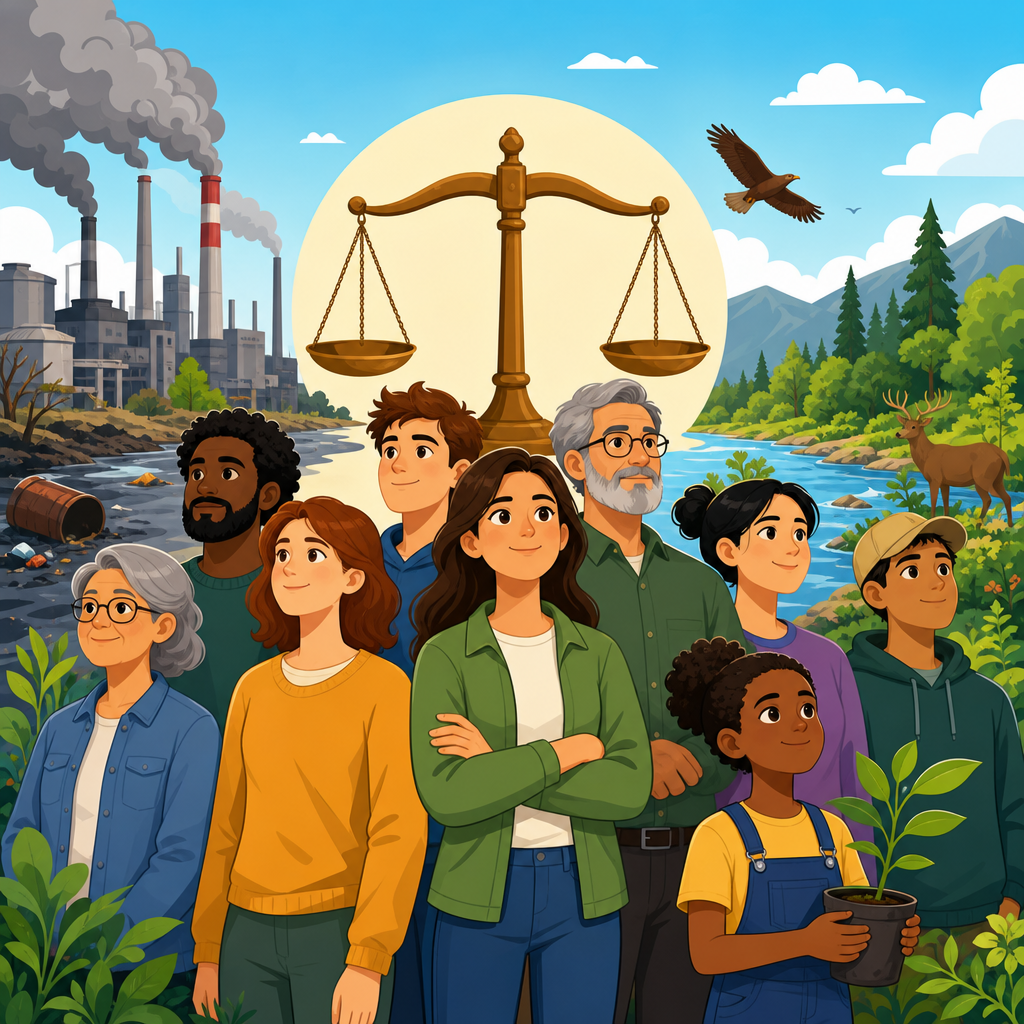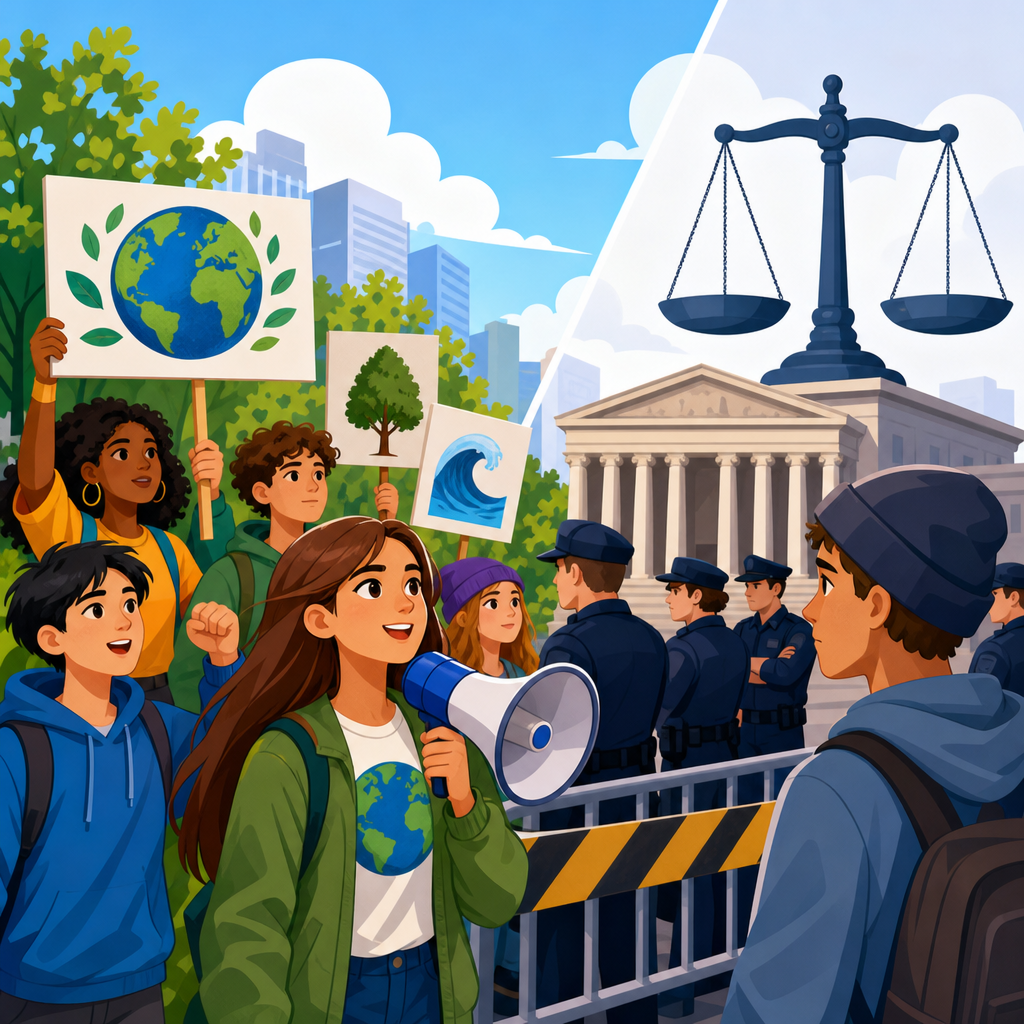
Youth and climate protests have become one of the defining legal and political stories of the past decade, forcing courts, schools, police agencies, and legislatures to confront a difficult question: how far can young people go when demanding action on a warming planet, and where do governments draw legal limits? In this context, youth climate protests include marches, school strikes, sit-ins, road blockades, campus demonstrations, banner drops, digital campaigns, and organized civil disobedience led or joined by minors and young adults. Legal impacts refers both to the laws that regulate protest activity and to the broader changes protests trigger, from new public assembly rules to landmark climate litigation. Restrictions can include permit requirements, curfews, school attendance enforcement, anti-blockade statutes, trespass laws, police dispersal powers, surveillance, and disciplinary action by educational institutions. This subject matters because youth protesters are not simply participants in public debate; they are often directly asserting intergenerational harm, arguing that today’s policy failures will shape their health, housing, education, and livelihoods for decades. I have worked with public-interest policy teams reviewing protest regulations, and the pattern is consistent across jurisdictions: when youth-led climate action grows visible, legal systems respond quickly, but not always proportionately. Understanding activism and legal rights therefore requires more than repeating slogans about free speech. It requires careful attention to constitutional protections, human rights standards, juvenile justice principles, administrative rules, and the practical realities of how protests are policed and punished.
At the hub level, this topic connects several closely related issues. Young demonstrators may invoke freedom of expression, freedom of peaceful assembly, association rights, voting and civic participation principles, educational rights, and in some countries environmental rights. Governments, meanwhile, cite public order, traffic flow, critical infrastructure protection, school discipline, and safety. The legal outcome usually turns on a familiar proportionality analysis: is the restriction lawful, pursuing a legitimate aim, necessary, and no broader than required? That framework appears in many constitutional systems and in international standards such as the International Covenant on Civil and Political Rights and regional human rights jurisprudence. For readers exploring environmental policy and law, this article maps the full landscape of activism and legal rights: what protections youth protesters have, which restrictions authorities most commonly use, how climate protests influence case law and legislation, where minors face special vulnerability, and what practical steps reduce legal risk without weakening advocacy. It serves as a central guide for deeper articles on school strikes, arrests, digital surveillance, campus protest policy, strategic climate litigation, and comparative protest law.
Core legal rights that protect youth climate protest
The starting point is simple: peaceful climate protest is generally protected speech. In the United States, the First Amendment safeguards speech, assembly, and petition, though protection depends heavily on where and how the protest occurs. Streets, parks, and sidewalks are classic public forums where governments may impose content-neutral time, place, and manner restrictions, but cannot suppress speech because officials dislike the message. In Europe, Articles 10 and 11 of the European Convention on Human Rights protect expression and assembly, and courts repeatedly stress that protest rights extend to messages that disrupt, offend, or challenge the status quo. Similar protections appear in many national constitutions, including South Africa, Canada, Germany, and India, although enforcement varies. For youth activists, these rights do not vanish because they are under eighteen. Minors retain civil liberties, even when schools or guardians also exercise authority over them.
That principle has concrete consequences. Students may distribute leaflets, wear symbolic clothing, organize walkouts, or speak at rallies, subject to lawful school rules. The best-known U.S. student speech precedent, Tinker v. Des Moines Independent Community School District, held that students do not shed their constitutional rights at the schoolhouse gate, though schools may regulate conduct that materially disrupts classwork or invades the rights of others. Outside school grounds, police generally need a clearer legal basis for intervention than mere annoyance or political disagreement. In practice, rights are strongest when organizers notify authorities, keep events peaceful, designate marshals, and document interactions. That does not mean permits are always legally required; many small marches, vigils, or sidewalk demonstrations can proceed without them. But understanding forum rules, local ordinances, and school codes often determines whether an event remains protected advocacy or becomes an arrestable offense.
How governments restrict climate protests in practice
Restrictions on youth climate protests usually arrive through ordinary public order law rather than climate-specific legislation. Cities require parade permits for large street marches. Police issue dispersal orders when traffic is blocked or emergency access is affected. Prosecutors use trespass, obstruction, disorderly conduct, unlawful assembly, criminal damage, or nuisance charges against sit-ins and occupations. Schools mark strikers absent, impose detention, suspend participants, or restrict access to campus spaces. Transit authorities remove demonstrators from stations. University administrations apply event approval procedures, amplified sound rules, and building access policies. Each restriction may look administratively modest on its own, yet collectively they can deter participation, especially for minors facing parental pressure, immigration concerns, scholarship conditions, or fear of police records.
A sharper trend since roughly 2019 has been the growth of laws targeting disruptive protest tactics associated with environmental movements. Several jurisdictions have increased penalties for blocking highways, interfering with pipelines or other energy facilities, or attaching oneself to infrastructure. The United Kingdom’s Public Order Act 2023 expanded police powers related to “locking on” and serious disruption. In parts of Australia, anti-protest laws have imposed significant fines for disrupting major roads or business operations. In the United States, some states strengthened critical infrastructure trespass statutes after pipeline protests, and although these measures were not written only for youth climate activists, they can reach them. Courts do not automatically uphold such laws. The key legal test remains whether measures are precise, necessary, and proportionate, especially when they burden peaceful assembly. Broad drafting can chill lawful protest far beyond the disruptive acts governments say they are targeting.
| Restriction | Typical legal basis | Main risk for youth protesters | Common legal challenge |
|---|---|---|---|
| School discipline for strikes | Attendance codes, campus conduct rules | Absences, suspension, academic penalties | Rule applied selectively or too broadly |
| Arrest during road blockade | Obstruction, public nuisance, traffic law | Juvenile record, fines, bail conditions | Disproportionate response to peaceful conduct |
| Removal from private property | Trespass law | Citation, arrest after warning | Unclear notice or public access expectation |
| Permit denial for march | Municipal event ordinance | Event cancellation, relocation | Content discrimination or vague standards |
| Police surveillance | Public safety, intelligence gathering rules | Chilling effect, data retention concerns | Lack of necessity, privacy violations |
Special issues when protesters are minors
Youth climate protest raises legal issues that adult protest guides often miss. Minors may be questioned without fully understanding their rights, may feel unable to leave when police request identification, and may accept school discipline without challenge. Parents or guardians usually control practical decisions about legal representation, transport, medical care, and consent, yet their interests do not always align perfectly with the young person’s political goals. Juvenile justice systems are supposed to prioritize rehabilitation and welfare, but even informal police contact can have lasting consequences through intelligence files, school reporting, or future background checks. For undocumented families or mixed-status households, the perceived risk is even greater, regardless of the formal charge.
Schools occupy the most contested ground. Climate strikes made clear that education law and protest law intersect awkwardly. Administrators can enforce attendance requirements, but punitive responses that ignore the expressive nature of a coordinated strike may draw legal scrutiny, especially if schools tolerate other absences or civic activities. I have seen institutions reduce conflict by creating designated forums, excused civic participation days, or supervised on-campus demonstrations. Others escalated matters by threatening blanket suspension, which often strengthened the activists’ public case. Universities present a different model: students are usually adults, but discipline codes can still be aggressive, especially around encampments, building occupations, or donor-facing events. Whether in secondary schools or colleges, a written protest policy that is viewpoint-neutral, publicly available, and consistently enforced is far less vulnerable than ad hoc punishment issued after administrators receive political pressure.
Climate protest as a driver of legal and policy change
The legal impact of youth climate protest is not limited to arrests and restrictions. Public demonstrations have shaped litigation strategies, legislative hearings, corporate disclosure debates, and judicial understanding of climate harm. Movements such as Fridays for Future turned youth voices into evidentiary and political force, helping normalize the argument that climate change is an immediate rights issue rather than a distant environmental abstraction. In Germany, the Federal Constitutional Court’s 2021 climate decision held that insufficient emissions reductions shifted disproportionate burdens onto future generations, a concept closely aligned with the claims youth activists had advanced in public debate. In Montana, Held v. State produced a 2023 ruling recognizing that state support for fossil fuel development harmed young people’s constitutional environmental rights under that state constitution. These cases did not arise from street protest alone, but protest created the social legitimacy and factual narrative that made the claims intelligible to broader audiences.
Protests also influence administrative practice. Cities revise permit systems after repeated enforcement disputes. Police departments adopt new crowd-management protocols, sometimes emphasizing liaison officers and de-escalation, sometimes expanding surveillance and preventive conditions. School districts issue guidance on walkouts and political activity. Legislatures introduce both protective measures, such as youth advisory councils or climate education reforms, and restrictive measures, such as broader anti-obstruction offenses. Corporate actors respond too. Pension funds, insurers, and universities facing repeated youth-led campaigns have changed investment disclosures, procurement standards, or decarbonization targets. In other words, activism and legal rights form a feedback loop: protest tests the boundaries of law, official response reshapes those boundaries, and resulting disputes generate precedent, policy revisions, and further mobilization. That is why this subtopic belongs at the center of environmental policy and law rather than at its edges.
Risk management, enforcement realities, and effective advocacy
For youth organizers, the most effective legal strategy is rarely maximal confrontation. It is informed preparation. Before an action, organizers should identify whether the location is a public forum, private property, school property, or regulated infrastructure; whether permits are required; who may issue dispersal orders; what counts as obstruction; and whether minors need guardian contact procedures. Legal observers, written know-your-rights materials, and a designated police liaison can materially reduce confusion. Digital security matters as much as physical planning. Group chats, location data, and social media posts are routinely used by authorities and sometimes by hostile third parties. Secure messaging, limited collection of participant data, and clear media consent practices are now standard components of responsible youth organizing.
Enforcement realities should not be romanticized. Peaceful protesters can still be handcuffed, searched, kettled, or exposed to chemical irritants, and complaints processes are often slow. Yet careful planning improves outcomes. A march with trained stewards, accessible routes, emergency contacts, de-escalation protocols, and legal support is safer and harder to mischaracterize than a spontaneous action with no structure. The same applies to message discipline. When demands are specific—ending a local fossil fuel subsidy, adopting a school district climate plan, disclosing financed emissions—decision-makers have fewer opportunities to dismiss the protest as symbolic only. Readers using this hub should treat it as the starting point for deeper guidance on student speech, protest permits, arrests, surveillance, and strategic litigation. The central lesson is clear: youth climate protest is legally protected, politically consequential, and increasingly contested. Knowing the rules, the risks, and the remedies allows young advocates and the institutions around them to engage this conflict more fairly. Review your local laws, build support early, and organize with both courage and care.
Frequently Asked Questions
1. Are youth climate protests legally protected under free speech and assembly laws?
In many countries, yes—at least in principle. Youth climate protests are often protected by constitutional, human rights, or statutory guarantees covering freedom of speech, peaceful assembly, association, and political expression. Marches, rallies, school walkouts, sign displays, chants, petitions, and online advocacy typically fall within the core of protected civic participation, especially when the message concerns public policy and government accountability. Courts generally treat political speech as highly protected, and that includes speech by minors, although the level of protection can vary depending on where the protest occurs and how it is carried out.
That said, legal protection is not unlimited. Governments may impose rules on the time, place, and manner of demonstrations, such as permit requirements for large marches, restrictions on blocking traffic, noise limits, and safety rules for public spaces. Schools may also regulate student expression more heavily on campus or during instructional hours than a city can regulate adults in a public park. A peaceful sidewalk demonstration usually receives stronger legal protection than a road blockade, building occupation, or trespass on restricted property. The key legal distinction is often not whether the protest message is about climate change, but whether the conduct remains peaceful and complies with neutral public-order rules.
For young protesters, another layer matters: age. Minors have rights, but they also remain subject to school discipline, parental authority, curfew laws, and juvenile legal systems. In practice, this means a student strike may be both politically protected expression and simultaneously a violation of school attendance rules. That apparent contradiction is common in protest law. A government usually cannot punish a student more harshly simply because officials dislike the climate message, but it may still enforce generally applicable rules if done lawfully and consistently. The result is a legal landscape where youth climate protests are broadly protected in theory, but often contested in the details.
2. Can schools punish students for participating in climate strikes or walkouts?
Often, yes. Schools usually retain substantial authority to enforce attendance policies, campus rules, and discipline standards, even when a student’s absence or demonstration is politically motivated. A student who leaves class to join a climate strike may be marked absent, assigned detention, barred from extracurricular activities, or subjected to other ordinary disciplinary measures. Courts in many jurisdictions have accepted that schools can maintain order and educational continuity, provided they are not discriminating against a particular viewpoint. In other words, a school may generally punish an unexcused absence, but it should not single out climate activism for harsher treatment than other comparable rule violations.
The legal analysis becomes more nuanced when the protest occurs on school grounds or during school-sponsored activities. Students do not lose all speech rights at school, but those rights are more limited than in traditional public forums like streets or parks. Administrators may regulate protests if they reasonably predict substantial disruption, safety risks, interference with instruction, or threats to the rights of other students. However, schools that overreach—such as by banning all climate-related expression, confiscating signs without cause, or disciplining students purely because officials disagree with the political message—may face constitutional or administrative challenges, depending on local law.
Some schools and education systems have responded by creating structured channels for civic participation, including approved assemblies, excused absences for certain events, or designated protest areas. Others have taken a stricter line, particularly where repeated walkouts strain attendance systems or create supervision concerns. For families and organizers, the practical takeaway is clear: the right to advocate for climate action does not automatically erase school rules, but schools must still apply those rules fairly, proportionately, and without viewpoint discrimination. The most legally defensible school response is usually one that respects student expression while enforcing content-neutral policies in a consistent way.
3. What legal risks do youth protesters face when demonstrations involve road blockades, sit-ins, or civil disobedience?
Once a protest shifts from speech into direct disruption, legal risk rises sharply. Road blockades, trespass, sit-ins inside private or government buildings, interference with transportation, and refusal to obey police dispersal orders can trigger arrests, citations, or court proceedings even when the underlying cause is widely supported. Authorities may rely on laws covering unlawful assembly, obstruction of highways, disorderly conduct, criminal trespass, vandalism, public nuisance, or emergency powers. Civil disobedience has a long history in social movements, but from a legal standpoint it usually involves knowingly crossing a line that the state claims authority to enforce.
For minors, the consequences may move through juvenile systems rather than adult criminal courts, but that does not make them insignificant. Youth protesters may face school consequences, parental intervention, fines, diversion programs, community service, probation-like supervision, or records that create future concerns depending on the jurisdiction. Police also have broad discretion at the scene, which means outcomes can vary dramatically based on crowd size, local protest culture, officer training, and whether officials treat the event as peaceful noncompliance or a public-safety threat. Even where charges are later dropped, the arrest process itself can be disruptive and intimidating.
Legal defenses may still be available. Protesters sometimes challenge arrests on free speech grounds, argue selective enforcement, contest whether police orders were lawful, or raise necessity-style arguments tied to climate harm, though courts have been uneven and often skeptical about those defenses in criminal cases. The core legal reality is that expressive motive does not automatically shield disruptive conduct. Youth-led groups considering escalated tactics usually need to understand not just the moral message of civil disobedience, but the specific offenses, procedures, and collateral consequences that may follow. In legal terms, the difference between a protected march and an arrestable blockade can be narrower than many first-time protesters expect.
4. How have governments responded legally to youth and climate protests in recent years?
Governments have responded in two competing ways: by recognizing youth climate activism as an important form of democratic participation, and by expanding legal tools to control disruptive protest tactics. On one side, courts, municipal bodies, school systems, and human rights institutions have often acknowledged that young people have a legitimate stake in climate policy because they will live longest with the consequences. That has helped normalize student marches, public demonstrations, and youth-led campaigns as part of mainstream political life. In some places, officials have even facilitated climate rallies through permits, traffic management, and public statements supporting civic engagement.
On the other side, many jurisdictions have adopted or proposed stricter anti-protest measures, especially in response to actions that interrupt roads, airports, energy infrastructure, cultural institutions, or public services. These laws may increase penalties for obstruction, broaden police dispersal authority, create special offenses for locking-on or interfering with infrastructure, or make organizers more vulnerable to civil and criminal liability. Critics argue that such measures can chill lawful expression by casting too wide a net or by giving police excessive discretion. Supporters argue they are necessary to protect public safety, commerce, emergency access, and the rights of nonparticipants.
The legal impact of these responses is significant. Stricter protest laws can reshape the tactics youth organizers are willing to use, shift protests into digital spaces, increase litigation over civil liberties, and intensify debates over proportionality. At the same time, visible youth activism has influenced climate litigation, education policy, local environmental decision-making, and public discourse about intergenerational justice. So while many legal restrictions focus on protest methods, the broader legal legacy of youth climate protest is much larger: it has pushed institutions to confront who gets heard in environmental governance, and under what rules.
5. Do youth climate protests have long-term legal impacts beyond individual arrests or school discipline?
Yes, and in many cases those broader effects are more important than any single enforcement action. Youth climate protests have helped drive legal and institutional change by reframing climate change as not only a scientific or political issue, but also a rights-based and generational justice issue. Courts and lawmakers are increasingly asked to consider whether governments owe special duties to younger generations, whether environmental harms implicate constitutional or human rights protections, and whether public institutions must give greater weight to long-term climate risks. Even when protests themselves are restricted, they often influence the legal agenda by creating pressure for hearings, policy reviews, litigation strategies, and legislative reform.
These movements also shape how legal systems interpret participation rights. Youth activism has strengthened arguments that minors are not merely passive subjects of policy, but stakeholders with legitimate democratic interests. That can affect school civic education policies, municipal consultation processes, child rights discussions, and environmental governance frameworks. In some regions, youth-led mobilization has supported lawsuits against governments or corporations, contributed evidence of public concern, or helped build momentum for stronger emissions regulation and environmental oversight. The courtroom and the street are different arenas, but they often interact more closely than they appear.
At the same time, there can be long-term restrictive effects. Repeated disruptive protests sometimes lead to tougher statutes, broader surveillance, more aggressive policing practices, and legal precedents that narrow the practical space for dissent. That means the legacy of youth climate protest is not automatically expansive; it can produce both stronger recognition of youth voice and stronger state control over protest methods. Ultimately, the long-term legal impact depends on how institutions balance democratic participation, public order, and the urgency of climate claims. What is already clear is that youth climate protest has become a lasting force in the law—not just a temporary wave of public demonstration.