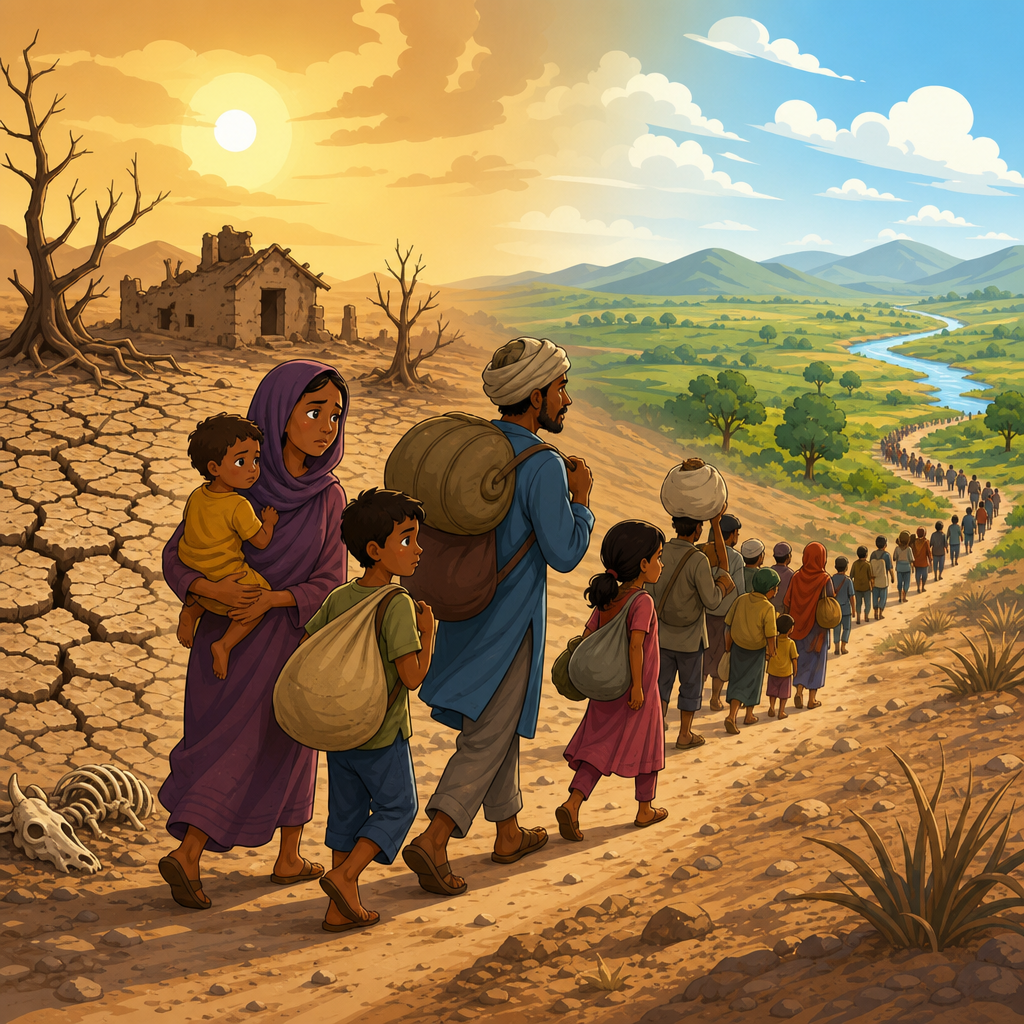

Climate migration and national security concerns are no longer abstract policy debates; they are operational realities shaping border management, urban planning, disaster response, and regional stability. Climate-induced migration refers to the movement of people driven partly or primarily by environmental stressors such as sea-level rise, extreme heat, prolonged drought, stronger storms, coastal erosion, salinization, wildfire damage, and water scarcity. Some people move temporarily after a disaster, others relocate seasonally as livelihoods become unreliable, and many ultimately resettle permanently when homes, farms, or local economies can no longer recover. In practice, this movement rarely has a single cause. Households usually leave because climate pressure collides with poverty, weak governance, conflict risk, poor infrastructure, and limited access to insurance or public services.
This topic matters because climate mobility is growing in scale and complexity. The World Bank has projected that, without strong climate and development action, tens of millions of people could become internal climate migrants across several world regions by 2050. The Internal Displacement Monitoring Centre has repeatedly documented millions of new disaster displacements each year, with floods and storms accounting for a large share. Security institutions pay attention not because migrants are threats, but because unmanaged displacement can strain housing, food systems, water supplies, health services, labor markets, and public trust. From my work reviewing disaster planning and risk assessments, the pattern is clear: when governments prepare early, migration can be orderly and adaptive; when they delay, population movement becomes more expensive, more political, and harder to govern.
For readers exploring environmental disasters, this hub explains how climate-induced migration works, why it is becoming a strategic issue, and what policymakers, businesses, and local communities should understand now. It covers key drivers, the connection to national security, legal and governance gaps, regional examples, practical risk indicators, and the policy tools that reduce instability. It also serves as a foundation for related articles on sea-level rise, drought, disaster displacement, resilience planning, food insecurity, and border governance. The central point is simple: climate migration is best understood not as a future emergency but as a present adaptation challenge with major security implications if ignored.
What drives climate-induced migration
Climate-induced migration happens through several pathways, and distinguishing them matters for good policy. Sudden-onset hazards such as cyclones, floods, wildfires, and storm surges can force immediate evacuation and temporary displacement. Slow-onset hazards such as desertification, saltwater intrusion, chronic drought, glacier loss, and rising average temperatures gradually erode livelihoods until relocation becomes the rational choice. In agricultural regions, a few failed rainy seasons can push families into debt, distress sales of livestock, school withdrawal, and eventual movement to cities. In coastal zones, repeated tidal flooding and aquifer salinization can make neighborhoods effectively uninhabitable long before they disappear underwater. Migration is therefore both a disaster response and a long-term adaptation strategy.
Economic exposure amplifies these pressures. Low-income households often live in higher-risk areas because land is cheaper, building standards are weaker, and public protection is limited. When a storm destroys an informal settlement or drought cuts harvests, families with no savings, crop insurance, or social protection have fewer recovery options. This is why climate migration is not evenly distributed: it concentrates where hazard exposure overlaps with poverty, fragile governance, and climate-sensitive livelihoods. I have seen local risk maps that treat hazards separately, but the better method overlays climate projections with employment data, water stress, transport access, and service capacity. That multi-layered view shows who is likely to move, where they may go, and what receiving areas will need.
Migration outcomes also differ by distance and duration. Most climate-related movement today is internal, often from rural areas to nearby towns or secondary cities rather than across international borders. That matters for planning because internal migrants still affect national security through urban crowding, informal settlement growth, land disputes, pressure on policing, and demand spikes for food, water, electricity, and health care. Cross-border movement can occur, especially where communities already have migration networks, but the popular image of sudden mass international flows often obscures the more common reality of incremental domestic relocation. Governments that focus only on border enforcement miss the larger planning challenge inside their own territory.
Why national security institutions are paying attention
National security concerns linked to climate migration arise from system stress, not from any assumption that displaced people are inherently destabilizing. Security planners look at whether population movement intensifies competition over scarce resources, overwhelms local administration, aggravates preexisting grievances, or creates openings for criminal networks and armed groups. A receiving city facing water shortages, housing deficits, and youth unemployment can absorb newcomers successfully if governance is competent and funding arrives on time. The same city can become volatile if informal settlements expand onto unsafe land, utilities fail, and authorities respond with neglect or coercion. The security issue is therefore state capacity under environmental pressure.
Defense and intelligence communities in multiple countries now treat climate change as a threat multiplier. The term is useful because climate hazards rarely create instability alone; they magnify existing weaknesses. In the Sahel, for example, changing rainfall patterns, pasture degradation, and water stress interact with weak state presence, trafficking routes, and intercommunal tensions. In Central America’s Dry Corridor, repeated drought and crop loss have contributed to livelihood collapse that feeds migration decisions alongside violence and governance failures. In South Asia, river flooding, heat extremes, and coastal erosion affect enormous populations in densely settled areas, raising questions about disaster readiness, infrastructure resilience, and urban absorption capacity. These cases show why climate migration sits at the intersection of humanitarian policy, development planning, and security strategy.
Critical infrastructure is another concern. Ports, military bases, roads, power grids, wastewater plants, and telecom systems are often located in exposed coastal or riverine zones. When disasters displace communities, those same events can damage the infrastructure needed to manage evacuation, relief, and recovery. If transport corridors fail, aid delivery slows and markets fragment. If power systems go down during a heat emergency, hospitals, cooling centers, and water pumping stations are affected. Security agencies plan for cascading failures because migration surges are hardest to manage when infrastructure disruption and governance stress occur simultaneously.
How climate migration becomes a governance challenge
The practical governance problem is not simply moving people from unsafe places to safer ones. It involves land tenure, compensation, urban zoning, school capacity, health systems, labor integration, cultural continuity, and public legitimacy. Planned relocation can reduce long-term risk, but it fails when authorities treat it as a housing project rather than a social transition. Communities need secure rights in destination areas, access to jobs and transport, and mechanisms to preserve social networks. After disasters, many families return even to unsafe sites because relocation programs separate them from income, relatives, fishing grounds, or farmland. That is why successful policy starts with community participation and livelihood planning, not just engineering.
Legal classification remains a major gap. International refugee law generally does not recognize climate change alone as grounds for refugee status, leaving many climate-displaced people dependent on temporary protection, humanitarian visas, domestic disaster programs, or ordinary migration channels. Some regional and national systems provide flexibility, but protection is inconsistent. This gap complicates security planning because authorities may face large displacement events without clear legal frameworks for admission, resettlement, documentation, or funding. Better policy distinguishes among evacuation, temporary displacement, internal relocation, labor migration, and cross-border protection needs. Each requires different tools.
Data quality is equally important. Governments often count disaster displacement but undercount slow-onset migration because it looks like normal urbanization. That blind spot leads to underinvestment in receiving areas. A drought-affected district may lose households gradually over several years, while a secondary city absorbs them through informal rentals and peri-urban expansion. If officials only track dramatic emergencies, they miss the slow accumulation of pressure on schools, clinics, transit, drainage, and waste management. The result is governance failure by mismeasurement.
| Climate driver | Typical migration pattern | Primary security concern | Best policy response |
|---|---|---|---|
| Floods and storms | Sudden evacuation and temporary displacement | Shelter shortages, infrastructure disruption, emergency logistics | Early warning, evacuation planning, resilient rebuilding |
| Drought and crop failure | Gradual rural-to-urban movement | Urban service strain, livelihood loss, social unrest | Water management, social protection, job creation |
| Sea-level rise and salinization | Permanent relocation from coastal areas | Land disputes, housing demand, loss of strategic assets | Planned retreat, compensation, land-use reform |
| Extreme heat | Seasonal or permanent movement from unsafe labor zones | Productivity decline, health emergencies, power stress | Heat action plans, worker protections, cooling infrastructure |
Regional examples and lessons from the field
Bangladesh is one of the clearest examples of climate-induced migration as a national planning issue rather than a single-border issue. River erosion, cyclones, flooding, and salinity intrusion have pushed households toward Dhaka and other urban centers for years. Yet Bangladesh also demonstrates how investment changes outcomes. Its cyclone shelters, early warning systems, and community preparedness have significantly reduced mortality compared with past decades. The lesson is not that migration disappears with better resilience, but that safer evacuation and recovery reduce forced distress movement and give families more choices.
In the Pacific, small island states face a different challenge: preserving sovereignty, identity, and economic viability as sea-level rise threatens land, freshwater, and infrastructure. Some communities are pursuing internal relocation, while governments also negotiate labor mobility arrangements and long-term adaptation finance. Here the security concern includes strategic competition, fisheries access, military basing, and the legal implications of maritime zones if land becomes uninhabitable. These are not symbolic issues; they affect revenue, territorial rights, and regional order.
In the United States, climate migration is increasingly visible in domestic patterns. After Hurricane Maria, many Puerto Ricans moved to Florida. Repeated wildfire seasons in California and severe flooding along the Gulf Coast have also influenced household decisions, insurance markets, and municipal budgets. Local governments now ask practical questions: Can roads support evacuation? Are receiving school districts funded for enrollment growth? Will insurers keep writing policies? Those are security questions in the broadest sense because they determine whether communities remain governable under stress.
African cities illustrate another key lesson. Much of the future risk lies not only where hazards occur, but where people arrive. Secondary cities in countries such as Ethiopia, Kenya, and Nigeria are often under-resourced yet growing quickly as climate and economic pressures reshape mobility. If expansion happens without drainage, tenure security, or basic services, a city can import vulnerability rather than reduce it. Managed well, however, migration supports economic adaptation by moving labor toward more diverse markets. The difference is planning.
What effective policy looks like
Effective climate migration policy starts with accepting mobility as part of adaptation. Trying to prevent all movement is unrealistic and often counterproductive. The better approach combines risk reduction in place, safe migration pathways, and support for receiving areas. First, governments should invest in early warning systems, resilient housing, drought management, water storage, heat action plans, and climate-smart agriculture so households are not forced to move prematurely. Second, they should create legal and financial mechanisms for planned relocation where risk is no longer tolerable. Third, they should strengthen destination communities through housing supply, transport, school capacity, health services, and labor market integration.
National security institutions should contribute without dominating. Militaries are often essential for logistics, airlift, engineering support, and disaster response, but long-term migration governance belongs primarily to civilian agencies. The most effective models use whole-of-government coordination: environment ministries provide hazard projections, interior ministries manage documentation and local administration, social ministries handle benefits and housing, and finance ministries align budgets with risk. International partners can support with climate finance, anticipatory action funding, satellite monitoring, and development lending. Tools such as geospatial risk mapping, parametric insurance, and scenario planning are now mature enough to support operational decisions.
Private sector incentives matter too. Insurers, lenders, and employers shape migration long before governments announce relocation programs. When insurance retreats from high-risk areas or agricultural lenders tighten credit after repeated crop failures, households begin moving. Conversely, investment in resilient infrastructure and job creation in safer growth corridors can channel mobility productively. I have seen plans fail because they treated displaced people solely as aid recipients. Households need income pathways, not just temporary shelter. Work permits, skills matching, transit access, and small-business finance often matter as much as emergency relief.
Key takeaways for the environmental disasters agenda
Climate migration and national security concerns should be approached with precision, not alarmism. Most climate-related movement is internal. Most displaced people want safety, stability, and a viable livelihood, not conflict. The real risk comes from unmanaged pressure on institutions, infrastructure, and social cohesion. When climate hazards interact with poverty, weak governance, and exposed livelihoods, migration becomes more likely. When governments prepare receiving areas, clarify legal pathways, and invest in resilience before crisis peaks, migration can reduce risk rather than amplify it.
As a hub within the environmental disasters topic, this page establishes the framework for deeper articles on drought displacement, sea-level rise, urban resilience, food insecurity, disaster recovery, and border management. The main benefit of understanding climate-induced migration is practical: it helps decision-makers move from reactive emergency response to forward planning. Assess hazard exposure, map likely mobility corridors, strengthen local capacity, and treat human movement as a central part of climate adaptation. If you are building policy, research, or preparedness content in this area, start with those fundamentals and then drill into the specific hazard, region, or population you need to address.
Frequently Asked Questions
What is climate migration, and why is it increasingly seen as a national security issue?
Climate migration refers to the movement of people influenced in whole or in part by environmental pressures such as sea-level rise, recurrent flooding, prolonged drought, extreme heat, stronger storms, wildfire destruction, crop failure, water scarcity, and land degradation. Some people relocate temporarily after a disaster, while others move permanently because local conditions become too dangerous, too costly, or too unstable to sustain daily life. In many cases, migration is not triggered by a single event but by the cumulative effect of repeated shocks that erode livelihoods, housing, infrastructure, and public health over time.
It is increasingly treated as a national security concern because large-scale or poorly managed displacement can place significant strain on state capacity. Governments may face pressure on border systems, emergency response networks, housing markets, healthcare services, transportation, and food and water supply chains. Rapid population movements can also intensify political tensions, especially where communities are already dealing with inequality, unemployment, weak governance, or fragile public trust. National security planners are not only concerned with military threats; they also assess risks that can undermine social stability, disrupt critical infrastructure, trigger humanitarian emergencies, or increase the likelihood of local and regional conflict. In that sense, climate migration sits at the intersection of human security, economic resilience, and state preparedness.
How does climate-induced migration affect border management and regional stability?
Climate-induced migration affects border management by changing both the volume and the pattern of population movement. Following major storms, droughts, or agricultural collapse, neighboring countries may see sudden increases in cross-border arrivals, while internal displacement can push people toward frontier regions that were not designed to support large populations. This creates operational challenges for immigration systems, customs enforcement, public health screening, shelter provision, and humanitarian coordination. Border agencies may be asked to perform roles that go far beyond traditional enforcement, including disaster response support, medical triage, registration, and coordination with local and international relief organizations.
Regional stability can be affected when climate stress compounds existing vulnerabilities such as political unrest, ethnic tensions, weak institutions, or competition over land and water. Importantly, climate migration does not automatically cause conflict. However, when many people move into areas with limited jobs, strained services, and poor governance, social friction can rise. Host communities may perceive newcomers as competitors for housing, education, energy, and public assistance, especially if national governments fail to communicate clearly or invest in shared resilience. At the regional level, disputes can also emerge over river access, agricultural resources, fisheries, or cross-border disaster spillover. Effective regional stability depends on early warning systems, legal pathways, burden-sharing agreements, coordinated humanitarian planning, and sustained investment in adaptation so that migration remains manageable rather than destabilizing.
Is all climate migration cross-border, or does most of it happen within countries?
Most climate migration occurs within national borders, not across them. People displaced by floods, storms, heat waves, wildfire damage, coastal erosion, or failing harvests often move first to nearby towns, cities, or safer rural areas where they have family ties, language familiarity, and better chances of finding work. Internal displacement is typically more common because crossing an international border requires money, documentation, transportation, and legal opportunity that many affected households do not have. In practice, migration is often gradual and stepwise: a family may first relocate seasonally, then send one wage earner to a city, and only later consider a more permanent move if conditions continue to deteriorate.
This matters for national security because internal migration can reshape domestic stability just as profoundly as international migration. Receiving cities may experience rapid growth without corresponding investments in housing, drainage, sanitation, schools, hospitals, and electricity. Informal settlements may expand into high-risk zones, increasing exposure to future disasters and complicating law enforcement and emergency management. Rural depopulation can also affect food production, local economies, and territorial governance. For policymakers, the key lesson is that climate migration should not be framed only as a border issue. It is also an urban planning issue, a public health issue, an infrastructure issue, and a governance issue. Countries that focus solely on external borders while neglecting internal displacement risk missing the largest and most immediate pressures.
Can climate migration lead to conflict, or is that relationship often overstated?
The relationship is real but often oversimplified. Climate migration does not directly or inevitably produce conflict. People move for many interconnected reasons, and whether migration contributes to unrest depends heavily on local conditions. Tensions are more likely when climate shocks intersect with weak institutions, political exclusion, corruption, poor service delivery, unresolved land disputes, youth unemployment, or existing communal grievances. In those settings, an influx of displaced people can become a flashpoint because it increases pressure on land, water, food, jobs, and public services. Political actors may also exploit migration fears for strategic gain, deepening polarization and mistrust.
At the same time, migration can be an adaptive and stabilizing response when it is supported well. Planned relocation, labor mobility pathways, resilient urban development, land-use planning, and social protection programs can reduce suffering and lower the risk of crisis escalation. In many communities, host populations and newcomers cooperate successfully when resources are allocated fairly and institutions are responsive. The most accurate way to understand the issue is that climate migration acts as a risk multiplier rather than a stand-alone cause of conflict. For national security planners, that means prevention matters more than alarmism. Strengthening governance, mediation systems, local infrastructure, and equitable access to services often does more to protect stability than treating all movement as a security threat.
What policies can governments adopt to reduce security risks linked to climate migration?
Governments can reduce security risks by approaching climate migration as a matter of preparedness and resilience rather than reacting only after a crisis unfolds. A strong policy framework starts with climate adaptation in high-risk areas: coastal protection, drought management, resilient agriculture, wildfire mitigation, heat planning, upgraded drainage, and investments in water infrastructure. When people can remain safely in place with dignified livelihoods, forced displacement becomes less likely. Just as important are early warning systems, evacuation planning, emergency shelters, interoperable data systems, and pre-positioned disaster response resources so that sudden displacement does not overwhelm local authorities.
Beyond adaptation, governments need clear migration and relocation strategies. These can include legal recognition of internally displaced populations, planned relocation standards, housing assistance, land tenure protections, labor market integration, school enrollment support, and healthcare access for receiving communities and migrants alike. National security institutions should coordinate with urban planners, development agencies, public health officials, and local governments rather than treating climate mobility as a narrow enforcement question. Regional cooperation is also essential, especially where climate pressures affect shared river basins, coastlines, or migration corridors. The most effective policies combine risk assessment, humanitarian protection, infrastructure investment, and transparent public communication. In practical terms, countries are more secure when they build systems that manage mobility safely, lawfully, and humanely before environmental pressures turn displacement into a broader political and security crisis.