
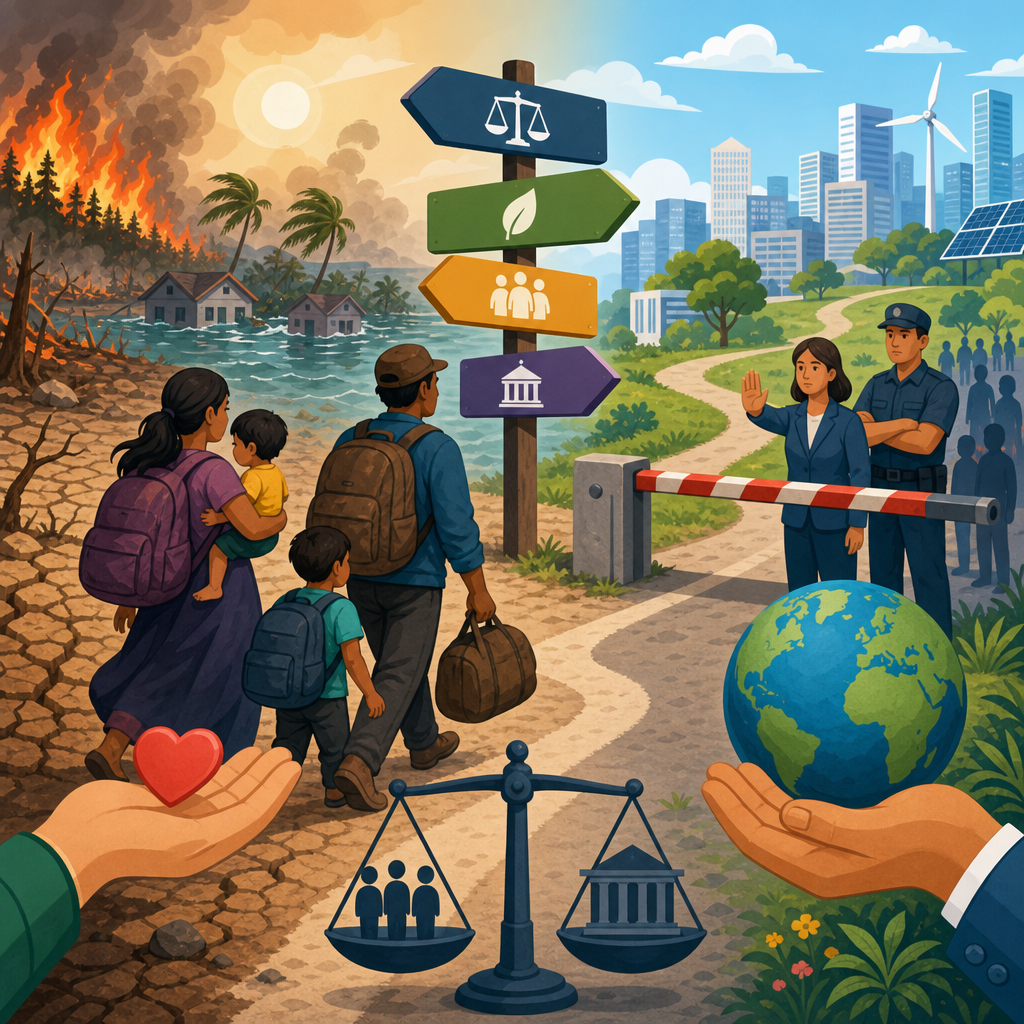
Ethical and policy dilemmas in climate-induced migration sit at the center of modern disaster governance because climate hazards are no longer isolated environmental events; they are drivers of human movement, legal uncertainty, and political conflict. Climate-induced migration refers to the movement of people prompted partly or primarily by climate-related impacts such as sea-level rise, drought, desertification, flooding, wildfire, storm surge, heat stress, and the collapse of livelihoods tied to land, water, and ecosystems. In practice, I have found that officials, researchers, and affected communities rarely debate whether climate pressures influence migration; the harder question is how to classify that movement and who bears responsibility for protecting people before, during, and after displacement. This matters because existing legal systems were built around categories like refugees, internally displaced persons, labor migrants, and disaster survivors, while climate reality cuts across all of them.
The stakes are enormous. The World Bank’s Groundswell reports have projected that, without strong development and climate action, tens of millions of people could become internal climate migrants across regions such as Sub-Saharan Africa, South Asia, and Latin America by 2050. The Internal Displacement Monitoring Centre has repeatedly shown that disasters trigger more new internal displacements each year than conflict does, although many are short term and some become protracted. Small Island Developing States face existential risks from sea-level rise and salinization, while agricultural communities in the Sahel, Central America, South Asia, and low-lying delta regions confront repeated crop failure, water stress, and debt spirals that make staying in place increasingly untenable. Climate-induced migration is therefore not a fringe humanitarian issue. It is a core policy challenge linking environmental disasters, development planning, urbanization, human rights, border policy, and international finance.
For a hub article under Environmental Disasters, the essential starting point is clarity. Climate-induced migration is not one thing. It includes sudden displacement after cyclones or floods, gradual relocation due to erosion or saltwater intrusion, seasonal mobility used as an adaptation strategy, and cross-border movement when domestic options fail. Some people move by choice, some under pressure, and many in conditions best described as constrained choice. That distinction shapes ethics and policy. Governments must decide when migration should be supported as adaptation, when in situ resilience should be prioritized, how planned relocation can respect consent and culture, and whether international law should evolve to protect people displaced across borders by climate harm. The dilemmas are difficult precisely because every answer involves competing values: sovereignty versus solidarity, risk reduction versus cultural continuity, efficiency versus justice, and immediate emergency response versus long-term transformation.
Why defining climate-induced migration is ethically difficult
One of the first policy problems is definitional. There is no universally accepted legal category of “climate refugee” under the 1951 Refugee Convention, which protects people fleeing persecution on specific grounds, not environmental change alone. That legal gap creates confusion in public debate and unrealistic expectations in policymaking. Yet rejecting the term entirely can also obscure real protection needs, especially when climate impacts interact with conflict, discrimination, or state fragility. In field practice and policy analysis, the most accurate approach is usually multicausal: climate change rarely acts alone, but it can be the threat multiplier that turns poverty, weak governance, and marginal land tenure into forced movement.
This definitional complexity has ethical consequences. If migration is framed as voluntary adaptation, states may avoid protection duties and place responsibility on households to move at their own expense. If it is framed as forced displacement, governments may focus on emergency shelter while neglecting livelihoods, social integration, and long-term rights. A coastal family leaving because repeated floods destroyed homes, schools, clinics, and fishing grounds may appear to be making a private economic decision, but the decision is often shaped by public failures in infrastructure, insurance access, early warning, and land-use planning. Clear definitions matter not because they solve every case, but because they determine eligibility, funding, and accountability.
Justice, responsibility, and who should pay
The central ethical dilemma is distributive justice. Those who contribute least to greenhouse gas emissions often face the highest exposure to climate-induced migration. Low-income rural communities, Indigenous peoples, pastoralists, and residents of informal urban settlements routinely absorb harms generated by a global economy from which they benefited least. This asymmetry underpins arguments for climate finance, loss and damage arrangements, and mobility-sensitive adaptation planning. It is not enough to say that migration is an unfortunate side effect of climate change. In policy terms, responsibility must be linked to finance, technical support, and legal pathways.
In negotiations and national planning, I have seen the funding debate turn on a practical question: who pays for prevention, movement, and resettlement? Costs include sea walls, resilient housing, drought adaptation, relocation site development, land acquisition, compensation, transport, school expansion, health services, and livelihood restoration. When these costs are left to local governments, underfunded municipalities often relocate people to peripheral sites with weak transport links and few jobs, creating secondary vulnerability. A fairer model blends domestic planning with international support, especially for countries facing severe climate exposure and constrained fiscal capacity.
| Policy approach | Main ethical benefit | Main risk or limitation | Real-world relevance |
|---|---|---|---|
| In situ adaptation | Protects community continuity and cultural ties to place | Can trap people in escalating risk if hazards outpace investment | Used in delta management, drought resilience, and urban flood control |
| Planned relocation | Reduces repeated disaster losses when areas become unsafe | May undermine consent, livelihoods, and identity if poorly designed | Relevant for erosion zones, sinking coastlines, and wildfire corridors |
| Labor mobility pathways | Creates income diversification and remittance-based adaptation | Can favor younger or wealthier migrants and exclude the most vulnerable | Seen in Pacific mobility debates and seasonal migration programs |
| Humanitarian protection after disasters | Offers rapid safety and immediate assistance | Often temporary and weak on long-term rights or integration | Common after cyclones, floods, earthquakes, and extreme storms |
The justice debate also includes historical emissions and intergenerational equity. High-emitting states have stronger ethical grounds to fund adaptation and displacement responses, even where legal liability remains contested. Equally, present decisions affect future generations. If governments delay adaptation in known high-risk areas, they effectively pass relocation costs and social rupture to children who had no role in creating the risk. Sound policy therefore treats climate-induced migration not as an isolated humanitarian budget line, but as part of a broader responsibility framework tied to emissions, development inequality, and prevention.
Protection gaps in international and domestic law
Current law protects some climate-displaced people well and others poorly. Internally displaced persons may receive support under domestic disaster law, constitutional rights, and the UN Guiding Principles on Internal Displacement, though implementation varies widely. Cross-border movers face a sharper gap. Most do not qualify for refugee status solely because a drought, cyclone, or rising sea has undermined their survival. Some countries offer temporary protection after disasters, humanitarian visas, complementary protection, or discretionary stay, but these tools are uneven, revocable, and often narrow.
An important legal development came from the UN Human Rights Committee in the Ioane Teitiota case, which did not grant protection in that instance but affirmed that people should not be returned to places where climate impacts create a real risk to life. That principle matters, yet it stops short of creating a dedicated migration status. Similarly, the Global Compact for Safe, Orderly and Regular Migration and the Platform on Disaster Displacement have advanced useful guidance, but they are not binding treaty regimes. The result is a patchwork: some people get temporary relief, others remain undocumented, and many fall between migration law, disaster law, and social protection systems.
Domestic law is just as important as international law. Land tenure systems, zoning regulations, compensation rules, and social registry design determine whether climate-induced migrants can access housing, education, health care, and work. In many countries, informal settlers displaced by floods receive less assistance than titled landowners, even when the hazard exposure was shaped by urban inequality and exclusionary planning. Legal reform should therefore focus not only on cross-border admission, but on non-discrimination, portable social benefits, accessible documentation, and clear standards for relocation, consultation, and compensation.
Planned relocation, consent, and cultural survival
Planned relocation is often presented as a technical solution when repeated disasters make continued residence dangerous. In reality, it is one of the most ethically charged responses to climate-induced migration. Moving a community is not equivalent to moving structures. It affects burial grounds, sacred sites, fishing routes, grazing patterns, language networks, kinship systems, and everyday routines that anchor identity. I have seen relocation plans judged successful on engineering metrics while failing socially because they placed communities far from work, split extended families, or ignored local governance structures.
Good relocation policy starts with free, prior, and meaningful consultation, especially where Indigenous peoples or customary land systems are involved. Consent cannot be reduced to a one-time meeting after officials have already selected the site. Households need real options, transparent hazard data, grievance mechanisms, and long-term support. The Pacific offers important lessons. Communities in Fiji and elsewhere have pursued village relocation in response to coastal erosion and flooding, showing that relocation can reduce risk but also generate disputes over land, culture, and livelihoods if host-community relations and service access are not addressed from the outset.
There is also a hard question of timing. Move too early, and governments may destroy viable communities and invite justified resistance. Move too late, and people endure repeated losses, trauma, and rising mortality. The answer is not a universal threshold but a monitored process using hazard maps, livelihood assessments, community preferences, and scenario planning. Relocation should be a last resort in some settings and an urgent necessity in others. Treating it as either inherently oppressive or automatically protective misses the evidence.
Urban pressure, inequality, and the risk of maladaptation
Most climate-induced migration is internal, and much of it ends in towns and cities. That means urban policy is climate migration policy, whether governments acknowledge it or not. Secondary cities often absorb displaced households because they are cheaper and socially familiar, yet they may lack drainage, affordable housing, secure tenure, and health capacity. When migrants settle in floodplains, unstable hillsides, or heat-exposed informal neighborhoods, displacement can become a revolving door: people leave one hazard only to face another. This is maladaptation, where responses to climate risk reproduce or deepen vulnerability.
Examples are easy to find. After major floods in South Asia, displaced families have moved to urban peripheries and entered precarious informal work without adequate sanitation or legal status. In parts of East Africa, drought-affected pastoralists settling near cities may gain access to markets and schools but lose herd-based livelihoods and social safety nets. Following hurricanes in Central America and the Caribbean, temporary displacement has sometimes become permanent urban migration, straining rental markets and public services. These patterns show why climate-induced migration cannot be managed through border policy alone. It requires integrated planning across housing, transport, employment, water, and public health.
The ethical issue is inclusion. If municipalities treat newcomers as illegal occupiers rather than residents with rights, cities externalize the costs of climate change onto those least able to bear them. Better practice includes risk-informed land-use planning, upgrading informal settlements, rental assistance, cash transfers, and labor market integration. Data systems matter too. Without reliable information on where displaced people go and how long they stay, governments cannot design schools, clinics, or infrastructure that match actual mobility patterns.
Migration as adaptation, not only failure
One of the most important corrections in this field is to stop treating all climate-related movement as evidence of policy collapse. Migration can be a legitimate form of adaptation when it is safe, voluntary enough, and supported. Seasonal work, circular migration, and remittances often help households spread risk, rebuild after disasters, and avoid distress sales of land or livestock. In my experience, communities frequently understand this long before policymakers do. People use mobility strategically: one family member moves for work, sends income home, and finances water storage, school fees, or stronger housing.
But celebrating migration without safeguards is equally misguided. The poorest households may be unable to move at all, creating populations trapped in place by debt, age, disability, caregiving responsibilities, or lack of documents. Others move under exploitative conditions into dangerous work or irregular status. Effective policy distinguishes adaptive mobility from distress migration. It expands legal labor pathways, supports skills recognition, reduces remittance costs, and protects workers from abuse. It also invests in the resilience of origin communities so movement remains an option, not an obligation.
This balance is the heart of sound climate-induced migration policy. People should have the capability to stay safely where possible, move safely when necessary, and rebuild with dignity wherever they live. That is a more useful standard than asking whether migration is good or bad in the abstract.
What policymakers should do now
The policy agenda is clear even if politics is not. First, governments should embed climate mobility into national adaptation plans, disaster risk reduction strategies, and development budgets rather than treating displacement as an afterthought. Second, they should improve risk data by combining climate projections with census information, land records, livelihood mapping, and local knowledge. Third, legal systems should guarantee documentation, social protection portability, housing access, and non-discrimination for internally displaced and relocating populations. Fourth, countries should expand humanitarian visas, temporary protection, and bilateral labor pathways for cross-border movers affected by environmental disasters.
Fifth, planned relocation must follow enforceable standards on consultation, compensation, livelihood restoration, and host-community support. Sixth, cities need direct finance to prepare for inflows through affordable housing, drainage, health services, and climate-resilient infrastructure. Seventh, international climate finance should recognize mobility-related loss and damage, not just physical adaptation assets. Finally, policymakers should link this hub topic to related Environmental Disasters issues such as flood displacement, drought insecurity, wildfire evacuations, sea-level rise, and disaster recovery governance, because climate-induced migration always intersects with those domains.
Climate-induced migration will shape this century whether leaders plan for it or not. The ethical and policy dilemmas are real, but they are not excuses for paralysis. Clear definitions, fair financing, legal protection, urban inclusion, and rights-based relocation can reduce harm dramatically. The main benefit of addressing climate-induced migration seriously is simple: people retain agency, safety, and dignity even as environmental disasters intensify. If you are building policy, research, or response capacity in Environmental Disasters, start by treating human mobility as a central climate risk and design every plan around that reality today.
Frequently Asked Questions
What is climate-induced migration, and why does it create unique ethical and policy dilemmas?
Climate-induced migration refers to the movement of people whose decision to leave home is shaped partly or primarily by climate-related pressures such as sea-level rise, prolonged drought, repeated flooding, desertification, wildfire, storm surge, extreme heat, and the breakdown of livelihoods tied to land, water, and ecosystems. What makes it especially difficult from an ethical and policy standpoint is that climate mobility rarely fits neatly into existing legal categories. Many people move because climate impacts interact with poverty, weak infrastructure, conflict risk, food insecurity, or political instability, which means they may not qualify for formal refugee protection even when remaining in place is no longer safe or viable. This gap creates a serious moral tension between the reality of displacement and the limits of current law.
The ethical dilemmas are equally significant. Communities that have contributed the least to global greenhouse gas emissions are often among the most exposed to climate harm, raising questions of fairness, historical responsibility, and distributive justice. Policymakers must decide who should fund adaptation, who should support relocation, and whether people should be helped to stay, assisted to move, or protected during displacement. There is also the issue of consent: migration can be framed as adaptation, but if people are effectively forced out by repeated disasters or collapsing livelihoods, the line between voluntary movement and coerced displacement becomes blurred. As a result, climate-induced migration sits at the intersection of human rights, environmental justice, national sovereignty, development policy, and disaster governance.
Are climate migrants considered refugees under international law?
In most cases, no. Under the 1951 Refugee Convention, a refugee is generally defined as someone fleeing persecution based on specific grounds such as race, religion, nationality, political opinion, or membership in a particular social group. People displaced by rising seas, crop failure, heat stress, or recurrent storms usually do not meet that legal definition unless climate impacts are tied to persecution or state failure in a way that fits existing refugee criteria. This legal mismatch is one of the most widely discussed policy dilemmas in climate governance because it leaves many climate-affected people without a clear international protection pathway.
That said, the issue is not entirely without legal development. Some regional instruments, human rights frameworks, and court decisions have begun to recognize that returning people to places where climate impacts threaten life, dignity, or survival may violate non-refoulement principles in certain circumstances. There is also growing international discussion around complementary protection, temporary protected status, humanitarian visas, labor mobility pathways, and regional agreements tailored to disaster and climate displacement. Still, these mechanisms remain uneven, limited, and often discretionary. The central policy challenge is whether the global community should expand existing refugee law, create a new legal category for climate-displaced persons, or strengthen flexible protection systems without reopening politically contentious refugee frameworks. Each option carries trade-offs involving feasibility, sovereignty, legal clarity, and the risk of leaving vulnerable populations in prolonged uncertainty.
Who bears responsibility for protecting and supporting people displaced by climate change?
Responsibility is shared, but not equally. At the domestic level, national governments retain the primary duty to protect populations within their borders, reduce disaster risk, invest in adaptation, and create safe relocation or social protection strategies when communities can no longer remain where they are. Local and regional authorities also play a critical role because they often manage land-use planning, evacuation systems, housing, public health, water access, and post-disaster recovery. However, many countries facing the harshest climate impacts have the fewest financial and institutional resources, which is why the question of international responsibility becomes unavoidable.
From an ethical perspective, high-emitting and wealthier states are often seen as carrying greater obligations because they have contributed more to the conditions driving climate disruption and generally have greater capacity to respond. This argument is grounded in principles of climate justice, common but differentiated responsibilities, and basic fairness. In practice, responsibility can take several forms: climate finance for adaptation, funding for loss and damage, support for planned relocation, legal pathways for migration, technical assistance for resilient infrastructure, and long-term development investments in host communities. The difficult policy issue is that while moral responsibility may be broad, enforceable legal obligations remain limited. As a result, support often depends on political will rather than guaranteed protection. This is why many experts argue that climate-induced migration cannot be treated solely as a border issue; it must be addressed as a shared governance challenge involving emissions responsibility, human rights protection, and equitable burden-sharing.
Is planned relocation an ethical solution, or does it risk creating new forms of harm?
Planned relocation can be a necessary and life-saving strategy, but it is not automatically ethical simply because it reduces exposure to climate hazards. Moving communities away from coastlines threatened by erosion, floodplains facing repeated inundation, or drought-stricken regions with collapsing water supplies may lower physical risk, yet relocation can also disrupt culture, identity, livelihoods, social networks, and political autonomy. For Indigenous peoples, small island communities, farming populations, and groups with deep ancestral ties to land, relocation may involve the loss of sacred places, burial grounds, customary governance systems, and collective memory. In these cases, the ethical issue is not just where people move, but what is lost in the process.
An ethical relocation process requires more than transportation and housing. It depends on free, prior, and informed participation; transparent planning; culturally appropriate site selection; livelihood restoration; legal security over land and property; and long-term monitoring after the move. If governments or outside actors impose relocation without meaningful consent, relocate people to unsafe or economically marginal areas, or fail to compensate them fairly, then planned relocation can become another form of injustice rather than a solution. There is also the danger that states may use relocation to avoid investing in adaptation measures that would allow some communities to remain in place. The most responsible policy approach treats relocation as one option within a wider toolkit, not as a default answer. It should be pursued only when it is genuinely safer, socially sustainable, and grounded in the rights and preferences of affected communities.
How can governments design fair policies for climate-induced migration without fueling political conflict?
Fair policy starts with recognizing that climate-induced migration is not only a humanitarian concern but also a governance issue involving housing, labor markets, public services, land rights, social cohesion, and democratic legitimacy. Governments can reduce conflict by planning early rather than reacting after displacement becomes chaotic. That means investing in climate adaptation in high-risk areas, building early warning systems, identifying mobility hotspots, protecting tenure rights, and creating legal channels for internal and cross-border movement before crises intensify. Policies should also distinguish between different forms of mobility, including temporary evacuation, seasonal movement, permanent displacement, and planned community relocation, because each requires different tools and protections.
To maintain legitimacy and reduce backlash, policymakers should ensure that host communities are included in planning and benefit from investment rather than being expected to absorb newcomers without support. Expanding schools, health services, housing, transport, and employment programs can help prevent competition narratives that often drive political tension. Clear communication matters as well: framing climate migrants solely as a security threat tends to harden borders and inflame public fears, while framing mobility as a manageable adaptation strategy can open space for pragmatic solutions. Finally, fair policy must be data-informed and rights-based. Governments need reliable information on climate risk, displacement patterns, and social vulnerability, but they also need safeguards against discrimination, exclusion, and arbitrary enforcement. When climate mobility policy is rooted in justice, participation, and practical support for both displaced and receiving populations, it is far more likely to be effective and politically durable.


