Education is one of the most effective tools for disaster risk reduction because it turns hazard awareness into practical action before, during, and after a crisis. In disaster preparedness, education means more than school lessons about earthquakes, floods, wildfires, cyclones, droughts, and heatwaves. It includes public drills, community training, early warning literacy, risk communication, first aid instruction, land-use awareness, and the ability to interpret official guidance quickly under stress. I have seen preparedness programs succeed when people understand not only what can happen, but what specific decisions reduce harm. That understanding saves lives, protects livelihoods, strengthens infrastructure planning, and speeds recovery. As a hub topic within environmental disasters, disaster preparedness depends on education because informed households, schools, employers, and local governments make fewer dangerous assumptions and respond faster when conditions change.
Disaster risk reduction is the systematic effort to analyze and reduce the causes of disasters. The widely used framework from the United Nations Office for Disaster Risk Reduction defines disaster risk as the potential loss of life, injury, and damage resulting from the interaction of hazards, exposure, vulnerability, and capacity. Education directly affects vulnerability and capacity. It teaches people where risks exist, how warning systems work, why building codes matter, what evacuation routes are safest, how to store water and medicine, and how to recover without increasing future risk. This matters because climate-related hazards are intensifying in many regions, urban populations are growing in exposed areas, and misinformation spreads quickly during emergencies. When disaster education is embedded in schools, workplaces, health systems, and community organizations, preparedness becomes normal behavior rather than a last-minute reaction.
Why education is central to disaster preparedness
Disaster preparedness works when people can recognize threats early and act without confusion. Education builds that capability in a structured way. A family that knows the difference between a watch and a warning reacts differently from one hearing those terms for the first time. A school that practices evacuation every term clears classrooms faster than one relying on improvised decisions. A coastal town that teaches storm surge maps and shelter rules reduces road congestion because residents understand when to leave and where to go. These are not abstract gains. In emergency management reviews, delays often come from uncertainty, conflicting assumptions, or failure to trust official information. Education reduces each of those problems.
Preparedness education also changes risk perception. Many people underestimate familiar hazards and overestimate rare ones. In flood-prone communities, long periods without major inundation can create false confidence, especially where development has expanded into floodplains. In wildfire areas, residents may focus on flames but ignore ember attack, which is often the main cause of home ignition. Effective education corrects these blind spots by explaining probability, consequence, and local conditions in plain language. It also addresses the practical barriers that stop people from acting, such as transport limits, disability access, language gaps, pet sheltering, and medication needs. Good programs do not merely say “be prepared”; they teach what preparedness looks like for different households.
Another reason education matters is that preparedness is cumulative. One lesson supports another. Knowing hazard terminology makes alerts easier to understand. Understanding local geography improves evacuation decisions. Practicing first aid increases survival until emergency services arrive. Learning how insurance, documentation, and backup communications work reduces chaos after impact. Over time, communities with repeated training develop shared norms around readiness. They know who checks on older neighbors, who manages school reunification, how local radios and messaging apps are used, and which agencies coordinate shelters. That social learning is often the difference between a technically available warning and a warning that people actually use.
What disaster education should include
Comprehensive disaster education covers more than emergency kits and evacuation bags. At minimum, it should explain local hazard profiles, exposure points, protective actions, warning channels, and recovery basics. In practice, the content should be tailored. Earthquake education emphasizes drop, cover, and hold on, safe shutoff of utilities, and nonstructural mitigation such as securing shelving and water heaters. Flood education focuses on forecast interpretation, route selection, contamination risks, and the rule to never drive through floodwater. Cyclone and hurricane education includes shuttering procedures, surge zones, generator safety, and the timing of mandatory evacuation. Heatwave education stresses hydration, cooling access, work-rest cycles, and the dangers faced by older adults, infants, and people with chronic illness.
Preparedness education should also teach systems thinking. Disasters are rarely single-event problems. A severe storm can trigger flooding, landslides, power failures, telecommunications outages, fuel shortages, school closures, and interruptions to dialysis, refrigeration, and public transport. When I build preparedness content, I always include these cascading effects because households plan better when they understand interdependence. A parent who realizes that phone networks may fail is more likely to agree on an out-of-area contact. A small business that understands supply-chain disruption is more likely to diversify vendors and back up records offsite. Education becomes powerful when it links personal actions to broader system resilience.
| Education focus | What people learn | Preparedness benefit |
|---|---|---|
| Hazard awareness | Local risks, seasons, maps, warning terms | Faster recognition of danger and earlier action |
| Protective action drills | Evacuation, sheltering, reunification, first aid | Reduced panic and fewer response errors |
| Home and building safety | Retrofitting, safe storage, utility shutoff, defensible space | Lower physical damage and injury risk |
| Communication planning | Alert apps, radio use, backup contacts, rumor checking | Clearer coordination during outages and confusion |
| Recovery literacy | Insurance records, relief access, sanitation, mental health support | Quicker recovery and less long-term vulnerability |
Schools, universities, and lifelong learning systems
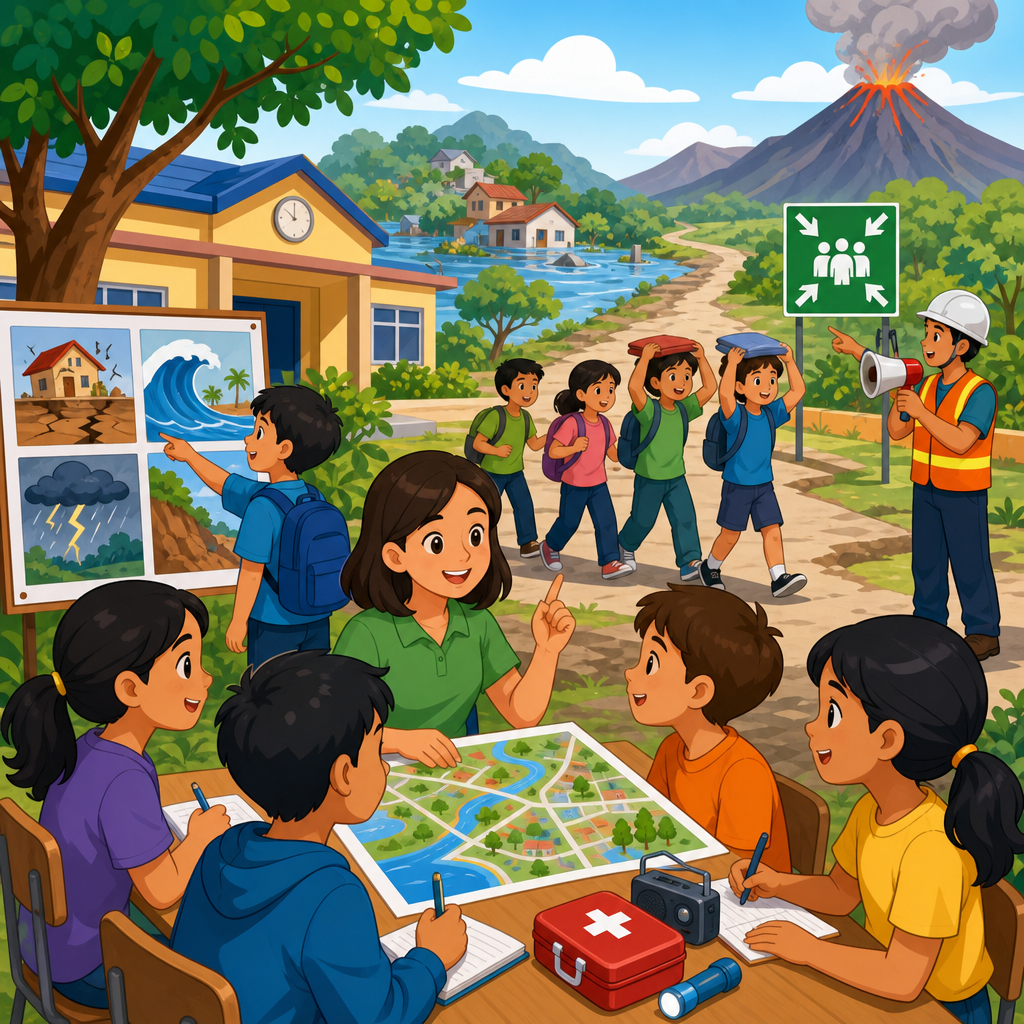
Schools are among the most powerful settings for disaster risk reduction because they reach children consistently and influence households indirectly. When students bring home evacuation maps, emergency contact forms, or wildfire mitigation checklists, parents engage with preparedness whether they planned to or not. The Comprehensive School Safety Framework has long emphasized safe learning facilities, school disaster management, and risk reduction education. Those elements work best together. A school cannot credibly teach preparedness while ignoring unsafe buildings, inaccessible exits, or poor reunification procedures. Children notice inconsistency, and so do families.
Age-appropriate instruction matters. Younger children need simple routines, visual cues, and repeated drills that avoid fear-based messaging. Adolescents can handle more complex topics, including climate risk, community mapping, volunteer roles, and misinformation analysis. At the university level, disaster education should move beyond emergency handbooks. Campuses are small cities with housing, laboratories, public events, data centers, and international populations. Preparedness plans must cover continuity of operations, laboratory hazards, disability accommodations, multilingual communication, and coordination with municipal agencies. I have found that universities improve performance when orientation programs include not just emergency numbers, but realistic scenario training tied to local risks.
Lifelong learning is equally important because adults make most household, workplace, and civic decisions. Public health departments, extension services, fire agencies, meteorological offices, and nonprofit organizations can deliver training through workshops, neighborhood meetings, online modules, and community drills. Effective adult education respects time constraints and uses practical examples. Showing a resident how to sign up for Wireless Emergency Alerts, store seven days of medication, photograph possessions for insurance, and identify the nearest cooling center is more useful than broad slogans. Preparedness becomes durable when learning is recurrent, local, and tied to decisions people already make.
Community-based education and inclusive risk communication
Community-based disaster education often outperforms top-down messaging because it starts with local realities. Risk is experienced differently by renters, homeowners, farmers, migrants, older adults, tourists, and people with disabilities. A standard preparedness brochure may miss those differences entirely. In contrast, community-led sessions can identify blocked evacuation routes, inaccessible shelters, language needs, or mistrust of authorities. They can also map assets such as volunteer drivers, amateur radio operators, faith centers, clinics, and social workers. This local knowledge improves preparedness plans and makes education more credible because people see their circumstances reflected.
Inclusive risk communication is essential. If warnings are not understandable and actionable for everyone, they are not effective. That means using plain language, multiple languages, captioned video, sign language interpretation where possible, accessible websites, and formats suitable for low-literacy audiences. It also means accounting for people who do not have smartphones, stable internet, private transport, or legal confidence in contacting public agencies. The best preparedness campaigns answer practical questions directly: Who should leave first? Where can pets go? How will dialysis patients get help? What documents should be carried? What if a caregiver is absent? Communities trust education that anticipates these details.
Social cohesion is one of the strongest predictors of survival and recovery, and education can build it intentionally. Neighborhood preparedness teams, school-parent networks, and local volunteer groups create relationships before a disaster, when coordination is still easy. During heatwaves, for example, communities that maintain check-in systems for isolated residents reduce health emergencies. During floods, neighborhoods with preassigned contact trees spread warnings faster than official channels alone. Education should therefore include not only self-protection, but mutual aid, ethical decision-making, and the importance of checking on those at greater risk. Preparedness is strongest when it is collective.
Technology, drills, and evidence-based practice
Modern disaster education is increasingly supported by technology, but tools only help when people know how to use them. Alert systems, hazard maps, weather apps, satellite-based forecasts, and mass notification platforms can provide excellent information, yet many users misread timing, severity, or location. Training is needed so residents can interpret radar colors, flood return periods, air quality indexes, and evacuation zones correctly. Emergency managers also need to test whether their messages trigger the intended action. A clear message is not the same as an effective one.
Drills remain indispensable because stress changes behavior. In real emergencies, people forget steps they seemed to understand in a classroom. Repetition creates muscle memory and exposes weaknesses in plans. Fire drills reveal congestion points. Earthquake exercises show which shelves or fixtures need securing. Hospital surge simulations test patient flow, backup power, and supply logistics. Business continuity exercises expose gaps in data recovery, remote work protocols, and vendor redundancy. I have repeatedly seen tabletop exercises prevent larger failures because they force participants to confront realistic timelines and competing priorities before an actual event.
Preparedness education should be measured, not assumed. Useful indicators include alert sign-up rates, drill participation, evacuation compliance, household supply levels, reunification times, and post-training knowledge retention. After-action reviews are critical. If a community received warnings but still delayed evacuation, educators should examine why. Was the message unclear? Were routes congested? Did prior false alarms reduce trust? Evidence-based practice means updating education as hazards, infrastructure, and demographics change. It also means admitting limits. Education cannot compensate for unsafe housing, weak drainage, or absent social protection. It works best alongside investment in resilient infrastructure, environmental management, and public services.
From awareness to a culture of preparedness
The ultimate goal of disaster education is not a single successful drill or a well-designed brochure. It is a culture of preparedness in which risk awareness shapes everyday choices. In that culture, schools teach local hazards as a normal part of science and citizenship. Builders and homeowners understand codes, retrofits, and defensible space. Employers plan for heat, smoke, outages, and supply disruption. Families know their evacuation routes, meeting points, and backup contacts. Local officials communicate consistently, and residents recognize trusted sources. Recovery planning begins before disaster, not after.
For an environmental disasters hub, disaster preparedness should connect readers to deeper topics such as emergency kits, evacuation planning, flood safety, wildfire readiness, heatwave protection, early warning systems, business continuity, school safety, and recovery planning. Education is the thread linking all of them. It translates expert guidance into action that ordinary people can take under pressure. The key lesson is simple: people do not rise to the occasion in disasters; they fall back on what they have learned and practiced. Strengthen that learning now. Review your local hazards, update your household plan, join a community drill, and use education to turn risk into readiness.
Frequently Asked Questions
Why is education considered so important in disaster risk reduction?
Education is central to disaster risk reduction because it helps people recognize hazards early, understand what those hazards mean in practical terms, and respond in ways that reduce harm. Without education, warnings can be misunderstood, ignored, or acted on too late. With education, individuals and communities are far more likely to know evacuation routes, prepare emergency supplies, protect vital documents, assist vulnerable neighbors, and follow official instructions calmly during high-pressure situations. In other words, education turns awareness into action.
Its value also goes far beyond classroom learning. Effective disaster education includes community workshops, school safety programs, evacuation drills, first aid training, early warning literacy, and public communication about local risks such as floods, earthquakes, wildfires, cyclones, droughts, and heatwaves. It helps people understand not just what can happen, but what they should do before, during, and after an event. That knowledge reduces panic, improves decision-making, and can significantly lower injuries, deaths, displacement, and economic losses.
What kinds of disaster education are most effective for communities?
The most effective disaster education is practical, locally relevant, and repeated over time. Communities benefit most from training that reflects the real hazards they face rather than generic advice. For example, flood-prone areas need education on safe evacuation timing, avoiding contaminated water, and protecting homes and important belongings, while wildfire-prone communities need instruction on defensible space, smoke safety, and evacuation readiness. When education is tailored to actual risk, people are more likely to remember it and use it correctly.
Hands-on activities are especially powerful. Public drills, simulation exercises, community response training, first aid instruction, and early warning system practice help people build confidence before a crisis occurs. Clear risk communication is also essential, including teaching people how to interpret weather alerts, emergency broadcasts, color-coded warning systems, and evacuation orders. Education is most effective when it reaches schools, families, workplaces, and local organizations together, creating a shared understanding of risk and a coordinated response culture across the whole community.
How does education improve disaster preparedness before an emergency happens?
Before a disaster occurs, education helps people prepare in organized, realistic ways instead of relying on guesswork or last-minute decisions. It teaches households how to create emergency plans, identify safe shelters, store food and water, assemble emergency kits, protect medications, and prepare for communication disruptions. It also helps people understand local geography, seasonal hazard patterns, and land-use risks, such as living near coastlines, steep slopes, dry vegetation, or floodplains. This kind of preparation can make the difference between a manageable disruption and a life-threatening crisis.
Preparedness education also strengthens institutions. Schools can establish evacuation and reunification procedures, workplaces can train staff on emergency roles, and local governments can build trust by communicating clearly and consistently with the public. When people already know what official guidance looks like and why it matters, they are more likely to act quickly when an alert is issued. Education therefore reduces hesitation, confusion, and dangerous misinformation at the exact moment when time is most critical.
What role does education play during and after a disaster?
During a disaster, education helps people interpret fast-changing information and make safer decisions under pressure. Individuals who have learned how warnings work are better able to distinguish between advisory messages, urgent alerts, and mandatory evacuation orders. They are more likely to know when to shelter in place, when to leave immediately, how to avoid common hazards such as floodwaters or unstable structures, and how to protect children, older adults, and people with disabilities. In these moments, even basic prior training can reduce panic and improve survival.
After a disaster, education remains just as important. Recovery often requires clear understanding of health risks, sanitation, safe cleanup practices, temporary shelter procedures, mental health support, and access to public assistance. People need to know how to avoid contaminated water, electrical dangers, mold exposure, heat stress, and unsafe rebuilding practices. Education also supports long-term recovery by helping communities rebuild more safely and sustainably, using lessons learned to reduce future vulnerability rather than simply restoring previous risk conditions.
How can schools and public institutions strengthen disaster risk reduction through education?
Schools and public institutions play a major role because they can reach large numbers of people consistently and credibly. Schools can incorporate hazard awareness into regular learning, run drills, teach age-appropriate safety behaviors, and involve families so preparedness extends into the home. Students often become powerful messengers, bringing disaster knowledge to parents and caregivers who may not otherwise receive formal training. When schools are safe, informed, and prepared, they help build a culture of resilience across generations.
Public institutions strengthen this process by providing trusted information, clear communication channels, and accessible training opportunities. Health agencies can teach first aid and public health protection, emergency management offices can explain warning systems and evacuation planning, and local authorities can share land-use and infrastructure risks in ways residents can understand. The most successful efforts are inclusive, reaching rural and urban populations, people with disabilities, non-native language speakers, and other groups who may face barriers to information. When institutions invest in education as an ongoing public safety strategy rather than a one-time campaign, communities become better equipped to anticipate, withstand, and recover from disasters.


