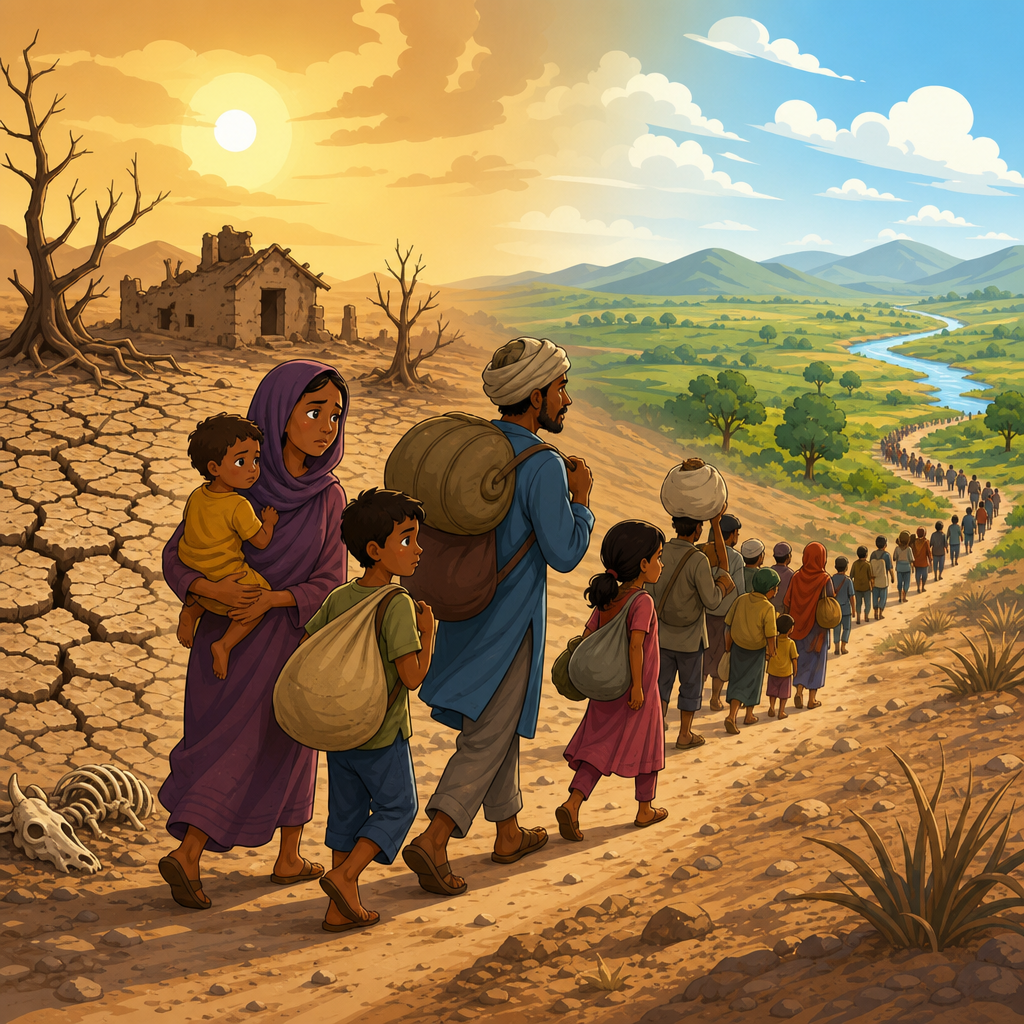
Floods and droughts displace communities through different physical processes, yet both uproot families, disrupt livelihoods, and reshape where people can safely live. In disaster management, displacement means people are forced to leave their homes temporarily or permanently because conditions threaten life, health, housing, or income. Floods include river floods, flash floods, coastal flooding, and urban flooding, while drought is a prolonged period of below-average precipitation that reduces water availability, damages crops, and stresses ecosystems. I have worked on disaster content and risk communication projects where the same pattern appears repeatedly: water arriving in destructive excess and water disappearing in damaging scarcity can produce similar human outcomes, including migration, poverty, conflict over resources, and long recovery timelines. This matters because climate change is intensifying heavy rainfall in many regions, raising sea levels, and increasing the frequency and severity of drought in vulnerable areas. Communities need clear information on how these hazards trigger displacement, who is most at risk, and what practical measures reduce harm.
Displacement is not only a humanitarian issue; it is also a housing, health, education, infrastructure, and planning issue. A flood can destroy roads, schools, clinics, sewage systems, and electrical networks within hours. A drought may unfold more slowly, but it can erase harvests, kill livestock, lower reservoir levels, increase food prices, and push households into debt until moving becomes the only option. The Internal Displacement Monitoring Centre has repeatedly identified floods and storms as leading causes of disaster displacement worldwide, while drought often causes more complex, gradual movement that may be undercounted because families relocate seasonally, send one wage earner away first, or settle informally in towns. Understanding these patterns helps governments design evacuation systems, drought early warning programs, insurance mechanisms, social protection, and long-term land-use policies. It also helps readers navigate related topics across environmental disasters, from climate migration and food insecurity to infrastructure resilience and public health planning.
How floods force people from their homes
Flood displacement is usually immediate because floodwater can make a home unsafe within minutes or hours. River flooding follows prolonged rainfall, snowmelt, or upstream releases from dams. Flash floods develop rapidly after intense rain, especially in steep terrain or paved urban areas where water cannot soak into the ground. Coastal flooding is driven by storm surge, high tides, sea level rise, or tropical cyclones. In each case, displacement happens when homes are inundated, roads are cut off, drinking water is contaminated, or authorities issue evacuation orders. The direct mechanism is simple: people leave because staying poses an acute threat of drowning, injury, disease exposure, electrocution, structural collapse, or isolation without supplies.
Recent disasters illustrate the scale. Pakistan’s 2022 floods affected tens of millions of people after extreme monsoon rainfall and glacial melt swelled rivers across multiple provinces. Entire villages were submerged, crops were ruined, and many families spent months in temporary shelters or with relatives. In Nigeria, recurrent river flooding has displaced hundreds of thousands during severe seasons, especially where settlements expand into floodplains without drainage or flood defenses. In the United States, Hurricane Harvey in 2017 demonstrated how urban flooding can trap residents in homes and apartments even in a high-income country, with repeated rainfall overwhelming drainage systems in the Houston area. These events differ in geography, but the displacement pathway is consistent: water damages housing, interrupts essential services, and makes return uncertain because repair costs, mold contamination, and infrastructure outages persist long after water recedes.
Not all flood displacement is temporary. Repeated flooding can produce managed retreat or involuntary permanent relocation. I have seen this distinction confuse readers: evacuation is leaving for safety during the emergency, while displacement includes the period afterward when return may not be possible. Homes can be technically standing but still uninhabitable due to sewage contamination, warped foundations, collapsed wells, and loss of access roads. Where flooding recurs annually, insurers may withdraw coverage, mortgages become harder to obtain, and public agencies may buy out properties rather than rebuild. That is why flood risk is increasingly tied to urban planning, building codes, wetland protection, and zoning restrictions in low-lying areas.
How drought pushes slow but profound displacement
Drought displaces communities more gradually than floods, but the social consequences can be deeper because the crisis erodes livelihoods over months or years. Meteorological drought begins with low rainfall. Agricultural drought follows when soil moisture falls below what crops need. Hydrological drought appears when rivers, lakes, and aquifers decline. Socioeconomic drought emerges when water shortages disrupt livelihoods, markets, and public services. In practical terms, displacement occurs when farming households cannot produce enough food, pastoralists cannot sustain herds, workers lose income from agriculture-related jobs, and basic water access becomes too expensive, distant, or unreliable.
The Horn of Africa offers a clear example. Consecutive poor rainy seasons in Somalia, Ethiopia, and Kenya have repeatedly killed livestock, reduced crop yields, and forced households to move toward towns, camps, or border areas in search of aid, work, and water. In Syria before the civil war, a severe multiyear drought from 2006 to 2010 contributed to crop failure and rural livelihood stress, pushing many families into urban peripheries already struggling with unemployment and poor services. Drought did not act alone, but it intensified existing vulnerability. This is a critical point: drought displacement is often indirect. People may not say they moved “because of drought” if the immediate trigger was debt, food prices, conflict, or lack of work. Yet drought often sits behind those pressures.
Because drought unfolds slowly, displacement decisions are staggered. One family member may migrate seasonally for labor first. Then children may leave school because fees cannot be paid. Livestock may be sold at distress prices. Finally, the household may relocate entirely. This pattern means drought displacement is frequently harder to count than flood evacuation. It also means policy responses must go beyond emergency water trucking. Effective drought risk reduction includes groundwater management, drought-tolerant crops, index insurance, social cash transfers, climate-informed extension services, and agreements that protect pastoral mobility routes. Without those systems, households deplete savings and assets until movement becomes a survival strategy rather than a choice.
Who faces the highest displacement risk
Displacement risk is not shared equally. Low-income households, renters, informal settlement residents, smallholder farmers, pastoralists, Indigenous communities, older adults, people with disabilities, and those lacking legal land tenure are often hit hardest by both floods and drought. Exposure matters, but vulnerability determines the outcome. A family living in a floodplain with no savings, no insurance, and weak housing is more likely to be displaced than a household in the same area with elevated construction, transport access, and money for repairs. Similarly, a drought has harsher consequences where irrigation is absent, livestock health services are limited, and markets are far away.
Cities concentrate another layer of risk. When displaced people move to urban areas, they often settle in hazard-prone land near riverbanks, drainage channels, unstable slopes, or peri-urban zones with unreliable water service. This creates a cycle in which people escaping one environmental shock become more exposed to another. I have found that clear risk communication must stress this compounding effect. Displacement is rarely a single event; it is a process shaped by repeated shocks, weak institutions, and unequal access to resources.
| Factor | Flood displacement effect | Drought displacement effect |
|---|---|---|
| Poverty | Limits safe housing, transport, repairs, and insurance | Reduces ability to buy water, food, seed, and animal feed |
| Informal housing | Often built in floodplains or drainage corridors | Usually located in areas with weak water infrastructure |
| Livelihood type | Daily wage workers lose income when transport and markets stop | Farmers and pastoralists lose crops, pasture, and herds |
| Public services | Damaged roads, clinics, and schools delay return | Water shortages and food stress push longer-term migration |
| Land tenure | Residents may be excluded from compensation or rebuilding aid | Migrants may struggle to settle legally or access support |
Health, education, and economic consequences after movement
Once displacement occurs, losses multiply. Floods contaminate drinking water with sewage, chemicals, and debris, increasing the risk of diarrheal disease, skin infections, and vector-borne illness where standing water supports mosquitoes. Drought contributes to malnutrition, dehydration, poor sanitation, and mental stress, especially when women and children spend more time collecting water. Both hazards disrupt maternal care, vaccination, chronic disease treatment, and school attendance. In temporary shelters after floods, overcrowding and poor ventilation can spread respiratory infections. During prolonged drought, households may reduce meals, sell productive assets, or marry off daughters earlier as a coping strategy, deepening long-term inequality.
Economic damage extends beyond damaged homes or failed harvests. Small businesses lose customers, supply chains break, schools close, and local governments face revenue losses just as response costs rise. When people relocate, they may lose social networks, identity documents, access to land, and voting representation. Host communities can also experience strain if housing, water systems, clinics, and labor markets are already stretched. That does not mean displaced people are a burden; many contribute skills and labor quickly. But unmanaged inflows can create tension unless planning, funding, and public communication keep pace. Durable recovery therefore depends on integrating housing policy, public health, education continuity, and livelihood support rather than treating displacement as only a temporary shelter issue.
What reduces displacement and supports safer recovery
The most effective response starts before disaster. For floods, priority measures include accurate floodplain mapping, early warning systems, maintained drainage, upstream watershed management, wetland restoration, elevated construction, and enforcement of land-use rules in high-risk zones. Forecast-based action is especially valuable: when agencies use rainfall and river forecasts to release emergency cash, pre-position boats, protect livestock, and organize evacuations before peak impact, fewer people suffer chaotic displacement. Countries such as Bangladesh have shown how cyclone shelters, community alerts, and evacuation planning can dramatically reduce mortality even when hazards remain severe.
For drought, prevention depends on water governance and livelihood resilience. That means monitoring rainfall and vegetation, managing aquifers sustainably, repairing leaks in municipal systems, expanding drought-tolerant crop varieties, diversifying incomes, and scaling safety nets before households sell assets. The Famine Early Warning Systems Network, national meteorological agencies, and tools such as the Standardized Precipitation Index help identify worsening drought conditions early. But data alone is not enough. Governments must convert early warning into early action through cash assistance, school feeding, veterinary support, emergency borehole repair, and temporary employment programs. In my experience, this is where many systems fail: institutions detect risk but respond too slowly to prevent displacement.
When return is unsafe, planned relocation may be necessary, but it must protect rights and livelihoods. Successful relocation provides secure tenure, access to jobs, schools, healthcare, transport, and culturally appropriate community design. Moving people far from farmland or fishing grounds without income options often creates new poverty. The central lesson is straightforward: communities are displaced not only by hazards, but by weak preparedness, unequal development, and recovery systems that rebuild the same risk in the same places.
Floods and droughts displace communities in different ways, but they produce a shared reality of loss, uncertainty, and hard choices about where to live and how to recover. Floods tend to trigger sudden evacuation through inundation, infrastructure failure, and unsafe housing. Droughts usually push slower movement through crop failure, livestock deaths, water scarcity, debt, and collapsing rural income. In both cases, the greatest impacts fall on people with the fewest resources and the least protection from repeated shocks. The evidence from Pakistan, the Horn of Africa, Syria, Bangladesh, and many other regions shows that displacement is rarely caused by hazard alone. It is shaped by exposure, poverty, land use, water management, governance, and the strength of public services.
For readers using this page as a hub within environmental disasters, the key takeaway is clear: reducing displacement requires combining disaster preparedness with long-term resilience planning. Better warnings, safer housing, stronger social protection, climate-smart agriculture, reliable water systems, and fair relocation policy all matter. Communities cannot stop every flood or drought, but they can reduce how often those hazards become human displacement crises. Use this understanding to explore related topics such as climate migration, food insecurity, water scarcity, resilient infrastructure, and post-disaster recovery, and apply these lessons when evaluating local risk, policy, or community preparedness efforts.
Frequently Asked Questions
How do floods and droughts displace communities in different ways?
Floods and droughts both force people from their homes, but they do so through very different processes. Flood displacement is often sudden and visible. River floods, flash floods, coastal flooding, and urban flooding can damage or destroy homes in a matter of hours or days, cut off roads, contaminate drinking water, and create immediate threats to life and safety. In these cases, families may be evacuated quickly, moved into shelters, or forced to stay with relatives until floodwaters recede and homes can be repaired. Some people return, but others cannot if the damage is severe, if repeated flooding makes the area unsafe, or if rebuilding is too expensive.
Drought usually causes displacement more slowly, but its effects can be just as disruptive. A prolonged period of below-average precipitation reduces water supplies, harms crops, weakens livestock, and undermines the livelihoods that rural households depend on. Over time, food insecurity, income loss, debt, health problems, and competition over scarce resources can make it impossible for families to remain where they are. Instead of a sudden evacuation, drought often leads to gradual migration, seasonal movement, or permanent relocation in search of work, water, and more reliable living conditions. In short, floods tend to trigger immediate physical displacement, while drought often drives slower economic and environmental displacement, but both can permanently reshape communities.
Why are some communities more vulnerable to displacement from floods and droughts than others?
Vulnerability is not determined by weather alone. It is shaped by where people live, the quality of housing and infrastructure, access to savings and insurance, public services, and the strength of local disaster planning. Communities in floodplains, low-lying coastal areas, informal urban settlements, drought-prone agricultural regions, and places with weak drainage or fragile water systems face greater risks from the start. If homes are poorly built, roads are limited, hospitals are far away, or early warning systems are weak, even a moderate hazard can trigger major displacement.
Social and economic factors also matter enormously. Lower-income households often have fewer resources to prepare, evacuate, repair property, or relocate safely. Farmers, pastoralists, fishers, and day laborers may lose not only housing but also the income source tied to the affected environment. Renters, migrants, older adults, people with disabilities, and communities that have historically faced discrimination may find it harder to access relief, legal support, or recovery assistance. Repeated exposure also increases vulnerability. A family that has already used up savings after one flood or one failed harvest is less able to withstand the next shock. That is why displacement risk is highest where environmental hazards overlap with poverty, inequality, weak governance, and limited adaptation options.
Is displacement from floods and droughts usually temporary or permanent?
It can be either, and the outcome depends on the severity of the event, the level of damage, and the ability of households and governments to support recovery. After a flood, many people are displaced temporarily. They may leave during evacuation orders, stay in emergency shelters or with relatives, and return once waters recede and basic services are restored. However, temporary displacement can become prolonged if homes are structurally unsafe, schools and health facilities remain closed, land is eroded, or neighborhoods repeatedly flood. In places facing recurrent river flooding or sea level rise, what starts as short-term evacuation may evolve into permanent resettlement.
Drought displacement is often harder to classify because it tends to unfold gradually. Some households send one or two family members elsewhere for seasonal work while others remain behind, making the movement partly temporary and partly strategic. But if water sources dry up, harvests continue to fail, livestock losses mount, and debts increase, families may decide they cannot return to previous livelihoods at all. In that case, displacement becomes long term or permanent, even if there was never a dramatic evacuation moment. The key point is that return is only possible when safety, housing, water access, and livelihoods are realistically restored. Without those conditions, displacement can persist for months or years and may become irreversible.
What are the main impacts of flood and drought displacement on families and communities?
The effects go far beyond the loss of a house. Displacement disrupts livelihoods, education, health care, social networks, and a family’s sense of stability and belonging. Floods can destroy homes, furniture, crops, tools, roads, power systems, and sanitation infrastructure. Families may lose identification documents, savings, and household goods all at once. In crowded shelters or temporary accommodation, people may face stress, illness, interrupted schooling, and limited privacy. Businesses close, local markets stall, and community services may take a long time to recover.
Drought displacement creates a different but equally serious chain of impacts. As water becomes scarce and agricultural production declines, families may experience food insecurity, malnutrition, debt, and reduced income long before they physically move. Migration can separate families, increase pressure on receiving communities, and push people into informal work or unsafe housing in towns and cities. Children may leave school to help earn money or collect water. Mental health effects are also significant in both flood and drought contexts, especially when people face repeated losses, uncertainty, and the breakdown of familiar ways of life. At the community level, displacement can alter settlement patterns, strain public services in destination areas, increase competition for housing and jobs, and deepen inequality if recovery support is uneven.
How can communities and governments reduce displacement caused by floods and droughts?
Reducing displacement requires both disaster risk reduction and long-term adaptation. For floods, effective measures include early warning systems, evacuation planning, floodplain management, stronger building standards, improved drainage, wetland restoration, levees where appropriate, and land-use policies that discourage development in high-risk areas. Authorities also need clear shelter planning, emergency communication, and rapid recovery support so displaced residents can return safely when possible. When repeated flooding makes return unrealistic, planned relocation may be necessary, but it should be done carefully, with community participation, legal protections, and access to livelihoods and services in the new location.
For drought, the focus is often on building resilience before crisis conditions force people to leave. That means investing in water storage, drought monitoring, efficient irrigation, watershed management, climate-resilient crops, livestock support, social protection programs, and diversified rural livelihoods. Governments can also reduce distress migration by supporting farmers and vulnerable households with cash assistance, crop insurance, food security measures, and reliable access to water and health services. Across both hazards, the most effective approach is proactive rather than reactive. Communities are less likely to be displaced when risk is mapped early, infrastructure is designed for changing climate conditions, and policies address the social inequalities that make certain groups far more likely to lose their homes and livelihoods in the first place.