
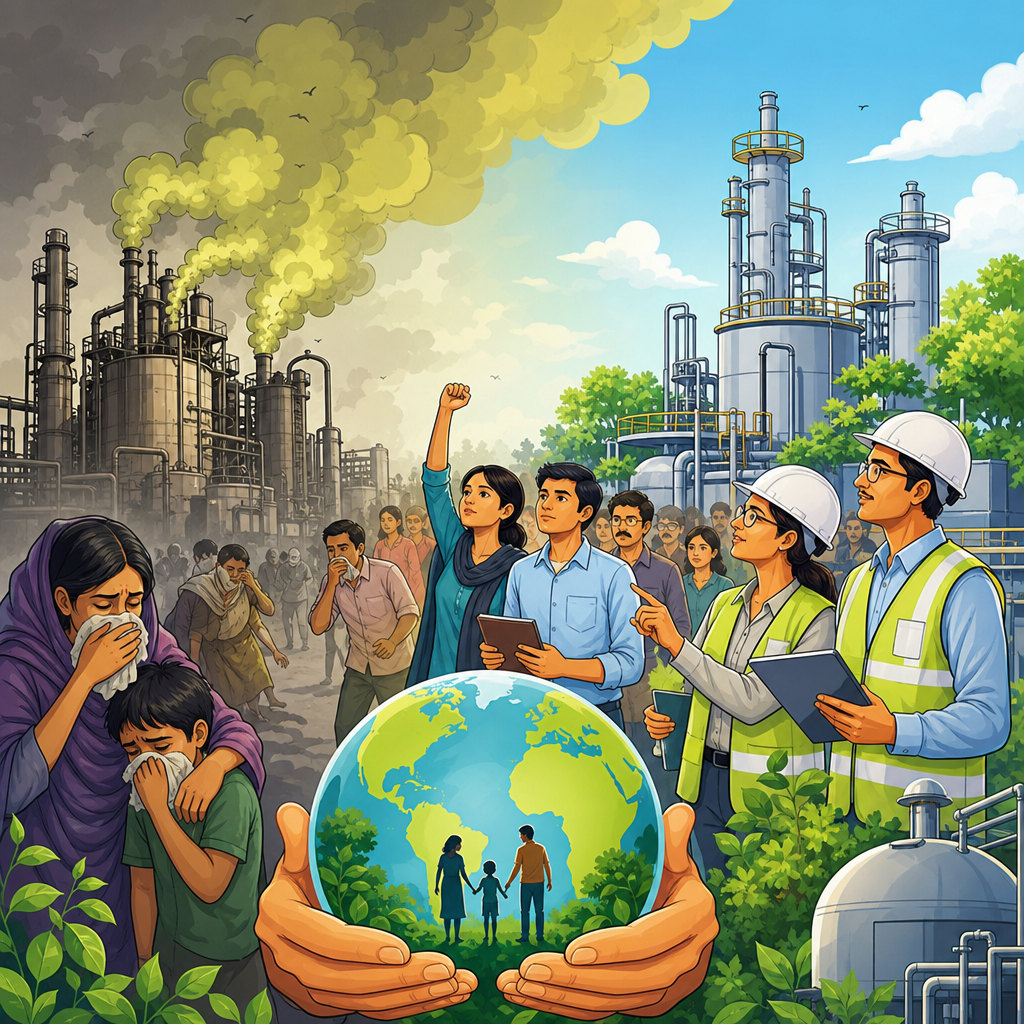
The Bhopal Gas Tragedy remains one of the most important industrial disasters in modern history because it exposed how weak process safety, poor emergency planning, and regulatory failure can combine into mass death within hours. For anyone studying environmental disasters, global case studies, or industrial safety, Bhopal is not simply a past event in central India; it is a benchmark for understanding how hazardous industries can devastate workers, neighboring communities, ecosystems, and public trust. In December 1984, a toxic gas release from the Union Carbide India Limited pesticide plant in Bhopal killed thousands of people immediately and injured many more, with health, legal, and environmental consequences still debated decades later. The phrase “Bhopal Gas Tragedy” refers to that release, the human suffering that followed, and the policy changes it forced around the world.
In industrial safety, key terms matter. Process safety is the discipline focused on preventing fires, explosions, and toxic releases from hazardous materials. Occupational safety protects individual workers from day-to-day injuries, while environmental risk management addresses harm to air, soil, water, and nearby populations. Bhopal showed that these fields cannot be separated in practice. A failure inside a plant can become a citywide disaster when storage, maintenance, training, alarms, and land-use planning are all inadequate. I have worked with incident reviews and risk registers where Bhopal is still cited alongside Seveso, Chernobyl, Piper Alpha, Deepwater Horizon, and Fukushima because it changed how professionals think about low-probability, high-consequence events.
This article serves as a hub for global case studies under the broader topic of environmental disasters. Bhopal matters not only because of the scale of death and injury, but because it became a turning point in industrial safety governance. It prompted tougher chemical regulation, sharper focus on inherently safer design, and stronger expectations for community right-to-know. It also revealed enduring gaps: cost cutting can erode safeguards, multinational accountability can become legally complex, and vulnerable communities often bear the highest risk. Understanding Bhopal helps readers interpret other disasters with more clarity. The central lesson is direct: catastrophic industrial accidents are rarely caused by a single mistake. They emerge from layered technical, managerial, and regulatory failures that were visible before the release occurred.
What happened in Bhopal and why the release became catastrophic
On the night of 2–3 December 1984, water entered a storage tank containing methyl isocyanate, usually called MIC, at the Union Carbide India Limited facility in Bhopal, Madhya Pradesh. MIC is a highly reactive and toxic chemical used in pesticide production. When water mixed with MIC, an exothermic reaction occurred, raising pressure and temperature inside the tank. The resulting gas cloud escaped and drifted over densely populated neighborhoods near the plant. Many residents were sleeping and had little or no warning. Survivors described burning eyes, choking, panic, vomiting, and collapse in the streets as people tried to flee.
The disaster became catastrophic because multiple protective layers were unavailable, degraded, bypassed, or ineffective. Investigations and later analyses repeatedly pointed to poor maintenance, understaffing, inadequate training, and malfunctioning or disabled safety systems. The refrigeration unit intended to keep MIC at lower temperature was reportedly not operating as designed. The flare tower and vent gas scrubber, critical controls for a toxic release, were not capable of neutralizing the event at that scale. Alarm systems did not provide meaningful protection to the surrounding population. The plant also sat near large informal settlements, which turned a process accident into a mass-casualty urban disaster. In modern process safety language, Bhopal was a classic case of failed barriers, poor hazard recognition, and weak management of change.
Official casualty figures have long been contested. Immediate deaths were in the thousands, while long-term estimates rise much higher when later illness and premature mortality are included. What is not disputed is the magnitude of suffering. Hundreds of thousands were exposed. Hospitals were overwhelmed. Medical staff initially lacked clear toxicological information. The gas composition remains debated in some details, but MIC was the primary known hazard. The absence of transparent, rapid chemical disclosure during the emergency worsened the medical response. That point later influenced emergency planning standards and hazardous materials communication practices in multiple countries.
Root causes: design choices, management failures, and regulatory gaps
No serious industrial safety analysis treats Bhopal as an unavoidable accident. The release was the product of interacting failures across equipment design, operations, corporate decision-making, and public oversight. One core issue was hazardous inventory. Storing large quantities of MIC created a substantial consequence potential. Inherently safer design, a principle later emphasized more strongly across the industry, asks whether a dangerous material can be minimized, substituted, moderated, or simplified. Bhopal demonstrated the cost of not doing so. Smaller inventories, different process routes, or different storage strategies reduce the size of a possible release before any emergency system is even tested.
Management failures were equally central. Cost pressure reportedly led to staffing reductions and deferred maintenance. In my experience reviewing high-hazard facilities, these are classic warning signs: safety-critical systems deteriorate quietly long before the disaster becomes visible. Training quality also matters. Operators must understand chemical reactivity, isolation procedures, abnormal conditions, and escalation pathways. When organizations normalize degraded equipment or repeated minor deviations, they create latent conditions for catastrophe. Bhopal is often taught as a case where organizational drift and weak process safety culture were as dangerous as the chemical itself.
Regulatory gaps widened the risk. At the time, many countries did not yet have mature major-hazard regimes requiring robust hazard analysis, emergency planning, and public disclosure. Land-use planning around hazardous plants was also weaker than it is today in many jurisdictions. Communities grew close to industrial sites without adequate buffer zones, evacuation planning, or realistic worst-case consequence assessments. This pattern appears in many environmental disaster case studies: a technical hazard becomes a social disaster when poor governance allows exposure to concentrate among people with the fewest protections.
| Failure area | Bhopal example | Industrial safety lesson |
|---|---|---|
| Hazardous inventory | Large MIC storage volume | Reduce inventory through inherently safer design |
| Safety systems | Controls unavailable or ineffective | Maintain independent layers of protection |
| Operations | Training and staffing concerns | Treat competence as a safety-critical asset |
| Emergency response | Limited public warning and medical guidance | Plan for off-site consequences, not only on-site events |
| Regulation | Weak oversight and land-use controls | Require major-hazard analysis and community protection |
Human, environmental, and public health consequences
The immediate human impact of the Bhopal Gas Tragedy was acute respiratory distress, eye injury, panic-related trauma, and widespread death. Long-term consequences included chronic respiratory disease, eye problems, reproductive health concerns, mental health effects, and unresolved questions about intergenerational harm. Public health experts still discuss the difficulty of measuring full lifetime impacts when exposure records are incomplete, baseline health data are weak, and compensation systems are inconsistent. Those limitations matter because undercounting can distort policy lessons and diminish survivor needs.
Environmental consequences extended beyond the gas release itself. Concerns persisted for years about contamination at and around the plant site, including soil and groundwater issues linked to hazardous waste handling and storage. This is a crucial point for global case studies in environmental disasters: the dramatic event captures public attention, but chronic contamination can continue harming communities long after headlines fade. Similar patterns are seen in Love Canal, Minamata disease, and some mining tailings failures, where delayed or poorly managed cleanup deepened social injustice.
Bhopal also reshaped the public understanding of environmental health. The disaster showed that exposure does not end when the visible cloud disappears. Survivors may need decades of clinical monitoring, specialized registries, epidemiological research, and transparent risk communication. In practical terms, a modern response to such an event requires toxicologists, pulmonologists, occupational physicians, environmental chemists, emergency planners, and community advocates working together. That multidisciplinary model, now common in serious disaster response, was much less developed in 1984.
How Bhopal changed industrial safety worldwide
Bhopal became a turning point because it accelerated reforms that linked chemical process safety with public accountability. In the United States, the Emergency Planning and Community Right-to-Know Act of 1986 reflected the growing recognition that communities and local responders need information about hazardous substances nearby. The Occupational Safety and Health Administration’s Process Safety Management standard, issued in 1992, and the Environmental Protection Agency’s Risk Management Program, later formalized under the Clean Air Act framework, reinforced expectations for hazard analysis, operating procedures, mechanical integrity, emergency planning, and incident investigation. Different countries took different regulatory paths, but the direction was unmistakable: major-hazard facilities required more systematic control.
Industry practice also evolved. Techniques such as HAZOP studies, layers of protection analysis, quantitative risk assessment, bow-tie analysis, and management of change gained broader prominence. None of these tools is a guarantee, and many existed in some form before 1984, but Bhopal made their absence or poor application impossible to ignore. I have seen companies use Bhopal in training to explain why process safety is not paperwork. A hazard review is only valuable if it leads to design improvements, maintained safeguards, audited procedures, and empowered operators who can stop unsafe operations.
The disaster influenced corporate governance as well. Boards and senior executives became more exposed to questions about major-accident risk, especially in multinational operations where standards could vary between countries. Bhopal remains a warning against dual standards in safety performance. A company cannot credibly maintain one level of control in a high-income country and a weaker one elsewhere, then claim the risk was unforeseeable. Industrial safety professionals now treat consistency of standards across sites as a basic requirement of responsible operations.
Bhopal in the context of global environmental disaster case studies
As a hub for global case studies, this article should place Bhopal beside other defining disasters while respecting what makes it distinct. Seveso in Italy in 1976 highlighted toxic chemical release and led to the European Seveso Directives on major accident hazards. Chernobyl in 1986 exposed how design flaws, secrecy, and weak safety culture in nuclear operations can create transboundary contamination. Piper Alpha in 1988 showed the deadly consequences of poor permit-to-work controls and emergency preparedness offshore. Deepwater Horizon in 2010 demonstrated how multiple technical and organizational failures can converge in high-risk energy operations. Fukushima in 2011 underscored the need to plan for extreme external events beyond design assumptions.
Bhopal differs from these events in one crucial respect: the exposed population was overwhelmingly a nearby urban community with limited protection, limited information, and little capacity to influence the risk imposed on them. That makes Bhopal especially important in discussions of environmental justice. Hazardous facilities often cluster near low-income populations because land is cheaper, political resistance is weaker, and planning systems fail to protect those residents. This pattern is global. From refinery corridors to informal industrial zones, the people most likely to suffer catastrophic exposure are often those least represented in decision-making.
For readers exploring this subtopic further, Bhopal connects naturally to related articles on Seveso, Chernobyl, Minamata disease, Love Canal, Deepwater Horizon, Fukushima, and major mining disasters. Together, these case studies reveal a consistent rule: when complex systems handle dangerous materials, safety depends on conservative design, transparent governance, practiced emergency response, and respect for the communities living nearby.
Legal accountability, compensation, and the unfinished legacy
The legal aftermath of the Bhopal Gas Tragedy remains controversial. Litigation, settlement, criminal proceedings, and jurisdictional disputes unfolded over years, shaping global debate about corporate accountability for transnational harm. Critics argued that compensation was inadequate relative to the scale of death, injury, and long-term health damage. Others pointed to the difficulty of assigning causation and valuation across such a vast affected population. Both points can be true: mass tort systems struggle with catastrophe, and that struggle often leaves survivors dissatisfied.
The unfinished legacy is not only legal; it is institutional. Bhopal is remembered because it forced a permanent question into industrial policy: who bears the risk of hazardous production, and who pays when controls fail? The strongest modern answer is that prevention must come first, and prevention requires disciplined engineering, independent oversight, honest reporting, and real community protection. For policymakers, the lesson is to strengthen major-hazard regulation, emergency planning, land-use controls, and environmental monitoring. For companies, the lesson is to minimize hazardous inventories, maintain safety-critical equipment, audit rigorously, and treat warning signs as commands to act. For readers following global environmental disasters, Bhopal is the case that makes industrial safety personal, visible, and impossible to dismiss. Use it as a starting point for deeper study across this hub, and judge every other case by the same standard: could the harm have been reduced by better design, better management, and greater accountability?
Frequently Asked Questions
1. Why is the Bhopal Gas Tragedy considered a turning point in industrial safety?
The Bhopal Gas Tragedy is widely seen as a turning point in industrial safety because it revealed, in the most devastating way possible, what can happen when hazardous chemical operations are managed without strong process safety systems, effective maintenance, emergency planning, and regulatory oversight. In December 1984, toxic gas leaked from the Union Carbide pesticide plant in Bhopal, exposing hundreds of thousands of people in nearby neighborhoods. The scale of death, injury, and long-term suffering forced governments, industries, researchers, and safety professionals around the world to confront a hard truth: industrial disasters are rarely caused by a single mistake. They are usually the result of multiple failures happening at once, including poor design decisions, disabled or inadequate safety systems, weak training, ignored warning signs, and a lack of preparedness for worst-case scenarios.
What makes Bhopal so important historically is that it shifted attention from basic workplace safety alone to the broader concept of process safety management. Before this, many organizations focused heavily on preventing routine injuries such as slips, falls, or equipment accidents, which are important but different from preventing catastrophic releases of toxic or flammable materials. Bhopal showed that facilities handling hazardous substances must be designed and operated with a deep understanding of chemical risks, human factors, operating procedures, maintenance standards, and emergency response capabilities. It also demonstrated that the consequences of a failure are not limited to workers inside a plant; surrounding communities can suffer on an even larger scale.
In practical terms, the disaster influenced debates and reforms related to chemical storage, hazard analysis, plant siting, community right-to-know laws, corporate accountability, and environmental regulation. It remains a benchmark case in industrial safety education because it continues to illustrate how cost-cutting, weak governance, and underestimation of risk can turn a preventable incident into a mass-casualty event. That is why Bhopal is not remembered only as a tragedy of the past, but as a lasting warning for every industry that handles dangerous materials.
2. What were the main causes of the Bhopal Gas Tragedy?
The main causes of the Bhopal Gas Tragedy were not limited to one technical malfunction. Instead, the disaster emerged from a chain of interconnected failures involving plant operations, safety management, maintenance practices, emergency preparedness, and regulatory control. At the center of the incident was the release of methyl isocyanate, or MIC, a highly toxic chemical used in pesticide production. Water is believed to have entered a storage tank containing MIC, triggering a dangerous chemical reaction that increased heat and pressure inside the tank. That pressure eventually contributed to the massive release of toxic gas into the surrounding city.
However, stopping the explanation at the chemical reaction would miss the bigger lesson. A major reason Bhopal remains such an important case study is that the release appears to have been made far worse by weakened safety systems and poor plant conditions. Reports and investigations over the years have pointed to issues such as inadequate maintenance, equipment problems, insufficient staffing, cost-cutting measures, and safety devices that were not fully functional, not operating effectively, or not capable of controlling a release of that scale. This meant that when the reaction began, the plant had fewer reliable barriers in place to detect, contain, neutralize, or reduce the toxic release.
Another critical cause was weak emergency planning. The surrounding population was highly vulnerable because many people lived close to the facility, and there was no effective public warning system or well-practiced evacuation plan that could protect them in time. In addition, regulatory and oversight weaknesses contributed to the conditions that allowed such a dangerous operation to continue without sufficient accountability. So while the immediate trigger involved a chemical reaction inside the MIC tank, the deeper causes included systemic negligence, poor risk management, and the failure to treat catastrophic chemical hazards with the seriousness they required.
3. What were the immediate and long-term impacts of the disaster on people and the environment?
The immediate human impact of the Bhopal Gas Tragedy was catastrophic. Within hours of the gas release, people in surrounding neighborhoods experienced intense burning in the eyes, choking, breathlessness, coughing, chest pain, vomiting, and panic. Many fled in the dark without understanding what they had been exposed to. Hospitals were rapidly overwhelmed, and thousands died in the immediate aftermath or soon after due to the severity of exposure. Families were torn apart overnight, and the suddenness of the event made it especially horrifying because so many victims had little or no warning and no practical way to protect themselves.
The long-term human consequences were equally serious. Survivors have reported chronic respiratory illness, eye damage, neurological problems, reproductive health issues, psychological trauma, and other lasting medical complications. Many people lived for years with disabilities or recurring symptoms that affected their ability to work, study, or care for their families. The health burden also extended across generations, with continuing concern and debate around long-term exposure, maternal health, and developmental effects. This is one reason the tragedy continues to be discussed not only as a historical accident, but as an ongoing public health issue.
Environmentally, the disaster raised deep concerns about contamination at and around the plant site. Hazardous industrial activity can affect soil, groundwater, and local ecosystems long after the initial release, especially if waste handling and site cleanup are inadequate. In Bhopal, environmental concerns became part of the broader legacy of the tragedy, because communities were not only dealing with the gas exposure itself but also with fears about persistent contamination and unsafe living conditions. Taken together, the human and environmental impacts show why Bhopal is studied as a multidimensional disaster: it was not only an industrial accident, but also a public health crisis, a community disaster, and a long-term environmental justice issue.
4. How did the Bhopal Gas Tragedy change industrial safety laws and emergency planning?
The Bhopal Gas Tragedy had a profound influence on how governments, regulators, and companies think about hazardous industry, especially in relation to catastrophic chemical risk. One of the biggest changes was the growing recognition that companies handling dangerous substances must go far beyond routine compliance and adopt formal systems for identifying, evaluating, and controlling major hazards. In many parts of the world, Bhopal helped strengthen support for regulations related to process safety management, hazard communication, toxic release prevention, and emergency response planning. It also reinforced the need for clearer accountability when industrial operations can threaten workers and surrounding communities.
Emergency planning became a central lesson. Bhopal showed that having hazardous chemicals on site is not just an internal plant issue; it is a community safety issue. As a result, greater emphasis was placed on off-site emergency plans, public warning systems, coordination with hospitals and local authorities, evacuation strategies, and communication with residents living near industrial facilities. The disaster also influenced the idea that nearby communities have a right to know what chemicals are being handled, what the risks are, and what to do in an emergency. This was a major shift from older approaches that treated industrial risk as something largely confined within plant boundaries.
In addition, Bhopal encouraged stronger attention to plant siting, safety culture, auditing, training, and management responsibility. It highlighted that emergency preparedness cannot compensate for poor prevention, and prevention cannot work without leadership commitment, proper investment, and independent oversight. Although legal and regulatory responses differed across countries, the broader effect was unmistakable: Bhopal became one of the defining case studies behind modern chemical safety reform. It remains a key reference point whenever experts discuss how law, engineering, management, and public policy must work together to prevent large-scale industrial disasters.
5. What lessons does the Bhopal Gas Tragedy still offer to modern industries and policymakers?
The most important lesson Bhopal offers modern industries is that catastrophic risk must be managed proactively, systematically, and ethically. Hazardous facilities cannot rely on luck, informal practices, or minimal compliance. They need strong process safety programs, reliable engineering controls, preventive maintenance, trained operators, clear procedures, robust incident reporting, and a culture in which warning signs are taken seriously. Bhopal demonstrated that when management weakens safety barriers, ignores deteriorating conditions, or prioritizes cost savings over hazard control, the consequences can extend far beyond the plant gate and affect entire cities.
For policymakers, Bhopal underscores the danger of weak regulation and ineffective enforcement. Industrial growth without strong oversight can create unacceptable risks for workers, residents, and the environment. Governments must ensure that hazardous industries are subject to strict inspections, transparent reporting, land-use planning controls, and credible penalties for noncompliance. Just as important, emergency systems must be realistic and community-centered. It is not enough to assume that people living near chemical facilities will somehow know how to respond in a crisis. Public education, medical preparedness, communication systems, and interagency coordination are essential.
Bhopal also offers a deeper moral lesson about environmental justice and corporate responsibility. The communities most affected by industrial disasters are often those with the fewest resources and the least power to demand protection. That reality makes safety a matter of social responsibility, not just technical management. Even today, Bhopal remains relevant because the world continues to depend on chemicals, energy, and large-scale industrial production. The tragedy reminds us that modernization without accountability is dangerous, and that real industrial progress must include rigorous safety, transparent governance, and respect for human life at every level of