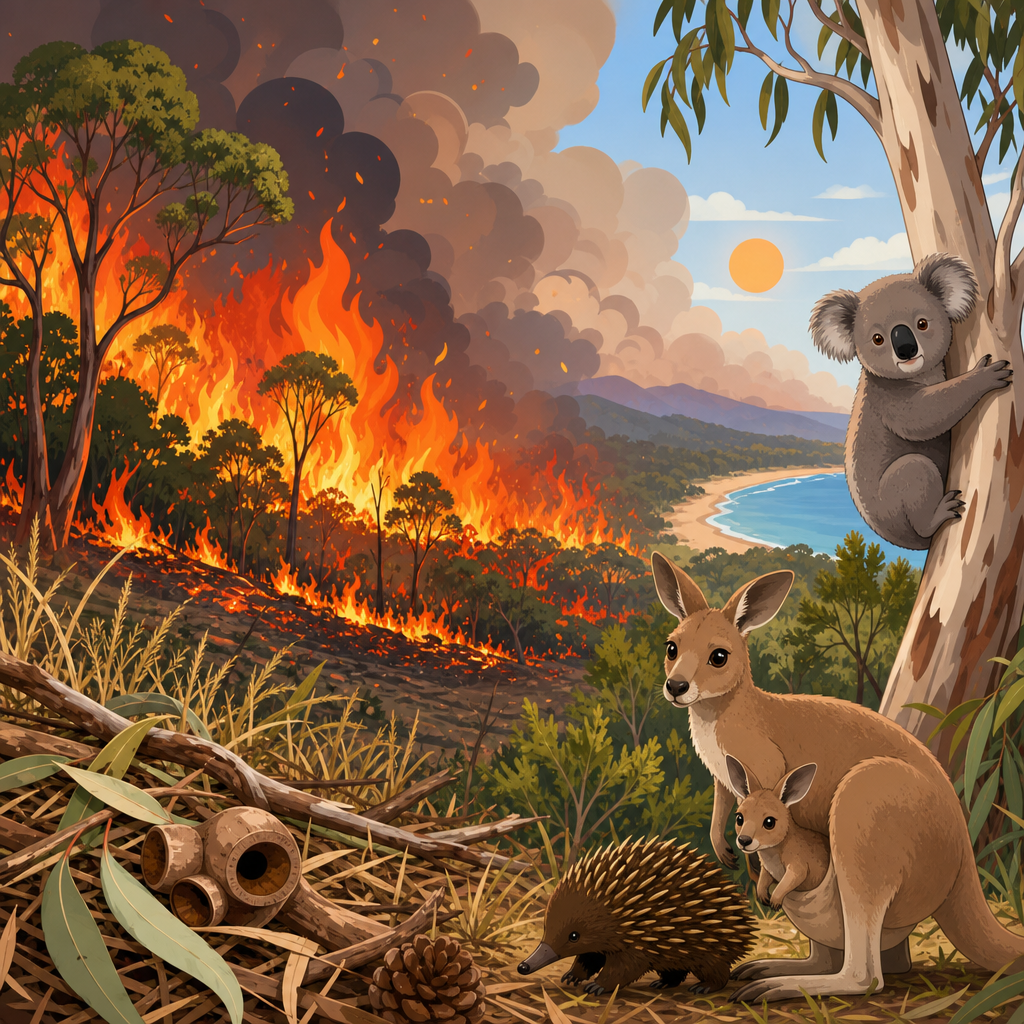
Australia’s bushfires are driven by a combination of climate, vegetation, weather extremes, land management decisions, and human activity, which is why they cannot be explained by a single cause. In Australia, the term “bushfire” refers to uncontrolled fires burning in forests, woodlands, scrub, grasslands, or peri-urban areas, and the country’s fire regimes differ sharply from one region to another. As someone who has worked with wildfire content and disaster-risk material across global case studies, I have seen the same mistake repeated: people reduce catastrophic seasons to arson, drought, heat, or fuel loads alone. The evidence shows a more complex system. Understanding that system matters because Australia has become one of the clearest global examples of how environmental disasters emerge when natural variability meets long-term warming, settlement patterns, and ecological limits. This hub article explains the main drivers, shows how major Australian fire seasons fit into a wider global case-study framework, and clarifies what readers should examine when comparing disasters across countries. It also serves as a foundation for deeper coverage of prevention, emergency response, recovery, public health, climate attribution, and land-use planning within the broader Environmental Disasters topic.
The fire environment: why Australia is unusually combustible
Australia is one of the most fire-prone continents on Earth because it combines flammable vegetation, highly variable rainfall, recurrent drought, extreme heat, and periodic strong winds. Many native plant communities, especially eucalyptus forests, generate fine fuels such as dry leaves, bark strips, twigs, and oils that can ignite readily and support ember attack. In practice, that means fires do not only spread through a flame front; they also leap ahead through windborne embers that ignite houses, fences, and spot fires kilometers away. When I evaluate global fire case studies, Australia consistently stands out for this ember-driven behavior, which makes suppression difficult even when firefighting resources are substantial.
Climate patterns amplify that baseline risk. El Niño events often reduce rainfall across eastern Australia, while positive Indian Ocean Dipole conditions can suppress winter and spring precipitation in the southeast. Lower rainfall dries fuels over months, then heatwaves lower fuel moisture even further over days. Add steep terrain, dry thunderstorms, or foehn-like winds descending ranges, and fire behavior can become explosive. The McArthur Forest Fire Danger Index, long used in Australia, captures this interaction by combining temperature, relative humidity, wind speed, and drought effects. High index values do not cause ignition by themselves, but they signal that once a fire starts, containment becomes far harder.
Another reason Australia is unusually combustible is the meeting point between settlement and vegetation. Large populations live in the wildland-urban interface around Sydney, Melbourne, Adelaide, Perth, Hobart, and many regional towns. Homes in these areas are exposed not only to radiant heat but also to ember storms, which are responsible for a large share of building loss. Building standards such as AS 3959 have improved resilience in bushfire-prone areas, yet older housing stock, informal landscaping choices, and evacuation constraints still leave communities exposed. That combination of natural fire potential and built-environment vulnerability is what makes Australian bushfires such important global case studies.
Climate change and the lengthening fire season
The most important long-term change is that dangerous fire weather is becoming more frequent in many parts of Australia. The Bureau of Meteorology and CSIRO have repeatedly documented rising temperatures, more extreme heat, shifts in rainfall patterns in parts of the south and east, and an increase in the number of days with high fire danger. Warmer conditions dry fuels faster and extend the seasonal window in which fires can start, spread, and resist suppression. In plain terms, climate change loads the dice. It does not ignite every fire, but it increases the likelihood that ignitions occur in conditions favorable to catastrophic spread.
The 2019–2020 Black Summer bushfires made this relationship impossible to dismiss. Before the season intensified, large areas of eastern Australia had already experienced prolonged drought and record warmth. Then came severe fire weather, pyrocumulonimbus events, mass evacuations, and losses on a continental scale. More than 24 million hectares burned across the season, over 3,000 homes were destroyed, and 33 people died directly, with many more deaths linked to smoke exposure. Attribution studies found that human-caused warming increased the likelihood of the extreme fire weather observed. The practical lesson is not that every future season will match Black Summer, but that the upper bound of plausible fire behavior is rising.
Longer fire seasons also strain emergency systems. Fire agencies once relied on partial overlap between northern and southern fire seasons to share personnel and aircraft, but expanding risk windows reduce that flexibility. This matters globally because similar constraints are emerging in California, Canada, the Mediterranean, and parts of South America. Australia therefore functions as a warning case: when climate change lengthens fire seasons, it does not only affect landscapes. It affects staffing, mutual aid, insurance pricing, infrastructure maintenance, tourism, and health systems dealing with prolonged smoke episodes.
Fuel loads, Indigenous burning, and land management realities
Fuel matters, but public debate often handles it badly. Fuel load describes the amount, type, continuity, and arrangement of burnable material. In mild conditions, reducing fuel through prescribed burning, grazing, mechanical treatment, or strategic clearing can lower fire intensity and aid suppression. In severe conditions, especially during extreme wind and low humidity, fuel treatment still helps locally but cannot guarantee control. I have reviewed many disaster explanations that claim either “hazard reduction solves the problem” or “fuel reduction never works.” Neither statement is credible. The truth is conditional: treatment is valuable, but its effectiveness depends on weather, vegetation type, timing, patch size, and proximity to assets.
Indigenous fire stewardship deserves separate attention because it is not simply another fuel-reduction technique. Aboriginal cultural burning is typically more targeted, place-based, seasonal, and ecologically informed than broad-acre hazard reduction framed only around tonnage. In northern Australia, savanna burning programs have shown how earlier dry-season burns can reduce the extent of later, more intense fires while also supporting biodiversity and generating carbon credit income. In southern forest systems, applying Indigenous knowledge is more complex because fuels, weather windows, and settlement patterns differ, but the core principle remains significant: fire management is strongest when it is local, continuous, and tied to landscape observation rather than emergency-only intervention.
| Driver | How it fuels bushfires | Australian example | Global comparison |
|---|---|---|---|
| Extreme heat | Dries fuels and raises fire intensity | Black Summer heat extremes | California heatwaves |
| Drought | Lowers live and dead fuel moisture over months | Eastern Australia drought before 2019–2020 | Mediterranean basin drought years |
| Wind | Accelerates spread and ember transport | Southerly wind changes in Victoria and NSW | Santa Ana winds in the US |
| Fuel continuity | Allows fire to move across landscapes | Eucalyptus forests with heavy litter | Canadian boreal forests |
| Ignitions | Starts fires through lightning or human causes | Dry lightning and powerline faults | Greece and Chile human-caused starts |
Land management also includes hard tradeoffs. Prescribed burns can reduce hazard, but they carry escape risk, smoke impacts, narrow weather windows, and ecological consequences if repeated too frequently. Mechanical thinning works in some forests and near assets but is expensive and less practical in remote terrain. Asset protection zones help around towns, yet they cannot substitute for resilient building design, evacuation planning, and infrastructure upgrades. The strongest global case studies do not look for a single land management fix. They examine how treatment, planning, building codes, detection, suppression, and public communication work together.
Ignition sources, infrastructure risk, and compounding disasters
A fire needs an ignition source as well as receptive fuels and dangerous weather. In Australia, ignitions come from lightning, escaped burns, machinery, campfires, cigarettes, arson, powerlines, and other electrical faults. Lightning is especially important in remote areas, where dry storms can start multiple fires at once and initial attack may be delayed. Human-caused ignitions are more common near roads, towns, farms, and utility corridors, which is why infrastructure management is central to bushfire prevention. Power networks are a recurring concern; the 2009 Black Saturday disaster in Victoria included fires started by electrical causes, and the Victorian Bushfires Royal Commission pushed major reforms in line maintenance, fault detection, and emergency warnings.
Compounding factors can turn a bad fire into a systemic disaster. Drought reduces water availability for agriculture and ecosystems before fire even starts. Heatwaves increase mortality among vulnerable populations while also stressing firefighters and degrading equipment performance. Smoke then creates a second emergency, affecting respiratory and cardiovascular health over enormous distances. During Black Summer, smoke from Australian fires circled the globe and caused severe air-quality episodes in Canberra, Sydney, Melbourne, and regional centers. Fine particulate pollution, especially PM2.5, does not remain a local issue; it closes schools, disrupts transport, damages tourism, and burdens hospitals. That is why modern bushfire analysis must include public health, not just burned area.
Post-fire impacts extend the disaster timeline. After severe burns, catchments can produce erosion, ash runoff, and water contamination that affect reservoirs and aquatic ecosystems. Burned slopes are more prone to debris flows when rain returns. Wildlife losses can be staggering, though estimates vary by method and species group. Insurance losses also reveal the economic scale of bushfires. In Australia, insured losses from major fire seasons have reached billions of dollars, and repeated disasters are reshaping underwriting, premiums, and withdrawal from high-risk areas. These patterns mirror challenges seen after wildfires in the United States and Mediterranean Europe, making Australia essential to any comparative environmental-disasters hub.
What Australian bushfires teach the world
Australia’s bushfires matter globally because they illustrate how environmental disasters emerge from interacting systems rather than isolated triggers. The first lesson is that climate trends and local land management are not competing explanations. Both matter, but they operate on different scales. Climate shifts alter the probability of dangerous fire weather across decades; land management influences fuel structure, ignition likelihood, access, and local fire behavior across seasons and landscapes. The second lesson is that disaster losses are shaped as much by exposure and vulnerability as by hazard. A fast-moving fire in remote country can be ecologically severe, but a similar fire entering an unprepared town becomes a mass-casualty event.
The third lesson is institutional. Countries need integrated fire governance that links meteorological services, emergency management, planning law, building standards, utility regulation, public health, ecological monitoring, and community education. Australia has advanced many of these areas, including warning systems, aerial firefighting capacity, and fire-danger forecasting, yet major inquiries after Black Saturday and Black Summer showed that improvement is continuous work, not a finished project. That is the pattern across global case studies. Greece, Portugal, Canada, the United States, and Chile all demonstrate that once fires occur under extreme conditions, late-stage suppression is often overwhelmed. The biggest gains come earlier: risk mapping, resilient construction, infrastructure hardening, targeted fuel treatment, and timely public warnings.
For readers using this article as a hub within Environmental Disasters, Australia provides the template for comparing wildfire case studies worldwide. Ask the same questions every time: What climatic conditions preceded the fire? What were the ignition sources? How continuous and dry were the fuels? What winds or topography accelerated spread? Which communities, ecosystems, and infrastructures were exposed? How effective were warnings, evacuations, and building standards? What health, economic, and ecological impacts followed? And what changed afterward in policy and practice? Use those questions as your framework for exploring related case studies across this topic. Australia shows that bushfires are not random acts of nature. They are predictable disasters when warning signs are ignored, and manageable risks when science, planning, and local knowledge are treated seriously.
Frequently Asked Questions
What exactly is a bushfire in Australia, and how is it different from other types of wildfires?
In Australia, a bushfire is the term used for an uncontrolled fire burning through natural or semi-natural vegetation such as forests, woodlands, scrub, grasslands, or the peri-urban fringe where housing meets flammable landscape. The basic idea is similar to what many other countries call a wildfire, but the Australian term reflects local ecosystems, land-use patterns, and fire behavior. Bushfires can move through dense eucalypt forest, race across dry grasslands, or burn through coastal heath and inland shrublands, and each of those settings produces very different fire dynamics.
That distinction matters because there is no single “Australian bushfire model.” Northern Australia, for example, often experiences large seasonal fires shaped by monsoonal growth and drying cycles, while the temperate southeast can face extreme forest fires driven by drought, heatwaves, low humidity, and strong winds. Some landscapes burn frequently at lower intensity; others burn less often but can produce very destructive, high-intensity fires under the right conditions. So when experts talk about bushfires in Australia, they are not describing one uniform hazard. They are talking about a wide range of fire regimes that vary by climate zone, vegetation type, ignition source, topography, and season.
It is also important to understand that bushfires are both ecological and social events. Fire has long been part of many Australian environments, and some native plant communities are adapted to it. But when fires occur under extreme weather, in heavily built-up areas, or after long dry periods, they can become catastrophic for people, wildlife, infrastructure, and public health. That is why the Australian term “bushfire” carries a broader meaning than just a flame front in vegetation; it often implies a complex interaction between natural fuel, weather, human settlement, and emergency risk.
Why can’t Australia’s bushfires be explained by one single cause?
Australia’s bushfires are not caused by one thing because fire only occurs when several conditions align: there must be fuel to burn, enough dryness in that fuel, weather conditions that support ignition and spread, and an ignition source. In practice, that means bushfire activity is shaped by overlapping factors including climate patterns, short-term weather extremes, vegetation characteristics, land management history, topography, and human behavior. Focusing on just one driver can oversimplify what is actually a layered risk system.
Climate helps set the broader background by influencing long-term temperature, rainfall, drought trends, and the length and severity of fire weather seasons. Vegetation determines how much fuel is available, how quickly it dries, and how intensely it can burn. Weather extremes such as heatwaves, strong winds, and very low humidity can rapidly turn a manageable fire into a fast-moving emergency. Land management decisions can affect fuel arrangement, access, suppression capacity, and landscape resilience, although their influence varies widely by region and fire type. Human activity adds another layer through accidental ignitions, machinery sparks, powerline faults, arson, and the expansion of development into fire-prone areas.
This is why serious fire analysis always looks at interaction, not just blame. A fire may ignite because of a human source, but whether it becomes a disaster depends heavily on fuel condition and weather. A landscape may contain abundant vegetation, but if conditions are moist and mild, the fire risk is far lower. Likewise, land management may reduce risk in some places or under moderate conditions, yet it may offer limited protection during extreme fire weather. The most accurate way to understand Australian bushfires is as the product of multiple drivers that reinforce one another in different combinations from one region and season to the next.
How do climate and extreme weather make bushfires worse in Australia?
Climate and weather shape bushfire danger at both long and short timescales. Over the longer term, warmer conditions can contribute to drier fuels, longer fire seasons, and a greater likelihood that dangerous fire weather will occur more often or over a wider area. Reduced rainfall in some regions, prolonged drought, and repeated heat events can lower fuel moisture and make forests, grasslands, and scrub more ready to burn. When the landscape is primed in that way, even a small ignition can have serious consequences.
On the shorter timescale, extreme weather is often what turns fire risk into fire disaster. High temperatures preheat and dry vegetation. Low relative humidity removes moisture from fine fuels such as leaves, bark, twigs, and grasses. Strong winds feed oxygen to flames, push fires rapidly across the landscape, carry embers ahead of the main front, and make suppression much more difficult. Sudden wind changes are especially dangerous because they can alter fire direction and trap firefighters or communities with little warning. In some severe events, dry thunderstorms can also produce lightning ignitions while generating erratic winds and little useful rainfall.
Australia’s most destructive bushfire days usually happen when several of these weather elements arrive together. That is why emergency agencies pay close attention to combined fire danger indicators rather than temperature alone. A hot day does not automatically mean catastrophic fire behavior, but hot, dry, windy conditions on top of drought-stressed fuels can produce exactly that. In simple terms, climate loads the dice over time, while extreme weather often determines when and how intensely the fire crisis unfolds on the ground.
What role do vegetation and fuel loads play in fueling bushfires?
Vegetation is the material that actually burns, so it is central to any explanation of bushfire behavior. But “fuel” is about more than just the amount of vegetation on the ground. Fire scientists also look at the type, structure, continuity, and moisture content of that vegetation. Fine fuels such as dry grass, leaves, bark strips, and small twigs ignite easily and help fires spread quickly. Shrubs and understory layers can act as ladder fuels, carrying flames upward into tree canopies. In some forest types, bark and canopy structure can support ember attack and spotting well ahead of the main fire front.
Australia’s vegetation is especially important because its ecosystems are so diverse. Dry grasslands can produce extremely rapid-moving fires, while tall eucalypt forests can generate intense heat, long-distance ember transport, and crown fire under severe conditions. Some landscapes accumulate fuel over time if growth is strong and decomposition is slow, while others are shaped by more frequent burning cycles. Seasonal growth followed by drying can be a major factor in savanna and grass-dominated systems. In forested areas, prolonged dryness can make deeper layers of litter and woody material more available to burn.
Fuel loads matter, but they are not a stand-alone explanation. A landscape with abundant fuel may still be relatively safe under cool, damp conditions, while a landscape with less fuel can still burn fiercely if the available fuels are critically dry and the weather is extreme. This is also why debates over fuel reduction often become oversimplified. Managing fuel can reduce risk in certain settings and under certain fire conditions, but the effect depends on timing, treatment scale, vegetation type, weather severity, and how recently the area was treated. In short, vegetation provides the energy for bushfires, but the way that energy is released depends on weather, climate, and landscape context.
Do land management and human activity significantly influence bushfire risk?
Yes, both land management and human activity significantly influence bushfire risk, but neither should be treated as the sole explanation. Land management affects how landscapes are prepared for fire, how fuels are arranged, how easily emergency crews can access an area, and how exposed communities are at the wildland-urban interface. Activities such as hazard reduction burning, mechanical thinning in some settings, maintaining firebreaks, planning access routes, enforcing building standards, and managing development in high-risk zones can all shape how fires start, spread, or impact people and property. However, the effectiveness of any one measure depends heavily on where it is used and what weather conditions occur during the fire.
Human activity also influences bushfires through ignition. Many fires begin because people accidentally or negligently provide the spark: machinery use, power infrastructure failures, escaped burn-offs, campfires, discarded cigarettes, vehicle-related ignitions, and arson are all documented causes. As population grows and more homes are built in flammable peri-urban landscapes, the number of potential ignition points rises, and so does the complexity of evacuation, defense, and recovery. Even when a fire starts naturally from lightning, human settlement patterns can determine whether it becomes a national disaster or remains a remote-area incident.
The key point is that land management and human behavior operate within the larger fire environment rather than outside it. Good planning and fuel treatments can reduce risk, improve resilience, and help moderate fire behavior in some circumstances. But under the most severe fire weather, even well-managed landscapes can experience dangerous and destructive fire. Likewise, reducing accidental ignitions can prevent many fires, yet it does not remove the underlying conditions that make bushfires possible. The strongest understanding is a balanced one: human choices matter greatly, but they interact with climate, vegetation, and weather rather than replacing them as explanations.