
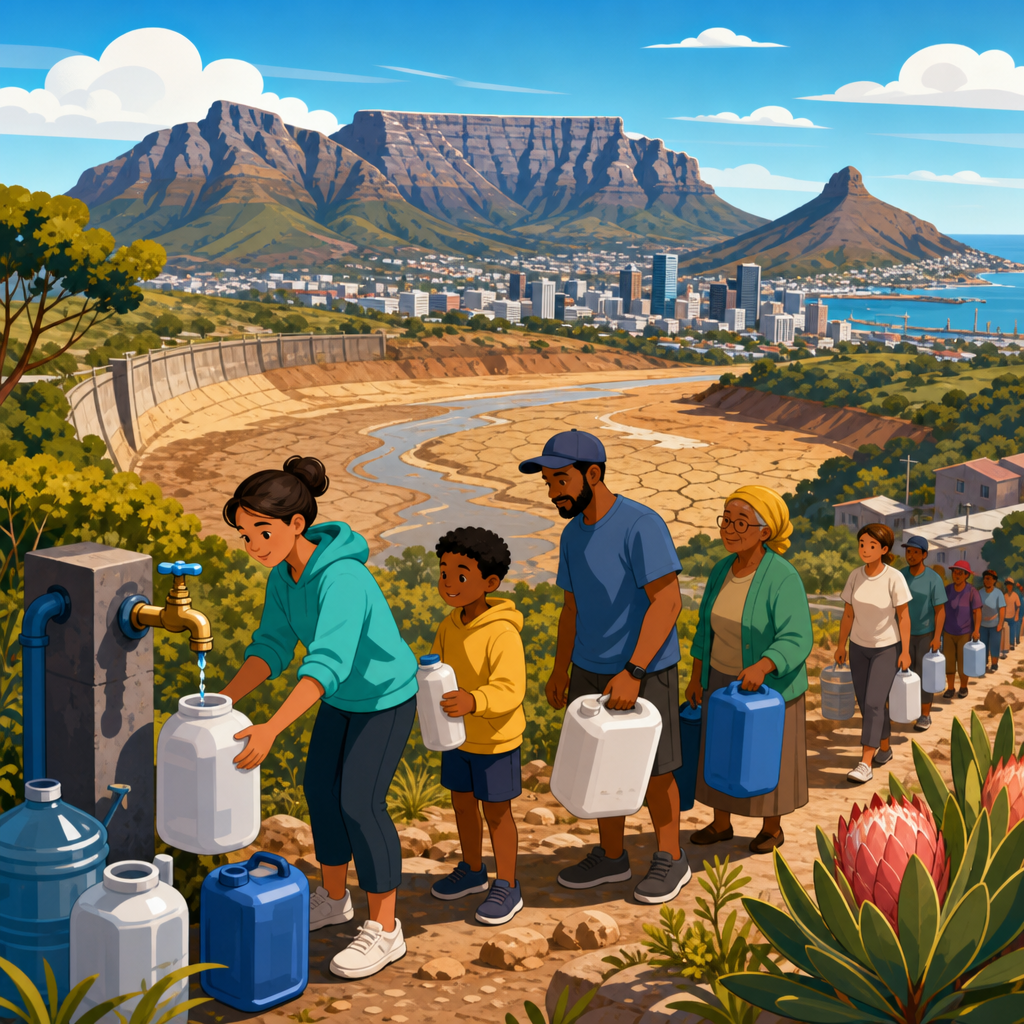
Cape Town’s Day Zero water crisis became one of the clearest modern examples of how drought, infrastructure stress, public policy, and household behavior can collide to threaten an entire city’s water supply. In simple terms, “Day Zero” was the projected date when municipal reservoir levels would fall so low that most taps would be turned off and residents would need to collect a daily water ration from distribution points. The phrase captured public attention because it translated a complex hydrological emergency into a concrete civic deadline. As a case study within floods and droughts, Cape Town matters far beyond South Africa: it shows how climate variability, rapid urban growth, unequal access to services, and delayed investment can turn a natural hazard into a near social disaster.
I have worked on drought communication and risk planning content for cities, and Cape Town remains the reference point practitioners return to because the city came frighteningly close to a municipal shutdown without ever fully crossing the line. From 2015 to 2018, an extreme multi-year drought sharply reduced inflows to the Western Cape Water Supply System, which depends heavily on six major dams including Theewaterskloof, Voëlvlei, Berg River, and Wemmershoek. When rainfall failed over successive winters, storage declined and restrictions intensified. Yet the story is not only about a drought. It is also a hub topic for understanding floods and droughts together, because both are water management crises shaped by timing, storage, land use, infrastructure design, and institutional preparedness. A city that runs short during dry years can still flood during intense storms if drainage, river corridors, and informal settlements are poorly protected.
That dual reality is why this article treats Day Zero not as an isolated headline, but as a central lesson in environmental disasters. Drought is a slow-onset hazard: reservoirs decline gradually, soils dry out, groundwater is stressed, and warning signs can be ignored because there is no single dramatic landfall. Floods are often the opposite: rapid, visible, and immediately destructive. Effective water resilience requires planning for both extremes at once. Cape Town demonstrates what happens when a city built around historically reliable winter rainfall meets persistent deficits. It also shows what can work: demand reduction, pressure management, emergency groundwater development, agricultural negotiation, and unusually strong public messaging. For readers exploring floods and droughts as a subtopic, this case study provides the core concepts, the timeline, the policy lessons, and the practical questions every community should ask before the next water emergency arrives.
What caused Cape Town’s Day Zero crisis?
The immediate cause of the Day Zero crisis was an exceptional drought between 2015 and 2017, capped by very poor winter rainfall in 2017, the city’s critical recharge season. Cape Town has a Mediterranean climate, which means most rain falls in winter, not summer. That seasonal dependence matters. If one wet season underperforms, dams can often recover the following year. If several do, storage can collapse quickly. By late 2017, dam levels had fallen to alarmingly low levels, and only a portion of remaining water was actually usable because sediment, intake design, and ecological reserve requirements make the bottom layers inaccessible. Theewaterskloof Dam, the largest component of the system, became the symbol of the crisis as satellite images and news photography revealed a shrinking reservoir bed.
Climate science did not say climate change “caused” the drought in a simplistic sense, but attribution studies found that warming likely increased the probability and severity of extreme dry conditions in the region. Higher temperatures raise evaporative demand, dry soils faster, and increase losses across the landscape. At the same time, Cape Town’s population had grown substantially, lifting baseline demand. Water planners were not operating blindly; they had conservation programs and augmentation plans. But the timing and scale of investment lagged behind risk. In practice, the system relied too heavily on surface reservoirs and assumed hydrological patterns that became less dependable. That is a common feature of both drought and flood disasters: infrastructure is usually designed using historical records, while the future shifts underneath those assumptions.
How close did Cape Town come to running out of water?
Cape Town came close enough that emergency collection logistics, police and military support discussions, and neighborhood distribution planning moved from contingency files into public debate. The city’s Day Zero threshold was tied to dam storage reaching around 13.5 percent, a level at which reticulation through the normal network would no longer be viable for most users. Even before that point, severe restrictions were imposed. Residents were limited to 50 liters per person per day at one stage, later tightened in practical communication to around that benchmark through intensive monitoring and public reporting. To put that in perspective, a conventional shower in many households can use more than that limit if not tightly controlled, and flushing older toilets several times a day can consume a substantial share on its own.
What prevented total shutdown was a combination of late 2017 and 2018 behavior change, some rainfall improvement, agricultural allocation adjustments, and emergency supply actions. Demand fell dramatically. The city reduced daily consumption from well over one billion liters a day in earlier years to roughly half that level during the peak response period. That reduction was extraordinary by international standards. It was achieved through tariff increases, strict restrictions, pressure management, leak repair, punitive enforcement for excessive users, and relentless public messaging. I still regard Cape Town’s communication campaign as one of the most effective urban demand-management efforts ever attempted, because it translated abstract scarcity into household routines: bucket flushing, two-minute showers, greywater reuse, and constant awareness of meter readings.
Why this drought case is also central to understanding floods
At first glance, a drought emergency may seem separate from floods, but the same urban systems determine vulnerability to both. Reservoir operations, catchment condition, drainage networks, wetlands, land zoning, and informal housing patterns shape whether water is stored safely or becomes destructive. In Cape Town and many other cities, communities on floodplains or in poorly drained informal settlements can face winter flood losses even while the wider region remains water insecure. This is not contradictory. A storm can overwhelm local drainage in a short burst, while annual totals remain below normal and reservoirs stay depleted. That distinction between weather events and water resource balance is essential for anyone studying floods and droughts comprehensively.
Drought and flood planning also compete politically for attention. During dry years, authorities prioritize supply augmentation, restrictions, and groundwater. After damaging storms, budgets shift toward culverts, stormwater maintenance, river management, and emergency shelter. Resilient cities do both. They protect recharge areas, maintain dams, diversify sources, preserve wetlands that slow runoff, and avoid development in high-risk corridors. The Cape Town case highlights this integrated principle: water security is not just about “more supply.” It is about managing variability across the full hydrological cycle. A city can survive rare deficits and rare deluges only if engineers, planners, emergency managers, and communities work from the same risk picture.
How the city responded: restrictions, infrastructure, and behavior change
The response combined emergency governance with highly visible consumer accountability. Level-based restrictions escalated over time, limiting outdoor irrigation, car washing, filling pools, and eventually many ordinary indoor uses. The city published usage maps and highlighted high-consuming households, a controversial but effective move that created social pressure. Pressure reduction in pipes lowered losses and curbed consumption without requiring every resident to make perfect decisions. Teams repaired leaks, accelerated groundwater projects into the Table Mountain Group Aquifer and Cape Flats Aquifer, expanded reuse and desalination planning, and renegotiated available allocations within the regional supply system.
One reason Cape Town’s response deserves close study is that it balanced short-term emergency steps with longer-term diversification, even if some projects arrived later than ideal. Temporary desalination plants were pursued, but desalination is expensive, energy-intensive, and slower to deploy at meaningful scale than many people assume. Groundwater offered faster marginal gains, but aquifers require careful monitoring to avoid saline intrusion, contamination, or over-abstraction. Water reuse can be highly reliable, especially for non-potable and eventually potable applications, yet public acceptance takes work. In my experience, the practical lesson is clear: the best emergency source is the one you permitted, financed, and tested before the crisis.
| Response measure | Purpose | Strength | Limitation |
|---|---|---|---|
| Water restrictions | Cut demand immediately | Fast to implement | Requires public compliance |
| Pressure management | Reduce leaks and consumption | System-wide savings | Can affect user convenience |
| Groundwater extraction | Add emergency supply | Useful diversification | Needs hydrogeological controls |
| Desalination | Create rainfall-independent supply | Climate-resilient source | High cost and energy use |
| Water reuse | Recover value from wastewater | Reliable local resource | Requires infrastructure and trust |
What households, businesses, and farms actually did
The public response was not symbolic. Households collected shower warm-up water in buckets, reused laundry water where safe, installed low-flow fixtures, stopped irrigating gardens, and monitored every liter. Restaurants changed service practices, hotels removed bath plugs and educated guests, and office buildings retrofitted fittings and checked for hidden leaks. Agriculture, especially in the Western Cape’s high-value fruit and wine sectors, faced difficult allocation cuts. Farmers shifted planting decisions, accepted lower yields in some areas, and invested in efficiency where capital allowed. The burden was not equal. Wealthier households could drill private boreholes or install storage tanks, while poorer residents often already lived far below average urban consumption and had little room to cut further.
That inequality is one of the most important lessons from Day Zero. A citywide average can hide radically different realities. In low-income settlements, people may share taps or toilets and already practice extreme water frugality. In affluent neighborhoods, ornamental gardens, pools, and larger properties make reduction both more possible and more politically contentious. Good drought policy therefore needs a fairness lens. Lifeline access, public health, and sanitation cannot be treated the same way as discretionary outdoor use. This same principle applies in floods: vulnerability is not distributed evenly, and adaptation that ignores social inequality will fail in practice even if it looks sound on paper.
Lessons for flood and drought resilience everywhere
Cape Town offers six durable lessons for any flood-and-drought hub page. First, track risk early using reservoir levels, streamflow, soil moisture, and seasonal forecasts, but communicate usable indicators to the public, not just technical dashboards. Second, diversify water sources before scarcity becomes acute; surface water alone is rarely enough in an era of climate volatility. Third, treat demand management as core infrastructure. Saving water through metering, pressure control, leak reduction, and efficient fixtures is often cheaper and faster than building new supply. Fourth, integrate land use with water planning. Wetlands, river buffers, and recharge zones reduce flood damage and support water security. Fifth, plan for equity. Emergency rules must protect basic needs and avoid shifting the heaviest burden onto those who already consume least. Sixth, rehearse crisis governance, because clear authority, transparent thresholds, and trusted messaging save time when conditions deteriorate.
These lessons generalize well. São Paulo’s 2014 to 2015 water crisis, California’s recurring droughts, Chennai’s 2019 shortage, and recurrent urban flooding in cities from Lagos to Jakarta all show the same pattern: hazards become disasters when exposure, weak planning, and unequal capacity amplify them. The most resilient cities invest in multiple barriers rather than one grand fix. They conserve water in normal years, maintain flood channels before storms, map vulnerable populations, protect catchments, and stress-test systems against compound shocks. Cape Town did not “solve” water risk forever, but it proved that decisive action can pull a city back from the brink. For readers navigating floods and droughts as a broader environmental disasters topic, that is the central takeaway: preparation matters most before a crisis is visible. Audit local water use, support resilient infrastructure, and press leaders to plan for both scarcity and excess now.
Frequently Asked Questions
What was Cape Town’s “Day Zero,” and why did it become such a defining global water crisis?
Cape Town’s “Day Zero” was the name given to the projected moment when the city’s dam levels would drop so low that the municipal water system could no longer supply most households through normal taps. Instead of continuous piped water, residents would have been required to collect a limited daily ration from designated distribution points. The term was powerful because it turned a highly technical issue involving reservoir capacity, rainfall deficits, infrastructure limits, and demand management into a simple and urgent public warning. It made the threat tangible: this was not just a drought in the abstract, but the possible temporary shutdown of urban water access for millions of people.
The crisis became globally significant because it showed how a major modern city could come close to exhausting its accessible water supply. Cape Town was not a small settlement with minimal infrastructure; it was a large, internationally known metropolitan area with established institutions, a complex economy, and a substantial public utility system. That reality challenged the common assumption that severe urban water shortages only occur in poorer or less developed places. Day Zero demonstrated that even relatively sophisticated cities can become vulnerable when prolonged drought combines with population growth, delayed infrastructure expansion, dependence on variable rainfall, and high per-capita water use.
It also became a defining case study because communication played such a central role. Officials used the phrase “Day Zero” to signal urgency and drive behavior change, and in many respects that strategy worked. Residents drastically reduced consumption, businesses adapted, and the city delayed the worst-case scenario. In that sense, the crisis was not only about hydrology and engineering; it was also about psychology, governance, and public cooperation. Cape Town showed that water crises are rarely caused by a single factor alone. They emerge when climate conditions, policy decisions, infrastructure constraints, and social behavior intersect in ways that leave very little margin for error.
What caused the Cape Town water crisis, and was drought the only reason the city got so close to running out of water?
Drought was the most visible trigger, but it was not the only cause. Cape Town experienced several years of exceptionally low rainfall, which sharply reduced inflows into the dam system that supplies most of the city’s water. Because the city depends heavily on surface water stored in reservoirs, poor rainy seasons directly translated into falling storage levels. When rainfall remains below normal over multiple years, reservoirs can decline faster than they recover, especially in a growing city with ongoing household, commercial, and institutional demand.
However, drought alone does not fully explain why the situation became so severe. The crisis was also shaped by structural and policy factors. One important issue was the degree of dependence on a relatively limited set of water sources. Cities with more diversified supply portfolios, such as groundwater, wastewater reuse, desalination, and stronger inter-basin transfers, may be more resilient when one source fails. Cape Town had some alternatives, but not enough at scale and speed to offset the decline in dam storage during the peak of the emergency. Expanding these alternatives typically requires years of planning, financing, permitting, and construction, which means resilience cannot be built overnight.
Population growth and rising demand also mattered. As urban populations increase, the pressure on water systems grows even in average rainfall years. If infrastructure expansion, new storage, and demand management do not keep pace, a city can become more exposed to climate variability. In Cape Town’s case, the crisis revealed the challenge of balancing long-term infrastructure planning with uncertain rainfall patterns and competing budget priorities. Water systems are expensive, and investments are often politically easier to delay until a visible emergency emerges.
There were also issues of institutional timing and risk perception. In many water systems around the world, authorities plan based on historical climate records, but prolonged drought events can exceed what planners once considered plausible. Cape Town’s experience suggested that climate variability, and potentially climate change, may be altering the assumptions on which cities have traditionally relied. So while drought was absolutely central, the near-failure of the system resulted from a combination of environmental stress, concentrated supply dependence, infrastructure constraints, demand pressures, and the difficulty of responding quickly enough once the crisis was already underway.
How did Cape Town avoid Day Zero, and what role did residents play in the city’s response?
Cape Town avoided Day Zero through an intense combination of emergency restrictions, public communication, behavioral change, and limited supply augmentation. One of the most important factors was the dramatic reduction in water consumption by residents and businesses. The city introduced strict usage limits, increased public reporting on dam levels, promoted conservation targets, and framed the crisis as a shared civic challenge. People responded by taking shorter showers, reusing greywater where possible, postponing non-essential washing, cutting outdoor irrigation, and fundamentally rethinking what “normal” daily water use looked like. This level of demand reduction was extraordinary and became one of the most discussed aspects of the crisis.
The city also used regulatory and pricing tools to reinforce the message. Restrictions on non-essential uses were tightened, and higher-volume users faced greater pressure to cut back. Public messaging was highly visible and often blunt, which helped keep the threat in the public eye. While the communication strategy sometimes generated anxiety and criticism, it also created a clear sense that every liter mattered. In water emergencies, clarity can be more effective than vague reassurance, and Cape Town’s authorities understood that public compliance would be essential if the system was to hold long enough for seasonal rains and supplementary measures to help.
At the same time, authorities pursued additional water sources, including groundwater projects, temporary desalination efforts, and water reuse initiatives. These projects varied in scale and speed, and many could not fully solve the immediate shortfall. Still, they formed part of the broader emergency response and signaled that supply-side interventions were underway. Improved agricultural allocation management in the wider regional system also contributed to the city’s ability to navigate the worst phase of the crisis, though trade-offs across sectors were difficult and politically sensitive.
Residents played a decisive role because the crisis could not have been managed by infrastructure alone. Household behavior became, in effect, a frontline water policy tool. The city’s success in postponing and eventually avoiding Day Zero depended on millions of individual decisions repeated every day. That is one of the clearest lessons from Cape Town: in a severe urban water emergency, public cooperation is not a side issue. It can be the difference between system collapse and temporary stabilization. The response showed that demand management is not merely about asking people to be careful; under the right conditions, it can become a powerful, measurable, city-scale intervention.
What were the social, economic, and political impacts of the Day Zero crisis on Cape Town?
The social impacts were immediate and uneven. Although the crisis affected the entire city, it did not affect every household in the same way. Wealthier residents often had greater capacity to adapt by installing storage tanks, drilling private boreholes where permitted, buying bottled water, or purchasing water-efficient appliances. Lower-income communities, by contrast, often had less flexibility and were already accustomed to tighter constraints on water access. This exposed a central reality of water crises: they tend to magnify existing inequalities. A city may face a shared threat, but the burden of adaptation is rarely distributed equally.
Economically, the crisis disrupted households, businesses, tourism, agriculture, and investor confidence. Businesses that depend heavily on water, such as hospitality, food service, manufacturing, and agriculture, had to redesign operations quickly. Tourism messaging became especially delicate because Cape Town is a major international destination. Authorities needed to persuade visitors to conserve water without triggering the perception that the city was unvisitable. Meanwhile, farmers in the broader region faced severe allocation cuts, illustrating how urban water security is deeply connected to surrounding agricultural systems and regional water governance. The crisis was not only a municipal issue; it rippled across the wider economy.
Politically, Day Zero intensified scrutiny of decision-making, preparedness, and accountability. Debates emerged over whether officials acted early enough, whether infrastructure diversification should have happened sooner, and how responsibility should be divided among local, provincial, and national institutions. Water governance often spans multiple layers of authority, and crises can expose coordination problems very quickly. Public trust becomes extremely important in this environment. If people believe leaders are minimizing risks, shifting blame, or communicating inconsistently, compliance can weaken. Cape Town’s case showed both the strengths and tensions of crisis governance: strong messaging can motivate action, but it can also raise public fear and political conflict.
In the longer term, the crisis changed public consciousness. Water became more visible as a finite and managed resource rather than an invisible service that simply appears when a tap is opened. That cultural shift may be one of the most lasting consequences of Day Zero. When a city comes close to widespread tap shutdowns, water policy stops being a niche technical topic and becomes part of everyday civic awareness. For policymakers, urban planners, and citizens alike, the crisis underscored that water security is tied not only to engineering capacity, but also to equity, governance, trust, and the ability of institutions to prepare before scarcity becomes an emergency.
What lessons can other cities learn from Cape Town’s Day Zero crisis about drought resilience and water management?
The first major lesson is that cities should not wait for a crisis to diversify their water supply. Heavy dependence on a single source type, especially rainfall-fed surface reservoirs, creates vulnerability when drought lasts longer than expected. A more resilient


