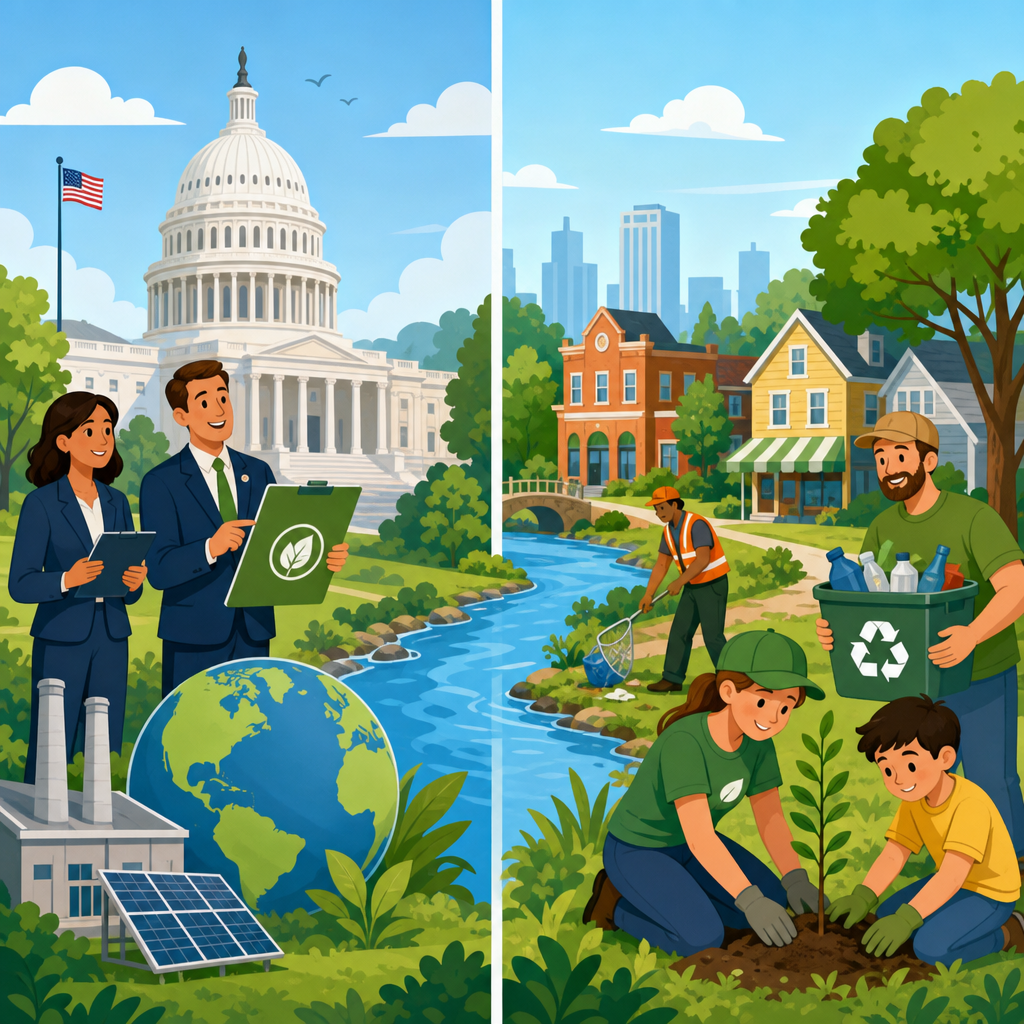
Environmental regulations shape how countries protect air, water, land, wildlife, and public health, but many readers struggle to understand the differences between federal and local environmental laws and how those differences play out across national systems. In practice, federal environmental laws are rules created by a national government, while local environmental laws include state, provincial, regional, municipal, and county measures that apply within smaller jurisdictions. The distinction matters because environmental harm rarely stays inside one boundary: a factory discharge can cross rivers, vehicle pollution can drift across cities, and land-use decisions in one district can increase flood risk downstream. After years of working with compliance teams, planning documents, and cross-border environmental reviews, I have seen that the sharpest legal conflicts usually come from misunderstanding who has authority, who enforces standards, and which rule controls when laws overlap.
This hub article explains those differences in plain terms while situating them within environmental regulations by country, since every legal system allocates power differently. In the United States, Congress sets nationwide baselines through statutes such as the Clean Air Act and Clean Water Act, while states and cities issue permits, zoning rules, and stricter requirements in some cases. In Canada, federal and provincial powers are divided constitutionally, producing a more negotiated model. In Germany, national law implements many European Union directives, but Länder and municipalities still shape permitting and land use. In India, central legislation establishes broad environmental obligations, yet state pollution control boards and local bodies carry much of the implementation burden. Understanding this layered structure helps businesses plan projects, helps citizens know where to challenge harmful decisions, and helps researchers compare environmental governance across countries with more precision.
At a practical level, the difference between federal and local environmental laws can be reduced to four questions. Who writes the rule? Who enforces it? What activities does it cover? What happens when one level of government wants tougher or weaker protection than another? Those questions determine whether a housing project needs only local stormwater approval or also a national impact review, whether a factory follows one emissions threshold or several, and whether community concerns about noise, wetlands, or hazardous waste can be handled at city hall or must go through a national regulator. Because this article serves as a hub under Environmental Policy & Law, it also provides a framework for comparing environmental regulations by country, identifying where readers should look next when studying permitting, climate policy, waste management, biodiversity protection, and environmental justice in specific jurisdictions.
What federal environmental laws do
Federal environmental laws establish national standards intended to create a minimum floor of protection across an entire country. They are usually designed to address problems that are interstate, cross-provincial, or plainly national in significance, such as ambient air quality, hazardous substances, navigable waters, endangered species, offshore resources, major infrastructure, and cross-border waste movement. In countries with constitutional divisions of power, federal laws also serve a market function: they reduce the compliance confusion that would arise if every locality created entirely separate definitions for pollutants, reporting methods, cleanup thresholds, or product restrictions. That uniformity is one reason national environmental laws often include technical schedules, formal permitting categories, standardized monitoring methods, and civil or criminal penalties.
The United States offers a clear example. The Environmental Protection Agency administers federal statutes, but many obligations are delegated to states. The Clean Air Act sets National Ambient Air Quality Standards, regulates hazardous air pollutants, and requires state implementation plans. The Clean Water Act creates the National Pollutant Discharge Elimination System for point-source discharges. The Resource Conservation and Recovery Act governs hazardous waste handling from generation to disposal. The Comprehensive Environmental Response, Compensation, and Liability Act addresses contaminated site cleanup. These statutes define national expectations, yet they rely heavily on state agencies for day-to-day permits, inspections, and enforcement actions. That mixed structure is common in environmental regulations by country: national law often sets the framework, while subnational bodies make it real.
Federal law also tends to govern international commitments. Climate targets under the Paris Agreement, transboundary movement rules under the Basel Convention, ozone obligations under the Montreal Protocol, and biodiversity commitments under the Convention on Biological Diversity are typically translated into national legislation before being implemented locally. Even where local governments are ambitious, they cannot usually negotiate treaties or regulate customs, shipping lanes, offshore drilling, or national product standards. That is why federal environmental laws remain the backbone of national environmental governance, especially for emissions inventories, chemical registration, national protected areas, and large-scale impact assessment.
What local environmental laws do
Local environmental laws operate closer to the ground. They regulate where development can occur, how stormwater is managed on-site, what hours noisy operations may run, how trees are protected, how waste is collected, how buildings meet energy codes, and how communities respond to place-specific risks such as wildfire, flooding, coastal erosion, heat islands, and traffic exposure. In my experience, local rules are often the laws people encounter first because they affect building permits, site plans, landscaping approvals, floodplain setbacks, recycling rules, and neighborhood air concerns. They may not have the reach of federal law, but they often determine the visible environmental outcome.
Municipal zoning is a good example. A national government may allow industrial activity generally, but a city can confine heavy industry to designated zones, impose buffers near schools, require green infrastructure, limit impervious surface coverage, or mandate tree replacement. Counties may adopt groundwater protection overlays. Regions may establish watershed rules stricter than the national minimum. States or provinces may set renewable portfolio standards, ban certain single-use plastics, require environmental justice reviews, or create cleanup programs tougher than federal baselines. California is frequently cited because its vehicle emissions authority, cap-and-trade program, Proposition 65 warnings, and coastal permitting system show how subnational governments can drive environmental policy beyond national floors.
Local regulation also tends to be more adaptive. When repeated flooding hits a district, a municipality can revise drainage ordinances faster than a national legislature can amend a statute. When residents document urban heat stress, a city can expand cool-roof standards or urban forestry targets. The tradeoff is variation. A company operating in ten cities may face ten different construction waste rules, idling restrictions, noise standards, and tree ordinances. For communities, that flexibility can be beneficial because local environmental laws reflect geography and land use. For regulated entities, it requires careful jurisdiction-by-jurisdiction compliance tracking.
How authority is divided in different countries
Environmental regulations by country differ because constitutions, administrative traditions, and court decisions divide power differently. In federal systems, authority is shared between national and subnational governments. In more unitary systems, local governments may still regulate environmental issues, but their powers are usually delegated by national law and can be narrowed or expanded centrally. This distinction affects how conflicts are resolved, how permits are issued, and how fast standards change.
| Country | Federal or national role | Local or subnational role | Typical friction point |
|---|---|---|---|
| United States | Sets national baselines under statutes like the Clean Air Act | States issue many permits; cities control zoning and local nuisances | Preemption and stricter state standards |
| Canada | Handles fisheries, toxic substances, impact assessment, criminal law powers | Provinces regulate resources, permitting, and land use | Overlap in project reviews and resource development |
| Germany | National law and EU directives establish core standards | Länder administer permits; municipalities shape planning | Balancing uniform standards with regional planning autonomy |
| India | Central acts and national boards set broad frameworks | State pollution control boards enforce; urban local bodies manage waste and land issues | Enforcement capacity and uneven implementation |
| Japan | National ministries issue framework laws and standards | Prefectures and municipalities adopt detailed ordinances | Local response to industrial siting and public health risks |
Consider Canada. The Constitution assigns provinces major control over natural resources, property, and local matters, yet the federal government regulates fisheries, navigation, toxic substances, and matters of national concern. A mining project may therefore require both provincial approvals and federal review, especially if fish habitat or Indigenous rights are affected. Germany shows another pattern: many environmental obligations arise from European directives, are transposed into federal law, and are then administered by Länder authorities. India illustrates the implementation challenge. The Environment Protection Act, Air Act, and Water Act provide national structure, but state pollution control boards carry substantial enforcement responsibility, leading to uneven outcomes depending on staffing, monitoring, and political capacity.
Preemption, conflict, and stricter standards
One of the most important differences between federal and local environmental laws is what happens when they do not align. In many systems, a national law can override a conflicting local rule under doctrines commonly described as preemption, supremacy, or inconsistency. The details vary by country, but the practical question is simple: can a local government go further than the national baseline, or has the national government occupied the field completely? Lawyers and compliance officers spend significant time on this issue because it changes project design, product labeling, emissions control strategy, and litigation risk.
In the United States, local governments generally cannot authorize what federal law prohibits, but they may sometimes impose stricter requirements if federal law leaves room. State authority is often broader than municipal authority because cities derive power from state law. California’s ability to seek waivers for stricter vehicle emissions standards has had nationwide effects, influencing automaker fleets beyond the state. By contrast, some local pesticide, plastic, or energy rules are struck down when state law expressly preempts municipal action. In other countries, local flexibility may be narrower. A unitary system may let municipalities administer environmental programs but not deviate materially from national standards unless enabling legislation allows it.
The safest working assumption is that environmental compliance is additive unless a law clearly says otherwise. If a factory must meet a national wastewater limit, a provincial permit condition, and a municipal sewer-use bylaw, it usually must satisfy all three. The strictest applicable rule often governs in practice, especially where one standard controls discharge quality and another controls receiving infrastructure or local nuisance impacts. For communities, this layered model can be powerful because it prevents a race to the bottom. For operators, it means legal mapping at project inception is not optional; it is the core of risk management.
Enforcement, permitting, and real-world compliance
The most visible difference between federal and local environmental laws appears during permitting and enforcement. Federal agencies usually focus on framework rules, major permits, national reporting, cross-border matters, and high-impact violations. Local or subnational authorities usually review site plans, operating conditions, inspections, odor complaints, waste storage, construction runoff, and land disturbance. When I audit facilities, the recurring problem is not ignorance of headline national statutes; it is failure to account for local permit conditions that are more specific than the statute itself. A company may know the national emissions threshold yet overlook a municipal dust-control requirement tied to truck routes, wheel washing, and work hours.
Environmental impact assessment shows how the layers interact. A national government may require review for pipelines, ports, highways, dams, or major industrial plants, while local authorities require separate approvals for access roads, wetlands buffers, traffic management, and stormwater detention. Public participation can also differ sharply. National reviews may accept broad written comments, while local hearings draw direct testimony from nearby residents who understand flood patterns, odors, school traffic, or fishing access better than distant agencies. Effective compliance therefore depends on integrating legal, technical, and community information early rather than treating local law as a minor afterthought.
Good practice is consistent across countries. Build a jurisdiction matrix. Identify every applicable statute, ordinance, permit, and technical standard. Confirm reporting deadlines, monitoring methods, and agency contacts. Check whether national standards are minimum baselines or exclusive rules. Review enforcement history, because agencies tend to focus on recurring local harms such as illegal dumping, open burning, sediment runoff, and diesel idling. Businesses that do this early avoid costly redesign. Citizens and advocacy groups can use the same framework to find the right forum, whether that means a national pollution complaint, a provincial permit appeal, or a city zoning hearing.
Why this distinction matters for policy and future research
Understanding the differences between federal and local environmental laws improves legal analysis, compliance strategy, and public advocacy because it shows where change is actually possible. Federal law is essential for setting nationwide floors, coordinating treaty obligations, and controlling harms that cross borders. Local law is essential for tailoring protection to geography, land use, infrastructure, and community health patterns. The strongest environmental systems use both: national consistency to prevent weak baselines and local flexibility to solve real place-based problems.
As you explore environmental regulations by country, use this article as the hub for deeper comparison. Look next at country-specific permitting systems, climate regulations, waste laws, biodiversity protection, environmental justice measures, and enforcement models. The key takeaway is straightforward: never ask only what the national law says. Ask which level writes the rule, which level enforces it, whether stricter local standards are allowed, and how overlapping permits work in practice. That approach produces better decisions, better compliance, and better environmental outcomes. If you are building a research map or planning a project, start by listing the federal rules, then layer in state, provincial, and municipal requirements before any major step.
Frequently Asked Questions
1. What is the main difference between federal and local environmental laws?
The main difference is jurisdiction. Federal environmental laws are created by a national government and apply across the entire country, setting broad standards for issues such as air quality, water pollution, hazardous waste, wildlife protection, climate policy, and public health. Local environmental laws, by contrast, are adopted by smaller governing bodies such as states, provinces, regions, counties, or municipalities, and they apply only within those boundaries. In many systems, local laws are used to address regional environmental conditions, community priorities, land-use concerns, and enforcement needs that are not identical from one place to another.
Another important difference is purpose and scale. Federal laws often establish a nationwide framework, including minimum standards, permitting systems, compliance obligations, and enforcement powers. Local laws usually build on that framework by tailoring rules to local geography, economy, and environmental risk. For example, a national law may regulate water pollution generally, while a state or city may add stricter stormwater controls, wetland buffer requirements, or zoning restrictions near drinking water sources. In practical terms, federal laws create consistency across the country, while local laws provide flexibility and more targeted protections where local conditions demand them.
2. Can local environmental laws be stricter than federal environmental laws?
Yes, in many countries and legal systems, local environmental laws can be stricter than federal laws, but they usually cannot be weaker where federal law sets a mandatory minimum standard. This is one of the most important principles for understanding how environmental regulation works. Federal law often acts as a baseline, meaning it establishes the minimum level of protection that all jurisdictions must meet. States, provinces, or municipalities may then adopt more demanding requirements if their legal system allows it and if those rules do not directly conflict with national law.
This happens often in areas where local governments face unique environmental pressures. A coastal region may impose stronger shoreline protections, a drought-prone area may adopt tighter water-use restrictions, and a city with severe air pollution may enforce emissions rules that go beyond federal requirements. However, whether stricter local rules are allowed depends on the structure of the country’s legal system and the wording of the federal statute. Some federal laws expressly allow local innovation, while others occupy the field so completely that local governments have limited room to regulate. As a result, anyone comparing environmental rules should always look at both the national standard and any additional state, provincial, or municipal requirements that may apply.
3. How do federal and local environmental laws work together in practice?
In practice, federal and local environmental laws usually operate as layered systems rather than isolated sets of rules. The federal government commonly sets nationwide goals, technical standards, enforcement mechanisms, and broad regulatory categories. Local governments then implement, administer, supplement, or refine those rules within their own jurisdictions. This relationship can include shared enforcement, delegated permitting authority, regional planning, inspections, reporting requirements, and locally tailored compliance programs.
For example, a federal government may pass a law requiring protection of rivers and lakes from industrial discharge. A state or provincial government may then run the permitting program, establish water-quality criteria for specific watersheds, and monitor compliance. A city or county may add ordinances addressing runoff from construction sites, sewage infrastructure maintenance, floodplain development, or local conservation zones. In that scenario, all levels of law are working together: the federal level provides the national framework, the regional level manages implementation, and the municipal level addresses site-specific impacts on the ground.
This cooperative structure is one reason environmental law can seem complex. A business, landowner, developer, or community group may need to comply with multiple layers of regulation at the same time. The benefit, however, is that the system can combine national consistency with local responsiveness. Federal law helps ensure that core protections do not disappear from one region to another, while local law helps make those protections meaningful in real-world settings where environmental risks differ widely.
4. What happens if federal and local environmental laws conflict?
When federal and local environmental laws conflict, the outcome usually depends on the country’s constitutional structure and the legal doctrine that governs the relationship between national and subnational laws. In many systems, federal law has supremacy when there is a direct conflict. That means if a local rule makes it impossible to comply with federal law, or if the federal government has clearly intended to fully control a particular area of regulation, the local rule may be invalid or unenforceable to the extent of the conflict.
That said, not every difference counts as a legal conflict. A local law is often allowed to stand if it simply adds stricter protections without frustrating the purpose of the federal statute. Courts and regulators typically look at several questions: Did the federal law establish a minimum standard or a complete system? Did the national legislature intend to leave room for local action? Does the local rule complement the federal objective, or does it interfere with it? The answers determine whether both laws can operate together or whether federal law overrides the local one.
Because these issues can be highly technical, conflict questions often arise in permitting, land use, emissions standards, waste disposal, resource extraction, and species protection. For businesses and property owners, the safest approach is not to assume that one level of law automatically replaces another. Instead, it is important to review all applicable rules carefully and determine whether the local requirement supplements federal law or is preempted by it. In many cases, legal advice or regulatory guidance is necessary to resolve the issue correctly.
5. Why is it important for people and businesses to understand both federal and local environmental laws?
It is important because environmental compliance rarely depends on just one set of rules. Individuals, companies, developers, farmers, manufacturers, and public agencies often operate under overlapping legal obligations. A federal law may govern broad issues such as emissions, water discharge, endangered species, or hazardous materials, while local laws may regulate zoning, noise, waste collection, tree removal, erosion control, building setbacks, water conservation, or site remediation. Missing even one local requirement can delay projects, increase costs, trigger fines, or create liability.
Understanding both levels of law is also important for strategic planning and risk management. Businesses deciding where to build or expand need to know not only the national environmental framework but also whether a particular state, province, or city has stricter standards. Residents and community groups benefit from the same knowledge because local environmental protections often have the most visible effect on daily life, including air quality, drinking water safety, land development patterns, recycling programs, green space preservation, and flood prevention. In other words, federal law may shape the national policy direction, but local law often determines how environmental protection is experienced in a specific community.
Finally, understanding the difference helps people participate more effectively in public decision-making. Environmental governance often involves permits, public hearings, agency reviews, local council actions, and national regulatory processes. Knowing whether an issue is controlled primarily at the federal level or the local level helps citizens, advocates, and businesses direct their efforts to the right authority. That makes it easier to challenge violations, support stronger protections, respond to development proposals, and stay compliant in a legal landscape where national standards and local implementation frequently work side by side.