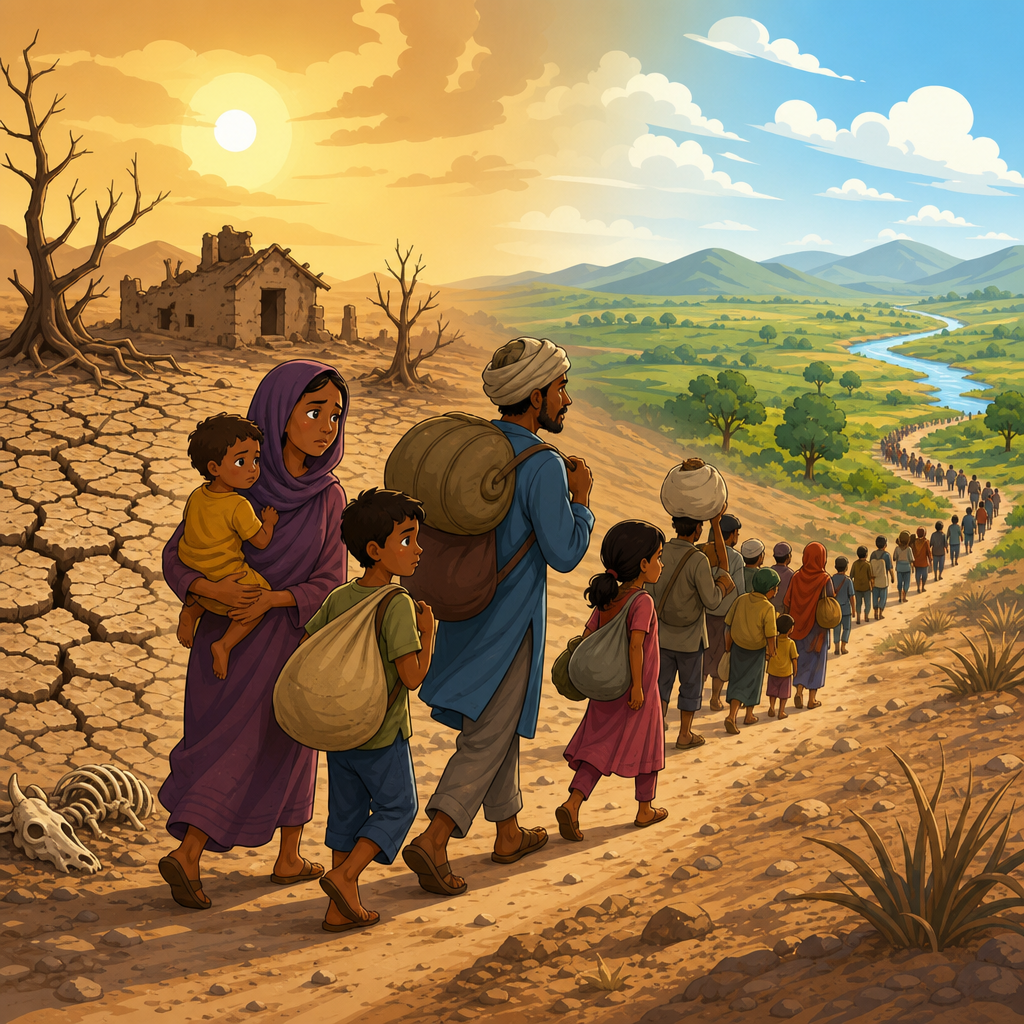
Famous droughts in history reveal how a shortage of rainfall can become a full-spectrum disaster, affecting food, water, health, migration, energy, ecosystems, and political stability at the same time. In environmental science, a drought is not simply “dry weather.” Meteorologists define meteorological drought as below-normal precipitation over a period of months or years. Hydrological drought refers to low river flow, reservoir levels, and groundwater recharge. Agricultural drought describes soil moisture deficits that damage crops and pasture. Socioeconomic drought emerges when those physical shortages disrupt daily life, markets, and public services. I have worked on disaster content and water-risk analysis long enough to see that the most damaging droughts are rarely sudden. They build quietly, then expose every weak point in a society.
This topic matters because floods and droughts are linked, not opposite stories. Both arise from variability in the water cycle, both are intensified by land-use decisions, and both create cascading losses when planning is weak. A river basin can swing from prolonged drought to destructive flooding when hard, dry soil cannot absorb intense rain. Communities therefore need one integrated approach to floods and droughts: monitoring, storage, drainage, land management, resilient infrastructure, and clear emergency communication. As a hub for the wider floods and droughts subtopic, this article explains major historical droughts, the conditions that made them catastrophic, and the lessons that now guide risk reduction, climate adaptation, and water policy. It also points readers toward the key questions every drought resource should answer: what caused the event, who was affected, how severe was it, and what changed afterward.
What causes drought, and why some droughts become historic disasters
Drought begins with persistent precipitation deficits, but historic drought disasters usually involve more than missing rain. Large-scale climate patterns such as El Niño-Southern Oscillation, shifts in sea surface temperatures, monsoon failure, and persistent high-pressure systems can suppress rainfall across huge regions. Heat then accelerates evaporation from soils, rivers, and reservoirs, while plants transpire more water. If groundwater is already overdrawn, forests have been cleared, or irrigation is inefficient, the same rainfall shortfall becomes far more destructive. In practice, drought severity is measured with tools such as the Standardized Precipitation Index, Palmer Drought Severity Index, soil-moisture observations, snowpack measurements, and reservoir storage data. No single metric is enough; planners need several indicators because drought hits different sectors at different speeds.
Human decisions often turn a climatic event into a historical turning point. When farmers plow fragile grasslands, cities depend on one reservoir, or governments delay relief, exposure rises sharply. I have repeatedly seen organizations focus on rainfall totals while ignoring vulnerability, which is a mistake. A one-year rainfall deficit in a diversified economy with strong water governance may remain manageable. The same deficit in a region dependent on rain-fed agriculture, weak transport links, and limited health services can trigger famine, migration, and conflict. Historic droughts matter because they show that the real hazard is not only aridity; it is aridity interacting with poor preparation. That is the core lesson connecting drought case studies across centuries.
The Dust Bowl, the Sahel, and other defining droughts
The 1930s Dust Bowl in the United States remains one of the most studied drought disasters because it demonstrated how climate stress and land misuse can reinforce each other. Severe drought hit the Great Plains after years of deep plowing that removed native grasses whose roots had stabilized topsoil. High winds lifted exposed soil into dust storms that darkened skies, buried fences, damaged lungs, and devastated farms. Millions of acres were affected across Texas, Oklahoma, Kansas, Colorado, and New Mexico. Crop yields collapsed, livestock died, and many families migrated west. The lasting lesson was concrete: soil conservation is drought policy. Contour plowing, shelterbelts, cover crops, and federal conservation programs emerged not as abstract environmental measures, but as direct disaster-reduction tools.
The African Sahel droughts of the late 1960s through the 1980s showed how prolonged rainfall decline can become a regional humanitarian crisis. Countries including Mali, Niger, Chad, Burkina Faso, and Mauritania faced repeated crop failures, pasture loss, livestock deaths, malnutrition, and displacement. The causes were complex: ocean-atmosphere variability influenced monsoon rainfall, while poverty, limited infrastructure, marginal land use, and weak governance intensified losses. Images of famine shaped global understanding of drought risk, but the deeper lesson was that relief alone is not enough. Long-term resilience requires drought-tolerant crops, livestock mobility, local grain storage, weather services, and policies that support pastoral systems rather than restrict them during stress.
Australia’s Millennium Drought, roughly from the late 1990s to 2010 in southeastern regions, became a landmark modern case because it affected advanced urban and agricultural systems simultaneously. Reservoir levels in Melbourne, Sydney, Adelaide, and other cities fell sharply. The Murray-Darling Basin, a major agricultural zone, experienced severe water scarcity that exposed the limits of overallocated river systems. In response, Australia expanded desalination, wastewater recycling, water trading reforms, leakage control, urban conservation campaigns, and basin-wide planning. Not every reform was simple or universally accepted, but the case proved that wealthy countries are not immune to drought disruption and that transparent allocation rules matter when multiple users compete for limited supply.
India has experienced many major droughts, including the 1876–1878 and 1899 famines under colonial rule and more recent drought years affecting Maharashtra, Karnataka, and other states. Historical analysis shows that failed monsoons were critical, yet mortality was magnified by administrative failures, inadequate relief, and economic systems that did not protect vulnerable households. Modern India has improved forecasting, reservoir operations, irrigation networks, and employment support, but water stress remains severe in many districts because groundwater depletion, heat extremes, and urban demand continue to grow. China’s 1928–1930 northern drought and the 2011 East African drought further underline the same pattern: when rainfall failure meets poverty, conflict, weak logistics, or degraded land, drought becomes lethal.
| Drought event | Region and period | Main impacts | Key lesson |
|---|---|---|---|
| Dust Bowl | U.S. Great Plains, 1930s | Crop collapse, dust storms, migration | Soil conservation reduces drought damage |
| Sahel droughts | West and Central Africa, 1968–1980s | Famine, livestock loss, displacement | Resilience must support local livelihoods |
| Millennium Drought | Southeastern Australia, late 1990s–2010 | Urban shortages, basin stress, farm losses | Allocation reform and reuse are essential |
| Indian famine droughts | South Asia, 1876–1878 and 1899 | Mass mortality, crop failure | Governance failures can turn drought into catastrophe |
| East Africa drought | Horn of Africa, 2011 | Food insecurity, malnutrition, migration | Early warning must trigger early action |
How drought reshaped agriculture, cities, and public health
Agriculture is usually the first sector hit because crops depend on soil moisture at specific growth stages. Maize pollination, wheat grain filling, and rice flowering are all highly sensitive to water stress. During major droughts, farmers often face a sequence of losses: poor germination, stunted growth, lower yields, reduced fodder, higher feed costs, and then herd liquidation. In the Dust Bowl and Sahel alike, livestock losses were not secondary details; they stripped households of wealth, traction, milk, and future income. Modern drought planning now emphasizes drought-tolerant seed varieties, deficit irrigation, mulching, conservation tillage, precision agriculture, and crop insurance. These measures do not eliminate risk, but they reduce the chance that one failed season destroys a farming system.
Cities experience drought differently but no less seriously. Reservoir depletion can force restrictions on irrigation, car washing, industrial use, and in severe cases household consumption. Groundwater-dependent cities may continue pumping during a dry spell, only to discover later that aquifers recover slowly and land subsidence has accelerated. During Australia’s Millennium Drought, public campaigns normalized shorter showers, rainwater tanks, and water-efficient appliances. Cape Town’s 2015–2018 crisis, though outside the main historical list, became a textbook urban example of communicating a possible “Day Zero” while expanding emergency supply and demand management. The lesson is practical: urban drought resilience depends on diversified supply, metering, leakage control, reuse, and public trust before a crisis peaks.
Public health impacts are often underestimated. Drought reduces water quality by concentrating pollutants in rivers and reservoirs, raising treatment challenges. It can increase respiratory illness through dust, worsen heat stress, and contribute to malnutrition where food systems fail. Hygiene may decline when households ration water, and mental health burdens rise as livelihoods collapse. In the Horn of Africa in 2011, severe food insecurity and displacement intensified disease risk among already vulnerable populations. Effective drought response therefore includes nutrition surveillance, mobile health services, water trucking standards, sanitation support, and protection for women and children, who often bear the heaviest burden of collecting water and managing household scarcity.
What drought taught us about governance, technology, and climate risk
The most important lesson from famous droughts is that preparedness must be institutional, not improvised. Governments that wait for visible crop failure are already late. Good drought governance starts with monitoring networks for rainfall, streamflow, snowpack, soil moisture, and groundwater. It then connects those observations to predefined triggers for action, such as livestock support, irrigation cuts, cash transfers, reservoir releases, or emergency imports. The United Nations Convention to Combat Desertification, the World Meteorological Organization, and national drought plans have all pushed this shift from crisis response to risk management. In practice, successful systems combine local observations with satellite data from platforms such as NASA GRACE for groundwater anomalies and MODIS for vegetation stress.
Technology helps, but technology without governance has limits. Desalination can protect coastal cities, yet it is energy intensive and expensive. Large dams increase storage, but they can fail if inflows decline over many years or if sedimentation reduces capacity. Groundwater buffers drought well, but only if abstraction stays within recharge limits. Water markets can move supply toward high-value uses, as seen in Australia, but they require oversight to prevent ecological damage and inequity. I have seen planners assume that one infrastructure project solves drought risk; history says otherwise. The durable gains come from portfolios: storage, efficiency, watershed restoration, pricing reform, contingency planning, and institutions willing to make unpopular decisions early.
Climate change is altering drought risk in ways history makes easier to understand. Rising temperatures intensify evaporative demand, meaning a modest rainfall deficit can now produce much more severe agricultural and hydrological stress than in the past. In snow-fed basins, warmer winters reduce snowpack and shift runoff earlier, shrinking summer water availability. At the same time, heavier downpours can increase flood risk even in drought-prone regions, because climate volatility is rising. That is why floods and droughts belong in one strategy. Healthy wetlands, permeable soils, reforested catchments, managed aquifer recharge, and smarter reservoir rules can reduce both extremes. Readers exploring this subtopic further should connect drought history with floodplain management, stormwater design, famine prevention, and climate adaptation planning.
The clearest takeaway from famous droughts in history is that drought is never only a weather story. The Dust Bowl taught that soil can be lost as quickly as rain. The Sahel showed that livelihoods, mobility, and governance determine whether aridity becomes famine. Australia proved that even advanced economies need water reform, reuse, and public cooperation. India and East Africa demonstrated that early warning has little value unless institutions act on it fast. Across every case, the same pattern appears: hazard matters, but vulnerability decides the scale of the disaster.
For anyone building knowledge in the floods and droughts field, this hub should anchor your understanding of how water extremes connect. Drought can raise food prices, drain reservoirs, and force migration; floods can destroy the same communities when rain finally returns. The strongest protection comes from integrated planning that links watershed health, agricultural resilience, urban water security, public health, and emergency management. If you are mapping environmental disasters, use these historical droughts as benchmarks, then explore the related topics of major floods, river basin management, water conservation, and climate resilience to build a complete picture of risk.
Frequently Asked Questions
What makes a drought historically significant rather than just a period of dry weather?
A historically significant drought is more than a few rainless months. It becomes important in history when prolonged precipitation deficits trigger cascading effects across water systems, agriculture, public health, ecosystems, energy production, migration, and political stability. In environmental science, drought is understood in several layers. Meteorological drought begins with below-normal rainfall. Hydrological drought follows when rivers, reservoirs, lakes, and groundwater supplies fall. Agricultural drought appears when soil moisture becomes too low to support crops and grazing. When all of these overlap over long periods, societies can experience crop failures, livestock losses, food inflation, famine risk, sanitation problems, wildfire, ecosystem collapse, and large-scale displacement.
What makes famous droughts stand out is usually the scale, duration, and consequences. Some lasted for years and affected entire regions or continents. Others exposed weaknesses in land management, irrigation systems, governance, or emergency response. A drought enters the historical record when it changes how people live, farm, govern, or prepare for risk. In other words, the event is remembered not only because it was dry, but because it revealed how dependent societies are on stable water supplies and how quickly that stability can unravel.
Why is the Dust Bowl often cited as one of history’s most important droughts?
The Dust Bowl of the 1930s in the United States is one of the clearest examples of drought turning into a human and ecological disaster. Severe drought struck the Great Plains, but the crisis was made much worse by unsustainable farming practices. Large areas of native grassland had been plowed under, leaving bare soil exposed. When the rains failed and strong winds arrived, massive dust storms carried away topsoil that had taken centuries to form. Farms became unproductive, crops failed, livestock suffered, and families lost livelihoods on a huge scale.
The Dust Bowl matters historically because it taught a powerful lesson: drought impacts are shaped not just by weather, but by how people manage land. It showed that poor soil conservation can convert climate stress into catastrophe. It also led to major policy and scientific responses, including erosion control, contour plowing, shelterbelts, crop rotation, and federal soil conservation programs. The broader lesson was that resilience requires working with ecological limits, not against them. Today, the Dust Bowl remains a warning that drought risk grows when fragile landscapes are pushed too hard.
How have famous droughts contributed to famine, migration, and political instability?
Major droughts have often acted as threat multipliers. When rainfall collapses, crop production drops, pasture declines, and water access becomes harder and more expensive. Food prices rise, household incomes shrink, and malnutrition can spread rapidly, especially where communities already live close to the margin. In severe cases, drought contributes to famine not because food disappears everywhere, but because local production fails and vulnerable people cannot afford or physically access enough food. Health risks also rise through unsafe water, poor sanitation, heat, and weakened immune systems.
Migration is another common consequence. Rural households may first sell assets, reduce meals, or change crops, but if drought persists, they often move in search of work, water, or aid. That movement can place pressure on cities and neighboring regions. Political instability can follow when governments are slow to respond, water allocation is seen as unfair, or basic services break down. Famous droughts in places such as the Sahel, Ethiopia, and parts of South Asia show that climate stress can interact with poverty, conflict, weak institutions, and market failures. The key lesson is that drought rarely acts alone. It becomes most dangerous when environmental stress meets social vulnerability and inadequate governance.
What have we learned from historical droughts about water management and preparedness?
One of the biggest lessons from historical droughts is that waiting until reservoirs are low is already too late. Effective drought management depends on preparation long before the crisis peaks. That means monitoring rainfall, soil moisture, streamflow, snowpack, and groundwater in real time; improving seasonal forecasting; and creating clear drought plans for agriculture, cities, energy systems, and emergency services. History shows that diversified water systems are more resilient than those relying on a single source. Communities are generally better protected when they combine reservoirs, groundwater management, wastewater recycling, conservation measures, efficient irrigation, watershed protection, and drought contingency rules.
Another lesson is that infrastructure alone is not enough. Large dams and canals can help, but they can also create false confidence if demand keeps rising faster than supply. Historical droughts have shown the importance of managing consumption, protecting aquifers from overuse, reducing leaks, pricing water more realistically where appropriate, and prioritizing essential uses during shortages. Preparedness also includes social systems: crop insurance, heat and health planning, emergency food support, wildfire readiness, and communication that helps the public understand risks early. The most durable takeaway is simple: resilience comes from combining science, planning, conservation, and fair governance before drought becomes a disaster.
Are modern societies better prepared for drought, or do famous droughts still have lessons for us today?
Modern societies are better prepared in some ways, but historical droughts remain highly relevant. Today we have satellite monitoring, climate data, advanced forecasting, engineered storage systems, desalination in some regions, and more sophisticated emergency response. Many countries also have drought plans, crop research programs, and public health systems that can reduce mortality and economic loss. These improvements matter. They mean that a drought of a given meteorological intensity does not always have to produce the same level of humanitarian disaster seen in the past.
At the same time, famous droughts still offer urgent lessons because vulnerability has not disappeared; it has changed form. Population growth, groundwater depletion, intensive agriculture, aging infrastructure, ecosystem degradation, and urban demand all increase exposure. Climate change is also making heat extremes more severe and altering precipitation patterns, which can intensify evaporation, dry soils faster, and make drought impacts more damaging even when rainfall deficits are moderate. Historical droughts remind us that resilience is not permanent. It must be maintained through better land stewardship, adaptive farming, drought-tolerant crops, flexible water policy, regional cooperation, and protection for vulnerable communities. The central lesson from the past is that drought should be treated as a recurring systemic risk, not as a rare surprise.