
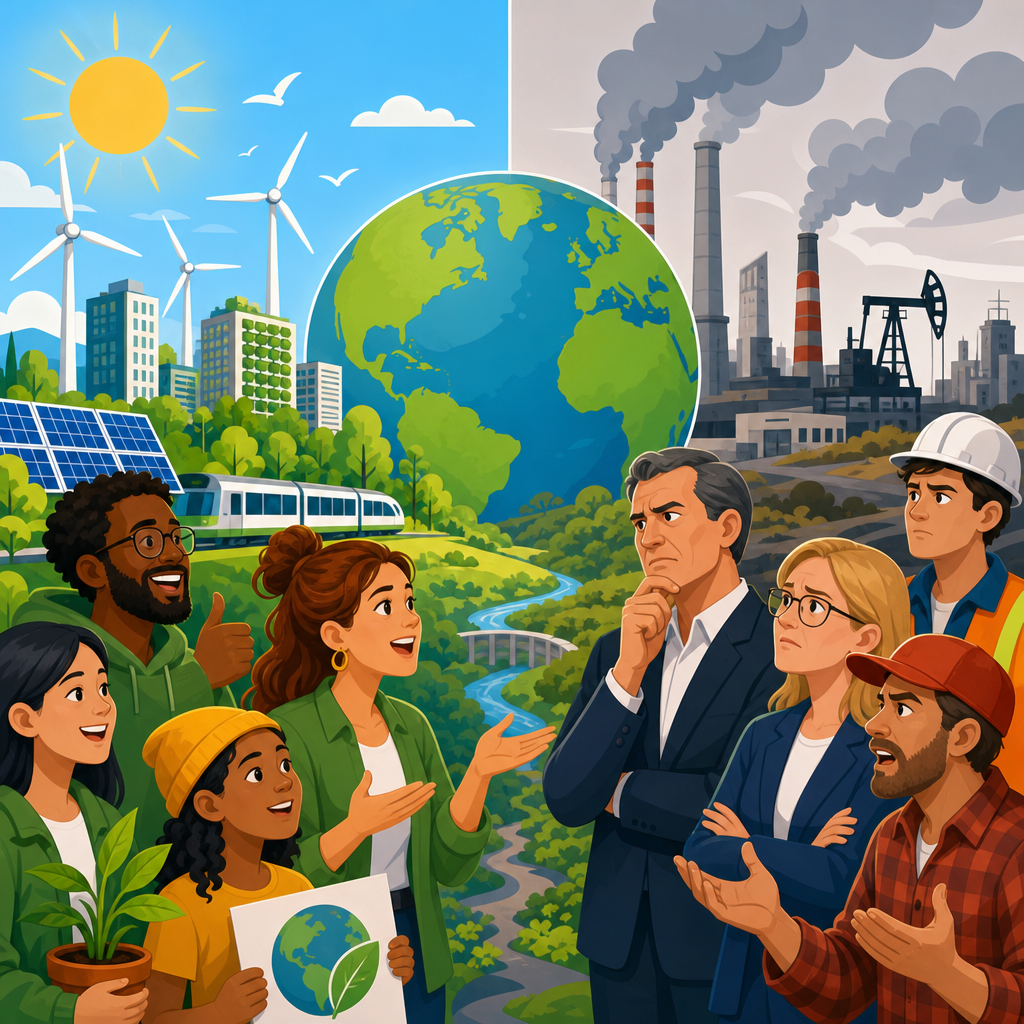
The Green New Deal is a broad policy framework that links climate action, economic reform, labor standards, public investment, and environmental justice into one political agenda. In the United States, the phrase usually refers to the 2019 congressional resolution introduced by Representative Alexandria Ocasio-Cortez and Senator Ed Markey, but the concept draws on older ideas: Franklin Roosevelt’s New Deal, clean energy transition planning, and decades of activism from frontline communities facing pollution, heat, flooding, and industrial decline. When people ask what the Green New Deal means, they are usually asking two different questions at once: what policies it proposes, and why it has triggered such intense support and opposition.
At its core, the Green New Deal argues that climate change is not a standalone environmental problem. It is tied to housing, transportation, health, jobs, infrastructure, land use, and inequality. That framing matters because climate policy can be designed narrowly, such as a carbon tax or power plant rule, or broadly, such as a national strategy to cut emissions while rebuilding public systems. I have worked on policy explainers and legislative analysis in this area, and the recurring source of confusion is that critics often debate the most ambitious rhetoric while supporters focus on the underlying policy direction. Understanding the gap between the resolution, later legislative proposals, and real-world agency action is essential.
This article serves as a hub for policy debates and reforms within environmental policy and law. It explains what the Green New Deal includes, why supporters believe it is necessary, why opponents challenge it, and how its ideas influence current lawmaking even without passage as a single statute. It also clarifies key terms such as decarbonization, just transition, environmental justice, electrification, resilience, and industrial policy. Decarbonization means reducing greenhouse gas emissions from energy, transport, buildings, industry, and agriculture. A just transition refers to helping workers and communities move from fossil fuel dependence toward new industries without absorbing all the losses. Environmental justice addresses the disproportionate burden of pollution on low-income communities and communities of color. Industrial policy means government uses procurement, tax credits, grants, loans, standards, and planning to shape markets toward national goals.
The issue matters because the stakes are concrete. The United States is the world’s second-largest annual emitter of greenhouse gases, according to recent global emissions inventories, and it faces escalating costs from extreme weather, wildfire smoke, sea-level rise, crop stress, and grid vulnerability. At the same time, climate policy affects energy prices, employment patterns, regional politics, federal spending, and household choices. For readers following broader environmental policy and law, the Green New Deal is a central reference point because it changed the debate from whether government should act to how comprehensive that action should be.
What the Green New Deal Actually Proposes
The Green New Deal was introduced as a nonbinding resolution, not an enacted program. That distinction matters. It did not create taxes, appropriations, or regulations by itself. Instead, it laid out goals: achieving net-zero greenhouse gas emissions, creating high-wage jobs, investing in infrastructure, securing clean air and water, promoting justice and equity, and strengthening resilience. It also called for major upgrades to buildings, transportation systems, power generation, manufacturing, and agriculture. Because the resolution was aspirational, supporters used it as a governing vision while opponents often treated it as a final bill with fixed costs.
In practical terms, Green New Deal-style policy usually includes a mix of clean electricity standards, renewable energy deployment, transmission expansion, electric vehicle incentives, public transit investment, building retrofits, heat pump deployment, efficiency standards, methane controls, domestic manufacturing support, and adaptation funding. It also emphasizes labor rules such as prevailing wages, apprenticeship programs, project labor agreements, and union-friendly procurement. A major difference between this framework and narrower climate policy is that it explicitly ties emissions cuts to job quality and distributional fairness.
That broad design has already shaped actual law. The Inflation Reduction Act of 2022, the Infrastructure Investment and Jobs Act of 2021, and parts of the CHIPS and Science Act are not the Green New Deal, but they reflect the same industrial-policy turn. The Inflation Reduction Act contains long-term tax credits for wind, solar, storage, hydrogen, carbon capture, nuclear power, and clean manufacturing, with bonus incentives linked to domestic content and labor standards. The infrastructure law funds grid upgrades, electric buses, EV charging, port electrification, abandoned mine cleanup, lead pipe replacement, and resilience projects. Those statutes are more incremental and less rhetorically sweeping than the Green New Deal, yet they show how the resolution shifted policy design.
Why Supporters Back It
Supporters argue that the Green New Deal matches the scale of the climate problem with the scale of public action required. Their first claim is scientific: limiting warming requires rapid emissions cuts across the whole economy, not isolated measures. The Intergovernmental Panel on Climate Change has repeatedly found that delaying reductions raises future costs and lock-in risk. In plain terms, every new long-lived fossil asset built today makes later decarbonization harder. Supporters therefore favor large, coordinated investment instead of a piecemeal approach.
Second, supporters see economic opportunity. Clean energy industries are capital intensive, infrastructure heavy, and geographically widespread. Wind components, solar modules, transmission hardware, transformers, batteries, and heat pumps all require manufacturing, installation, maintenance, engineering, logistics, and skilled trades. In states like Georgia, Michigan, Arizona, and Ohio, new battery and EV plants have been announced or expanded partly because federal incentives lowered business risk. Supporters argue that if public policy is already shaping the energy transition, it should direct benefits toward domestic workers and communities rather than letting gains concentrate in a few firms or regions.
Third, supporters emphasize environmental justice and public health. Communities located near highways, refineries, ports, warehouses, and power plants experience higher exposure to particulate matter, nitrogen oxides, sulfur dioxide, and toxic co-pollutants. Electrifying buses, tightening industrial controls, cleaning up diesel freight corridors, and replacing gas appliances in schools can produce health gains long before global temperature benefits are visible. I have seen this point resonate most strongly at the local level, where residents are less interested in abstract carbon metrics than in asthma rates, flood insurance costs, and whether the lights stay on during heat waves.
Fourth, supporters believe climate policy works better when it addresses fairness directly. A coal plant closure can improve air quality and reduce emissions, but without wage replacement, pension protection, remediation funding, and redevelopment planning, the transition can hollow out local tax bases. The Green New Deal’s just-transition language tries to prevent that political and social backlash. Whether every promise can be delivered is debatable, but the strategic logic is clear: durable climate policy must distribute both burdens and benefits in ways voters perceive as legitimate.
Why Opponents Push Back
Opposition to the Green New Deal comes from several directions, and not all critics make the same argument. Fiscal conservatives often object to its potential cost, warning that large federal spending packages, tax incentives, and industrial subsidies can worsen deficits or misallocate capital. Market-oriented analysts argue that governments are poor at picking technological winners and that broad frameworks invite mission creep. From this perspective, simpler tools such as carbon pricing or streamlined permitting may achieve emissions cuts more efficiently than a sprawling investment agenda.
Another line of criticism focuses on reliability and energy affordability. Opponents worry that aggressive decarbonization timelines can retire fossil generation before enough firm low-carbon capacity, storage, transmission, and demand flexibility are in place. The California electricity system, Texas winter outages, and European gas shocks are frequently cited, though each case has different causes. The underlying concern is real: grids must balance supply and demand every second. If policymakers underestimate interconnection delays, supply chain bottlenecks, or seasonal variability, consumers can face higher bills or reliability risks.
Labor and regional politics also complicate opposition. Some unions support Green New Deal-style investment because it can create construction and manufacturing jobs, while others fear job loss in fossil fuel production, pipelines, refining, or combustion-engine supply chains. States dependent on oil, gas, coal, or energy-intensive manufacturing often see the agenda as a threat to their tax base and identity. In those places, opposition is not only ideological. It reflects credible fears about stranded assets, declining royalty revenue, and uneven redevelopment.
Cultural backlash matters too. Because the Green New Deal bundles climate policy with housing, labor, healthcare, and equity language, critics say it overreaches and turns a potentially bipartisan environmental issue into a partisan realignment project. Some moderate analysts who support decarbonization still oppose the branding because they believe it triggers unnecessary polarization. In legislative practice, that criticism has bite. The broader the package, the harder it becomes to assemble a durable coalition across committees, industries, and regions.
Core Policy Debates and Reform Choices
The Green New Deal sits at the center of larger policy debates that define this subtopic hub: regulation versus incentives, federal authority versus state innovation, rapid build-out versus local consent, and universal benefits versus targeted equity programs. These are not abstract disputes. They determine what actually gets built, where, and who pays.
| Debate | Supporters’ view | Opponents’ view | Practical reform question |
|---|---|---|---|
| Carbon pricing vs public investment | Investment speeds deployment and creates jobs | Pricing is more efficient and technology neutral | Should Congress prioritize tax credits, standards, or a carbon fee? |
| Permitting reform | Needed for transmission and renewables | May weaken environmental review and community rights | How can NEPA reviews be faster without becoming superficial? |
| Justice targeting | Direct funds to overburdened communities | Can add complexity and slow delivery | What metrics should define disadvantaged communities? |
| Industrial policy | Build domestic supply chains and resilience | Risks subsidy races and protectionism | Which sectors merit long-term federal support? |
| Phaseout timelines | Urgency requires deadlines | Rigid dates can raise costs and reliability risks | How should policy handle regional grid differences? |
Take permitting as an example. Supporters of transmission expansion note that high-voltage lines can take a decade or more to approve and build, even when they would connect low-cost wind or solar to demand centers. Opponents of rushed reform answer that environmental review under the National Environmental Policy Act and related laws exists for good reason, especially where projects cross tribal lands, farms, forests, or neighborhoods already burdened by infrastructure. The best reform path is usually procedural precision: earlier consultation, clearer timelines, better staffing, stronger data, and transmission planning that reduces conflict before projects reach a crisis stage.
Another major debate concerns whether climate policy should focus mainly on emissions or also on industrial competitiveness. The Green New Deal clearly chooses both. That approach has grown more prominent as China has scaled clean technology manufacturing and as the European Union has deployed its Green Deal Industrial Plan and Carbon Border Adjustment Mechanism. In the United States, this raises legal and strategic questions about trade rules, domestic content requirements, critical mineral sourcing, and alliance politics. A climate plan that ignores supply chains is incomplete; a manufacturing plan that ignores environmental safeguards is equally flawed.
How the Green New Deal Influences Law and Politics Now
Even without becoming a single enacted statute, the Green New Deal changed the baseline of U.S. environmental politics. It made industrial policy, climate justice, and job-linked decarbonization mainstream within one major party. It influenced executive branch priorities at the Department of Energy, Environmental Protection Agency, Department of Transportation, Department of Housing and Urban Development, and Federal Energy Regulatory Commission. It also helped local and state policymakers justify climate plans that pair emissions targets with housing retrofits, transit expansion, community solar, and workforce development.
The strongest current influence is indirect. Agencies now design programs around measurable community benefits, domestic manufacturing, and resilience, not only least-cost emissions reductions. For example, federal grant competitions often score projects on pollution reduction, labor quality, and service to disadvantaged communities. Utilities and developers respond because procurement rules shape markets. That is how broad political frameworks become operational: first in guidance, then in finance, then in infrastructure decisions.
For readers exploring policy debates and reforms across environmental law, the Green New Deal is best understood as a lens rather than a line-item bill. It frames disputes over clean electricity standards, vehicle rules, methane limits, building codes, transmission siting, public transit, industrial subsidies, environmental review, and adaptation finance. Support and opposition both rest on serious arguments. The most productive analysis avoids caricature and asks harder questions: which tools cut emissions fastest, which protect affordability and reliability, which respect local communities, and which create durable political coalitions? Follow those questions through current legislation, agency rules, and state programs, and the Green New Deal becomes much easier to evaluate. If you are building deeper knowledge of environmental policy and law, use this hub as your starting point and then trace each reform debate to the statutes, agencies, and communities shaping the next phase of climate governance.
Frequently Asked Questions
What is the Green New Deal, and what does it actually propose?
The Green New Deal is a broad political and policy framework that combines climate action with economic reform, labor protections, public investment, and environmental justice. In the United States, the term is most closely associated with the 2019 congressional resolution introduced by Representative Alexandria Ocasio-Cortez and Senator Ed Markey. That resolution did not function as a detailed law or regulatory code. Instead, it outlined a national vision for responding to climate change while also addressing long-standing social and economic inequalities.
At its core, the Green New Deal argues that climate policy should not be treated as a narrow environmental issue. Supporters say the transition away from fossil fuels affects jobs, housing, health, transportation, wages, infrastructure, and access to clean air and water. For that reason, the framework calls for large-scale public investment in clean energy, modernized infrastructure, energy-efficient buildings, public transit, resilient communities, and industrial transformation. It also emphasizes creating high-quality jobs, protecting workers during the transition, and directing resources toward communities that have historically borne the heaviest burdens of pollution and economic neglect.
The idea also draws inspiration from older traditions. The name echoes Franklin Roosevelt’s New Deal, which used federal action and public spending to respond to economic crisis, while the climate side reflects decades of clean energy planning and activism from frontline communities. In practice, the Green New Deal is less one single policy than an umbrella agenda. Different politicians and advocates may support different versions, but the central premise remains the same: climate action should be ambitious, economy-wide, and tied to fairness, employment, and justice.
Why do supporters back the Green New Deal?
Supporters back the Green New Deal because they see climate change as both an environmental emergency and a structural economic challenge. From their perspective, incremental policy changes are not enough to cut emissions at the speed scientists say is necessary, especially while communities continue to face rising heat, stronger storms, wildfire risk, polluted air, and costly energy systems. The Green New Deal appeals to supporters because it proposes a scale of response that matches the scale of the problem.
Another major reason for support is that the framework links decarbonization with jobs and public investment. Advocates argue that building renewable energy systems, upgrading the electric grid, expanding public transit, retrofitting buildings, restoring ecosystems, and improving water and energy infrastructure can create millions of jobs across multiple sectors. Labor-aligned supporters often emphasize that these should not be low-wage or precarious jobs. Instead, they argue for union protections, prevailing wage standards, apprenticeship pathways, and stronger worker bargaining power so the energy transition produces broadly shared economic benefits.
Environmental justice is also central to support for the Green New Deal. Many low-income communities, Indigenous communities, and communities of color have experienced disproportionate exposure to pollution, industrial hazards, underinvestment, and climate vulnerability. Supporters argue that climate policy should actively correct these patterns rather than simply reduce emissions in the abstract. That means targeting investments where the need is greatest, reducing toxic exposure, improving housing quality, expanding access to transportation, and making sure communities historically excluded from policy decisions have a stronger voice in shaping outcomes.
For many backers, the Green New Deal is compelling because it offers a unifying political story. Rather than asking voters to choose between environmental protection and economic security, it presents the clean energy transition as a chance to rebuild infrastructure, strengthen labor standards, improve public health, and make the economy more resilient. Even among those who disagree on the exact policy details, the vision attracts support because it treats climate action as an opportunity for national renewal, not just a set of restrictions.
Why do opponents criticize or oppose the Green New Deal?
Opposition to the Green New Deal comes from several directions, and not all critics object for the same reason. One common criticism is that the framework is too broad, too expensive, or too vague. Because the original resolution was written as a vision statement rather than a detailed legislative package, opponents argue that it leaves unanswered questions about cost, timelines, implementation, trade-offs, and legal authority. Critics often say that without more specificity, it is difficult to assess how such a sweeping agenda would work in practice.
Another major source of opposition concerns the role of government. Many conservatives and market-oriented critics see the Green New Deal as an example of excessive federal intervention in the economy. They object to the idea of Washington directing large-scale investment, shaping industrial strategy, setting labor standards, or redesigning major sectors such as transportation, power generation, and housing. In their view, innovation should be driven more by markets, private enterprise, technological competition, and targeted incentives than by a comprehensive national mobilization.
Economic disruption is another concern. Opponents often argue that a rapid transition away from fossil fuels could raise energy costs, destabilize existing industries, or threaten jobs in coal, oil, gas, refining, heavy manufacturing, and related supply chains. Even some people who support climate action in principle worry that poorly designed transition policies could harm workers and regions that currently depend on conventional energy production. These critics may favor a more gradual or sector-by-sector strategy instead of a highly ambitious national framework.
There is also criticism from people who believe the Green New Deal mixes too many issues together. They argue that climate policy becomes harder to pass when it is bundled with broader debates about healthcare, housing, wages, inequality, and labor rights. From this perspective, a narrower focus on emissions, clean technology, and carbon reduction would be more politically feasible. In short, opposition often centers on feasibility, cost, economic risk, ideological disagreement over government’s role, and concern that the agenda is broader than climate policy alone.
Is the Green New Deal a law, and how is it different from specific climate legislation?
No, the Green New Deal itself is not a law. The 2019 congressional Green New Deal was introduced as a nonbinding resolution, which means it expressed goals and priorities rather than creating enforceable legal requirements. It served as a statement of direction: a way of framing what an ambitious climate-and-economic agenda could look like. That distinction matters because many public debates have treated the Green New Deal as if it were a fully written statute, when in reality it functioned more like a blueprint or organizing vision.
Specific climate legislation is different because it contains detailed mechanisms, funding structures, eligibility rules, timelines, agency responsibilities, and enforcement provisions. For example, an actual law might provide tax credits for renewable energy, allocate grants for home weatherization, fund public transit projects, regulate power plant emissions, or establish incentives for domestic clean technology manufacturing. Those are concrete tools. The Green New Deal, by contrast, is the larger framework that can influence what kinds of policies lawmakers choose to pursue.
This is why people can support Green New Deal goals while disagreeing on the exact policy path. Some may favor public spending and direct federal planning. Others may prefer tax incentives, carbon pricing, procurement rules, or state-led implementation. Likewise, some critics oppose the Green New Deal as a political brand but still support certain pieces commonly associated with it, such as grid modernization, clean energy research, or infrastructure resilience. The phrase often functions as a symbol for a broader debate over how ambitious climate policy should be and whether it should also address inequality and labor standards at the same time.
Understanding that difference helps clarify political arguments around the topic. The Green New Deal is best understood as a comprehensive agenda-setting idea. Laws are the specific instruments that either partially reflect that agenda, move away from it, or translate selected parts of it into real programs.
How has the Green New Deal shaped political debate in the United States?
The Green New Deal has had an outsized influence on U.S. political debate because it changed the way many people talk about climate policy. Before it entered mainstream national politics, climate proposals were often framed primarily around emissions targets, fuel standards, or environmental regulation. The Green New Deal helped push a different conversation into public view, one that connected climate change to jobs, racial equity, labor rights, public health, housing, infrastructure, and economic power. Whether people supported or opposed it, they had to engage with a much wider set of questions about what a climate transition should involve.
It also moved the political center of gravity among many Democrats, especially younger lawmakers and activist groups. The framework encouraged stronger emphasis on industrial policy, clean energy manufacturing, environmental justice funding, and worker protections in later policy discussions. Even when legislation did not carry the Green New Deal label, debates over federal climate spending, clean energy incentives, grid upgrades, and support for disadvantaged communities were shaped by the broader expectations it created. In that sense, the Green New Deal has been influential not only as a proposal but also as a benchmark for ambition.
At the same time, the phrase became a target for political attack, especially among Republicans and centrist critics who used it to argue that climate progressives favored unrealistic or economically harmful policies. That backlash helped turn the Green New Deal into a cultural and electoral flashpoint. For supporters, that visibility was useful because it forced climate change higher onto the national agenda. For opponents, it served as a warning about what they saw as ideological overreach. The result was a sharper, more public debate over the balance between urgency, affordability, jobs, and government intervention.
Ultimately, the Green New Deal’s biggest impact may be conceptual.


