Environmental Impact Assessments, commonly called EIAs, are one of the most practical tools governments, developers, lenders, and communities use to prevent ecological damage before it happens. An EIA is a structured process for identifying, predicting, evaluating, and mitigating the environmental effects of a proposed project, policy, or land-use change before approvals are granted and construction begins. In environmental policy and law, EIAs sit at the point where science, regulation, economics, and public accountability meet. When done well, they protect biodiversity, conserve water, soil, forests, wetlands, and fisheries, and help decision-makers weigh development benefits against irreversible ecological loss.
Biodiversity refers to the variety of life at genetic, species, and ecosystem levels. Natural resources include renewable assets such as freshwater, timber, fertile soils, and ecosystem services, as well as finite resources affected by extraction, pollution, and habitat conversion. EIAs matter because most serious environmental harm is easier and cheaper to avoid at the planning stage than to repair afterward. I have seen projects that looked routine on paper reveal major risks only when baseline surveys, seasonal wildlife monitoring, and alternatives analysis were completed. A road alignment shifted by a few hundred meters can preserve a migration corridor. A construction schedule revised around breeding season can prevent colony failure. A wastewater outfall redesigned early can save a river reach from chronic nutrient loading.
This hub article explains how EIAs protect biodiversity and natural resources, what the process includes, where it succeeds, and where it falls short. It also provides the legal and practical context readers need if they are comparing national EIA systems, reviewing a project, or planning deeper reading across this topic. The core principle is straightforward: environmental harm should be anticipated, disclosed, avoided where possible, minimized where necessary, and monitored over time. That principle underpins modern environmental governance worldwide, from the United States National Environmental Policy Act to the European Union EIA Directive, the Convention on Biological Diversity, International Finance Corporation Performance Standard 6, and lender safeguard systems used in major infrastructure finance.
What an Environmental Impact Assessment Actually Does
An EIA is not a single report; it is a decision-making process with several linked stages. Standard steps include screening, scoping, baseline studies, impact prediction, alternatives analysis, mitigation design, public participation, reporting, regulatory review, approval conditions, and post-approval monitoring. Screening determines whether a project requires a full assessment. Scoping identifies the issues that matter most, such as critical habitat, groundwater drawdown, sedimentation, cumulative traffic emissions, or Indigenous land use. Baseline studies establish existing environmental conditions through field surveys, mapping, seasonal sampling, satellite imagery, hydrological analysis, and species inventories. Without a credible baseline, impact prediction becomes guesswork.
Impact prediction translates project activities into ecological consequences. For biodiversity, that usually means asking how habitat clearing, noise, vibration, lighting, water abstraction, discharge, roads, blasting, invasive species introduction, or human access will affect species presence, breeding success, mortality, and ecosystem function. For natural resources, the assessment examines quantities and quality: how much water will be withdrawn, how runoff patterns will change, whether topsoil will be lost, whether forests will fragment, and how fisheries or grazing lands may be affected. The best EIA reports use significance criteria, spatial analysis, and seasonal data rather than broad statements like “minor impact expected.” Regulators need specifics to impose conditions that can be enforced.
Alternatives analysis is where EIA often creates the greatest environmental value. The objective is not merely to document impacts but to compare feasible options, including the no-project alternative. In practice, that can mean relocating a transmission line away from wetlands, using directional drilling instead of open trenching across a river, reducing a mine footprint, choosing a brownfield over intact habitat, or adopting closed-loop water systems to limit extraction. Effective EIAs also apply the mitigation hierarchy: avoid impacts first, minimize impacts second, restore affected areas third, and offset residual impacts only as a last resort. That sequence is essential because some biodiversity losses, especially in old-growth forests, peatlands, coral reefs, and endemic-rich ecosystems, cannot be truly replaced.
How EIAs Protect Biodiversity in Practice
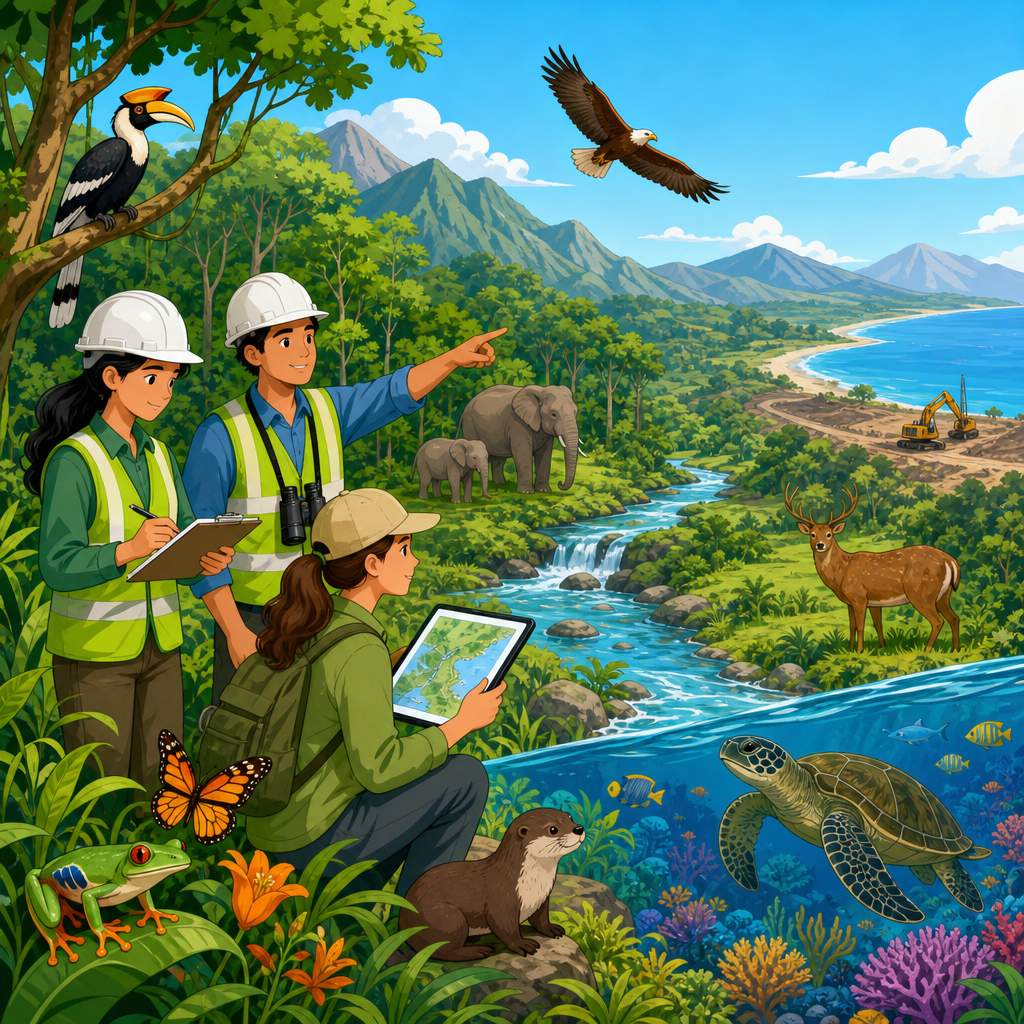
EIAs protect biodiversity by forcing early ecological due diligence and translating scientific findings into binding project changes. The process typically starts with habitat classification and species risk screening. Consultants review protected area maps, critical habitat indicators, Key Biodiversity Areas, red list status, migratory routes, and local ecological knowledge to determine whether the site intersects sensitive ecosystems. Fieldwork then confirms species presence and habitat condition. For example, a solar development on apparently degraded land may still overlap with ground-nesting bird habitat, reptile refuge areas, or rare seasonal wetlands visible only during part of the year. Without targeted surveys, those values are often missed.
Once ecological receptors are identified, EIAs evaluate direct, indirect, induced, and cumulative impacts. Direct impacts include vegetation removal, nest destruction, wildlife mortality from vehicle strikes, and sediment release into streams. Indirect impacts include altered hydrology, edge effects, and increased poaching risk from new access roads. Induced impacts arise when a project stimulates settlement, logging, or agriculture nearby. Cumulative impacts occur when multiple projects affect the same landscape, watershed, or species population over time. In one regional infrastructure review I worked on, each project independently claimed negligible forest loss, yet combined GIS analysis showed corridor fragmentation across an entire elephant movement route. A project-by-project lens would have missed the real risk.
Protection measures become effective when they are specific and measurable. Common examples include no-go zones around nesting cliffs, buffer distances from wetlands, canopy bridge installation for arboreal mammals, fish passage design at culverts, sediment and erosion controls, dark-sky lighting to reduce disorientation, seasonal work windows, invasive species biosecurity plans, and biodiversity monitoring tied to thresholds for corrective action. These are not abstract ideas. Transportation agencies routinely alter drainage and culvert sizing to maintain aquatic connectivity. Wind projects curtail turbine operation during peak bat activity. Quarry approvals may require progressive rehabilitation and topsoil conservation so disturbed areas recover as extraction advances rather than years later.
| EIA stage | Biodiversity protection function | Practical example |
|---|---|---|
| Screening | Flags high-risk projects early | Mine expansion near protected forest triggers full assessment |
| Scoping | Focuses study on sensitive receptors | Terms of reference require wet-season amphibian surveys |
| Baseline studies | Documents current ecological conditions | Camera traps confirm use of corridor by large mammals |
| Alternatives analysis | Compares less damaging options | Road rerouted to avoid peatland and breeding marsh |
| Mitigation planning | Sets avoidance and minimization measures | Construction paused during turtle nesting period |
| Approval conditions | Makes commitments enforceable | Permit requires riparian buffers and monthly water testing |
| Monitoring | Checks whether measures work in reality | Bird mortality surveys trigger adaptive turbine shutdowns |
How EIAs Safeguard Water, Soil, Forests, and Other Natural Resources
Natural resource protection in EIAs is broader than wildlife conservation. Water is often the most contested issue because projects can alter both quantity and quality. A robust EIA examines source sustainability, competing users, seasonal flows, groundwater recharge, discharge chemistry, flood risk, and downstream dependence. For industrial facilities, this means modeling water demand under drought conditions, assessing treatment capacity, and designing containment for spills and tailings seepage. For dams or diversions, it means environmental flow analysis, sediment transport assessment, and impacts on fisheries, floodplains, and wetlands. The legal importance is clear: once water allocation and contamination problems occur, social conflict and ecological decline often follow quickly.
Soil and land resources are equally important. EIAs evaluate erosion risk, topsoil stripping, contamination pathways, slope stability, and the long-term productivity of agricultural land. In linear infrastructure projects such as roads, pipelines, and transmission lines, poor soil management can turn a narrow right-of-way into a chronic source of sedimentation and invasive plant spread. Good assessment practice therefore links engineering details to ecological outcomes. Measures may include phased clearing, topsoil segregation, geotextiles, stormwater retention, revegetation with native species, and controls on borrow pits and spoil disposal. When farmland is affected, compensation alone is not sufficient; maintaining soil structure, drainage, and access can matter more than a one-time payment.
Forests, fisheries, coastal resources, and mineral resources each require tailored analysis. Forest impacts involve more than hectare counts because fragmentation, fire access, and edge drying can degrade remaining habitat. Fisheries assessments must consider turbidity, spawning grounds, migration timing, and the livelihood effects on small-scale fishers. Coastal EIAs often address mangroves, coral reefs, shoreline erosion, dredging plumes, ballast water, and storm-surge resilience. Resource extraction projects must evaluate ore processing chemicals, acid mine drainage potential, waste rock characterization, and closure liabilities. In all these cases, EIAs protect natural resources by making environmental costs visible before commitments harden, by forcing design changes, and by creating permit conditions that can be monitored against measurable standards.
The Legal Framework, Public Participation, and Common Weaknesses
Most national EIA systems share a common legal logic: potentially significant environmental effects must be assessed before a project is approved. The details differ. Some jurisdictions issue environmental clearance through a specialized ministry; others integrate EIA into planning, mining, water, energy, or coastal zone permits. Internationally, the most influential models include the United States National Environmental Policy Act, which established environmental review as a front-end decision tool; the European Union EIA Directive, which harmonizes minimum requirements across member states; and lender standards such as the Equator Principles and IFC Performance Standards, which often shape private-sector practice even where domestic law is weak.
Public participation is not an optional extra; it is one of the strongest mechanisms for improving biodiversity and resource protection. Local residents, Indigenous peoples, fishers, farmers, and civil society groups often know seasonal water patterns, wildlife movement, flood behavior, and resource use that desktop studies miss. Meaningful consultation can identify sacred sites, subsistence harvest zones, community forests, and pollution concerns long before they become legal disputes. Good practice requires early disclosure, understandable summaries, accessible hearing formats, response to comments, and transparent reasons for approval decisions. Where free, prior, and informed consent applies under national law or project commitments, consultation standards become even more demanding.
Still, EIAs have real limitations. Weak baseline data, consultant conflicts of interest, rushed timelines, poor cumulative impact analysis, political pressure, and inadequate enforcement can reduce the process to paperwork. Biodiversity offsets are particularly controversial when used to justify damage to irreplaceable ecosystems. Monitoring can also fail if permit conditions are vague or agencies lack staff for inspections. The practical lesson is that EIA quality depends on institutional capacity and accountability, not only on legal mandates. Readers exploring this subtopic should next look at screening thresholds, strategic environmental assessment, cumulative effects assessment, habitat offsets, environmental permitting, and compliance monitoring, because those connected topics determine whether EIA functions as genuine prevention or merely procedural formality.
Why Strong EIAs Remain Essential
EIAs protect biodiversity and natural resources because they move environmental protection upstream, before bulldozers arrive and before permits lock in harmful design choices. They create a disciplined record of ecological conditions, test alternatives, require mitigation, invite public scrutiny, and connect science to enforceable approval terms. Their greatest strength is prevention. Avoiding a wetland fill, maintaining environmental flows, preserving a forest corridor, or redesigning waste management at the planning stage delivers better outcomes than restoration attempts after damage occurs. That is true for governments seeking lawful decisions, developers managing risk, financiers protecting investments, and communities defending the ecological systems they depend on.
For anyone working within environmental policy and law, this hub topic deserves close attention because EIAs influence nearly every sector: energy, transport, mining, housing, water infrastructure, forestry, and coastal development. The most reliable assessments are evidence-based, site-specific, participatory, and tied to monitoring that can trigger corrective action. They acknowledge tradeoffs, but they do not treat biodiversity loss or resource depletion as invisible side effects. If you are building knowledge in this area, use this page as your starting point, then go deeper into project screening, alternatives analysis, public participation, cumulative impacts, and post-approval enforcement. Better environmental decisions begin with better assessment, and better assessment begins before the first approval is signed.
Frequently Asked Questions
What is an Environmental Impact Assessment, and why is it important for biodiversity protection?
An Environmental Impact Assessment, or EIA, is a formal process used to identify, predict, and evaluate the likely environmental effects of a proposed project before any major approvals are issued or construction begins. In practical terms, it helps decision-makers understand how activities such as road building, mining, energy development, industrial expansion, or land-use change could affect habitats, species, water systems, soil quality, and broader ecosystem health. That matters because biodiversity loss is often difficult, expensive, or impossible to reverse once damage has already occurred.
EIAs are especially important for biodiversity protection because they move environmental planning upstream. Instead of reacting to pollution, habitat destruction, or species decline after the fact, an EIA requires those risks to be examined early enough for real changes to be made. This may include redesigning a project, relocating infrastructure, reducing its physical footprint, changing construction timing, or rejecting particularly harmful options altogether. In that sense, EIAs are one of the most practical preventive tools available in environmental governance.
They also create a structured link between science, law, and public accountability. Biological surveys, ecological modeling, hydrological studies, and cumulative impact assessments can all be incorporated into the review process. Regulators, lenders, developers, and local communities can then evaluate whether the proposed action is compatible with conservation goals, legal protections, and sustainable resource use. When done properly, an EIA does not just check a compliance box. It helps ensure that development decisions reflect the real ecological value of forests, wetlands, rivers, grasslands, coastal systems, and the species that depend on them.
How do EIAs help prevent damage to natural resources before a project starts?
One of the greatest strengths of an EIA is that it is designed to prevent harm before it happens. Rather than waiting until a project has already cleared land, diverted water, fragmented habitat, or introduced pollution, the EIA process requires planners to study the likely effects in advance. That gives governments and developers a chance to avoid high-risk outcomes while there is still time to change the proposal. For biodiversity and natural resources, that early intervention is critical.
EIAs typically begin with screening and scoping. Screening determines whether a project requires a full environmental review, while scoping identifies the key issues that need detailed study. If a proposed development sits near a protected area, migration corridor, wetland, spawning ground, forest ecosystem, or community water source, those features can be flagged early as sensitive receptors. Specialists then assess likely impacts such as habitat loss, edge effects, altered drainage patterns, erosion, sedimentation, invasive species introduction, noise disturbance, wildlife mortality, groundwater depletion, and contamination of air or water.
Based on those findings, the EIA process can lead to practical protective measures. For example, project access roads may be rerouted to avoid intact habitat, buffer zones may be established around rivers and nesting sites, clearing limits may be imposed, and seasonal restrictions may be applied to reduce impacts during breeding or migration periods. In some cases, mitigation hierarchies are used, prioritizing avoidance first, then minimization, restoration, and only finally offsetting where appropriate. This sequence is important because the best way to protect natural resources is usually to avoid damaging them in the first place.
EIAs can also expose hidden long-term risks that are easy to overlook in conventional planning. A project might appear manageable on paper, yet still trigger downstream water stress, cumulative forest fragmentation, or slow declines in species that rely on connected ecosystems. By requiring a fuller analysis before approvals are granted, EIAs help decision-makers recognize those risks early and act on them while meaningful alternatives are still available.
What kinds of biodiversity impacts are usually examined in an EIA?
EIAs examine a wide range of biodiversity-related impacts because ecosystems can be affected in direct, indirect, short-term, and long-term ways. The most obvious category is habitat loss. If a project clears vegetation, drains wetlands, dredges coastal areas, or converts natural land into industrial or urban use, species may lose breeding areas, shelter, food sources, and movement routes. But the analysis does not stop there. A high-quality EIA also considers habitat fragmentation, which can isolate wildlife populations and reduce genetic exchange even when some habitat technically remains.
Another major focus is species-level impact. EIAs often assess whether the project area contains threatened, endemic, migratory, keystone, or legally protected species. Experts may conduct field surveys, camera trapping, vegetation mapping, aquatic sampling, bird counts, or seasonal studies to determine how different species use the landscape. The assessment may examine risks such as collision with infrastructure, nest disturbance, changes in prey availability, disruption of breeding behavior, or increased exposure to human activity.
Natural resource impacts are also central. EIAs commonly evaluate how a project could affect water quantity and quality, soil stability, forest cover, fisheries, air quality, and ecological services such as pollination, flood regulation, and carbon storage. For example, a project that changes runoff patterns can damage streams and wetlands far beyond the project boundary. Similarly, groundwater extraction or contamination can undermine both ecosystem health and local livelihoods that depend on clean and reliable water.
Importantly, strong EIAs also consider indirect and cumulative effects. A single project may not seem catastrophic by itself, but when added to nearby roads, agricultural expansion, energy infrastructure, or urban growth, the combined pressure on biodiversity can become severe. This broader view helps regulators and stakeholders understand whether a project contributes to a pattern of ecological decline, rather than evaluating it in isolation. That is often where EIAs deliver some of their greatest value for long-term conservation planning.
Can an EIA actually change or stop a development project if the environmental risks are too high?
Yes, an EIA can absolutely influence, redesign, delay, or even stop a development project, depending on the legal framework, the quality of the evidence, and the severity of the identified impacts. An EIA is not supposed to be a passive document that simply describes damage. Its purpose is to inform decision-making. If the assessment shows that a project would cause unacceptable harm to biodiversity, critical habitat, water resources, or protected ecosystems, regulators may require major changes or deny approval altogether.
In many cases, the EIA process leads to redesign rather than outright rejection. A project footprint may be reduced, a site may be relocated, linear infrastructure may be rerouted, technology may be upgraded to reduce pollution, or operational plans may be revised to protect sensitive species and habitats. These changes can significantly lower environmental risk while still allowing some form of development to proceed. That is one reason EIAs are considered practical tools rather than purely restrictive ones: they help balance environmental protection with economic planning by making impacts visible early enough to address them.
However, there are situations where mitigation is not enough. If a project threatens a highly sensitive ecosystem, a protected species population, a critical watershed, or an irreplaceable habitat, the evidence may show that no reasonable mitigation can reduce the impact to an acceptable level. In such cases, the EIA provides the scientific and procedural basis for a regulator, lender, court, or permitting authority to say no. This is especially important where national law, international standards, or lender safeguards require avoidance of critical habitat destruction or serious ecosystem degradation.
The effectiveness of this role depends heavily on implementation. A weak EIA conducted too late, with poor baseline data or limited public scrutiny, may have little influence. A strong EIA, by contrast, can reshape project design, strengthen permit conditions, trigger monitoring requirements, and ensure biodiversity concerns are treated as central decision criteria rather than afterthoughts. In other words, the power of an EIA lies not just in producing information, but in making that information matter before irreversible damage occurs.
How do public participation and monitoring make EIAs more effective for protecting ecosystems?
Public participation and post-approval monitoring are two of the most important features that determine whether an EIA works in practice. Public participation matters because local communities, Indigenous peoples, land users, fishers, farmers, and conservation groups often hold detailed knowledge about seasonal water flows, wildlife presence, resource dependence, and landscape change that may not appear in technical reports alone. Their input can identify overlooked species, culturally important ecosystems, traditional use areas, or impact pathways that consultants and developers might otherwise miss.
Meaningful participation also improves transparency and accountability. When EIA documents are publicly available and stakeholders can comment on project risks, alternatives, and mitigation plans, there is greater pressure for the assessment to be accurate, evidence-based, and responsive. This can lead to better baseline studies, stronger mitigation commitments, and more credible decisions. It also helps build trust, which is essential when projects affect shared natural resources such as rivers, forests, grazing land, coastal zones, or fisheries.
Monitoring is just as important because predictions made during an EIA must be tested against real-world outcomes. Even well-prepared assessments involve uncertainty. Species may respond differently than expected, pollution controls may underperform, and cumulative effects may intensify over time. Monitoring allows regulators and project operators to track key indicators such as water quality, habitat condition, wildlife movement, vegetation recovery, erosion, noise levels, and compliance with permit conditions. Without monitoring, mitigation measures may look good on paper but fail in reality.
When monitoring is tied to adaptive management, EIAs