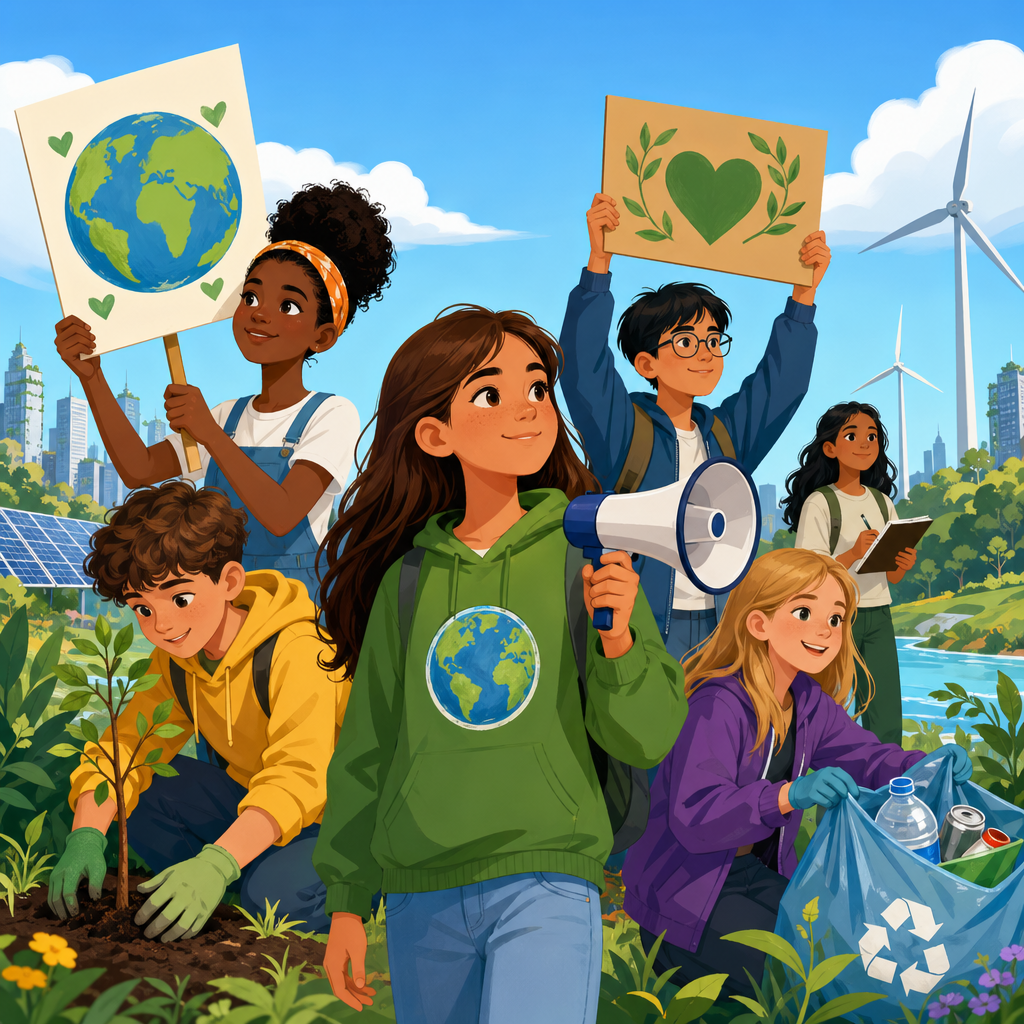
Young climate activists have transformed public debate by proving that age does not limit influence, strategic thinking, or moral clarity. Youth and climate activism refers to organized efforts led by children, teenagers, and young adults to push governments, businesses, schools, and communities toward stronger action on global warming, pollution, conservation, and environmental justice. The topic matters because today’s young people will live longest with rising temperatures, extreme weather, food insecurity, biodiversity loss, and the economic disruption that follows. They are not simply future stakeholders; they are current organizers, litigants, educators, campaigners, and policy advocates. In my work reviewing climate campaigns and civic engagement programs, I have repeatedly seen youth-led initiatives change boardroom agendas, reshape local ordinances, and force national media to cover issues long treated as technical or distant.
The strongest inspiring stories of young climate activists are compelling not only because they feature courage, but because they reveal how social change actually happens. A student strike can become a nationwide movement. A school recycling project can evolve into municipal waste reform. A lawsuit filed by young plaintiffs can redefine government responsibility. These stories also help readers understand key terms that shape the field. Climate justice connects environmental harm with inequality, showing that low-income communities and Indigenous peoples often bear the heaviest burdens. Adaptation means preparing for climate impacts already underway, while mitigation means reducing greenhouse gas emissions to limit future damage. Advocacy includes lobbying, public education, protest, community science, and legal action. Taken together, youth and climate activism is not one movement with one tactic; it is an ecosystem of action that spans classrooms, courtrooms, streets, farms, coastlines, and digital platforms.
What makes this hub especially important is that it helps connect scattered headlines into a clear picture. Searchers often ask who the most influential young climate activists are, what they have accomplished, whether youth activism produces measurable results, and how students can get involved without waiting for permission or large budgets. The answer is yes: youth-led work has already shaped public awareness, corporate accountability, education policy, and legal strategy. To understand why these efforts resonate so widely, it helps to examine the people, methods, and outcomes that define the movement.
Why Young Voices Carry Unusual Power
Young people occupy a unique position in climate politics. They can speak with moral authority about long-term consequences because they will inherit decisions made today, yet they also bring practical energy to organizing. I have seen youth groups outperform older institutions in digital mobilization because they understand platform culture, visual storytelling, and peer-to-peer trust. Their message is usually direct: adults have known the science for decades, emissions continue rising, and delay is a choice. That clarity cuts through the policy fog that often weakens public engagement.
Youth advocates also broaden the frame beyond carbon numbers. Many link climate change to public health, racial equity, housing, transportation, and education. When students campaign for cleaner school buses, shaded playgrounds, or heat-safe classrooms, they translate a planetary issue into daily experience. This local grounding matters. People act when climate impacts become concrete: wildfire smoke cancelling sports practice, floods damaging homes, or heat waves closing schools. Young activists are exceptionally good at making those connections visible.
Another reason their stories inspire is that they show leadership developing in real time. Unlike established public figures with large staffs, many youth activists begin with limited resources. They learn media relations, coalition building, fundraising, and policy analysis while still in school. That visible learning process makes their success feel attainable to others. It also demonstrates that democratic participation is a skill built through practice, not a privilege reserved for experts.
Global Figures Who Changed the Climate Conversation
Any serious hub on inspiring stories of young climate activists must begin with individuals whose work reshaped global awareness. Greta Thunberg remains the most recognized example. Her solo school strike outside the Swedish parliament in 2018 became Fridays for Future, a movement that mobilized millions across continents. Her impact was not limited to symbolic protest. She changed media framing by insisting that climate change be discussed as an emergency grounded in scientific consensus, particularly assessments from the Intergovernmental Panel on Climate Change. Her speeches worked because they were specific, repetitive, and strategically uncompromising.
Vanessa Nakate of Uganda expanded the movement’s geographic lens. She has consistently challenged the tendency of international climate coverage to center Europe and North America while underrepresenting African communities facing severe drought, crop loss, and energy inequality. By founding the Rise Up Movement, she amplified youth activists across Africa and highlighted a critical truth: those contributing least to cumulative emissions often face the greatest risks. Her advocacy brought adaptation, climate finance, and loss and damage into mainstream discussion for younger audiences.
Xiye Bastida, born in Mexico and active in the United States, has become a leading voice linking Indigenous knowledge, migration, and climate justice. Her work illustrates that activism is strongest when rooted in culture and community history. Autumn Peltier, an Anishinaabe water protector from Canada, broadened public understanding of how climate action intersects with freshwater protection and Indigenous sovereignty. Isra Hirsi, co-founder of the U.S. Youth Climate Strike, helped connect mass mobilization with policy demands such as equitable investment and a just transition. These activists differ in style, location, and emphasis, yet each transformed concern into organized pressure.
How Youth Activism Produces Real-World Results
Critics sometimes dismiss student activism as awareness without outcomes, but the record shows otherwise. Youth climate activism produces results through agenda setting, institutional pressure, litigation, electoral influence, and market signals. Agenda setting happens when youth-led protests force decision-makers and journalists to prioritize climate coverage. Institutional pressure occurs when students target universities, school districts, pension funds, or city councils with specific demands, such as fossil fuel divestment or renewable energy procurement. Litigation creates another path: young plaintiffs can argue that governments have failed to protect fundamental rights threatened by climate disruption.
A useful way to understand outcomes is to match common tactics with the kind of change they are most likely to achieve.
| Tactic | Typical Target | Likely Outcome | Example |
|---|---|---|---|
| School strikes | Media, elected officials | Public attention and agenda pressure | Fridays for Future global mobilizations |
| Divestment campaigns | Universities, pension funds, faith groups | Capital reallocation and reputational pressure | Student-led fossil fuel divestment wins on campuses |
| Youth lawsuits | National or state governments | Legal scrutiny and policy accountability | Juliana v. United States inspired global youth litigation |
| Community projects | Neighborhoods, schools, local agencies | Immediate resilience and education benefits | Urban tree planting and school composting programs |
From experience, the most durable wins usually combine two or more tactics. A protest gets attention, research supplies credibility, community partnerships build legitimacy, and policy proposals create a path to implementation. Youth leaders who understand this sequence tend to move from symbolic visibility to measurable change faster than groups focused on visibility alone.
Local Stories Often Create the Deepest Impact
While global names attract headlines, many of the most inspiring stories of young climate activists unfold locally. Consider students who organize for diesel-free school bus fleets in urban districts with high asthma rates. Their campaigns are climate activism because transportation emissions matter, but they are also public health interventions. When those students collect testimonies from parents, map idling zones, and present data to school boards, they are practicing evidence-based advocacy. I have seen local officials respond more quickly to these grounded campaigns than to broad ideological arguments because the requested changes are specific, budgetable, and politically understandable.
In coastal communities, youth activists often lead adaptation work. They monitor flooding, advocate for wetland restoration, and push planners to account for sea-level rise in zoning decisions. In wildfire-prone regions, students have organized clean-air resource drives, emergency preparedness workshops, and campaigns for resilient school infrastructure. In agricultural areas, young organizers have partnered with farmers on soil health, water conservation, and regenerative practices. These examples matter because they show activism is not only about opposing harmful systems; it is also about designing practical alternatives.
Local activism also creates leadership pipelines. A teenager who starts by organizing a climate education week may later serve on a city youth advisory council, intern with an environmental nonprofit, study environmental engineering, or run for office. The story becomes inspiring not because one event solved climate change, but because sustained civic participation took root. For a hub page on youth and climate activism, that is a central lesson: participation scales.
Climate Justice, Representation, and Frontline Leadership
The movement is most effective when it centers those living closest to harm. Frontline youth, including Indigenous activists, island communities, rural farmers, and residents of low-income urban neighborhoods, often understand climate risk in practical terms because they experience it directly. Their stories challenge the misconception that climate change is mainly a future problem. For many communities, it is a present reality measured in crop failures, unsafe drinking water, heat stress, displacement, or storm recovery costs.
Representation matters because public narratives shape funding and policy. When coverage highlights only a narrow set of voices, solutions become narrow too. Young activists such as Licypriya Kangujam in India have pressed for stronger disaster awareness and environmental protection while demonstrating that children can claim civic space even in highly formal policy environments. Pacific Island youth activists have been especially influential in explaining sea-level rise not as an abstract metric but as a threat to culture, land, burial grounds, and sovereignty.
In practice, justice-centered organizing changes priorities. It shifts attention toward affordable clean energy, public transit, heat-resilient housing, clean water infrastructure, and financing mechanisms for vulnerable regions. It also asks harder questions about who benefits from transition policies and who might be left behind. Strong youth leadership does not avoid these tradeoffs; it names them early and demands fair design.
Digital Organizing, Education, and the Skills Behind the Movement
One reason youth climate activism has spread so rapidly is that young organizers are fluent in digital coordination. They use short-form video, livestreams, encrypted messaging, collaborative documents, and data dashboards to recruit supporters and maintain momentum. Effective digital activism is not random posting. It relies on message discipline, visual consistency, event logistics, and clear calls to action. The best campaigns turn online attention into offline behavior, whether that means attending a rally, emailing legislators, joining a citizen science effort, or donating to mutual aid after a climate disaster.
Education is another core pillar. Many activists become trusted communicators because they can explain emissions, adaptation, biodiversity, greenwashing, and net-zero claims in plain language. This interpretive role is increasingly important in a crowded information environment where misleading corporate marketing and political spin are common. I have found that youth-led teach-ins, classroom presentations, and explainer content often outperform institutional materials because they answer the questions peers actually ask: What can my city change? Which companies are credible? How do we tell the difference between a promise and a plan?
Behind every visible activist is a set of learnable skills: public speaking, coalition building, stakeholder mapping, media pitching, data literacy, and campaign planning. That should encourage readers. Most successful young climate advocates were not born experts. They developed competence by working on real problems, making mistakes, and staying engaged long enough to improve.
How Young People Can Start and Sustain Climate Action
For readers exploring youth and climate activism for the first time, the most practical starting point is to choose a problem close enough to study and specific enough to change. A school energy audit, cafeteria waste reduction plan, tree equity campaign, bike safety initiative, or municipal composting proposal can all become meaningful entry points. Start by gathering facts: emissions sources, decision-makers, budget cycles, and existing policies. Then build a small coalition, define one or two concrete demands, and connect the issue to everyday life. Decision-makers respond better when a campaign explains who is affected, what change is requested, how much it costs, and how success will be measured.
Sustaining activism requires pacing. Burnout is common, especially when students carry schoolwork, jobs, or family responsibilities alongside organizing. The groups that last tend to distribute roles, celebrate incremental wins, document processes, and train new leaders before founding members graduate. They also balance urgency with realism. Not every meeting produces a breakthrough, and not every official responds in good faith. Persistence, recordkeeping, and coalition maintenance matter more than dramatic moments.
Young climate activists are inspiring because they model disciplined hope. They show that courage can be organized, evidence can be translated into action, and local efforts can connect to global change. If this hub sparked your interest, take the next step: read deeper, support youth-led groups, and turn concern about climate change into practical work in your school, workplace, or community.
Frequently Asked Questions
What makes young climate activists so influential in today’s environmental movement?
Young climate activists are influential because they combine moral urgency with lived stakes. Unlike many older leaders who may discuss climate change as a long-term policy issue, young people speak from the perspective of those who will inherit its deepest consequences, including rising temperatures, stronger storms, ecosystem loss, pollution, and widening inequality. That gives their message unusual clarity and emotional force. Their activism often resonates widely because it is rooted not only in scientific evidence but also in a simple ethical argument: the people least responsible for the crisis should not be left to bear its greatest costs.
They are also effective communicators. Many young activists understand how to use speeches, social media, school organizing, community networks, and public demonstrations to bring attention to issues that were once treated as technical or distant. They often translate complex climate science into relatable language, helping broader audiences understand how environmental breakdown affects health, housing, education, food systems, and economic opportunity. In doing so, they expand climate activism beyond a narrow environmental frame and connect it to justice, democracy, and everyday life.
Another reason for their influence is that youth-led activism has helped shift public debate from awareness to accountability. Young organizers frequently challenge governments, corporations, and institutions to match their promises with measurable action. They ask hard questions about emissions targets, fossil fuel dependence, greenwashing, and who gets protected during climate disasters. Their influence does not come from age alone; it comes from persistence, organization, and the ability to make climate action feel immediate, human, and impossible to ignore.
How have inspiring stories of young climate activists changed public conversation about climate change?
Inspiring stories of young climate activists have changed public conversation by making climate change feel personal, visible, and urgent. For years, climate discussions were often dominated by policy reports, scientific briefings, and distant projections. While those remain essential, young activists added a powerful human dimension. Their stories show what it looks like when students organize school strikes, speak before world leaders, protect local water sources, campaign for cleaner air, or demand environmental justice in neighborhoods burdened by pollution. These examples help people understand that climate activism is not abstract; it is practical, courageous, and happening right now.
These stories have also broadened who gets seen as a legitimate climate leader. Young activists have demonstrated that leadership does not require formal office, advanced age, or institutional power. It can begin with a local campaign, a classroom conversation, a handwritten sign, or a community cleanup that grows into a wider movement. That shift matters because it invites more people into the conversation, especially students, families, educators, and communities that may not have previously viewed themselves as part of climate policy debates.
Just as importantly, the stories of youth activists often highlight inequalities within the climate crisis. Many of the most compelling voices come from frontline communities already facing drought, flooding, wildfire smoke, displacement, or industrial contamination. Their experiences have helped move public conversation beyond carbon alone toward questions of fairness, public health, Indigenous rights, economic justice, and intergenerational responsibility. In that way, their stories do more than inspire; they reshape the terms of the debate and push society to think more honestly about who is affected, who is heard, and what real solutions require.
What challenges do young climate activists commonly face?
Young climate activists often face a unique mix of practical, political, and emotional challenges. One of the most common is being underestimated because of their age. Adults in positions of power may praise young people symbolically while dismissing their proposals when decisions become difficult. This can take the form of token invitations to panels, vague public support, or patronizing responses that celebrate youth “passion” without addressing the policies they are demanding. Many young activists have to work harder than older advocates to be treated as credible voices, even when they are well informed and strategically organized.
They also frequently confront limited resources. Many are balancing activism with school, jobs, family responsibilities, and financial constraints. Unlike large organizations, youth-led groups may have less access to funding, transportation, legal support, media training, or institutional connections. Despite that, they are often expected to sustain campaigns, organize events, speak publicly, and respond quickly to breaking climate issues. The result can be a heavy burden of unpaid labor and emotional strain.
Another major challenge is burnout. Climate activism is fueled by hope, but it is also shaped by grief, fear, and frustration. Young people are absorbing alarming scientific findings while watching many governments and corporations move too slowly. For those in frontline communities, the crisis is not theoretical; it is already affecting daily life through heat, storms, pollution, or instability. That reality can lead to anxiety, exhaustion, and discouragement. Yet many young activists continue by building supportive networks, practicing collective care, celebrating small wins, and remembering that lasting change is usually the result of sustained effort rather than one dramatic moment. Their resilience is part of what makes their stories so powerful.
Why is youth and climate activism closely connected to environmental justice?
Youth and climate activism is closely connected to environmental justice because many young organizers understand that climate change does not affect all people equally. Communities with fewer resources, weaker political representation, or long histories of discrimination often face the harshest impacts first and recover more slowly. That can include neighborhoods exposed to higher pollution, coastal areas vulnerable to flooding, regions suffering repeated heat waves, or Indigenous communities defending land and water from extraction. Young activists increasingly frame climate action not simply as an environmental necessity but as a matter of fairness, health, dignity, and rights.
This perspective is especially strong among youth from frontline communities, who often speak from direct experience. They may be dealing with unsafe air near industrial sites, contaminated water, food insecurity caused by drought, or school disruptions linked to extreme weather. Their activism pushes back against the idea that climate policy can be separated from housing, public transit, labor conditions, racial equity, or access to clean energy. Instead, they argue that effective solutions must improve people’s lives in concrete ways, especially for those who have been most ignored or harmed.
Environmental justice also matters because it changes the goals of climate activism. The aim is not only to reduce emissions, but to build healthier and more equitable communities. That means advocating for cleaner neighborhoods, disaster protections, renewable energy access, green jobs, safer schools, and decision-making processes that include the people most affected. Young activists have helped popularize this broader view, reminding the public that climate solutions are strongest when they are democratic, inclusive, and designed to protect both the planet and the people living on it.
How can readers support and learn from the work of young climate activists?
Readers can support young climate activists by moving beyond admiration and taking practical action. One of the most important steps is to listen carefully to what youth organizers are actually asking for, whether that means stronger local climate plans, fossil fuel divestment, cleaner school infrastructure, better public transportation, tree planting, pollution monitoring, or protections for vulnerable communities. Support is most meaningful when it responds to specific goals rather than offering only general encouragement. Adults, educators, community leaders, and institutions can help by sharing resources, opening decision-making spaces, offering mentorship without controlling the message, and using their influence to amplify youth-led demands.
Another valuable form of support is participation. Readers can attend public meetings, sign petitions, volunteer with local environmental groups, donate to youth-led organizations, and vote for policies and leaders that prioritize climate responsibility and environmental justice. Parents and teachers can help students access opportunities for civic engagement and climate education. Journalists, nonprofit leaders, and businesses can create platforms for young voices while ensuring that youth activists are recognized as serious contributors rather than symbolic figures. Even small actions matter when they help transform concern into consistent public pressure.
There is also much to learn from young climate activists. Their work demonstrates that effective advocacy combines urgency with strategy, and passion with preparation. They show how personal stories can strengthen public arguments, how local action can influence national conversations, and how moral clarity can expose the gap between rhetoric and reality. Perhaps most importantly, they remind readers that activism is not reserved for experts or elites. It begins when people decide that silence is no longer acceptable. The inspiring stories of young climate activists teach that leadership is not defined by age, but by courage, persistence, and the willingness to fight for a livable future.