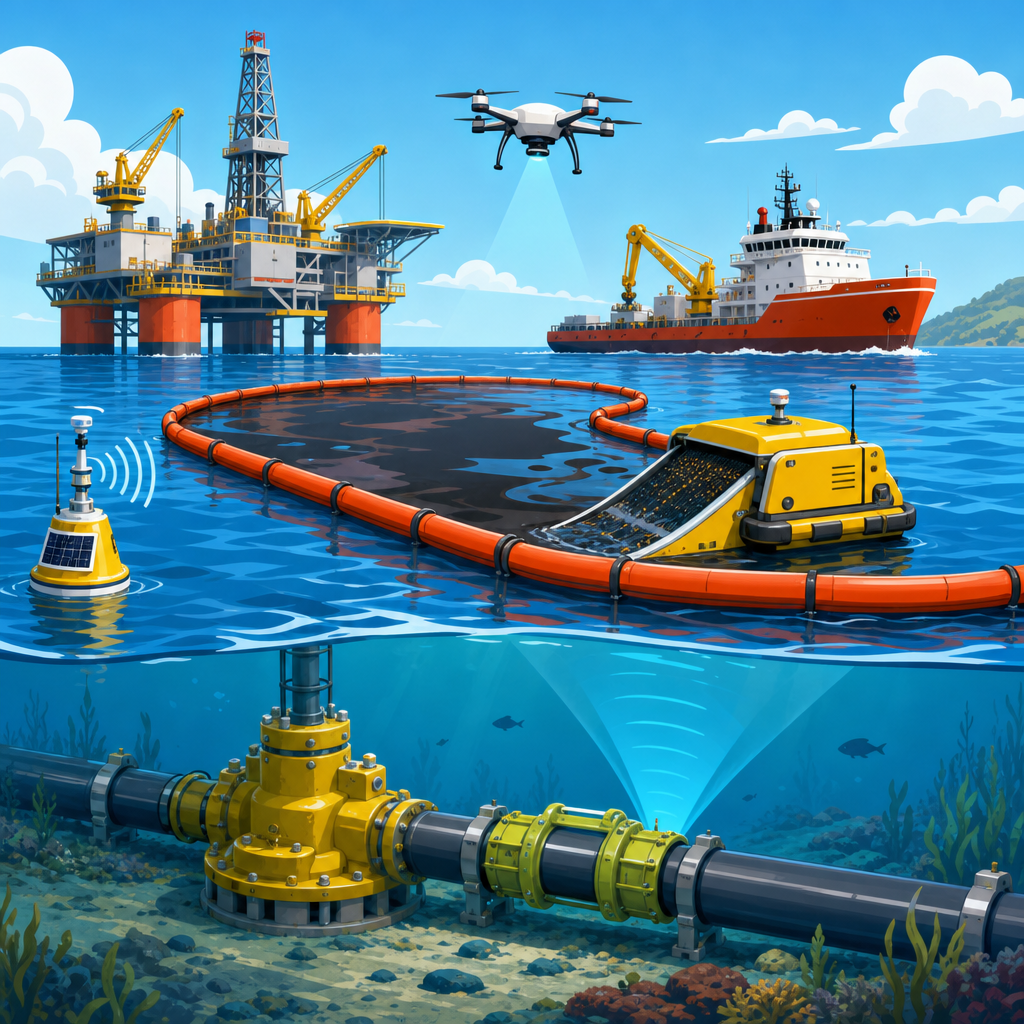
Oil spill prevention technology has advanced from basic containment gear to integrated systems that detect risk early, reduce human error, and harden offshore, marine, and industrial operations before a release begins. In the environmental disasters field, “prevention” means stopping a spill at the source through design, monitoring, maintenance, training, and operational controls, while “oil spills and industrial accidents” covers tanker incidents, offshore blowouts, pipeline leaks, refinery failures, storage tank overflows, and transfer mishaps at ports and terminals. This subtopic matters because cleanup is always costlier, slower, and less certain than prevention; once oil reaches water, wetlands, soil, or groundwater, ecological harm can persist for years. I have worked with incident reporting, contractor audits, and risk reviews around fuel storage and marine transfer systems, and the same lesson repeats across sectors: the best technology is the one embedded into routine operations, not deployed only after alarms sound. Today’s most effective solutions combine sensors, automation, materials engineering, predictive maintenance, emergency shutdown architecture, and disciplined management systems aligned with standards from bodies such as the International Maritime Organization, the American Petroleum Institute, and OSHA. For readers exploring environmental disasters, this hub explains what is working now, where the limits remain, and how modern spill prevention connects offshore safety, pipeline integrity, industrial reliability, and regulatory compliance into one practical strategy.
How modern spill prevention starts with risk identification
Effective oil spill prevention begins long before a vessel loads crude or a pipeline starts pumping. Operators now rely on formal hazard identification methods including HAZOP studies, bow-tie analysis, layers of protection analysis, and quantitative risk assessment to map where a loss of containment could occur. In plain terms, these tools force teams to ask what can fail, what warning signs appear first, which barriers should stop escalation, and what backup exists if the first barrier fails. In offshore facilities, this means examining blowout preventer reliability, well control procedures, mud weight management, and gas detection coverage. In terminals, it means studying hose integrity, overfill protection, manifold pressure, mooring loads, and emergency release systems. In refineries and tank farms, it means focusing on corrosion under insulation, seal failures, tank overfill scenarios, and contractor work near live equipment.
What is working today is the move from static paperwork to live risk registers tied to maintenance systems and operating data. A pipeline operator that tracks pressure excursions, corrosion coupon data, in-line inspection results, and valve failure history can revise risk rankings continuously rather than waiting for annual reviews. The same applies in shipping. Electronic navigation, weather routing, automatic identification system data, and bridge decision support tools have reduced some collision and grounding risks, especially in congested waterways. The strongest prevention programs also treat near misses as leading indicators. A small flange seep, repeated nuisance alarms, or a transfer shutdown caused by communication failure may not produce headlines, but each one reveals a weak barrier. Organizations that investigate those signals rigorously prevent larger releases later.
Smart sensors, leak detection, and real-time monitoring
Among the most useful prevention technologies in service now are continuous monitoring systems that detect abnormal conditions before product escapes in large volumes. Pipelines use computational pipeline monitoring, fiber optic sensing, acoustic leak detection, mass balance systems, and negative pressure wave detection. No single method is perfect. Mass balance can miss small leaks during transient flow conditions, while acoustic systems may generate false positives in noisy environments. The best-performing operators layer methods so one system confirms another. Fiber optic distributed temperature and acoustic sensing is especially valuable on high-consequence routes because it can identify digging activity, ground movement, or the sound signature of a release across long distances.
Storage terminals and refineries increasingly deploy radar tank gauging, independent high-level alarms, automatic shutoff valves, and digital twins that compare expected process conditions with live readings. Overfill prevention has improved substantially because newer systems separate basic control from independent protection. That distinction matters. If the same instrument both controls filling and acts as the emergency safeguard, one hidden fault can defeat both functions. Independent alarms, proof testing, and safety instrumented systems reduce that risk. Offshore, subsea sensors monitor pressure, temperature, and valve position, while remotely operated vehicles and autonomous underwater vehicles inspect infrastructure that divers cannot routinely access. Drones equipped with optical gas imaging, thermal cameras, and high-resolution video now support tank roof inspections, flare line checks, and marine terminal surveys without exposing workers to unnecessary hazards.
Remote visibility also improves decision quality during bad weather or staffing shortages. In my experience, operators become more disciplined when leak indications, valve positions, and permit status are visible to control rooms, field teams, and management at the same time. Shared situational awareness reduces the delay between anomaly detection and action, which is critical because minutes often determine whether an incident stays contained or becomes a reportable spill.
Automation, shutdown systems, and engineered barriers
Prevention technology works best when it does not depend entirely on flawless human response. That is why automation and engineered barriers remain central to reducing oil spills and industrial accidents. Emergency shutdown systems isolate equipment rapidly when pressure, flow, level, fire, or gas readings exceed safe limits. On offshore platforms and floating production units, shutdown logic can close subsea isolation valves, stop pumps, and segment process trains in seconds. At loading terminals, emergency release couplings and powered quick-connect systems help prevent spills if a ship moves unexpectedly under wind, current, or mooring failure. Double-hull tanker design, mandated widely after major historical spills, remains one of the clearest examples of engineering reducing consequences during collisions and groundings.
Blowout preventers are another essential barrier, though their limitations are well documented. Modern systems include redundant control pods, condition monitoring, and stricter testing protocols, but reliability still depends on maintenance quality, crew competence, and realistic emergency drills. The lesson is not that technology fails, but that critical equipment must be designed, tested, and operated as part of a complete barrier strategy. Secondary containment around tanks, impermeable liners, drip trays at transfer points, and closed drain systems also continue to work because they address ordinary failures such as hose leaks, valve misalignment, and seal degradation. These controls are not glamorous, but they stop many real spills.
| Technology | Where it is used | Main prevention benefit | Key limitation |
|---|---|---|---|
| Fiber optic leak detection | Pipelines, subsea lines | Early detection of leaks and third-party interference | High installation cost on legacy systems |
| Independent high-level alarms | Tank farms, terminals | Prevents overfill when basic controls fail | Requires proof testing and disciplined bypass control |
| Emergency shutdown systems | Offshore platforms, refineries, terminals | Rapid isolation reduces spill volume | Can be undermined by poor logic design or maintenance |
| Double-hull design | Tankers, barges | Reduces outflow after collision or grounding | Does not prevent operational transfer spills |
Predictive maintenance and asset integrity in high-risk systems
Many oil spills begin as ordinary reliability problems that were visible months earlier. Corrosion, vibration, fatigue cracking, gasket aging, coating breakdown, instrument drift, and seal wear all leave evidence before containment is lost. What is working today is the combination of inspection technologies with predictive analytics and risk-based maintenance planning. Operators use ultrasonic thickness testing, guided wave ultrasonics, magnetic flux leakage tools, smart pigging, infrared thermography, vibration analysis, and corrosion monitoring probes to see degradation earlier and prioritize repairs by consequence. API 570 for piping inspection, API 653 for aboveground storage tanks, and API 580 and 581 for risk-based inspection provide useful frameworks for turning raw condition data into action.
Pipeline integrity programs are stronger when they combine internal inspection runs with direct assessment, hydrotesting where appropriate, geohazard mapping, and right-of-way surveillance. In practice, this means the operator is not just looking for metal loss but also dents, seam defects, stress corrosion cracking, landslide exposure, and unauthorized excavation. At tank farms, floor scanning and settlement monitoring can prevent releases that would otherwise emerge slowly into soil and groundwater. In refineries, machine learning models increasingly help forecast pump seal failure or exchanger fouling, but these tools are only as good as the maintenance culture around them. If planners ignore bad actor equipment because production targets dominate every discussion, analytics become decoration rather than protection.
I have seen strong results when companies classify equipment by criticality and require management approval to defer inspection or repair on high-consequence assets. That simple governance step prevents routine schedule pressure from eroding barriers. Predictive maintenance does not eliminate spills by itself, but it shifts organizations from reacting to breakdowns toward managing deterioration systematically.
Human factors, training, and operational discipline
Technology prevents more spills when it is designed for real people working in real conditions. Human factors engineering addresses alarm overload, poor interface design, ambiguous procedures, fatigue, communication failures, and maintenance error. Many industrial accidents involve capable workers navigating badly designed systems. Modern control rooms use alarm rationalization, clearer graphics, and priority schemes so operators can distinguish nuisance signals from true threats. Permit-to-work software, digital shift handovers, and electronic checklists reduce omissions during startup, shutdown, confined space entry, and hot work near hydrocarbon systems.
Marine and terminal transfers remain especially sensitive to communication quality. A significant number of spills still occur during bunkering, loading, unloading, and hose connection activities because one party assumes a valve is shut, a tank has capacity, or pumping will stop on verbal instruction alone. What works is a standardized pre-transfer conference, closed-loop communication, verified line-up checks, independent level confirmation, and a tested emergency stop protocol shared by ship and shore. Training is most effective when it is scenario-based rather than generic. Crews should rehearse realistic situations such as sudden weather change during transfer, loss of radar level indication, manifold gasket failure, or a vessel surge at berth.
Contractor management is another underappreciated control. During turnarounds and construction work, unfamiliar personnel often interact with live systems under schedule pressure. Companies with lower incident rates usually enforce stricter competency verification, simultaneous operations reviews, and field supervision during these periods. Prevention is not just about better hardware; it is about making the safe action the easy action.
Regulation, industry standards, and the future of spill prevention
Current prevention performance is shaped as much by regulation and standards as by hardware. The International Convention for the Prevention of Pollution from Ships, commonly known as MARPOL, sets baseline discharge rules and equipment requirements for ships. In the United States, the Oil Pollution Act, EPA spill prevention requirements, Coast Guard rules, PHMSA pipeline regulations, and OSHA process safety management all influence design, inspections, training, and emergency planning. After major incidents, regulators often tighten expectations around independent protection, safety culture, and verification of critical barriers. Companies that treat compliance as a floor rather than a ceiling generally perform better because they build resilience beyond minimum rules.
Looking ahead, the technologies with the greatest practical value are not necessarily the most futuristic. Better satellite monitoring can identify slicks faster, but preventing spills more often comes from combining robust design with trustworthy operational data. Artificial intelligence will help prioritize anomalies, detect inspection patterns humans miss, and optimize maintenance schedules. Robotics will expand inspection in hazardous areas. New materials, including improved coatings and composite repair systems, will extend asset life. Yet the core principle will remain unchanged: spills are prevented when organizations identify credible failure modes, maintain independent barriers, respond early to weak signals, and enforce operational discipline every day.
For anyone navigating the broader environmental disasters landscape, oil spills and industrial accidents deserve hub-level attention because they sit at the intersection of energy systems, transportation, ecology, and public safety. The evidence from shipping, offshore production, pipelines, refineries, and terminals is clear. What is working today includes layered leak detection, automated shutdowns, overfill protection, predictive maintenance, double-hull design, risk-based inspection, and training built around human performance. None of these measures is sufficient alone, and every one has limits, but together they reduce both the likelihood and severity of releases in measurable ways. If you are building knowledge in this subtopic, use this hub as your starting point, then go deeper into offshore blowout prevention, pipeline leak detection, tanker safety, storage tank integrity, and industrial incident investigation to strengthen prevention where it matters most.
Frequently Asked Questions
1. What does oil spill prevention technology include today?
Today’s oil spill prevention technology is much broader than booms, skimmers, and other response tools used after a release. In modern environmental risk management, prevention means stopping a spill before oil ever escapes into water, soil, or surrounding infrastructure. That includes engineered safeguards such as blowout preventers, double-hulled tankers, automatic shutoff valves, overfill protection systems, corrosion-resistant materials, leak detection sensors, pressure monitoring, and secondary containment. It also includes digital systems that continuously watch for abnormal operating conditions, using real-time data from pumps, pipelines, storage tanks, offshore wells, and marine transfer operations.
What is working best today is the integration of these layers rather than reliance on any single device. Operators increasingly combine sensor networks, remote monitoring, predictive maintenance software, vessel navigation systems, and operational control procedures to catch small warning signs early. For example, a pressure change in a pipeline, an abnormal vibration pattern in a pump, or a navigation deviation near a sensitive transfer zone can trigger alerts before those issues become full-scale incidents. In practice, the strongest prevention programs blend equipment design, human oversight, automated controls, training, and emergency shutdown capability into one system. That layered approach is now considered the most effective way to reduce spill risk across offshore, marine, pipeline, terminal, and refinery environments.
2. Which technologies are proving most effective at preventing spills at the source?
Several technologies are consistently delivering strong results because they address the most common causes of spills: equipment failure, corrosion, overpressure, navigation errors, and human mistakes. In pipelines and fixed facilities, continuous leak detection systems are especially important. These systems use flow balance, pressure analysis, acoustic monitoring, fiber-optic sensing, and thermal or infrared tools to identify possible leaks quickly. Smart pigging and in-line inspection tools are also highly effective because they find corrosion, cracking, dents, and wall loss before a line fails. In tanks and terminals, automatic overfill prevention, level monitoring, shutdown interlocks, and valve position verification help stop releases during storage and transfer operations.
In offshore operations, blowout prevention systems remain a central safeguard, but their effectiveness depends on rigorous maintenance, testing, redundancy, and operator readiness. Dynamic positioning systems, subsea sensors, well integrity monitoring, and remote-operated safety controls also play a major role in preventing incidents tied to drilling and production. In marine transportation, modern bridge systems, electronic charting, AIS vessel tracking, collision avoidance tools, and fatigue management measures are helping reduce grounding and collision risk. Just as important are maintenance platforms powered by analytics, which can predict component degradation before a failure occurs. The technologies working best today are the ones tied to actionable decisions: they do not just generate data, they trigger inspections, shutdowns, maintenance, route corrections, or operating limits that prevent a spill from starting.
3. How are automation and artificial intelligence improving oil spill prevention?
Automation and artificial intelligence are improving prevention by detecting weak signals that humans can miss, reducing response time, and standardizing critical decisions under pressure. In complex industrial systems, operators may be watching thousands of data points at once. AI-based monitoring platforms can analyze trends in flow, pressure, temperature, vibration, corrosion rates, weather conditions, and equipment performance continuously, then flag patterns associated with elevated spill risk. That matters because many serious incidents are preceded by small anomalies that seem minor on their own but become meaningful when viewed together. Machine learning tools are especially useful for predictive maintenance, where they estimate when a seal, valve, pump, pipe segment, or rotating asset is likely to fail if conditions continue.
Automation is also helping by reducing dependence on manual intervention during high-risk operations. Automated shutdown systems, emergency isolation valves, overfill cutoffs, and transfer interlocks can act faster than a person when a threshold is crossed. In offshore and marine settings, automated navigation support, weather-based routing, and station-keeping controls reduce the chance of accidents caused by drift, collision, or poor situational awareness. That said, AI is most effective when it supports trained operators rather than replaces them. Good prevention programs use automation to improve visibility and speed while keeping human judgment central for confirmation, escalation, and complex problem-solving. The current best practice is human-machine collaboration: software identifies risk earlier, and experienced teams use that information to intervene before a release occurs.
4. Why do human factors still matter so much if prevention technology is getting better?
Human factors still matter because most prevention technologies only work as intended when they are correctly installed, maintained, interpreted, and acted on. Even highly advanced systems can be undermined by poor procedures, alarm overload, weak safety culture, inconsistent inspections, skipped maintenance, communication failures, or inadequate training during shift changes and high-risk tasks. Many oil spills and industrial accidents are not caused by one dramatic equipment breakdown alone; they result from a chain of smaller failures involving decisions, supervision, fatigue, workload, or misunderstanding of warning signs. That is why leading prevention strategies now treat human reliability as part of the technology stack, not as a separate issue.
What is working today is a stronger focus on operational discipline. That includes simulation-based training, permit-to-work controls, standardized transfer checklists, competency verification, alarm management, fatigue reduction, and clearer escalation rules when something looks abnormal. Companies are also redesigning control rooms, dashboards, and interfaces so personnel can understand risks faster and avoid missing critical alerts. In other words, prevention is no longer just about having better hardware; it is about making it easier for people to make the right decision at the right moment. The most effective organizations combine robust engineering with strong reporting culture, regular drills, maintenance accountability, and lessons learned from near misses. Technology lowers risk, but people still determine whether early warnings become timely action.
5. What is the biggest challenge in modern oil spill prevention, and what is working to address it?
The biggest challenge is managing complexity across aging infrastructure, harsh operating environments, and interconnected systems that span offshore platforms, tankers, pipelines, terminals, and refineries. Many operators are trying to improve prevention while dealing with older assets, remote locations, extreme weather, corrosion exposure, and rising expectations for environmental performance and regulatory compliance. Another major challenge is that prevention often depends on seeing the full picture. A leak detection system may work well, for example, but if its alerts are not connected to maintenance planning, field verification, or automatic isolation capability, valuable time can still be lost. The same is true when companies have strong equipment standards but weak contractor oversight or inconsistent procedures during transfers and startup-shutdown events.
What is working is a systems-based approach. Instead of treating spill risk as a single-point equipment problem, leading operators are connecting integrity management, digital monitoring, crew training, inspection records, emergency shutdown logic, and operational controls into one prevention framework. Risk-based inspection programs help prioritize the assets most likely to fail. Digital twins and asset integrity software provide a clearer picture of equipment condition over time. Remote sensing, drones, subsea monitoring, and satellite support improve visibility in places where direct inspection is difficult. Perhaps most importantly, organizations are using near-miss reporting and incident learning more proactively, correcting weaknesses before they produce a release. The lesson from today’s most effective prevention programs is clear: the best technology is not just the newest tool, but the one embedded in a disciplined system that detects risk early, reduces uncertainty, and acts before oil reaches the environment.