
Post-Chernobyl ecology examines how plants, animals, soils, rivers, and people interact in landscapes contaminated by radioactive fallout after the 1986 Chernobyl nuclear disaster. The Chernobyl Exclusion Zone, spanning parts of northern Ukraine and southern Belarus, is often described in simple terms: either a dead wasteland or a thriving wildlife refuge. After years of reading field reports, tracking camera-survey results, and comparing contamination maps with species records, I can say neither version is fully accurate. The zone is a large, uneven, scientifically valuable case study showing how ecosystems respond when chronic radiation exposure and sudden human withdrawal occur at the same time.
That tension matters far beyond Ukraine. Chernobyl is one of the world’s most important environmental disaster case studies because it forces a hard question: what harms wildlife more, industrial society or persistent contamination? The answer depends on species, location, dose rate, season, and the ecological process being measured. “Wildlife” here includes large mammals such as wolves, elk, and boar, but also birds, insects, microbes, fungi, amphibians, and forest communities. “Ecology” means more than counting animals. It includes reproduction, mutation, food webs, decomposition, fire risk, habitat succession, and long-term population viability. Understanding those distinctions is essential for anyone studying environmental disasters through global case studies.
The exclusion zone functions as a hub example because it connects multiple themes found across environmental disasters worldwide: toxic legacy, land abandonment, contested science, uneven recovery, and the difference between visible return and full biological health. It also highlights why broad claims fail. A camera trap image of a healthy lynx does not prove radiation is harmless, and a documented genetic effect in barn swallows does not mean all wildlife is collapsing. Good analysis separates abundance from fitness, local hotspots from regional averages, and short-term observations from multidecade trends. That disciplined approach is what makes post-Chernobyl ecology one of the most useful reference points in the wider field of global case studies.
For readers using this page as a hub, Chernobyl also helps frame comparisons with Fukushima, Minamata, Deepwater Horizon, Bhopal, the Aral Sea, and other disasters where ecosystems changed under combined chemical, physical, and social pressures. In each case, researchers ask similar questions: What exposure pathways matter most? Which species are resilient? How do abandoned or restored landscapes evolve? When does recovery mean true ecological repair, and when does it simply mean reduced human presence? Chernobyl remains unusually important because the contamination is long-lived, the study area is vast, and the wildlife response is visible enough to attract public attention while still complex enough to challenge easy conclusions.
How the Exclusion Zone Became an Ecological Laboratory
The 1986 reactor explosion and fire at Unit 4 released a mixture of radionuclides, including iodine-131, cesium-137, strontium-90, and plutonium isotopes. Iodine-131 drove acute early health concerns because of its short half-life and uptake through milk, but for long-term ecology the most discussed contaminants are cesium-137 and strontium-90. Cesium behaves chemically like potassium and can move through soils, plants, fungi, and animal tissues. Strontium behaves more like calcium and can accumulate in bones. Fallout was highly patchy. Wind, rainfall, topography, and forest cover created hotspots and lower-dose areas, which is why two nearby sites can produce very different ecological findings.
The exclusion zone now covers roughly 2,600 square kilometers in Ukraine, with adjacent contaminated territories in Belarus forming a broader transboundary landscape. Human evacuation drastically reduced farming, logging, road traffic, hunting, and settlement density. From an ecological perspective, that human retreat was transformative. Old villages became overgrown. Fields reverted to grassland and then scrub or forest. Wetlands persisted where drainage systems failed. Predators gained space, ungulates moved more freely, and disturbance patterns changed. In practical fieldwork terms, this means radiation is only one variable. Habitat regeneration and the absence of routine human pressure are equally important drivers of wildlife patterns.
Scientists use the zone as a natural laboratory because few places offer such a stark combination of contamination gradient and land-use change. Research methods include dosimetry, radioecological sampling, aerial surveys, track counts, camera traps, bird censuses, small mammal trapping, genetic assays, and remote sensing. Agencies and organizations such as the International Atomic Energy Agency, UNSCEAR, and national research institutes have all contributed data, though conclusions sometimes differ because they focus on different endpoints. Population presence, for example, is easier to document than subtle reproductive damage. That difference explains much of the public confusion surrounding claims that wildlife has either recovered completely or remains broadly impaired.
What Happened to Mammals After People Left
Large mammals are central to the public image of post-Chernobyl wildlife. Elk, roe deer, red deer, wild boar, wolves, beavers, raccoon dogs, foxes, and lynx are all recorded in the region, and European bison and Przewalski’s horse have also been associated with the wider contaminated landscape. In my review of field studies, the most defensible statement is this: many medium and large mammal populations increased after human evacuation, largely because hunting, agriculture, and settlement pressures declined. This does not mean radiation had no effect. It means reduced human disturbance created a powerful ecological release that can be stronger, at least for some mammals, than the negative effects of chronic exposure.
A frequently cited example comes from surveys indicating that wolf density in parts of the exclusion zone may exceed that of nearby protected areas. Beavers expanded as wetlands and riparian corridors became less disturbed. Wild boar benefited from abandoned farmland and forest edge habitat, though their numbers can fluctuate sharply due to disease, mast years, and winter severity. These are standard ecological drivers, and they still operate in contaminated landscapes. Mammals also move across contamination gradients rather than remaining fixed in one hotspot, which complicates any attempt to assign a single dose-response outcome to an entire population.
Still, mammal recovery should not be overstated. Population abundance is not the same as individual health. Researchers have examined cataracts, developmental effects, reproductive changes, and tissue contamination in different species, with mixed results. Some animals accumulate radionuclides through mushrooms, roots, invertebrates, or aquatic food chains. Wild boar are especially known in parts of Europe for persistent radiocesium burdens because fungi and soil pathways remain active decades later. In other words, visible presence can coexist with invisible physiological cost. Chernobyl teaches that ecological success must be measured at multiple levels, from occupancy and behavior to survival, fertility, and genetic integrity.
Birds, Insects, and the Debate Over Hidden Damage
Smaller organisms often reveal impacts that charismatic mammals can obscure. Birds have been intensively studied in the exclusion zone because they are diverse, abundant, and relatively easy to survey. Some researchers reported lower bird abundance and diversity in highly contaminated areas, along with elevated rates of abnormalities such as albinism, tumor incidence, or reduced brain size in selected populations. Barn swallows became one of the best-known examples because long-term observations suggested radiation-related developmental and reproductive stress. These findings attracted attention because birds can act as indicators of ecosystem condition, especially where food availability, nesting success, and migration all intersect with contaminant exposure.
Other studies, however, found more variable results, emphasizing habitat structure and land-use change as strong predictors of bird distribution. This disagreement is not just academic. It reflects methodological challenges that apply across global environmental disaster case studies. If a contaminated site also differs in forest age, wetness, fire history, or observer access, then radiation effects can be misread. Insects present similar complexity. Some studies reported reduced pollinator abundance and decomposition rates in more contaminated plots, suggesting slower nutrient cycling and altered ecosystem function. Yet insect populations also swing with temperature, moisture, vegetation, and year-to-year weather, making simple narratives unreliable.
| Ecological question | Common finding in the exclusion zone | Main caution |
|---|---|---|
| Are large mammals present? | Yes, many species are widespread and sometimes abundant | Presence does not prove absence of physiological harm |
| Do birds show damage? | Some studies report lower abundance and developmental stress in hotspots | Habitat differences can confound radiation effects |
| Are food webs contaminated? | Yes, especially through soils, fungi, and wetlands | Transfer varies greatly by species and season |
| Has nature “recovered”? | Partly, in terms of rewilding and habitat use | Recovery is uneven and not equivalent to full ecological health |
The broader lesson is that post-Chernobyl ecology cannot be judged by a single species group. Large mammals may flourish demographically while birds or invertebrates register sublethal stress. Soil microbes may shift in ways that alter decomposition. Scavengers may redistribute contaminants through carcasses. The exclusion zone remains scientifically important precisely because it shows how disaster ecology works at different speeds and scales. Readers exploring related global case studies should carry this principle forward: visible return is real, but hidden damage can also be real, and both can occur in the same landscape.
Forests, Fire, Water, and Long-Term Radioecology
Forests dominate much of the exclusion zone, and they are central to long-term risk. The “Red Forest,” where pine stands near the reactor died after acute radiation exposure, remains the most iconic example of severe ecological damage. Over time, dead stands were replaced by new vegetation, but forest recovery did not erase contamination. Organic litter, roots, fungi, and mineral soils continue to store radionuclides. As a result, forests act both as habitat and as contaminant reservoirs. This is why radioecology in Chernobyl is inseparable from fire management. When contaminated biomass burns, radionuclides can be resuspended in smoke and ash, creating renewed exposure risks for ecosystems and nearby communities.
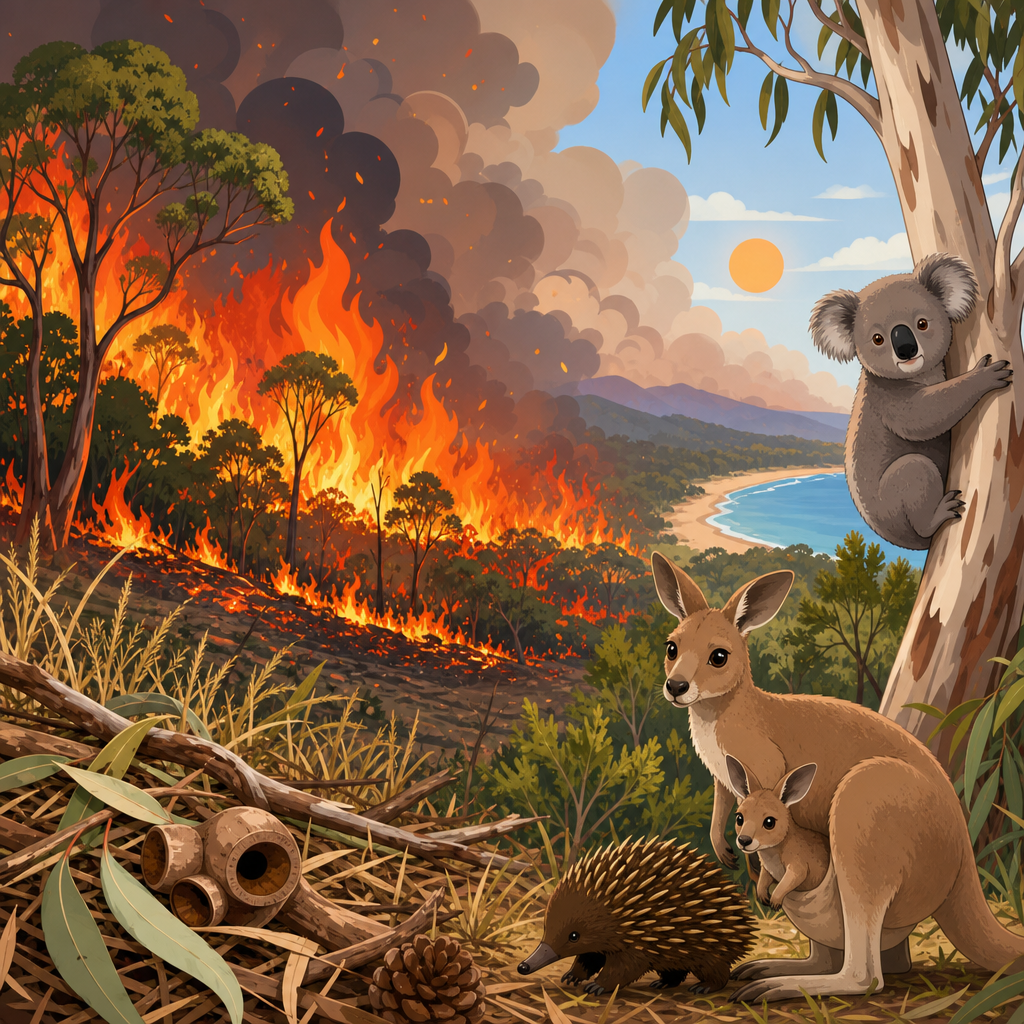
Wildfire has become one of the most important post-disaster ecological concerns in the zone. Major fires in recent years showed that abandoned landscapes can accumulate fuel loads, especially where management is limited by access, funding, or radiological safety constraints. Satellite monitoring, airborne surveys, and ground measurements are now standard tools for assessing burn extent and smoke transport. Although most resuspended contamination events are far smaller than the 1986 release, they are not trivial. Fire also reshapes habitat, alters succession, and changes wildlife movement. In this sense, Chernobyl is not a static accident site. It is an evolving disturbance landscape where radiation, climate, vegetation, and management interact.
Aquatic systems add another layer. Rivers, floodplains, ponds, and cooling channels can transport radionuclides through sediments and food webs. Fish, amphibians, aquatic plants, and invertebrates are exposed through both water and diet, while seasonal flooding can redistribute contaminated particles across wetlands. Some water bodies show declining concentrations over time, but legacy contamination remains relevant, especially in sediments. This matters for wider environmental disaster studies because it demonstrates a recurring pattern: contaminants often move slowly, settle unevenly, and re-enter biological systems long after the original event has left the headlines.
What Chernobyl Teaches Other Global Environmental Disaster Case Studies
As a hub within global case studies, Chernobyl is most useful when compared carefully rather than mythologized. Fukushima Daiichi offers the closest parallel in nuclear terms, yet the ecological context differs in geography, land use, evacuation pattern, decontamination strategy, and contaminant distribution. Minamata shows how mercury can biomagnify through aquatic food webs and devastate both wildlife and human health. Deepwater Horizon reveals how oil exposure affects marshes, fisheries, birds, and long-tail restoration timelines. Bhopal demonstrates the ecological and public health consequences of industrial toxic release in a densely inhabited landscape. The Aral Sea crisis illustrates how hydrological engineering can collapse fisheries, generate toxic dust, and transform regional climate and livelihoods.
Across these examples, three lessons recur. First, disaster impacts are shaped by exposure pathway, not just by the headline pollutant. Second, ecological recovery is rarely linear; some species rebound quickly while others experience delayed or hidden harm. Third, social decisions after the event matter enormously. Evacuation, land access, cleanup standards, compensation, hunting rules, and fire management all influence ecological outcomes. Chernobyl stands out because human absence created conditions for rewilding at the same time that radiation continued to impose biological stress. That combination makes it a powerful comparison point for anyone studying environmental disasters through a global lens.
The clearest takeaway is that the exclusion zone is neither a pristine sanctuary nor a biological void. It is a functioning, contaminated ecosystem where many animals thrive in demographic terms, some organisms show measurable damage, and landscape processes continue to redistribute risk. That balanced interpretation is the most useful one for students, researchers, and general readers following global case studies in environmental disasters. If you are building out this topic cluster, use Chernobyl as the reference hub for questions about contamination, rewilding, ecosystem tradeoffs, and long-term monitoring. Then compare each new case study against those same themes to understand what truly drives ecological resilience or decline.
Frequently Asked Questions
Is the Chernobyl Exclusion Zone a dead wasteland or a thriving wildlife sanctuary?
Neither description is fully accurate. The Chernobyl Exclusion Zone is best understood as a complex, uneven landscape where ecological recovery, chronic contamination, habitat change, and reduced human pressure all operate at the same time. Since the 1986 disaster, many areas have seen forests regenerate, fields revert to shrubland and woodland, and wetlands continue to support birds, amphibians, and aquatic life. Camera traps, track surveys, and field observations have documented wolves, boar, elk, deer, foxes, beavers, lynx in some areas, and a wide range of bird species across the region.
At the same time, radiation has not disappeared, and its effects are not uniform. Some hotspots remain highly contaminated, especially in certain soils, forest litter, and sediments. Organisms living in these places may experience long-term exposure through food, water, and direct contact with contaminated ground. Effects can vary by species, by life stage, by season, and by where an animal feeds or nests. So the Zone is not empty of life, but it is also not a pristine refuge untouched by harm. It is a living, dynamic system shaped both by the absence of intensive human activity and by the lingering consequences of radioactive fallout.
How has wildlife been able to return and persist in a radioactive landscape?
Wildlife persistence in the Exclusion Zone is largely tied to one major ecological shift: people largely left, and many of the pressures associated with farming, forestry, settlement, traffic, hunting, and industrial land use dropped dramatically. When villages were abandoned, cultivated land often transitioned into grassland, scrub, and young forest, creating habitat mosaics that can benefit many species. Large mammals in particular often respond strongly to reduced human disturbance, and this helps explain why some populations appear stable or even relatively abundant in portions of the Zone.
That does not mean radiation is harmless or irrelevant. It means that ecosystems respond to multiple forces at once. In some places, the ecological benefits of reduced human activity may partially offset the costs of chronic contamination, at least for certain species and over certain timescales. Species with large home ranges may move through cleaner and more contaminated patches rather than remaining in a single hotspot. Others may tolerate exposure better than expected, while more sensitive species or individuals may experience reduced survival, lower fertility, developmental problems, or altered behavior. The result is not a simple story of “nature healing itself,” but a more nuanced one in which wildlife recovery and radiation stress coexist.
What kinds of radiation effects have scientists found in plants and animals in the Exclusion Zone?
Researchers have reported a wide spectrum of effects, and the scientific picture is often more complicated than headlines suggest. In plants, radiation can influence growth, reproduction, mutation rates, and community composition, especially in heavily contaminated areas. Some forests experienced severe damage immediately after the accident, most famously the “Red Forest,” where high doses killed large numbers of pine trees. In animals, studies have examined reproductive success, cataracts, immune function, oxidative stress, genetic damage, developmental abnormalities, and population trends. Birds, insects, rodents, amphibians, and large mammals have all been studied, but findings are not always consistent across taxa or study methods.
Part of the challenge is that ecological effects are shaped by many overlapping variables: soil type, fire history, moisture, food availability, predator-prey dynamics, migration, and differences in how radionuclides move through food webs. Cesium-137 and strontium-90, for example, behave differently in soils and organisms, and internal exposure from contaminated food can matter as much as external exposure from the environment. Some studies have found measurable negative effects in more contaminated sites, while others have shown that populations still persist or even expand at the landscape level. The most responsible summary is that radiation can and does affect living systems in the Zone, but those effects are patchy, species-specific, and often difficult to separate from other ecological pressures.
Are animals in Chernobyl dangerously radioactive, and is it safe for them to move beyond the Exclusion Zone?
Some animals in the Zone do carry radioactive contaminants in their bodies, particularly if they feed on contaminated plants, fungi, invertebrates, or sediments. Wild boar are a well-known example in Europe because they can accumulate cesium through diet, especially when rooting in soil or eating fungi and underground food sources. However, contamination levels are not the same in every species, every habitat, or every individual. An animal’s radioactivity depends on where it has been feeding, what it eats, how contamination is distributed in the landscape, and how radionuclides cycle through local ecosystems.
As for movement beyond the Zone, animals do not recognize political or administrative boundaries, and some do disperse in and out of surrounding regions. That said, movement alone does not mean they automatically pose a broad environmental or public health threat. Monitoring, food safety regulations, and wildlife management practices are designed to track contamination where it matters most, particularly in hunted game and in agricultural areas. The greater scientific concern is usually not that wildlife is “spreading Chernobyl” in some dramatic way, but rather that radionuclides continue to circulate through certain food webs and habitats over long periods. In short, some animals can be measurably contaminated, but the issue is ecological and regulatory, not a simple movie-style scenario of radioactive animals roaming outward.
What does the Chernobyl Exclusion Zone teach us about ecology, conservation, and human impact?
The Zone is one of the world’s most unusual large-scale ecological case studies because it reveals two powerful truths at once. First, ecosystems can be remarkably resilient when direct human pressure declines. Forests regrow, wetlands remain active, and many animal species can recolonize or persist even in landscapes associated with severe industrial disaster. Second, resilience is not the same as full recovery. Radioactive contamination continues to influence soils, food webs, fire risk, and organism health, and these effects can persist for decades. The Zone therefore challenges simplistic conservation stories that treat “more wildlife” as proof that an ecosystem is entirely healthy.
It also reminds us that human influence extends beyond visible infrastructure. The disaster altered land use, settlement patterns, hydrology, forest management, and contamination pathways across a broad region. In many ways, the Exclusion Zone is a living laboratory for understanding chronic pollution, rewilding, abandoned landscapes, and the tradeoffs between human absence and environmental damage. For conservationists and ecologists, the key lesson is not that nuclear accidents create nature preserves. It is that ecological outcomes depend on multiple interacting pressures, and if we want to understand biodiversity honestly, we have to measure both the harms of contamination and the profound effects of reducing everyday human disturbance.