
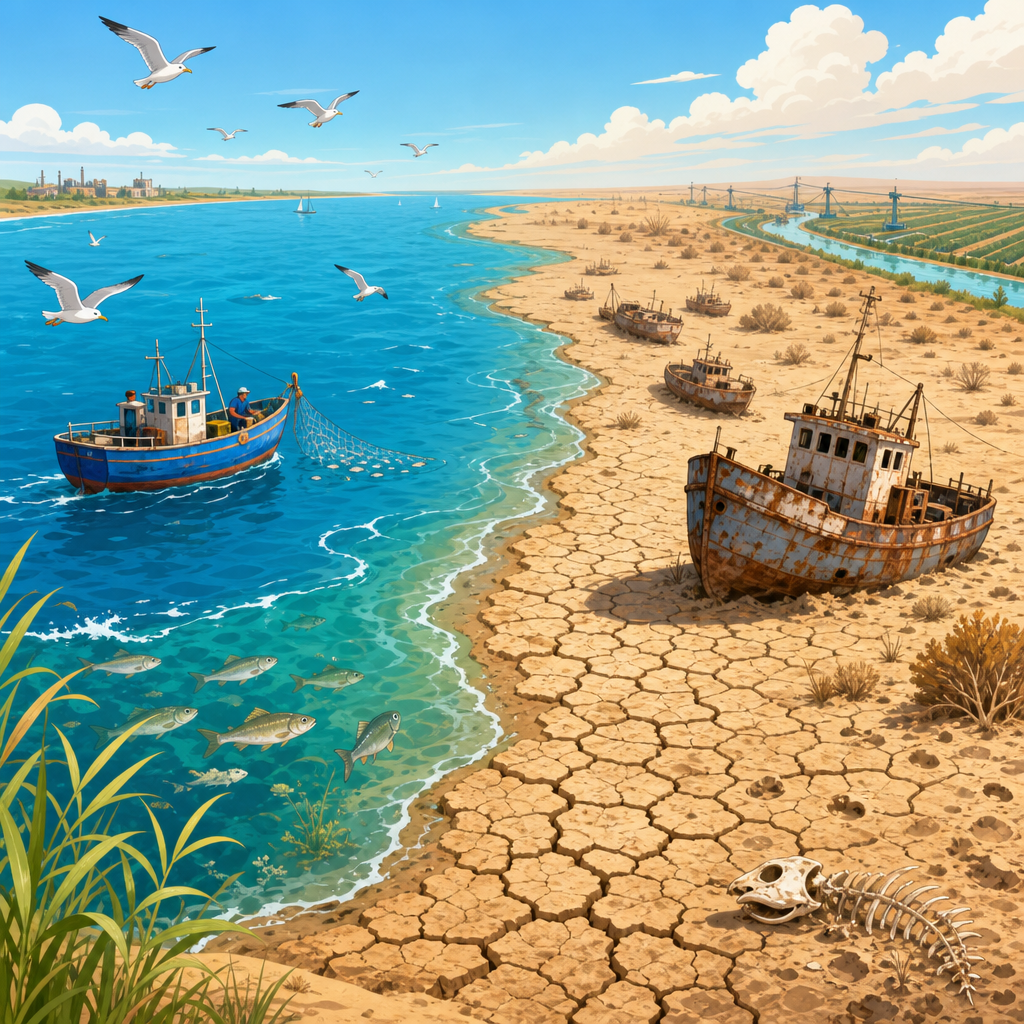
The Aral Sea disaster is one of the clearest examples of how state planning, water mismanagement, and ecological neglect can destroy an entire region within a single human lifetime. Once the world’s fourth-largest inland lake, the Aral Sea lay between Kazakhstan and Uzbekistan and supported thriving fishing towns, wetlands, and local climates moderated by its vast body of water. Today, much of it has become the Aralkum Desert, a toxic landscape of exposed seabed, salt, pesticide residues, and abandoned ships. For anyone studying environmental disasters, this case stands as a foundational global case study because it connects hydrology, agriculture, public health, economics, and geopolitics in one stark story.
At its core, the Aral Sea disaster began with river diversion. Two major rivers, the Amu Darya and the Syr Darya, historically fed the sea. During the Soviet era, especially from the 1960s onward, planners expanded massive irrigation systems to turn Central Asia into a cotton-producing powerhouse. Water that once reached the Aral Sea was rerouted through canals, reservoirs, and poorly engineered distribution networks. In official terms, this was an irrigation-led development strategy. In practical terms, it meant the sea was starved of inflow year after year until shrinkage became unavoidable.
Why does this disaster matter beyond Central Asia? Because the same pattern appears in environmental crises worldwide: short-term production goals overriding ecological limits, weak monitoring, underpriced water, and delayed political response after early warning signs are obvious. I have worked on water and land-use content where the same policy failures recur, from groundwater depletion in agricultural basins to river fragmentation by dams. The Aral Sea is unusually dramatic, but the mechanisms behind it are familiar. If a hub page on global case studies needs one essential lesson, it is this: environmental disasters rarely arrive as surprises. They are usually managed into existence.
Understanding key terms helps frame the issue correctly. An endorheic basin is a closed drainage system where water does not flow to the ocean; the Aral Sea depended entirely on inflow from its tributary rivers plus the balance between evaporation and replenishment. Salinization refers to rising salt concentration, which can make water unusable for drinking, farming, and aquatic life. Desertification is land degradation in arid areas, often accelerated by human activity. These concepts are not abstract here. They explain why cutting river input in a hot, dry region did not merely lower water levels but triggered a chain reaction affecting ecosystems, jobs, disease patterns, and regional stability.
How Soviet Water Policy Set the Disaster in Motion
The Soviet Union did not intend to create an ecological catastrophe; it intended to maximize agricultural output, especially cotton, often called “white gold.” Central planners viewed the rivers feeding the Aral Sea as underused resources. Large irrigation projects expanded across Uzbekistan, Turkmenistan, and other republics, supported by canals such as the Karakum Canal, one of the largest in the world. The policy logic was straightforward: divert water, irrigate desert lands, boost cotton harvests, and increase economic returns. The ecological math, however, was fatally ignored.
Many of these irrigation systems were inefficient from the start. Earthen canals lost huge volumes through seepage and evaporation. Some estimates indicate that a majority of diverted water never reached crops efficiently. Instead of investing first in lining canals, drainage control, crop diversification, and realistic water accounting, planners kept expanding withdrawal. By the 1980s, inflows to the Aral Sea had fallen so sharply that the sea was shrinking fast enough to be visible in satellite imagery and local observation. This was not a subtle decline hidden in technical reports. Shorelines receded, ports were stranded, and fisheries collapsed.
The disaster was also institutional. Water allocation was driven by production targets rather than basin sustainability. Environmental impacts were subordinated to quota fulfillment. Because the Aral Sea sat at the end of the system, it functioned as the residual claimant: whatever water remained after irrigation demand was met would flow to the sea. In dry years, that meant almost nothing. This pattern appears in many global case studies, including overallocated river basins in the western United States and the overuse of the Murray-Darling Basin in Australia before reforms strengthened environmental flow protections.
What Happened to the Sea, the Fisheries, and the Local Climate
The physical transformation of the Aral Sea was extreme. From the 1960s to the early 2000s, the sea lost most of its volume and split into separate water bodies, including the North Aral Sea in Kazakhstan and the South Aral Sea in Uzbekistan. Surface area declined dramatically, and salinity rose beyond the tolerance of most native fish species. Commercial fishing, once producing tens of thousands of tons annually, effectively disappeared in many areas. Former ports such as Moynaq became symbols of collapse, with rusting vessels left far from any shoreline.
As the water retreated, the exposed seabed became a new environmental hazard. Winds lifted salt and contaminated dust into the atmosphere and carried it across farms, towns, and even distant mountain glaciers. Scientists have documented aerosol transport from the former seabed containing salts mixed with agricultural chemicals deposited over decades. This worsened soil degradation and reduced crop yields in nearby areas, undercutting some of the same agricultural ambitions that had justified the diversions in the first place.
Local climate changed as well. Large water bodies moderate temperature by absorbing and releasing heat more slowly than land. As the Aral Sea shrank, summers became hotter, winters colder, growing seasons shorter, and humidity lower in adjacent areas. Residents reported harsher conditions for farming and daily life. This climate effect is often misunderstood. The Aral Sea disaster did not alter the global climate in the way greenhouse gas emissions do, but it substantially changed regional microclimate patterns, which then amplified economic and ecological stress.
| Impact Area | Before Major Diversions | After Severe Shrinkage |
|---|---|---|
| Water balance | Rivers regularly replenished the sea | Inflow often insufficient to offset evaporation |
| Fisheries | Commercial fishing industry supported towns and jobs | Fish populations crashed as salinity rose |
| Public health | Lower exposure to salt-laden toxic dust | Respiratory and related health burdens increased |
| Climate moderation | Sea buffered seasonal temperature extremes | Hotter summers and colder winters nearby |
Human Costs: Health, Livelihoods, and Social Disruption
Environmental disasters become historically important not only because landscapes change, but because human systems unravel around them. In the Aral Sea region, fishing communities lost their economic base as catches collapsed and processing facilities shut down. Jobs tied to ports, transport, and fish canning vanished. Out-migration followed, especially among younger residents seeking work elsewhere. What remained was an economy more dependent on low-value agriculture and public sector support, both vulnerable to continuing environmental decline.
Health impacts were serious and multifaceted. Dust storms from the exposed seabed increased respiratory irritation and likely contributed to broader chronic health burdens in already stressed communities. Drinking water quality often deteriorated. Agricultural runoff and poor infrastructure compounded exposure to pollutants. During the late Soviet and post-Soviet periods, researchers and aid organizations drew attention to elevated rates of anemia, kidney problems, gastrointestinal disease, and maternal and child health concerns in parts of the region. Causation in public health is rarely singular, and it would be inaccurate to attribute every illness directly to the sea’s shrinkage. Still, the evidence is strong that environmental degradation magnified existing health vulnerabilities.
The disaster also reveals a recurring theme seen in global environmental case studies: people nearest the resource are often least responsible for policy decisions that destroy it. Local fishers did not design river diversions. Rural households did not set cotton quotas. Yet they bore the consequences first. This distribution of harm mirrors patterns seen in the Minamata mercury poisoning disaster in Japan, the Bhopal gas tragedy in India, and oil contamination in the Niger Delta, where communities suffered while decision-making power sat elsewhere.
Why the Aral Sea Disaster Matters in Global Environmental History
The Aral Sea is not simply a regional cautionary tale; it is a benchmark case in environmental history and resource governance. Scholars, development agencies, and water managers study it because it demonstrates how a technically sophisticated state can fail when incentives reward extraction over resilience. The Soviet Union had engineers, hydrologists, maps, and administrative reach. What it lacked was an institutional commitment to ecological thresholds and feedback. Once policy locked onto maximizing irrigated output, warning signals were discounted.
That pattern is globally recognizable. The Dust Bowl in the United States showed how farming systems can collapse when land use ignores climatic limits. Lake Chad’s fluctuations, shaped by both climate variability and water withdrawals, show how fragile inland water systems become under pressure. The shrinking of Iran’s Lake Urmia, driven by dams, irrigation, and drought, offers one of the closest modern parallels to the Aral Sea. In each case, the key issue is not just nature but governance: who gets water, how much, at what price, for which crop, with what monitoring, and under what legal constraints.
For a hub on global case studies, the Aral Sea deserves central attention because it links sectors that are too often analyzed separately. Agricultural policy cannot be isolated from hydrology. Public health cannot be separated from land degradation. Economic planning cannot ignore ecosystem services. This integrated perspective is now standard in serious environmental assessment, reflected in approaches such as integrated water resources management, basin-scale planning, and environmental flow allocation. The Aral Sea became catastrophic in part because these principles were absent in practice, even if pieces of the technical knowledge already existed.
Can the Aral Sea Be Restored? Partial Recovery and Realistic Limits
The most important corrective to simplistic narratives is that the Aral Sea story is not only about irreversible loss. There has been measurable recovery in the North Aral Sea, especially after Kazakhstan, with World Bank support, completed the Kok-Aral Dam in 2005. By separating the northern basin from the more degraded southern portion, the project helped retain inflow from the Syr Darya, raise water levels, lower salinity, and support some return of fish populations and fishing activity. This is a genuine restoration success, though limited in geographic scope.
At the same time, full restoration of the historical Aral Sea is not realistic under current political, hydrological, and economic conditions. The southern basin has suffered far greater decline, and upstream water demand remains high. Cotton and other irrigated agriculture still shape regional economies, though reforms and diversification efforts have occurred. Climate change adds pressure by increasing heat, altering runoff patterns, and making water management even more difficult. In other words, engineering can improve parts of the system, but it cannot erase decades of basin-wide overuse without deeper structural change.
The practical lesson is that recovery depends on clear goals. If the objective is to recreate the entire pre-1960 sea, policy is likely to fail because the target is detached from current constraints. If the objective is to stabilize key basins, improve irrigation efficiency, protect human health, restore select wetlands, and support local livelihoods, meaningful progress is possible. I have seen this same distinction matter in restoration planning elsewhere: successful projects define ecological priorities, social benefits, and water budgets early, rather than promising total reversal.
Lessons for Water Management and Future Disaster Prevention
The Aral Sea disaster teaches several firm lessons for governments, planners, and development institutions. First, water diverted from a closed basin has cumulative consequences that cannot be hidden indefinitely. Second, irrigation expansion without efficiency standards is not development; it is deferred scarcity. Third, pricing, monitoring, and enforcement matter. When water is treated as effectively free and losses are ignored, waste becomes structural. Fourth, environmental flows must be protected as a baseline requirement, not an afterthought once extraction targets are met.
There are practical tools available today that were weak or absent during the key decades of Aral Sea decline. Remote sensing from Landsat and Sentinel satellites can track shoreline change, evapotranspiration, crop patterns, and illegal withdrawals. Drip irrigation, canal lining, soil moisture monitoring, and crop switching can reduce water demand substantially when paired with incentives that farmers can actually use. Basin agreements can set measurable allocations and seasonal release rules. None of these tools is magical. They work only when institutions are transparent, data is shared, and political leaders accept limits.
The broader benefit of studying the Aral Sea is that it sharpens judgment. Environmental disasters are often presented as accidents, but this case proves they are frequently governance failures with visible precursors. If you are exploring global environmental disasters, use the Aral Sea as a reference point for understanding how mismanagement scales from policy to landscape to household. Then follow the connected case studies in this topic—industrial contamination, deforestation collapse, dam-driven displacement, and air pollution crises—to see the same warning pattern in different forms. The lesson is simple: manage natural systems within their limits, or those limits will eventually manage societies far more harshly.
Frequently Asked Questions
What caused the Aral Sea to dry up so dramatically?
The Aral Sea shrank primarily because the two great rivers that fed it, the Amu Darya and the Syr Darya, were heavily diverted for large-scale irrigation during the Soviet era. Beginning in the 1960s, state planners redirected enormous volumes of river water into canals to expand cotton production and other agricultural projects across Central Asia. On paper, this looked like an efficient way to turn arid land into productive farmland. In reality, the irrigation system was wasteful, poorly maintained, and often unlined, so huge amounts of water were lost through seepage and evaporation before they ever reached crops.
Because the Aral Sea depended on those rivers for replenishment, cutting off its inflow had devastating consequences. Year after year, more water evaporated from the sea’s surface than entered it, so the shoreline retreated, the water level dropped, and salinity rose sharply. As the sea became saltier, fish populations collapsed, wetlands disappeared, and the ecosystem unraveled. This was not a natural drought cycle or an unavoidable environmental shift. It was the result of deliberate human decisions that treated rivers as tools of production while ignoring the basic ecological reality that an inland sea cannot survive if its lifelines are diverted away.
Why is the Aral Sea disaster considered one of the world’s worst environmental catastrophes?
The Aral Sea disaster stands out because it combined environmental collapse, economic ruin, and public health damage on a massive scale, all within a single human lifetime. The region went from supporting a major inland fishing industry, biodiverse wetlands, and relatively stable local weather patterns to becoming a landscape of abandoned ports, dead ecosystems, and exposed seabed. Few environmental disasters so clearly show how quickly a large and seemingly permanent natural system can be dismantled by mismanagement.
What makes the catastrophe especially severe is that the damage did not stop at the shoreline. As the sea receded, it exposed vast stretches of former seabed that contained salt, industrial pollutants, and agricultural chemicals, including pesticide residues that had accumulated over decades. Winds then lifted this toxic material into the air and carried it across farms, towns, and grazing lands. That process damaged soils, reduced agricultural productivity, and increased respiratory and other health risks for nearby populations. The regional climate also became harsher, with hotter summers, colder winters, and shorter growing seasons because the moderating effect of the large water body was lost.
In short, the Aral Sea disaster is not just the story of a lake shrinking. It is the story of a whole regional system breaking down: water, fisheries, agriculture, climate, economy, and human health were all affected at once. That interconnected collapse is why it remains one of the clearest and most sobering examples of ecological neglect caused by state-driven resource extraction.
How did the drying of the Aral Sea affect local communities and public health?
The human toll was profound. Communities that had depended on the Aral Sea for fishing, fish processing, shipping, and related trades saw their livelihoods disappear as the shoreline moved farther and farther away. Former fishing towns found themselves stranded in the desert, sometimes dozens of kilometers from the remaining water. Boats were left rusting on dry land, ports became useless, and entire local economies unraveled. For many families, this meant unemployment, poverty, out-migration, and the loss of cultural traditions tied to the sea.
Public health suffered in several ways. The newly exposed seabed became a source of dust storms loaded with salt and chemical residues, which residents inhaled regularly. This has been associated with higher rates of respiratory illness, throat irritation, eye problems, and broader environmental stress. Salinization and pollution also degraded local water supplies, making access to clean drinking water more difficult in some areas. Combined with economic decline, poor healthcare access, and nutritional challenges, the disaster contributed to worsening living conditions across affected communities.
The psychological and social consequences were also severe. People watched familiar landscapes vanish, local industries collapse, and once-vibrant settlements decline. That kind of environmental loss is not abstract; it changes how people live, work, raise children, and imagine their future. The Aral Sea crisis therefore became both an ecological tragedy and a long-term humanitarian one, particularly for communities in Uzbekistan and Kazakhstan that had the fewest resources to adapt.
Can the Aral Sea be restored, or is the damage permanent?
The answer depends on which part of the former Aral Sea you are talking about. Complete restoration to its historical size is widely considered unrealistic under current political, economic, and water-use conditions. The sea was so drastically reduced, and the river systems feeding it remain so heavily used for agriculture, that returning it to its former extent would require enormous and sustained changes in regional water management. That would include reducing irrigation withdrawals, improving canal efficiency, changing crop choices, and coordinating water policy across multiple countries that share the same river basins.
That said, partial recovery has shown that restoration is not impossible in every area. In Kazakhstan, the construction of the Kok-Aral Dam helped stabilize and partly revive the North Aral Sea by retaining water from the Syr Darya. As water levels rose in that section, salinity decreased, some fish species returned, and local fishing activity partially recovered. This is one of the most important lessons from the Aral Sea story: even after severe ecological damage, targeted intervention and better water governance can produce meaningful improvements.
However, the southern portions, especially those associated with Uzbekistan, remain far more difficult to restore because of lower inflows and continued heavy demand for irrigation water. Much of the former seabed has effectively transitioned into the Aralkum Desert. So while some localized successes are real and significant, the broader disaster cannot simply be reversed with one engineering project. The future of the region depends on realistic adaptation, smarter water use, cross-border cooperation, and continued efforts to reduce environmental and public health harm.
What lessons does the Aral Sea disaster teach about water management and environmental policy?
The central lesson is that water systems cannot be managed as if they exist only to serve short-term economic targets. The Soviet push to maximize cotton production treated the Amu Darya and Syr Darya as inputs for an industrial agricultural system, with too little regard for the ecosystems and communities downstream. That mindset produced apparent gains in crop output but concealed immense long-term costs. The destruction of the Aral Sea shows what happens when planners ignore environmental limits, underestimate inefficiency, and fail to account for cumulative impacts over time.
Another key lesson is that infrastructure and policy quality matter just as much as ambition. Diverting river water on a massive scale might already be risky, but doing so through leaking canals, weak oversight, and rigid production targets made the damage far worse. Good water management requires accurate monitoring, efficient delivery systems, realistic allocation, and policies that value ecological sustainability alongside economic development. It also requires governments to think across sectors, because water decisions affect food production, public health, regional stability, biodiversity, and climate resilience all at once.
Finally, the Aral Sea disaster demonstrates the importance of accountability and international cooperation. Rivers do not follow political boundaries in ways that make unilateral decisions harmless. When upstream withdrawals reshape downstream environments, the consequences can spread across entire regions. Modern policymakers often cite the Aral Sea as a warning that ecological collapse is not always sudden or accidental; it can emerge gradually from policies that seem practical in the short term but are deeply destructive in the long term. That is why the disaster remains one of the world’s most powerful case studies in failed environmental governance.


