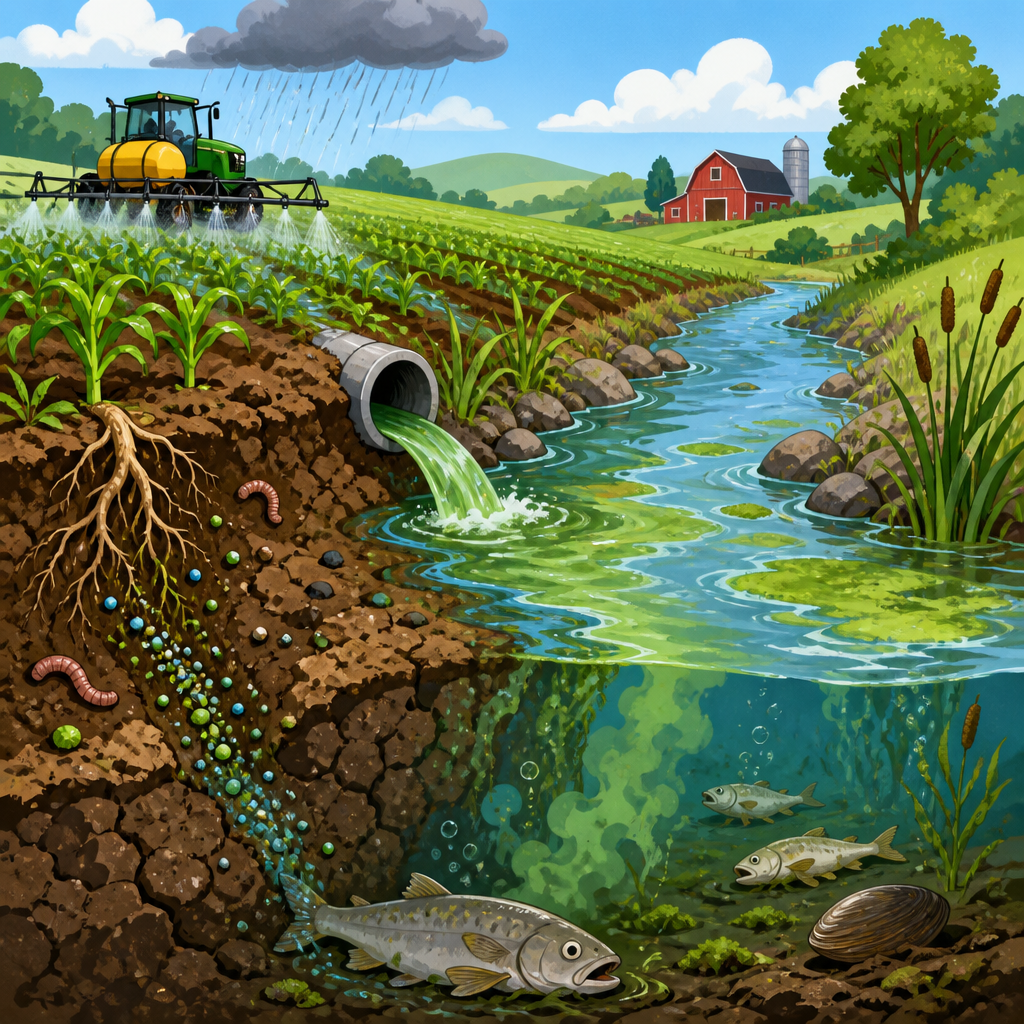
Chemical runoff affects soil and water systems by moving fertilizers, pesticides, petroleum compounds, metals, salts, and industrial residues from fields, streets, lawns, and worksites into the wider environment, where those substances alter chemistry, biology, and physical structure in ways that can persist for years. In environmental chemistry, runoff describes contaminants transported by rainfall, irrigation, snowmelt, or drainage flow across land surfaces and through shallow subsurface pathways. Soil systems include mineral particles, organic matter, pore water, air spaces, microbes, roots, and soil fauna; water systems include streams, rivers, lakes, wetlands, groundwater, estuaries, and the connected food webs they support. This topic matters because runoff links everyday land use to drinking water quality, agricultural productivity, biodiversity loss, and public health. In practice, I have seen a single storm wash visible sediment from a bare construction edge, invisible nitrate from a fertilized field, and copper-rich brake dust from a parking lot into the same drainage channel, creating a chemical mixture far more complex than most people imagine.
Understanding how chemical runoff affects soil and water systems requires more than listing pollutants. It means tracing sources, transport pathways, reactions, exposure routes, and ecological outcomes. Nitrogen and phosphorus can trigger algal blooms and low-oxygen zones. Herbicides can suppress non-target plants and alter microbial communities. Chloride from road salt can accumulate in freshwater and change density stratification. Hydrocarbons from fuel spills bind to organic matter, while some solvents remain mobile and reach groundwater. Metals such as lead, cadmium, zinc, arsenic, and mercury can adsorb to clay and iron oxides, then remobilize when pH or redox conditions shift. Even so-called low-level contamination matters because repeated inputs create chronic stress. That is why environmental chemistry sits at the center of land management, stormwater design, watershed planning, remediation, and regulation under frameworks such as the Clean Water Act and drinking water standards.
As a hub for environmental chemistry, this article explains the main pollutant classes, how they move, what they do to soil and water, how scientists measure impacts, and which control strategies work best. It also connects related subjects that readers usually search next: nutrient pollution, pesticide fate, acidification, salinization, heavy metal contamination, groundwater vulnerability, stormwater treatment, and remediation. The key idea is simple: runoff is not just dirty water leaving a site; it is a chemical delivery mechanism that changes the receiving environment. When you understand that mechanism, you can predict risk, design better land practices, and evaluate claims about sustainability with far more confidence.
Major Sources and Types of Chemical Runoff
Chemical runoff comes from agricultural, urban, industrial, transportation, and residential landscapes. Agriculture is the most familiar source because fertilizers, manure, lime, pesticides, and irrigation water are applied directly to land at large scale. Nitrogen often leaves fields as nitrate, which is highly soluble, or as ammonium attached to particles. Phosphorus usually moves with eroded sediment or organic matter, though dissolved reactive phosphorus can also run off when soils are saturated or over-applied. In urban areas, the source mix broadens: motor oil, polycyclic aromatic hydrocarbons from combustion, tire wear particles, zinc from galvanized surfaces, copper from brake pads, detergents, cleaning chemicals, paint residues, and deicing salts all enter storm drains. Industrial sites can contribute solvents, acids, alkalis, process chemicals, and metals if storage, handling, or wastewater controls fail.
Different chemicals behave differently because their solubility, volatility, persistence, and affinity for particles are not the same. A pesticide with high water solubility and low soil adsorption moves very differently from one that binds tightly to organic carbon. Environmental chemists often use partition concepts such as the soil organic carbon-water partition coefficient to estimate mobility. Nutrients are reactive and biologically active, so their impacts can appear quickly. Metals do not degrade, which makes accumulation a long-term concern. Salts raise conductivity and osmotic stress. Petroleum products contain complex mixtures, including compounds that evaporate, compounds that dissolve, and compounds that linger in sediments. This is why source identification matters: controlling runoff begins with knowing exactly which chemicals are present and in what form.
How Runoff Moves Through Soil and Water Systems
Runoff transport starts with hydrology. When rainfall intensity exceeds infiltration capacity, water flows overland and picks up dissolved chemicals and fine particles. On compacted soils, paved surfaces, and steep slopes, this happens quickly. When water infiltrates, contaminants may still move downward through macropores created by roots, worms, or soil cracks. That preferential flow can bypass the upper soil matrix and deliver chemicals to drains or groundwater faster than standard models predict. Tile-drained agricultural landscapes are a good example: nitrate can move through the root zone, enter subsurface drains, and reach streams with little visible erosion.
Once contaminants enter a soil or aquatic system, their fate depends on adsorption, desorption, dissolution, precipitation, oxidation-reduction, hydrolysis, photolysis, and biodegradation. These are not abstract textbook terms; they determine whether a chemical becomes less available or more dangerous. For example, phosphorus may sorb to iron oxides in soil, reducing immediate mobility, but under low-oxygen conditions in wet sediments, iron can be reduced and phosphorus released back into water. Similarly, arsenic mobility often increases under reducing conditions, while many metals become more soluble as pH drops. In streams, contaminants can attach to suspended sediment, settle into depositional zones, then resuspend during later storms. In wetlands, longer residence times may promote denitrification, which removes nitrate as nitrogen gas, but they can also trap and concentrate some metals in sediments.
| Contaminant class | Common sources | Typical transport path | Primary environmental effect |
|---|---|---|---|
| Nitrate | Fertilizer, manure, septic leakage | Dissolved in soil water, drains, groundwater | Drinking water risk, eutrophication |
| Phosphorus | Fertilizer, manure, eroded soil | Attached to sediment or dissolved during saturation | Algal blooms, oxygen depletion |
| Pesticides | Crop protection, lawn care | Surface runoff, sorbed to particles, spray drift | Toxicity to non-target species |
| Metals | Industry, traffic, mining, old paint | Particle-bound runoff, sediment deposition | Bioaccumulation, chronic toxicity |
| Salts | Road deicers, irrigation return flow | Dissolved in runoff and groundwater recharge | Salinization, aquatic stress |
Effects on Soil Chemistry, Structure, and Biology
Soil is not just a passive filter. Chemical runoff can fundamentally change its chemistry and function. Excess nitrogen can acidify soils over time, especially where ammonium-based fertilizers are repeatedly applied and nitrified. Lower pH affects nutrient availability, increases the solubility of some metals, and stresses sensitive microbial communities. High sodium from irrigation return flows or saline runoff can disperse clay particles, collapse soil aggregates, reduce infiltration, and create crusting. That structural decline then increases future runoff, forming a damaging feedback loop. In contaminated urban soils, hydrocarbons may coat particles and reduce oxygen exchange, while repeated deposition of metal-rich dust can build up toxic concentrations in the topsoil.
Biologically, runoff-borne chemicals alter decomposition, nutrient cycling, and root health. Soil microbes drive carbon turnover and nitrogen transformations such as mineralization, nitrification, and denitrification. Herbicides and fungicides can shift microbial composition even when crops appear unaffected. Earthworms and other soil organisms may decline in metal-contaminated sites, reducing bioturbation and aggregation. I have seen fields with adequate fertilizer on paper still perform poorly because salt buildup and compaction changed the soil’s physical and biological balance. Plants then experience a double burden: direct chemical stress and weaker soil support. Over time, that lowers resilience to drought, reduces organic matter formation, and makes restoration more expensive than prevention.
Effects on Surface Water, Groundwater, and Aquatic Life
The best-known impact of chemical runoff on water systems is eutrophication, the enrichment of water with nutrients that stimulates excessive algal and cyanobacterial growth. When blooms die, microbial decomposition consumes dissolved oxygen, causing hypoxia that can kill fish and invertebrates. The Gulf of Mexico hypoxic zone is a classic example tied largely to nutrient delivery from the Mississippi River basin. Freshwater lakes show similar patterns at smaller scales, with phosphorus often acting as the limiting nutrient. Cyanobacteria can also produce toxins such as microcystins, which threaten drinking water supplies and recreation. The 2014 Toledo water crisis, when microcystin contamination disrupted municipal water use, made this risk visible to a wide public.
Groundwater impacts are quieter but equally serious. Nitrate is especially important because it is mobile and common. Elevated nitrate in drinking water is associated with infant methemoglobinemia and signals broader contamination pressure from agriculture or wastewater. Pesticides and solvents can also enter aquifers, particularly in sandy soils, karst terrain, or areas with shallow water tables. Metals may be less mobile in many settings, but acidic or reducing conditions can increase transport. In streams, runoff pulses create acute toxicity episodes after storms, while low-level chronic inputs reshape aquatic communities over time. Sensitive macroinvertebrates disappear first, tolerant species increase, and food web structure changes. Amphibians are vulnerable because they depend on both terrestrial and aquatic habitats, making them effective indicators of cross-system chemical stress.
Why Mixtures, Timing, and Landscape Context Matter
Real runoff events rarely involve one chemical at a time. They involve mixtures, and mixtures can interact in additive, synergistic, or antagonistic ways. A stream receiving nutrients, warm runoff from pavement, chloride from deicing salts, and trace metals from traffic experiences multiple stressors simultaneously. Laboratory thresholds based on single compounds do not always predict field outcomes under those conditions. Timing matters too. The first flush of a storm often carries high contaminant concentrations after pollutants have accumulated during dry periods. Seasonal timing also changes risk: fertilizer applied before intense rain, pesticide use during sparse vegetation cover, or deicing salt application before freeze-thaw cycles all increase transport potential.
Landscape context determines whether a contaminant is diluted, retained, transformed, or intensified. Riparian buffers can slow water, trap sediment, and promote uptake, but they are less effective for highly soluble chemicals moving through drains. Clay-rich soils may hold metals well yet generate more overland flow when compacted. Sandy soils reduce ponding but allow leaching. Wetlands can be nutrient sinks under some conditions and nutrient sources under others if stored phosphorus is released. Watershed connectivity is therefore central to environmental chemistry. A small source located beside a storm drain or stream can have greater impact than a larger source farther away. This is why good assessments map flow paths, not just land use categories.
How Scientists Measure and Assess Chemical Runoff
Assessment combines field sampling, laboratory analysis, and modeling. Water quality monitoring commonly measures nitrate, ammonium, phosphate, pH, conductivity, dissolved oxygen, turbidity, total suspended solids, biochemical oxygen demand, and selected pesticides or metals. In soils, analysts test pH, cation exchange capacity, organic matter, extractable nutrients, salinity, and contaminant concentrations. Instruments and methods matter. Ion chromatography is widely used for anions such as nitrate and chloride. Inductively coupled plasma mass spectrometry is a standard choice for trace metals. Gas chromatography-mass spectrometry supports analysis of many pesticides and hydrocarbons. Quality assurance requires blanks, duplicates, calibration standards, chain of custody, and detection limits appropriate to regulatory thresholds.
Models help translate measurements into management decisions. The EPA’s SWMM is common for urban stormwater, while watershed tools such as SWAT are used to estimate nutrient and sediment transport from agricultural basins. No model is perfect; calibration with local data is essential. Source tracking may also use isotopes, land use mapping, or event-based sampling to distinguish fertilizer nitrogen from manure or wastewater inputs. Biological monitoring adds another layer by showing whether chemistry changes are affecting life. Benthic macroinvertebrate indices, chlorophyll measurements, fish surveys, and toxicity tests often reveal impacts that grab-sample chemistry misses. The strongest assessments combine chemistry, hydrology, and ecology rather than relying on a single metric.
Prevention, Control, and Remediation Strategies
The most effective way to reduce chemical runoff is source control. In agriculture, that means matching nutrient application to crop need using soil testing, realistic yield goals, and the well-established practice of applying the right source at the right rate, right time, and right place. Cover crops reduce erosion, capture residual nitrate, and improve infiltration. Conservation tillage lowers sediment loss when managed correctly. Vegetated buffer strips, saturated buffers, and constructed wetlands can intercept runoff before it reaches open water. Controlled drainage and bioreactors help remove nitrate from tile drainage. In urban settings, prevention includes street sweeping, leak control, careful storage of chemicals, reduced salt application through calibrated spreaders, and low-impact development features such as rain gardens, bioswales, permeable pavement, and retention basins.
Remediation depends on the contaminant and setting. Liming can counter soil acidification. Gypsum is often used to improve sodic soils by replacing exchangeable sodium with calcium. Activated carbon, biochar, phosphate amendments, and organic matter additions can immobilize some contaminants, though performance varies by chemistry and site conditions. Dredging may remove contaminated sediments but can disturb habitat and resuspend pollutants if poorly managed. Pump-and-treat systems, permeable reactive barriers, and monitored natural attenuation are established groundwater approaches. The practical lesson is clear: prevention costs less than cleanup, and treatment works best when designs are based on actual contaminant behavior rather than generic assumptions.
Chemical runoff is one of the clearest examples of how land use decisions shape environmental outcomes across entire soil and water systems. The same rainfall event can move nutrients into a lake, salts into a stream, and metals into roadside sediment, while also degrading soil structure at the source. Environmental chemistry explains these changes through transport pathways and reactions: dissolution, sorption, redox shifts, microbial transformation, and accumulation over time. When those processes are understood, runoff stops being an unpredictable nuisance and becomes a manageable risk.
The central takeaway is that chemical runoff is both a soil problem and a water problem. It reduces soil fertility, weakens biological function, contaminates groundwater, fuels eutrophication, and harms aquatic life through chronic and acute exposure. The most reliable solutions are source reduction, smarter timing, landscape buffering, monitoring, and targeted remediation where legacy contamination already exists. If you are building out your understanding of environmental science, use this hub as the foundation for deeper study of nutrient pollution, pesticides, salinity, heavy metals, stormwater treatment, and watershed restoration, then apply those insights to the places you manage or influence.
Frequently Asked Questions
What is chemical runoff, and how does it move through soil and water systems?
Chemical runoff is the movement of dissolved or particle-bound contaminants from land into surrounding soil, groundwater, streams, ponds, wetlands, and larger water bodies. It usually begins when rain, irrigation, snowmelt, or drainage water flows across surfaces such as crop fields, roads, lawns, construction sites, and industrial areas. As that water moves, it can pick up fertilizers, pesticides, petroleum compounds, metals, salts, and industrial residues, then carry them downslope or into nearby drains and ditches. Some contaminants stay dissolved in water, while others attach to soil particles or organic matter and travel with sediment.
Once runoff enters the environment, it does not follow a single path. Part of it may flow directly into creeks and rivers as surface runoff. Another portion may infiltrate the ground and move through shallow subsurface pathways, where it can affect soil chemistry and potentially reach groundwater. The way a chemical moves depends on several factors, including its solubility, persistence, reactivity, and ability to bind to soil. Land slope, soil texture, vegetation cover, rainfall intensity, and drainage systems also influence how far and how fast contaminants travel. This is why runoff can create both immediate water-quality problems and longer-term contamination in soils and aquifers.
How does chemical runoff damage soil health?
Chemical runoff can disrupt soil health by changing the soil’s chemistry, biology, and physical structure. Excess nutrients such as nitrogen and phosphorus may seem beneficial at first, but in large or repeated amounts they can throw off nutrient balance, alter pH, and increase salt levels. Pesticides and industrial chemicals can interfere with the microbial communities that drive decomposition, nutrient cycling, and organic matter formation. When beneficial bacteria, fungi, and invertebrates are reduced, soil becomes less biologically active and less capable of supporting resilient plant growth.
Some runoff contaminants, especially metals, hydrocarbons, and salts, can remain in soil for long periods. These substances may accumulate over time, creating chronic stress for plants and soil organisms. Salts can reduce water uptake by roots and degrade soil structure, while petroleum compounds can coat soil particles and limit oxygen exchange. Fine sediments transported with runoff can also clog soil pores, reducing infiltration and increasing compaction. As soil structure weakens, erosion risk rises, which makes future runoff even worse. In that sense, chemical runoff often creates a reinforcing cycle: damaged soil absorbs less water, generates more runoff, and becomes increasingly vulnerable to contamination and physical degradation.
What happens when chemical runoff reaches rivers, lakes, and groundwater?
When chemical runoff enters surface water, it can quickly alter water quality and ecosystem function. Nutrients such as nitrates and phosphates often trigger excessive algae and aquatic plant growth, a process commonly associated with eutrophication. As algae die and decompose, dissolved oxygen levels can drop, stressing or killing fish and other aquatic organisms. Pesticides and industrial chemicals may be toxic even at relatively low concentrations, affecting reproduction, development, feeding behavior, and survival in insects, amphibians, fish, and birds. Sediment carried by runoff can also cloud the water, block sunlight, smother habitat, and transport attached contaminants deeper into the food web.
Groundwater can be affected more slowly, but the consequences may last much longer. Chemicals that infiltrate through soil can enter shallow aquifers, especially in areas with permeable soils, fractured rock, or heavy irrigation. Nitrates are a well-known example because they are highly mobile and can persist in groundwater used for drinking supplies. Other compounds, including certain pesticides, solvents, and metals, may also migrate downward under the right conditions. Because groundwater moves slowly and is difficult to remediate, contamination can remain for years or even decades. This makes prevention especially important, since restoring polluted aquifers is often expensive, technically challenging, and sometimes not fully achievable.
Which chemicals in runoff are most concerning, and why are they so persistent?
Several categories of runoff pollutants are especially concerning because of their toxicity, mobility, or persistence. Fertilizers contribute large nutrient loads, particularly nitrogen and phosphorus, which can destabilize both soil systems and aquatic ecosystems. Pesticides are concerning because many are designed to affect living organisms, meaning they can unintentionally harm beneficial insects, soil microbes, aquatic invertebrates, and higher wildlife. Petroleum compounds from vehicles, equipment, and paved surfaces introduce hydrocarbons that may be toxic and slow to break down. Metals such as lead, cadmium, copper, and zinc can accumulate in soils and sediments, where they may remain available to plants and organisms over long periods. Salts from fertilizers, irrigation return flow, or de-icing materials are also important because they can build up gradually and alter soil structure and freshwater chemistry.
Persistence depends on how a chemical behaves in real environmental conditions. Some compounds resist biodegradation, while others bind tightly to soil particles or sediment and remain in place until erosion or changing chemistry releases them again. Low oxygen conditions, cold temperatures, limited sunlight, and low microbial activity can all slow natural breakdown. Even chemicals that degrade relatively quickly in one setting may persist in another if the soil or water chemistry is different. In practice, the greatest concern often comes not from a single exposure, but from repeated runoff events that continually replenish contamination. That is why areas receiving ongoing inputs from agriculture, urban stormwater, or industrial activity may show long-term soil and water impairment even when individual runoff episodes seem small.
How can chemical runoff be reduced to protect soil and water systems?
Reducing chemical runoff starts with controlling pollutants at their source and improving the landscape’s ability to absorb, filter, and slow water movement. In agriculture, this often means applying fertilizers and pesticides at the correct rate, time, and location, rather than before heavy rain or in excess of crop needs. Precision application, soil testing, integrated pest management, cover crops, reduced tillage, and vegetated buffer strips can all lower the amount of chemicals leaving fields. On construction and industrial sites, spill prevention, proper storage, sediment controls, and drainage management are critical. In urban areas, better lawn-care practices, street sweeping, storm drain protection, and careful handling of oil, solvents, and cleaning chemicals can significantly reduce pollutant loads.
Landscape design also plays a major role. Rain gardens, bioswales, wetlands, retention ponds, permeable pavement, and restored riparian zones help capture runoff and allow sediment and contaminants to settle, degrade, or be taken up before they reach sensitive waters. Healthy soil with strong organic matter content improves infiltration and reduces overland flow, making soil restoration part of runoff prevention. Policy and monitoring matter as well: water testing, watershed management plans, and regulations on agricultural, municipal, and industrial discharges help identify problem areas and guide corrective action. The most effective approach is usually layered rather than singular, combining better chemical management, erosion control, vegetation, and stormwater infrastructure to protect both soil function and water quality over the long term.