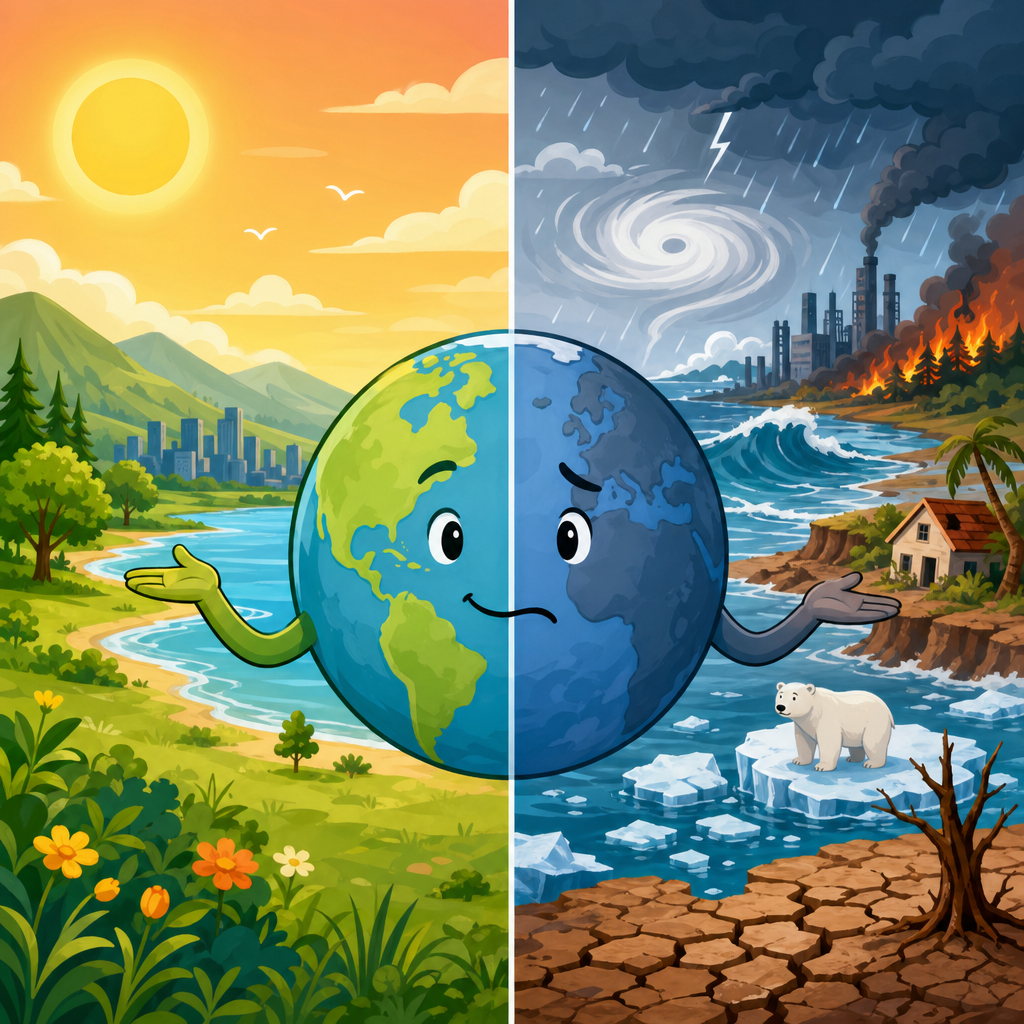
Global warming and climate change are related terms, but they do not mean the same thing, and understanding the difference is essential for clear public discussion, sound policy, and better personal decisions. In climate reporting, I have repeatedly seen these phrases used interchangeably, yet the distinction matters because one describes a specific temperature trend while the other describes the full system-wide consequences. Global warming refers to the long-term rise in Earth’s average surface temperature, driven primarily by increased concentrations of heat-trapping greenhouse gases such as carbon dioxide, methane, and nitrous oxide. Climate change is broader. It includes global warming, but it also covers changes in precipitation, drought frequency, storm intensity, sea level, snow and ice cover, ocean chemistry, wildfire conditions, and ecosystem behavior.
The simplest way to frame it is this: warming is the temperature signal; climate change is the total pattern of disruption created by that signal. That distinction helps explain why one region can experience stronger heat waves while another sees heavier rainfall, why some places face chronic water shortages while others face repeated flooding, and why oceans can become more acidic even though acidity is not a temperature measurement. Leading scientific bodies including the Intergovernmental Panel on Climate Change, NASA, NOAA, and the World Meteorological Organization use terminology carefully for this reason. Precision improves understanding, and better understanding supports better action.
This article serves as a hub for the wider topic of global warming vs. climate change. It explains the core definitions, the science behind each term, the evidence scientists use, the common points of confusion, and the practical implications for communities, businesses, and governments. If a reader asks, “Are they the same thing?” the short answer is no. If the next question is, “Why do both terms exist?” the answer is that each captures a different level of the same planetary story. One measures the rise in heat. The other explains how that extra heat reshapes weather patterns, physical systems, and risks over time.
Defining global warming and climate change clearly
Global warming is the observed increase in the planet’s average near-surface temperature over many decades. Instrument records show that Earth has warmed by about 1.1 degrees Celsius above the 1850–1900 average, according to assessments widely used by the IPCC. That increase may sound small, but for the climate system it is substantial. A shift of even one degree in the global average changes the probability of extremes, alters evaporation rates, melts land ice, and raises ocean heat content. The main cause is human activity, especially the burning of coal, oil, and natural gas, along with deforestation and certain agricultural practices.
Climate change includes that warming trend but extends beyond it. It refers to long-term changes in average weather conditions and the range of variability around them. Scientists look at decades, not single seasons. A city can have an unusually cold week and still be part of a warming world because climate is measured over long periods and across larger patterns. Climate change can show up as earlier spring snowmelt, more intense downpours, stronger marine heat waves, longer fire seasons, shifts in crop suitability, and coastal flooding driven by rising seas. In practice, global warming is one major driver within climate change, but not the whole phenomenon.
Older public communication often favored the term global warming because it directly highlighted rising temperatures. Over time, climate change became more common because it better captured the breadth of observed impacts. Neither term is wrong. The better choice depends on the point being made. If the discussion is specifically about heat records, the energy imbalance of the planet, or greenhouse gas forcing, global warming is exact. If the discussion includes rainfall patterns, adaptation planning, public health, infrastructure resilience, or ecological shifts, climate change is more accurate.
How the greenhouse effect turns warming into wider climate disruption
The science begins with Earth’s energy balance. Sunlight reaches the planet, warming land, oceans, and atmosphere. Earth then emits heat back toward space as infrared radiation. Greenhouse gases absorb and re-emit some of that outgoing heat, slowing its escape. This natural greenhouse effect makes the planet habitable. The problem is that human activity has strengthened it. Carbon dioxide concentrations now exceed 420 parts per million, far above preindustrial levels near 280 parts per million. Methane, though shorter-lived, traps much more heat per molecule over shorter timescales. Together these gases create radiative forcing, meaning more energy stays in the climate system.
That added energy does not remain only in the air. More than 90 percent of the excess heat accumulates in the oceans. Warmer oceans expand, contributing to sea level rise, and they can intensify rainfall and tropical cyclone behavior. Warmer air also holds more water vapor, roughly 7 percent more per degree Celsius, a relationship described by Clausius-Clapeyron physics. That is one reason heavy precipitation events are becoming more intense in many regions. At the same time, higher temperatures dry soils and vegetation faster, increasing drought stress and wildfire potential when rainfall is limited. In other words, warming changes the background conditions that shape weather, and that broader alteration is climate change.
I often explain this to clients and readers using a simple analogy. If global warming is like turning up the heat under a pot, climate change is everything that happens inside the pot afterward: faster evaporation, altered circulation, pressure changes, and new thresholds being crossed. The original cause is extra heat, but the results spread through the whole system. That is why discussions limited to temperature alone miss the larger story.
What the evidence shows in observations and records
The distinction between global warming and climate change is not just semantic; it is visible in multiple lines of evidence. Surface thermometer networks, satellite observations, ocean buoy systems such as Argo, glacier measurements, tide gauges, and ice core records all contribute to the picture. We see a steady rise in global average temperatures, but we also see shrinking Arctic sea ice, retreating glaciers in nearly every mountain region, earlier spring onset in many ecosystems, rising sea level, and more frequent marine heat waves. These are not isolated indicators. They are connected responses to a warming planet.
Attribution science strengthens confidence in the human cause. Climate models run with natural factors alone, such as volcanic activity and solar variability, cannot reproduce observed modern warming. When scientists add human emissions of greenhouse gases and aerosols, the models align much more closely with recorded temperature trends and many regional patterns. This is why major assessments state unequivocally that human influence has warmed the atmosphere, ocean, and land. In practical terms, the fingerprint is clear: nights are warming, winters are warming, oceans are storing heat, and the atmosphere is carrying more moisture.
| Aspect | Global Warming | Climate Change |
|---|---|---|
| Core meaning | Long-term rise in Earth’s average temperature | Broad long-term shifts in climate patterns and impacts |
| Main indicator | Surface and ocean temperature trends | Temperature, rainfall, drought, storms, sea level, ice, ecosystems |
| Primary cause today | Human greenhouse gas emissions | Human-driven warming affecting the full climate system |
| Typical example | Record global average heat | Heavier downpours, longer fire seasons, coastal flooding |
| Best use of term | When discussing heat rise specifically | When discussing wider environmental and societal effects |
Data from the United States offers concrete examples. NOAA has documented increases in heavy precipitation in the Northeast, longer and hotter heat waves in many regions, and rising relative sea level risks along vulnerable coasts. Western states have experienced hotter drought conditions that intensify wildfire behavior, while Alaska has warmed at roughly twice the global average over recent decades. These examples show why climate change is the broader operational term. A single driver, planetary warming, expresses itself differently depending on geography, atmospheric circulation, land use, and baseline climate conditions.
Why people confuse the terms and why the distinction matters
People often confuse global warming and climate change because the two are causally linked and both describe real parts of the same phenomenon. Media shorthand contributes to the overlap. So does everyday weather experience. If someone hears about a snowstorm, they may assume warming is not happening, because they are mixing short-term weather with long-term climate. In reality, a warmer atmosphere can still produce snow when conditions are cold enough, and in some situations extra moisture can make snow events heavier. One storm does not cancel a decades-long trend.
The distinction matters because each term guides attention differently. Global warming directs focus to emissions, heat-trapping gases, and the need to limit temperature rise. Climate change directs focus to impacts, adaptation, preparedness, and regional planning. City engineers designing stormwater systems need the climate change lens because rainfall intensity and flood recurrence matter more than the global average temperature alone. Energy planners need both lenses because higher average temperatures raise cooling demand while changing weather extremes threaten power infrastructure. Farmers need both because crop stress depends on heat, water timing, pest ranges, and seasonal variability together.
Clear terminology also improves public trust. When scientists say climate change, they are not retreating from the reality of warming. They are describing a larger set of observed effects. In my experience, readers understand the issue much faster when the explanation is framed as cause and consequence: greenhouse gases cause global warming, and global warming drives climate change across the Earth system. That wording is accurate, memorable, and easy to use in education, journalism, and policy analysis.
Real-world impacts across ecosystems, economies, and health
The broader term climate change is especially useful when examining effects on daily life. Heat is the most direct consequence of global warming, and extreme heat is already one of the deadliest weather-related hazards. It increases hospital visits for heat stress, worsens cardiovascular and respiratory disease, and reduces labor productivity, especially for outdoor workers. But the consequences do not stop with temperature. Warmer conditions can increase ground-level ozone formation, lengthen allergy seasons, and expand the range of some disease vectors such as ticks and mosquitoes in certain areas.
Water systems reveal the same relationship. A warmer atmosphere accelerates evaporation and can deepen soil moisture deficits, which raises drought risk in susceptible regions. Yet that same atmosphere can unload heavier rainfall when storms form. The result is a more volatile hydrological cycle: longer dry spells punctuated by more intense precipitation. Communities then face the dual burden of water scarcity and flood damage. We have seen this pattern in parts of the American West, the Mediterranean, South Asia, and eastern Australia, though the exact mix differs by region.
Economic impacts are equally broad. Coastal property faces repeated nuisance flooding as sea level rises. Insurance markets in high-risk zones are tightening or repricing. Transportation systems suffer when rail lines buckle in heat, roads degrade, or ports contend with storm surge. Agriculture faces shifting planting windows, heat stress on livestock, and changing pest pressures. Fisheries are affected by ocean warming, coral bleaching, and species migration. These are climate change effects rooted in global warming, and they illustrate why the broader framework is necessary for practical decision-making.
Mitigation, adaptation, and the role of this hub in the climate change topic
Understanding global warming vs. climate change helps clarify the two major response strategies. Mitigation addresses the cause by reducing greenhouse gas emissions or increasing carbon removal. That includes cleaner electricity, energy efficiency, electrified transport, methane leak reduction, industrial process changes, forest protection, and better land management. Adaptation addresses the consequences by preparing for impacts already occurring or likely to intensify. Examples include heat action plans, flood-resilient infrastructure, drought-tolerant crops, building-code updates, urban tree cover, and managed retreat in the most exposed coastal zones.
Neither strategy is optional. Even aggressive mitigation cannot prevent all near-term impacts because the climate system has inertia and past emissions continue to influence today’s conditions. At the same time, adaptation alone cannot solve the problem, because unchecked warming will eventually overwhelm many coping measures. The most effective climate change strategy combines both: cut emissions fast enough to limit future warming, while investing in resilience for the changes already underway. That is the operational takeaway for governments, companies, and households alike.
As a hub article within the broader climate change topic, this page should anchor related discussions on greenhouse gases, extreme weather attribution, sea level rise, climate models, mitigation pathways, adaptation planning, and climate justice. The central idea remains simple. Global warming is the rise in Earth’s average temperature caused mainly by human greenhouse gas emissions. Climate change is the wider transformation of weather patterns, oceans, ice, ecosystems, and risks that results from that warming. Keep that distinction in mind as you explore the rest of the climate change section, and use it to read headlines, evaluate claims, and support practical climate action.
Frequently Asked Questions
What is the difference between global warming and climate change?
Global warming and climate change are closely connected, but they are not interchangeable terms. Global warming refers specifically to the long-term increase in Earth’s average surface temperature, primarily caused by the buildup of heat-trapping greenhouse gases such as carbon dioxide, methane, and nitrous oxide. It describes the warming trend itself: the measurable rise in temperature observed over decades and supported by extensive instrumental records, satellite observations, and climate science research.
Climate change is the broader concept. It includes global warming, but it also covers the many related shifts that occur throughout Earth’s climate system as temperatures rise. These include changes in rainfall patterns, stronger heat waves, altered growing seasons, melting glaciers and ice sheets, sea-level rise, ocean warming, ocean acidification, and changes in the frequency or intensity of some extreme weather events. In simple terms, global warming is one major driver, while climate change is the larger set of consequences that unfold across the atmosphere, oceans, land, and ecosystems.
This distinction matters because using the right term improves public understanding. If a discussion is only about rising average temperature, “global warming” is usually the more precise phrase. If the discussion includes broader environmental, social, agricultural, coastal, or economic impacts, “climate change” is usually the better fit. Clear language helps people understand not just that the planet is warming, but that the effects extend far beyond the thermometer.
Why does it matter to visualize warming separately from broader climate change?
Visualizing warming separately from climate change helps people understand cause and effect more clearly. A graph showing long-term temperature rise can reveal the underlying warming trend in a straightforward way. It answers a focused question: Is Earth getting warmer over time? That kind of visual is useful because it presents the core signal directly, often through global temperature records, anomaly charts, or long-range trend lines that show how average conditions are changing across decades.
By contrast, visualizing climate change usually requires a wider set of indicators. A reader may need maps of shifting precipitation, charts of sea-level rise, images of shrinking ice cover, records of ocean heat content, and comparisons of extreme weather patterns. These visuals show that the issue is not limited to heat alone. The climate system is interconnected, so a warmer atmosphere can hold more moisture, influence storm behavior, intensify drought in some places, increase flood risk in others, and reshape habitats and seasonal cycles.
Separating the visuals also prevents confusion. People sometimes assume that if a local cold spell occurs, global warming must not be happening. But a warming trend in global averages can still exist alongside short-term regional variability. A temperature chart helps clarify the long-term warming signal, while climate change visuals show the wider consequences that emerge from that signal over time. Used together, these forms of visualization make the science easier to grasp and help readers move from abstract terminology to a more complete understanding of what is happening and why it matters.
Can climate change happen without global warming?
Yes, climate change can happen without modern human-caused global warming, at least in the broad historical sense. Earth’s climate has always changed over long periods due to natural factors such as volcanic activity, variations in solar energy, orbital cycles, and shifts in ocean circulation. These influences have contributed to past ice ages, warmer interglacial periods, and major regional climate transitions long before industrialization.
However, in today’s context, the current period of climate change is strongly linked to human-driven global warming. The rapid increase in greenhouse gases since the Industrial Revolution has created an energy imbalance in the climate system, trapping more heat and raising global average temperatures. That warming then triggers many of the broader changes people associate with climate change, from stronger heat extremes to melting ice and rising seas. So while climate change is the larger category and can occur for different reasons, the climate change being discussed in modern policy, science communication, and risk planning is largely being driven by global warming caused by human activity.
This is an important nuance. Saying that climate change is broader than global warming does not mean the two are unrelated. It means one is a specific measured trend and the other is the wider pattern of effects. In the present era, global warming is not a side issue within climate change; it is one of its central engines. Recognizing that relationship helps people understand both the terminology and the urgency behind scientific warnings and policy responses.
What are the best ways to visualize the difference for a general audience?
The most effective approach is to pair one simple warming visual with several impact-focused climate visuals. For global warming, a clean line graph of global average temperature anomalies over time is often the strongest choice. It clearly shows the long-term upward trend and avoids unnecessary complexity. A well-designed chart can also distinguish short-term fluctuations from the long-term pattern, helping readers see that year-to-year variability does not erase the larger rise.
For climate change, a dashboard or series of complementary visuals usually works better than a single image. A map of shifting precipitation can show that some regions are becoming wetter while others become drier. A sea-level chart can illustrate long-term coastal risk. Before-and-after glacier imagery can make ice loss tangible. A graph of increasing ocean heat content can show that much of the excess trapped energy is going into the oceans, not just the air. Seasonal change visuals, such as earlier spring blooms or longer wildfire seasons, can make climate change feel more immediate and relatable to everyday life.
For a general audience, clarity matters more than technical density. Good visuals use plain labels, explain what is being measured, identify the time scale, and avoid mixing too many variables in one chart. It also helps to explicitly state the relationship: “This graph shows warming. These others show how that warming changes the climate system.” When visuals are organized this way, readers are more likely to understand that warming is the temperature trend, while climate change is the larger web of environmental and societal effects that follows from it.
How does understanding this distinction improve public discussion and personal decision-making?
Understanding the difference between warming and change improves public discussion by making conversations more precise. In policy debates, for example, people need to know whether they are talking about reducing the cause, adapting to the effects, or both. Measures aimed at cutting greenhouse gas emissions are primarily responses to global warming as a driver. Measures such as flood planning, heat preparedness, drought management, wildfire resilience, and infrastructure upgrades are often responses to climate change impacts that are already unfolding. Without clear terminology, these discussions can become muddled, making it harder to design effective policy and communicate risk honestly.
It also matters for journalism, education, and public trust. When the terms are used carelessly, people may misunderstand what scientists are actually saying. A person might hear “global warming” and think only of hotter summers, missing the broader realities of changing precipitation, coastal hazards, ecosystem disruption, and agricultural stress. On the other hand, hearing “climate change” without understanding its link to warming can make the issue sound vague or overly abstract. Distinguishing the two helps audiences connect the physical cause to the real-world consequences.
On a personal level, this distinction can guide better decisions. If someone understands global warming as the long-term rise in heat and climate change as the broader pattern of impacts, they can think more clearly about risks that affect their own region and routines. That may include preparing for more dangerous heat, evaluating flood or wildfire exposure, considering home energy efficiency, supporting resilient community planning, or making informed choices about transportation and consumption. In short, accurate language leads to better understanding, and better understanding supports smarter action at both the societal and individual level.