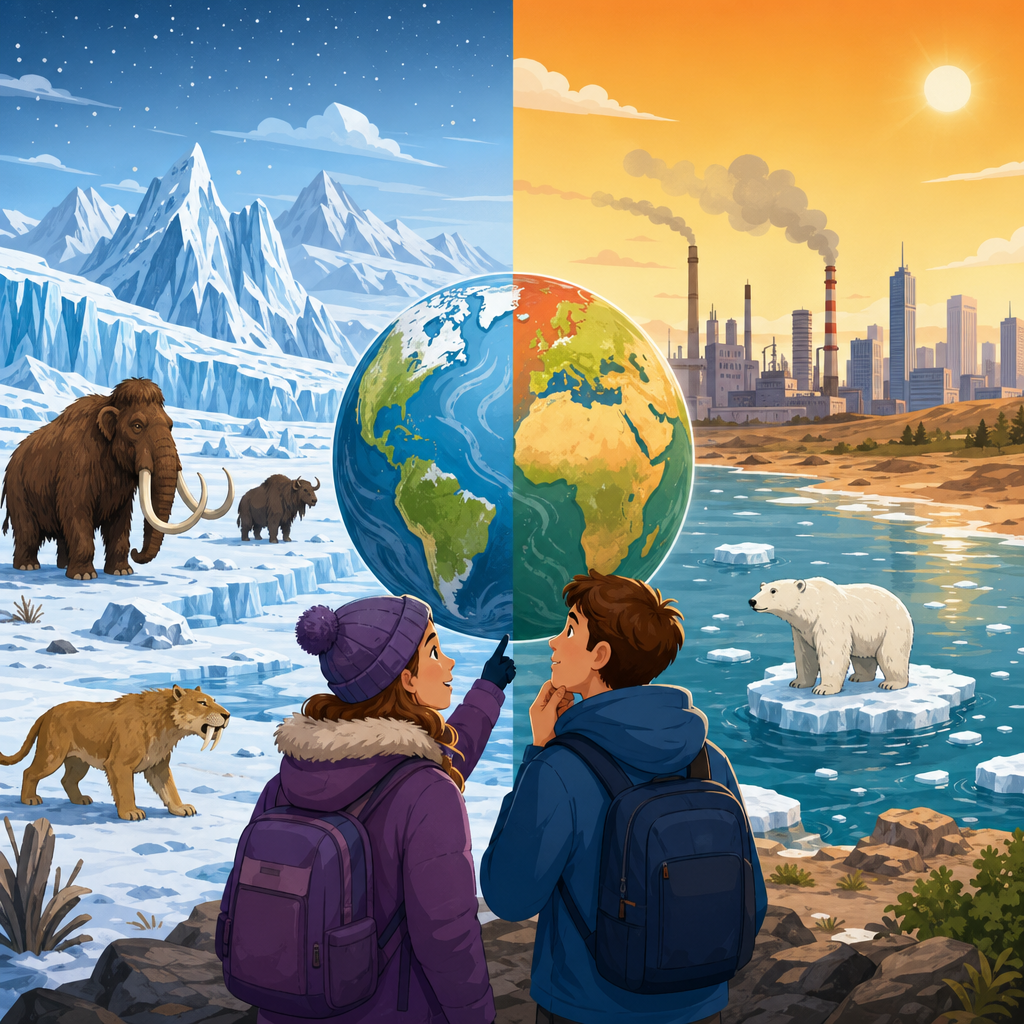
Comparing past ice ages to today’s global warming reveals a central truth about Earth’s climate system: the planet has always changed, but the speed, cause, and direction of change today are fundamentally different from the natural swings that shaped earlier eras. In climate science, “global warming” refers specifically to the long-term rise in Earth’s average surface temperature, while “climate change” is the broader term covering shifts in temperature, rainfall, storms, oceans, ice, and ecosystems. That distinction matters because many public debates still treat the phrases as interchangeable, even though one describes a temperature trend and the other describes the full chain of consequences. I have worked with climate datasets, paleoclimate reconstructions, and emissions reports long enough to see the same misunderstanding appear again and again: people hear that Earth experienced ice ages before humans existed and assume modern warming must be another natural cycle. The evidence does not support that conclusion.
Past ice ages were driven mainly by slow changes in Earth’s orbit, tilt, and wobble, amplified by feedbacks involving greenhouse gases, ice sheets, and ocean circulation. Today’s warming is being driven primarily by rapid increases in carbon dioxide, methane, and nitrous oxide from fossil fuel use, deforestation, industry, and agriculture. Ice core records, tree rings, sediment cores, satellite observations, and direct thermometer measurements all point in the same direction. Atmospheric carbon dioxide now exceeds 420 parts per million, far above preindustrial levels near 280 parts per million, and the increase happened over roughly two centuries rather than thousands of years. Understanding global warming vs. climate change through the lens of past ice ages is useful because it answers the questions readers ask most often: What changed before? What is changing now? Why is this warming different? And what does that mean for people, economies, and ecosystems today?
What ice ages were and how scientists reconstruct them
An ice age is a long interval when permanent ice sheets exist on Earth, especially near the poles. Within an ice age, the climate alternates between colder glacial periods and warmer interglacial periods. We are technically still living in an ice age because Greenland and Antarctica retain large ice sheets, but we are in a warm interglacial called the Holocene, and more recently in a human-dominated phase many researchers discuss as the Anthropocene. When people compare past ice ages to global warming, they usually mean the repeated glacial cycles of the last 2.6 million years, especially the last 800,000 years, where ice cores provide exceptionally clear records of temperature and atmospheric composition.
Scientists reconstruct these climates using multiple independent lines of evidence. Antarctic and Greenland ice cores trap ancient air bubbles, allowing direct measurement of past carbon dioxide and methane. Marine sediment cores contain shells of foraminifera whose oxygen isotope ratios indicate ocean temperature and ice volume. Pollen records show which plants grew in different regions, revealing past temperature and rainfall patterns. Moraines and glacial striations map former ice sheet boundaries. These methods are not guesses layered on top of ideology; they are standardized paleoclimate tools used across institutions such as NOAA, NASA, the IPCC, and major geoscience departments worldwide. The strength of the science is that many records from different places tell the same story: climate changed naturally in the past, but those changes followed known physical drivers and usually unfolded far more slowly than modern warming.
Why past ice ages happened: orbital cycles, feedbacks, and thresholds
The classic explanation for glacial cycles begins with Milankovitch cycles: changes in Earth’s eccentricity, axial tilt, and precession. These orbital variations alter the seasonal and geographic distribution of sunlight, especially summer sunlight at high northern latitudes where large ice sheets can either melt or persist. By themselves, orbital changes are modest. Their power comes from feedbacks. As ice expands, Earth reflects more solar energy, cooling further through the ice-albedo effect. As oceans cool, they absorb more carbon dioxide; as they warm, they release more. Dust, vegetation shifts, and ocean circulation changes add complexity.
The key point is that carbon dioxide acted both as a feedback and an amplifier in past glacial-interglacial transitions. During the last deglaciation, small orbital shifts helped start warming, then rising greenhouse gas concentrations magnified it and spread it globally. Temperatures and carbon dioxide moved together, but that historical pattern does not mean carbon dioxide cannot also be the initial driver. In modern conditions, humans are supplying the forcing directly by burning coal, oil, and gas and by altering land use. This distinction is central to understanding global warming vs. climate change. In past ice ages, the climate system was nudged by orbital mechanics and then amplified internally. Today, the atmosphere is being forced externally at a speed unmatched in the instrumental era and unusual even in deep paleoclimate context.
How today’s global warming differs from natural climate change
Three differences separate today’s warming from past ice-age transitions: cause, rate, and observed fingerprints. The cause is well established. Carbon from fossil fuels has a distinct isotopic signature, and atmospheric measurements show declining oxygen alongside rising carbon dioxide, exactly what combustion predicts. The rate is equally important. Global average temperature has risen by roughly 1.2 degrees Celsius above the late nineteenth-century baseline, with most warming occurring in recent decades. During the transition out of the last ice age, global temperatures rose by several degrees over thousands of years. That natural warming was profound, but it generally gave ecosystems and coastlines far more time to adjust than today’s changes allow.
Observed fingerprints also matter. The lower atmosphere is warming while the stratosphere cools, a pattern expected from greenhouse gas trapping rather than increased solar output. Nights are warming faster than days in many regions. Winters are warming rapidly, Arctic amplification is pronounced, glaciers are retreating, ocean heat content is rising, and sea level is climbing through both thermal expansion and land-ice loss. If modern warming were simply a rebound from the last ice age, these detailed signals would not align so neatly with greenhouse physics. Climate models that include only natural drivers such as volcanic activity and solar variability fail to reproduce the observed warming trend. Add human emissions, and the models match the record much more closely.
Global warming vs. climate change: the terms are related but not identical
Global warming is the temperature increase. Climate change is the full system response. In practice, that means global warming is the engine and climate change is the vehicle moving in many directions at once. A city may experience hotter summers, heavier downpours, longer allergy seasons, and worsening coastal flooding even if its yearly average temperature rises modestly. Farmers may face altered planting zones, higher evaporative demand, and more variable spring rainfall. Fisheries may shift because warmer oceans hold less oxygen and marine heat waves disrupt food webs. These are climate change outcomes driven by global warming but not reducible to a single thermometer reading.
This distinction helps explain common confusion. A cold snap does not disprove global warming because weather is short-term and local, while warming is long-term and global. Likewise, climate change includes regional effects that can look different from one another. Some places become drier on average, others wetter, and many experience greater variability at both ends. The hydrologic cycle intensifies in a warmer atmosphere because air can hold about 7 percent more water vapor per degree Celsius according to the Clausius-Clapeyron relationship. That is why discussions under the climate change umbrella include flood risk, drought, wildfire weather, crop stress, coral bleaching, and health impacts, not just heat records.
What the evidence shows today across atmosphere, oceans, ice, and ecosystems
The modern evidence base is unusually strong because it combines direct measurement with long historical context. Thermometer records from land stations and ships extend back into the nineteenth century. Satellites measure lower tropospheric temperature, sea ice extent, atmospheric moisture, and outgoing radiation. Argo floats track ocean heat down to around 2,000 meters, and the oceans have absorbed more than 90 percent of the excess heat trapped by greenhouse gases. Tide gauges and satellite altimetry show accelerating sea level rise. Spring snow cover is shrinking in many regions, and mountain glaciers from the Alps to the Andes continue to lose mass.
| Indicator | Past Ice Age Pattern | Today’s Warming Pattern | Why It Matters |
|---|---|---|---|
| Primary driver | Orbital cycles amplified by feedbacks | Human greenhouse gas emissions | Shows modern change is not just a natural cycle |
| Typical pace | Usually thousands of years | Decades to centuries | Limits adaptation time for infrastructure and ecosystems |
| Carbon dioxide level | About 180 to 280 ppm during recent glacial cycles | Above 420 ppm | Indicates a climate state outside recent human history |
| Sea level response | Large changes over long periods | Rising now with acceleration | Affects coasts, ports, aquifers, and flood planning |
Ecosystems are responding in ways that align with these measurements. Species ranges are shifting poleward and upslope. Earlier flowering and longer growing seasons are being documented across temperate regions. Coral reefs are stressed by marine heat waves and ocean acidification, which occurs as seawater absorbs carbon dioxide and forms carbonic acid, lowering pH and reducing carbonate availability for shell-building organisms. In my own work reviewing regional assessments, one recurring pattern stands out: even where annual averages obscure the signal, climate impacts emerge clearly in extremes, seasonality, and water management. That is why planners increasingly use heat index days, wildfire weather indices, and extreme precipitation metrics instead of relying only on mean temperature.
Lessons from past climate shifts for policy, adaptation, and public understanding
Comparing ice ages with current warming does not weaken the case for action; it strengthens it. Paleoclimate records show climate sensitivity is real, feedbacks are powerful, and ice sheets do not respond linearly forever. They can reach thresholds that produce long-lasting change. For policy, the lesson is straightforward: preventing additional warming is easier and cheaper than adapting to every consequence after the fact. That means cutting emissions from power generation, transport, buildings, industry, and agriculture while also investing in resilience. Practical adaptation includes updated flood maps, urban tree cover, cool roofs, heat warning systems, drought planning, coastal setback rules, and grid modernization.
Public understanding improves when the comparison is framed correctly. Yes, climate has changed naturally before. No, that does not mean current warming is natural or harmless. Earth’s history contains both reassurance and warning: the climate system is understandable, but it is also highly responsive to atmospheric greenhouse gas concentrations. For readers exploring the wider Climate Change topic, this hub idea should guide every related article. Global warming is the measurable rise in planetary temperature. Climate change is the broader transformation of weather patterns, oceans, ice, and living systems that follows. Past ice ages help scientists calibrate how the system works; modern observations show humans are now driving it. The practical benefit of understanding this distinction is better judgment, better policy, and better personal decisions about energy, risk, and resilience. If you are building out your knowledge of climate change, use this comparison as your starting point and then explore impacts, causes, mitigation, and adaptation in greater detail.
Frequently Asked Questions
How were past ice ages different from today’s global warming?
Past ice ages were part of Earth’s natural climate rhythm and developed over very long periods of time, usually tens of thousands to hundreds of thousands of years. These cold phases were influenced mainly by slow changes in Earth’s orbit, tilt, and wobble, which altered how sunlight was distributed across the planet. Those orbital shifts were then amplified by feedbacks involving ice sheets, greenhouse gases, oceans, and vegetation. In other words, ancient climate changes often began with natural triggers and unfolded gradually.
Today’s global warming is different in several critical ways. First, it is happening much faster than the transitions into and out of most past ice age conditions. Second, the main driver is not a natural orbital cycle but the rapid buildup of heat-trapping gases such as carbon dioxide and methane from human activities, especially burning fossil fuels, deforestation, and industrial processes. Third, the current trend is toward warming in a period when long-term natural patterns alone would not be expected to create such a rapid global temperature rise.
That distinction matters because climate systems can sometimes adapt to slow changes, but rapid changes leave less time for ecosystems, infrastructure, agriculture, and societies to respond. So while Earth has certainly changed before, comparing ancient ice ages with modern warming shows that the current episode is not just another ordinary swing in climate. Its pace, cause, and global reach make it fundamentally different.
What caused ice ages in the past?
The primary pacing mechanism behind ice ages was a set of long-term orbital variations often called Milankovitch cycles. These include changes in the shape of Earth’s orbit around the Sun, the tilt of Earth’s axis, and the wobble of that axis over time. Together, these cycles changed how much solar energy reached different latitudes and seasons, especially in the Northern Hemisphere, where large landmasses allowed major ice sheets to grow or melt.
However, orbital cycles did not act alone. They triggered broader climate responses that were strengthened by powerful feedbacks. For example, when ice sheets expanded, they reflected more sunlight back into space, which cooled the planet further. At the same time, colder oceans could store more carbon dioxide, helping reduce greenhouse gas concentrations in the atmosphere and reinforcing cooling. During warming phases, the opposite occurred: retreating ice lowered reflectivity, oceans released more carbon dioxide, and warming accelerated.
Other factors also influenced ancient climate, including volcanic activity, continental positions over geologic time, ocean circulation shifts, and changes in vegetation. But for the ice age cycles of the recent geologic past, orbital forcing combined with greenhouse gas and ice-albedo feedbacks was the dominant pattern. The key point is that these natural causes operated slowly, whereas today’s warming is being driven primarily by a very rapid human-caused increase in greenhouse gases.
Why do scientists say current global warming is unusually fast?
Scientists say modern global warming is unusually fast because the observed rise in global average temperature has occurred over roughly a century and a half, with especially strong warming in recent decades. In contrast, major climate shifts associated with the end of ice ages usually unfolded over many thousands of years. Even when past climate records show abrupt regional changes, the current globally averaged warming trend stands out for its speed and its close match with the rapid increase in human-caused greenhouse gas emissions.
Evidence for this comes from many independent sources. Thermometer records show a clear long-term warming trend. Ice cores reveal how carbon dioxide and temperature changed in the deep past. Ocean measurements show that the oceans are storing vast amounts of excess heat. Glaciers and ice sheets are losing mass, sea levels are rising, and seasonal patterns are shifting. When scientists compare these observations with climate models, they find that natural factors alone, such as solar variability or volcanic activity, cannot explain the warming seen since the industrial era. Human influence is required to match the data.
The speed of warming matters because it increases the risk of disruption. Natural systems and human systems often have limits to how quickly they can adjust. Species may struggle to migrate or adapt, coastal communities face increasing sea-level threats, and agricultural zones can shift faster than farming practices and water systems can easily respond. This is why the rate of change is not just a scientific detail; it is central to understanding the seriousness of today’s climate challenge.
Did carbon dioxide also change during past ice ages, and what does that tell us today?
Yes, carbon dioxide changed significantly during past ice age cycles, and those changes are one of the clearest clues to how sensitive Earth’s climate is to greenhouse gases. Ice core records from Antarctica show that during glacial periods, atmospheric carbon dioxide levels were lower, and during warmer interglacial periods, they were higher. These records demonstrate a strong relationship between greenhouse gas concentrations and global temperature over long stretches of Earth’s history.
In past ice age cycles, carbon dioxide often acted as both a feedback and an amplifier. Small orbital changes could start a warming or cooling trend, and then carbon dioxide changes would strengthen that trend. For example, as oceans warmed, they released more carbon dioxide into the atmosphere, which added more warming. This process helped transform modest initial changes in sunlight distribution into larger global climate shifts.
What makes today different is that carbon dioxide is not simply responding to a natural orbital shift. It is being added directly to the atmosphere in massive amounts by human activities. Scientists can confirm this not only from rising atmospheric measurements, but also from the chemical fingerprint of the carbon itself, which points to fossil fuels. This tells us something very important: if greenhouse gases amplified climate change in the past, then a rapid human-driven increase in those same gases can strongly drive climate change now. Past climate records do not weaken the case for concern; they strengthen it by showing how powerful carbon dioxide is in shaping Earth’s temperature.
What is the difference between global warming and climate change in this discussion?
In climate science, global warming refers specifically to the long-term rise in Earth’s average surface temperature. It is the temperature component of the broader changes now being observed. Climate change is the larger umbrella term that includes global warming but also covers shifts in rainfall patterns, drought, heat waves, stronger precipitation events, ocean warming, melting ice, sea-level rise, ecosystem disruption, and changes in the frequency or intensity of some extreme weather events.
This distinction is especially useful when comparing past ice ages to the present. Ice ages involved large-scale climate change, not just colder temperatures. They included expanded ice sheets, altered storm tracks, changing ocean circulation, lower sea levels, and major ecosystem shifts. Likewise, today’s human-driven warming is not only about rising thermometer readings. It is reshaping the entire climate system, from oceans and glaciers to forests, fisheries, and water supplies.
Using the broader term climate change helps capture the full picture of what a warming planet means in practice. A warmer atmosphere can hold more moisture, influencing rainfall extremes. Warmer oceans affect marine life and storm energy. Melting land ice contributes to sea-level rise. So while global warming describes the central temperature trend, climate change describes the many connected consequences. Understanding both terms helps explain why today’s changes are so significant and why the comparison with past ice ages must include the entire Earth system, not temperature alone.