Biodiversity and ecology vocabulary can feel technical at first, but once the core terms are explained in plain language, the subject becomes far easier to understand and apply in school, conservation work, policy debates, and everyday discussions about nature. This glossary-style hub for environmental terms focuses on the words people most often encounter when reading about habitats, species loss, food webs, climate pressures, restoration, and ecosystem health. In practical terms, biodiversity means the variety of life, including genes, species, and ecosystems, while ecology is the study of how organisms interact with one another and with their physical environment. Those definitions are only the starting point, because environmental writing also relies on related concepts such as niche, biome, carrying capacity, keystone species, succession, resilience, and invasive species. I have found that readers usually do not struggle with the science itself; they struggle with vocabulary that is used inconsistently across textbooks, news articles, and advocacy materials. A clear glossary solves that problem by defining terms accurately, showing how they connect, and separating similar ideas that are often confused. This matters because environmental decisions depend on language. If a student mixes up habitat and ecosystem, or if a policymaker treats abundance as the same thing as diversity, the conclusion can be wrong even when the intention is good. Learning biodiversity and ecology vocabulary simplified into direct, reliable explanations gives readers a stronger foundation for advanced environmental science and for informed civic participation.
Core biodiversity terms everyone should know
The most important starting point is biodiversity itself. Biodiversity refers to the variety of life at three recognized levels: genetic diversity within a species, species diversity within a community, and ecosystem diversity across a region. A forest with many tree species, varied insects, healthy fungi, and different microhabitats generally has higher biodiversity than a monoculture plantation. Species richness means the number of species present, while species evenness describes how evenly individuals are distributed among those species. An area with ten species where one species makes up ninety percent of all individuals is less even than an area where numbers are more balanced. Abundance refers to how many individuals of a species exist in a place. Endemic species are native to one restricted area, such as lemurs in Madagascar. Native species occur naturally in an area without human introduction. Invasive species are non-native organisms that spread and cause ecological, economic, or health harm, as zebra mussels have done in North American waterways. Extinction is the permanent disappearance of a species, whereas extirpation means local disappearance from a specific region. Conservation status terms often come from the International Union for Conservation of Nature, which uses categories such as Vulnerable, Endangered, and Critically Endangered to reflect extinction risk.
Ecology vocabulary that explains how nature works
Ecology studies relationships among organisms and their environment, and many key terms describe levels of organization. An organism is one individual living thing. A population is all individuals of one species in one area. A community includes all interacting populations in that area. An ecosystem adds nonliving components such as soil, water, light, and nutrients. A biome is a large regional system defined by climate and dominant vegetation, including tundra, desert, temperate forest, and tropical rainforest. Habitat means the physical place where an organism lives, while niche means the role it plays, including what it eats, where it feeds, when it is active, and how it interacts with competitors and predators. Two species can share a habitat but occupy different niches. Producers, usually plants and algae, make energy-rich compounds through photosynthesis. Consumers eat other organisms. Decomposers such as fungi and many bacteria break down dead matter and recycle nutrients. Food chains show one feeding path, while food webs show many interconnected feeding relationships. Trophic levels describe feeding positions in a system, from primary producers to herbivores, carnivores, and top predators.
Habitat, ecosystem, and biome: terms often confused
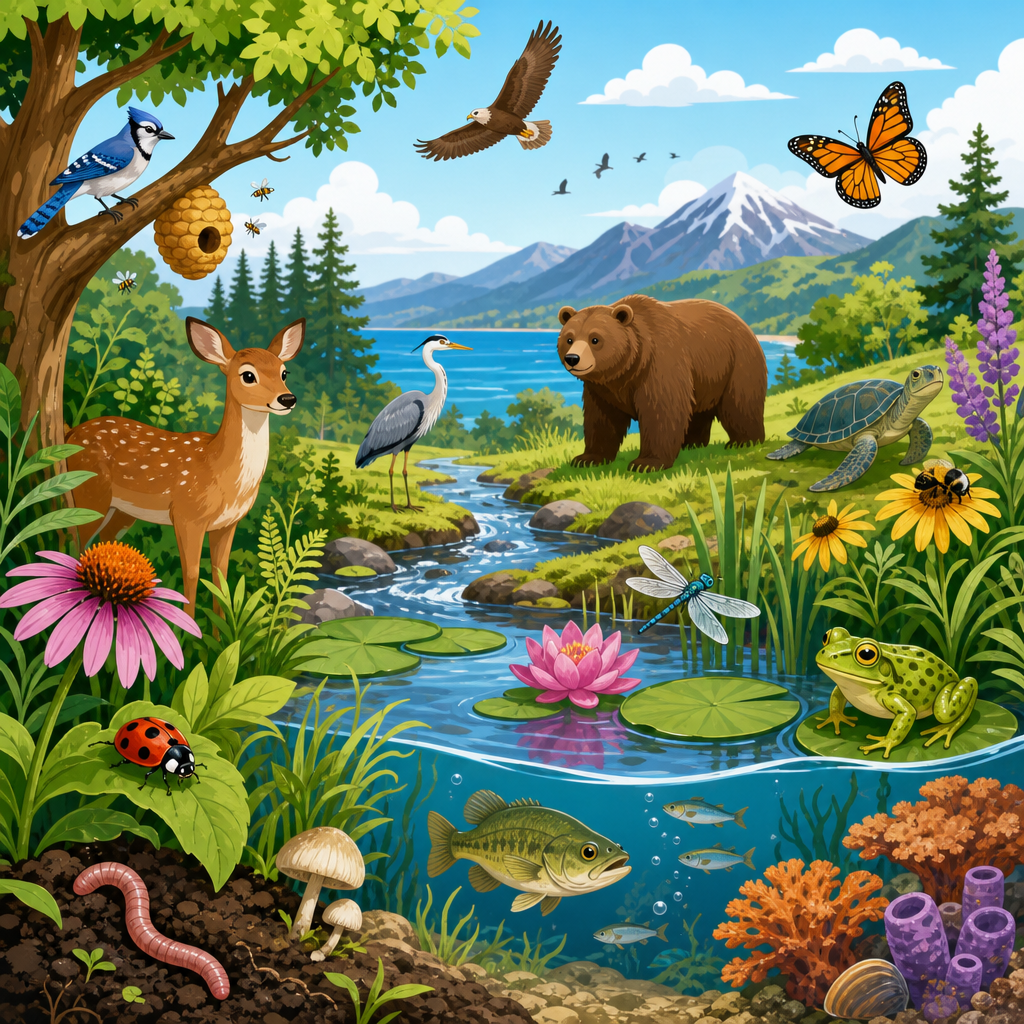
Many readers confuse habitat, ecosystem, biome, and landscape, so it helps to separate them clearly. A habitat is the home conditions an organism needs, such as a wetland edge for a frog or old-growth bark crevices for certain lichens. An ecosystem includes the living community plus nonliving factors and the processes linking them. For example, a pond ecosystem includes fish, algae, insects, microbes, dissolved oxygen, sediments, and nutrient cycling. A biome is much larger and is shaped mainly by long-term climate patterns; the boreal forest biome spans vast areas across Canada, Alaska, and northern Eurasia. Landscape ecology looks at how different habitats and ecosystems are arranged across space and how movement occurs between them. Fragmentation describes the breaking of large habitats into smaller isolated patches, often by roads, farms, or urban development. Connectivity refers to how easily organisms, genes, water, fire, or nutrients can move through a landscape. Wildlife corridors are practical conservation tools designed to improve connectivity. Edge effects are the ecological changes that happen at habitat boundaries, such as increased light, wind, predation, or invasive species pressure. In fieldwork, I often explain this simply: a habitat suits one species, an ecosystem describes interactions, and a biome describes climate-defined regions.
Population and community terms used in environmental science
Population ecology focuses on how and why numbers change over time. Population size is the total number of individuals, and population density is the number per unit area or volume. Distribution describes how individuals are spaced: clumped, uniform, or random. Birth rates, death rates, immigration, and emigration all shape population growth. Carrying capacity is the maximum population size an environment can sustain over time without degrading essential resources. Limiting factors include food, water, shelter, disease, predation, and available breeding sites. A boom-and-bust pattern happens when populations rise quickly and then crash, often after overshooting resources. Community ecology examines interactions among species. Competition occurs when organisms rely on the same limited resource. Predation is one organism killing and eating another. Herbivory is consumption of plants or algae. Mutualism benefits both species, as with many pollinators and flowering plants. Commensalism benefits one species without clearly affecting the other. Parasitism benefits one organism while harming the host. Keystone species have effects on ecosystems that are disproportionately large relative to their abundance. Sea otters are a classic example because they limit sea urchins, which helps kelp forests persist. Indicator species signal environmental conditions, and umbrella species are protected to indirectly conserve many others sharing the same habitat.
Processes that shape ecosystems over time
Ecological systems are dynamic, not static, so process terms matter as much as object terms. Succession is the gradual change in species composition after disturbance or the creation of new substrate. Primary succession begins where no soil exists, such as on fresh volcanic rock or land exposed by retreating glaciers. Secondary succession begins where a community has been disturbed but soil remains, such as after wildfire or abandoned agriculture. Disturbance includes events that alter ecosystem structure, from storms and floods to insect outbreaks and controlled burns. Resilience is the ability of an ecosystem to absorb disturbance and recover function. Resistance is the ability to remain largely unchanged during disturbance. Adaptation refers to inherited traits that improve survival or reproduction in a particular environment. Natural selection is the process by which traits associated with higher reproductive success become more common. Nutrient cycling describes how elements such as nitrogen and phosphorus move through organisms, soils, water, and the atmosphere. Carbon sequestration is the storage of carbon in biomass, soils, sediments, or oceans. Ecological restoration aims to assist the recovery of degraded ecosystems, while rehabilitation improves function without necessarily recreating historical conditions. Rewilding generally means restoring ecological processes, often by reconnecting habitats or reintroducing influential species.
Environmental glossary quick-reference table
| Term | Simple meaning | Example |
|---|---|---|
| Biodiversity | Variety of life across genes, species, and ecosystems | A coral reef with many fish, corals, algae, and microbes |
| Habitat | The place and conditions where an organism lives | A mangrove root zone used by juvenile fish |
| Niche | A species’ role, resource use, and interactions | A nocturnal pollinator feeding on night-blooming flowers |
| Carrying capacity | The population size resources can support long term | Deer numbers limited by winter forage availability |
| Keystone species | A species with unusually strong ecosystem influence | Sea stars controlling mussel dominance on rocky shores |
| Succession | Gradual community change over time after disturbance | Grasses followed by shrubs and young trees after fire |
| Invasive species | Non-native species that spread and cause harm | Kudzu overtaking native vegetation in the southeastern United States |
| Resilience | Capacity to recover after stress or disruption | A wetland regaining plant cover after seasonal flooding |
Conservation and human impact vocabulary in plain language
Modern environmental discussions frequently center on human pressures, so understanding these terms is essential. Habitat loss is the reduction or destruction of natural living space through logging, drainage, mining, urban expansion, or intensive agriculture. Habitat degradation means the habitat still exists but its quality has declined, perhaps through pollution, noise, altered water flow, or overgrazing. Overexploitation is unsustainable harvesting of species, as seen in overfishing of Atlantic cod. Pollution includes contaminants introduced into air, soil, or water, but the term also covers thermal, light, and noise pollution when they disrupt ecological function. Eutrophication is nutrient enrichment, often from nitrogen and phosphorus runoff, that triggers algal blooms and oxygen depletion in lakes, rivers, and coastal waters. Bioaccumulation means a substance builds up within an organism over time, while biomagnification means concentrations increase at higher trophic levels; mercury in predatory fish is a common example. Climate change refers to long-term shifts in temperature, precipitation, and extreme events driven today largely by greenhouse gas emissions. Mitigation reduces causes of change, whereas adaptation adjusts systems to expected impacts. Protected areas, conservation easements, captive breeding, seed banks, and community-based management are all tools used to reduce biodiversity loss, but none works equally well in every social or ecological context.
How to use this biodiversity and ecology glossary effectively
A strong glossary is more than a list of definitions; it is a map for reading deeper environmental science. The best way to use biodiversity and ecology vocabulary simplified is to learn terms in clusters rather than in isolation. Pair organism, population, community, ecosystem, and biome because they describe nested scales. Pair habitat with niche because one is a place and the other is a role. Pair richness, evenness, and abundance because together they explain what people mean when they say an area is diverse. Students preparing for exams should rewrite terms in their own words and attach one local example, such as a park, stream, schoolyard, or coastline they know firsthand. Teachers can use this hub as the anchor page in a broader glossary of environmental terms, then link outward to dedicated pages on climate, pollution, conservation biology, restoration ecology, and field methods. Readers following environmental news should watch for sloppy usage, especially when reports confuse reforestation with restoration or label every non-native species as invasive. Precise vocabulary improves critical thinking. Keep this hub bookmarked, use it as your reference point, and return to it whenever a biodiversity or ecology term needs a clear, reliable explanation.
Frequently Asked Questions
What does biodiversity mean in simple terms?
Biodiversity refers to the variety of life in a place or across the planet as a whole. In simple terms, it includes all living things—plants, animals, fungi, and microorganisms—and the ways they differ from one another. It also includes the habitats they live in and the relationships that connect them. When people use the word biodiversity, they are not just talking about how many species exist. They may also be talking about genetic diversity within a species, such as different traits in a population, and ecosystem diversity, such as forests, wetlands, grasslands, rivers, and coral reefs.
This term matters because healthy biodiversity helps natural systems function properly. A wide range of species often means stronger pollination, better soil health, cleaner water, more stable food webs, and greater resilience when conditions change. For example, if one species declines, another may partially fill its role, helping the ecosystem continue to function. That is why biodiversity is often discussed in conservation, climate adaptation, agriculture, and public policy. It is a foundational concept for understanding how nature supports both wildlife and human life.
How is ecology different from biodiversity?
Ecology is the study of how living things interact with each other and with their environment. Biodiversity, by contrast, describes the variety of living organisms and ecosystems. A helpful way to think about it is this: biodiversity tells you what life is present, while ecology helps explain how that life is connected and how those connections work. Ecology looks at relationships such as predation, competition, symbiosis, nutrient cycling, habitat use, and the movement of energy through food webs.
For example, a wetland with many species of birds, insects, amphibians, and plants has high biodiversity. Ecology would explore how those organisms depend on one another—what they eat, where they breed, how seasonal flooding affects them, and how changes in water quality might disrupt the system. In practice, the two ideas are closely linked. You cannot fully understand biodiversity without some ecology, because species do not exist in isolation. They are part of dynamic systems shaped by climate, resources, disturbance, and long-term environmental change.
What is an ecosystem, and why is it such an important word in environmental discussions?
An ecosystem is a community of living organisms interacting with each other and with nonliving parts of their environment, such as water, air, sunlight, soil, and temperature. It can be very large, like a rainforest or an ocean, or much smaller, like a pond, a salt marsh, or even a decaying log. The key idea is that an ecosystem includes both life and the physical setting that supports it. This is one of the most important terms in ecology because it captures the idea that nature works as a connected system rather than as separate pieces.
People often talk about ecosystem health because ecosystems provide essential services that humans rely on every day. These include pollination of crops, water filtration, carbon storage, flood control, nutrient cycling, and habitat for species. When an ecosystem is damaged by pollution, habitat loss, invasive species, overuse, or climate stress, those functions can weaken. That is why ecosystem-based thinking is common in conservation and environmental policy. Instead of focusing on only one species or one problem, it encourages people to look at the broader system and the many relationships that keep it functioning.
What do terms like habitat, niche, and food web mean?
These are some of the most common ecology terms, and they are easier to understand than they first appear. A habitat is the place where an organism lives. It includes the conditions it needs to survive, such as shelter, food, water, and space. A forest canopy, a desert floor, a riverbank, and a coral reef can all be habitats. A niche is different. A niche describes the role a species plays in its ecosystem—how it lives, what it eats, when it is active, what uses it makes of resources, and how it interacts with other species. Two species may live in the same habitat but occupy different niches.
A food web shows how energy moves through an ecosystem. Unlike a simple food chain, which follows one path, a food web reflects the many overlapping feeding relationships among organisms. Plants and algae usually form the base because they produce energy through photosynthesis. Herbivores eat plants, carnivores eat other animals, omnivores may eat both, and decomposers break down dead material and return nutrients to the system. Understanding habitat, niche, and food webs helps explain why species loss can have ripple effects. If one species disappears, it may affect predators, prey, decomposers, and even the physical conditions of the habitat itself.
Why are biodiversity loss, restoration, and ecosystem health discussed together so often?
These terms are closely connected because they describe different parts of the same environmental story. Biodiversity loss happens when species decline, populations shrink, genetic variation is reduced, or entire ecosystems become degraded. Common causes include habitat destruction, pollution, overexploitation, invasive species, and climate change. As biodiversity falls, ecosystems often become less stable and less able to recover from stress. That decline can affect both wildlife and people by reducing ecosystem services such as clean water, fertile soil, and natural climate regulation.
Restoration is the process of helping damaged ecosystems recover. This can involve replanting native vegetation, removing invasive species, restoring wetlands, reconnecting rivers, rebuilding soils, or reintroducing key species. The goal is not always to return a landscape to an exact historical condition, but to improve ecological function and resilience. Ecosystem health refers to how well an ecosystem is operating—whether it supports life, cycles nutrients, maintains structure, and responds to disturbance without collapsing. These terms are often grouped together because conservation today is not just about preventing damage; it is also about understanding system function, reversing decline where possible, and building healthier, more resilient natural environments for the future.