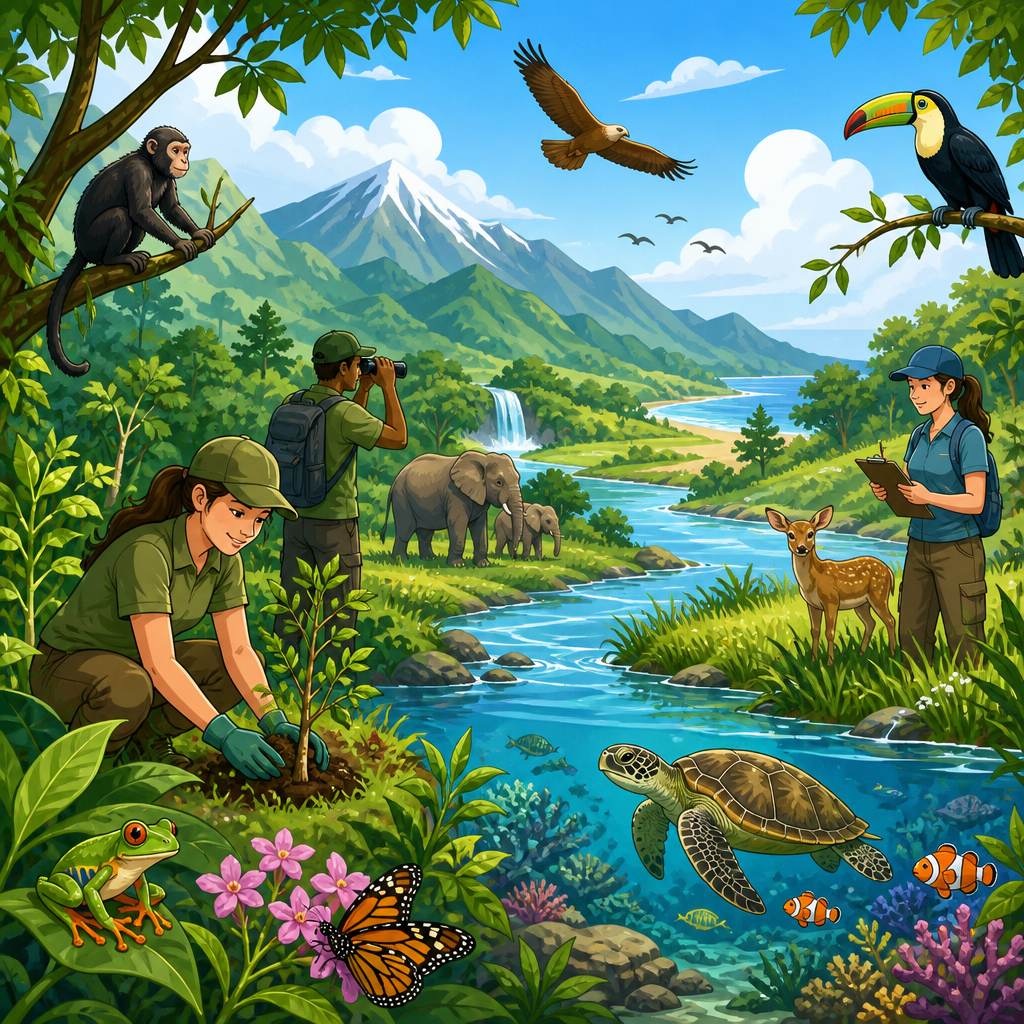
Conservation ecology is the branch of environmental science focused on protecting ecosystem integrity: the capacity of forests, wetlands, grasslands, rivers, coasts, and urban habitats to retain their structure, functions, native biodiversity, and resilience under pressure. In practice, that means safeguarding species interactions, nutrient cycling, hydrology, soil formation, disturbance regimes, and genetic diversity rather than treating nature as a collection of isolated parts. I have worked on habitat assessments where a site looked healthy by simple acreage metrics yet was functionally degraded because pollinators were missing, stream temperature had risen, and invasive plants had altered fire behavior. That gap between appearance and ecological reality is exactly why conservation ecology matters.
To understand the field, it helps to define a few core terms. Ecology studies relationships among organisms and their physical environment. An ecosystem is a dynamic system made up of living communities and nonliving components such as water, climate, soils, and topography. Biodiversity includes variation at genetic, species, and ecosystem levels. Ecosystem integrity goes beyond species counts; it asks whether a system still operates in ways shaped by native evolutionary and physical processes. A wetland with standing water but disrupted hydroperiods, polluted sediments, and simplified food webs may still exist on a map, yet its integrity is reduced. Conservation ecology examines those conditions and designs interventions that maintain or restore ecological function over time.
This topic sits at the center of environmental science because ecosystems support climate regulation, food production, water purification, flood buffering, disease control, and cultural values. The Millennium Ecosystem Assessment established a useful language for these benefits by grouping them into provisioning, regulating, cultural, and supporting services. Current global assessments from the Intergovernmental Science-Policy Platform on Biodiversity and Ecosystem Services have reinforced the same message: biodiversity loss is not a side issue but a direct risk to economies, public health, and climate adaptation. For readers exploring ecology and ecosystems as a larger subject, conservation ecology serves as the hub because it connects population ecology, community dynamics, biogeochemical cycles, landscape ecology, restoration, and environmental policy into a single applied framework.
The central question is straightforward: how do we keep ecosystems whole enough to continue functioning in a rapidly changing world? The answer is not a single tactic. Effective conservation ecology combines field observation, long-term monitoring, spatial analysis, experimental science, and governance. It relies on concepts such as habitat connectivity, keystone species, trophic cascades, disturbance ecology, ecological succession, adaptive management, and resilience theory. It also requires honest tradeoff analysis, because protecting ecosystem integrity can involve restrictions on land use, altered water allocation, changed harvest practices, or costly restoration. The sections below map the major ideas, pressures, tools, and applications that define ecology and ecosystems from a conservation perspective.
What Ecosystem Integrity Means in Practice
Ecosystem integrity has three practical dimensions: composition, structure, and function. Composition refers to which species and genes are present. Structure includes age classes, canopy layers, patch patterns, dead wood, stream pools, reef complexity, and other physical arrangements. Function covers processes such as primary productivity, decomposition, pollination, predation, sediment transport, and nutrient cycling. A conservation plan that protects only one dimension usually fails. For example, a plantation may retain tree cover but lack the structural diversity and species composition needed to support forest birds, mycorrhizal networks, and natural regeneration. Likewise, a river channel may look intact while dams have disrupted flow timing so severely that spawning cues, floodplain recharge, and sediment delivery no longer occur normally.
Ecologists often assess integrity using indicators. Species richness is useful but incomplete, so practitioners also track native-to-invasive ratios, functional diversity, recruitment success, water chemistry, hydroperiod, soil organic matter, canopy closure, and landscape connectivity. In freshwater systems, benthic macroinvertebrate indices are widely used because mayflies, stoneflies, and caddisflies respond predictably to oxygen levels, temperature, and pollution. In terrestrial systems, indicator guilds such as grassland birds or amphibians can reveal fragmentation and moisture changes before those shifts become obvious in satellite imagery. The point is not to create a perfect score but to detect whether the ecosystem still behaves like itself under local conditions.
Major Threats Across Ecology and Ecosystems
The strongest drivers of ecological degradation are well established: land-use change, habitat fragmentation, invasive species, overexploitation, pollution, and climate change. These pressures interact rather than act alone. When forests are cleared for roads or agriculture, remaining patches become smaller and more isolated. Edge effects increase sunlight, wind exposure, nest predation, and desiccation. Fragmentation also blocks dispersal, reducing gene flow and making populations more vulnerable to random events. I have seen this repeatedly in riparian corridors where a narrow strip of trees remained after development; visually the corridor persisted, but bird movement, shade cover, and stream bank stability had all declined.
Invasive species can then exploit the disturbance. Kudzu in the southeastern United States, zebra mussels in North American waters, and brown tree snakes on Guam show how nonnative organisms can outcompete natives, alter nutrient pathways, and restructure food webs. Pollution adds another layer. Excess nitrogen and phosphorus drive eutrophication, leading to algal blooms and hypoxic zones such as the seasonal dead zone in the Gulf of Mexico. Pesticides can suppress pollinators and aquatic invertebrates. Plastic debris changes marine habitats and enters food chains. Climate change amplifies every one of these pressures by shifting temperature ranges, precipitation patterns, fire weather, sea levels, and disturbance frequency.
Ecological thresholds matter here. Ecosystems can absorb stress up to a point, then change rapidly into a different state. A clear lake may become persistently turbid after nutrient loading passes a threshold. A coral reef can shift to algae dominance after repeated bleaching and overfishing reduce herbivory. Conservation ecology therefore emphasizes prevention as much as restoration, because crossing a threshold can make recovery slower, more uncertain, and far more expensive.
Key Concepts That Organize Conservation Decisions
Several ecological concepts guide real conservation work. Carrying capacity explains how population size relates to available resources, but conservation rarely stops there because density dependence interacts with habitat quality and disturbance. Metapopulation theory is especially useful in fragmented landscapes: local populations may go extinct in some patches, yet the regional population persists if dispersal allows recolonization. That is why corridor design and stepping-stone habitats matter for mammals, amphibians, insects, and plants. Island biogeography also remains foundational, showing how patch size and isolation influence colonization and extinction rates. In practice, larger connected reserves usually support more species and more stable populations than small isolated ones.
Trophic dynamics are equally important. Keystone species exert ecological influence disproportionate to their abundance. Sea otters limit sea urchins, which helps maintain kelp forests. Wolves in Yellowstone changed elk behavior and browsing pressure, contributing to vegetation recovery in some valleys and affecting carrion availability for scavengers. These examples are often simplified in popular writing, but the core lesson is accurate: species interactions can regulate ecosystem structure at multiple levels. Conservation plans that ignore predators, decomposers, pollinators, or engineers such as beavers often miss the mechanisms that sustain ecosystem integrity.
| Concept | What it explains | Applied conservation example |
|---|---|---|
| Habitat connectivity | Movement of organisms, genes, and ecological flows across landscapes | Wildlife crossings that reduce road mortality and reconnect elk, bear, and cougar ranges |
| Resilience | Ability of an ecosystem to absorb disturbance without losing core function | Restoring floodplains so rivers can spread high flows instead of failing catastrophically |
| Trophic cascades | Top-down effects that ripple through food webs | Protecting predators to reduce overgrazing and improve vegetation recovery |
| Succession | Predictable ecological change after disturbance | Using native pioneer species to stabilize mined land before later-stage restoration |
| Adaptive management | Learning by monitoring outcomes and adjusting actions | Changing prescribed burn frequency after vegetation and fuel data show underburning |
Conservation Tools: From Field Surveys to Landscape Planning
Good conservation ecology starts with baseline data. Field methods include quadrat sampling for vegetation, mark-recapture for animal populations, camera traps for elusive mammals, acoustic monitoring for birds and bats, eDNA for detecting rare aquatic species, and water or soil sampling for chemical analysis. Remote sensing adds scale. Landsat and Sentinel imagery can track deforestation, wetland extent, burn severity, and phenology. LiDAR reveals canopy height, terrain roughness, and floodplain structure. Geographic information systems integrate these layers to identify habitat cores, corridors, and conflict zones. Tools such as Marxan and Zonation are used to prioritize areas that maximize biodiversity value within cost constraints.
Monitoring must be tied to decision thresholds. A protected area is not effectively managed if staff collect years of data without predefined triggers for action. In restoration projects I have supported, the most successful teams wrote measurable criteria into the plan from the beginning: percent native cover after three years, maximum invasive stem density, summer stream temperature thresholds, target groundwater depth, or breeding pair counts for focal species. That approach supports adaptive management, where managers test actions, evaluate results, and revise methods instead of repeating unsuccessful interventions. It is slower than issuing a one-time plan, but it is more honest to ecological complexity.
Landscape planning also requires social data. Ownership patterns, infrastructure, fire risk to nearby communities, water rights, and agricultural economics all shape what is feasible. Conservation easements, community forestry, Indigenous co-management, payments for ecosystem services, and watershed partnerships are not side issues; they are the implementation framework that turns ecological goals into durable outcomes.
Restoration, Protected Areas, and Working Landscapes
Conservation ecology is not limited to preserving untouched places. It operates across a spectrum from strict protection to restoration and sustainable use. Protected areas remain essential because some ecosystems and species need secure refuges with minimal extraction. However, reserve networks work best when they are representative, connected, and effectively managed. A park drawn around scenic highlands but excluding migration routes, lowland forests, or river headwaters may protect less biodiversity than its size suggests. The IUCN protected area categories help clarify management intent, but category alone does not guarantee ecological integrity if enforcement, funding, and community support are weak.
Restoration ecology addresses damaged systems. Common techniques include removing invasive species, reestablishing natural flow regimes, reconnecting floodplains, replanting native vegetation, adding woody debris to streams, amending compacted soils, and reintroducing extirpated species where conditions are suitable. Yet restoration has limits. Ancient peatlands, old-growth forests, and complex coral reefs cannot be recreated quickly because they depend on long time horizons and intricate biological interactions. That is why avoidance of damage remains more effective than trying to rebuild lost complexity later.
Working landscapes matter just as much as reserves. Agroecology, silvopasture, reduced-impact logging, rotational grazing, riparian buffers, and integrated pest management can maintain production while protecting biodiversity and ecosystem processes. In urban areas, green roofs, bioswales, native plant corridors, tree canopy expansion, and daylighted streams improve habitat and climate resilience. Conservation ecology treats human-dominated systems as part of the ecological map, not as areas outside it.
Why Governance, Equity, and Climate Adaptation Determine Success
Ecology and ecosystems are shaped by institutions as much as by biology. Laws such as the U.S. Endangered Species Act, the Clean Water Act, and similar national frameworks elsewhere can reduce habitat loss and pollution, but legal protection is only one layer. Conservation succeeds when local communities, landowners, scientists, and governments share incentives and trust the process. Indigenous peoples manage or have tenure rights over substantial portions of the world’s remaining biodiversity-rich lands, and conservation outcomes are often stronger when their knowledge systems and governance authority are respected rather than bypassed. Fire stewardship in many landscapes is a clear example; cultural burning can reduce fuel loads, support key species, and restore disturbance patterns that exclusion policies disrupted.
Climate adaptation now has to be built into every conservation decision. Historical baselines remain informative, but managers cannot assume past species ranges, snowpack patterns, or fire intervals will persist. Forward-looking conservation uses climate refugia mapping, connectivity planning across elevation gradients, assisted gene flow in limited cases, drought-tolerant native plant selection, and water management that preserves environmental flows during scarcity. The goal is not to freeze ecosystems in time. It is to retain ecological function, evolutionary potential, and as much native biodiversity as possible while change unfolds. If you are building an environmental science reading path around ecology and ecosystems, start by assessing local habitats, learning the indicators used in your region, and supporting conservation actions that protect integrity before repair becomes harder.
Frequently Asked Questions
What is conservation ecology, and how is it different from general conservation efforts?
Conservation ecology is the scientific study and practical application of protecting ecosystem integrity, not just individual species or scenic places. In other words, it focuses on keeping ecosystems functioning as living systems. That includes maintaining the relationships among plants, animals, fungi, microbes, soils, water, and climate so that forests, wetlands, grasslands, rivers, coasts, and even urban habitats can continue to support life over time. While general conservation can sometimes emphasize preserving a particular species, setting aside land, or reducing visible environmental damage, conservation ecology asks a deeper question: is the ecosystem still able to retain its structure, functions, native biodiversity, and resilience under pressure?
This distinction matters because nature does not operate in isolated pieces. A river is shaped by upstream land use, groundwater flow, flood cycles, and riparian vegetation. A forest depends on soil organisms, pollinators, seed dispersers, disturbance regimes such as fire or storms, and the genetic diversity that helps species adapt to change. Conservation ecology therefore looks beyond simple protection and toward ecological processes such as nutrient cycling, hydrology, soil formation, predator-prey relationships, and regeneration. The goal is not to freeze nature in place, but to preserve the capacity of ecosystems to recover, adapt, and continue functioning despite human pressures, invasive species, habitat fragmentation, pollution, and climate change.
Why is ecosystem integrity so important in conservation ecology?
Ecosystem integrity is important because it reflects whether an ecosystem is still operating in a healthy, resilient, and self-sustaining way. When integrity is intact, an ecosystem can support native species, regulate water, store carbon, build and retain soils, cycle nutrients, recover from disturbance, and provide the conditions needed for long-term ecological stability. This is far more meaningful than simply asking whether a landscape still looks natural on the surface. An area may appear green and undisturbed, but if key species interactions have been lost, water flow has been altered, soils are degrading, or invasive species are reshaping food webs, the underlying integrity may already be compromised.
From a conservation standpoint, integrity is what allows ecosystems to remain resilient under stress. For example, a wetland with intact hydrology and diverse native vegetation is much better able to absorb floods, filter pollutants, and provide wildlife habitat than one that has been drained, fragmented, or overtaken by invasive plants. A grassland with functioning grazing dynamics, healthy soils, and native plant diversity is more resistant to drought and erosion than one reduced to a simplified plant community. Protecting ecosystem integrity also benefits people directly, because the same ecological functions that support biodiversity often support clean water, climate regulation, food systems, coastal protection, and cultural values. In that sense, ecosystem integrity is not an abstract scientific ideal; it is the foundation of both ecological and human well-being.
What are the biggest threats to ecosystem integrity today?
The biggest threats are usually multiple, overlapping pressures rather than a single cause. Habitat loss and fragmentation remain among the most serious problems, because they break continuous ecosystems into smaller, isolated patches that disrupt migration, breeding, pollination, seed dispersal, and predator-prey dynamics. Pollution is another major threat, affecting everything from water chemistry and soil health to reproductive success in wildlife. Nutrient runoff can trigger algal blooms and oxygen depletion in aquatic systems, while pesticides and industrial contaminants can alter food webs and reduce biodiversity in less visible but equally damaging ways.
Climate change intensifies nearly every existing pressure. It shifts temperature and rainfall patterns, changes river flow and fire regimes, increases the frequency of extreme events, and forces species to move or adapt faster than many ecosystems can accommodate. Invasive species add further stress by outcompeting native organisms, altering nutrient cycles, changing disturbance patterns, and sometimes transforming entire habitats. Overexploitation, including unsustainable logging, fishing, groundwater extraction, and wildlife harvest, can remove key ecological components faster than they can recover. Urban expansion and infrastructure development also modify hydrology, fragment habitats, and introduce chronic disturbances such as noise, light, and heat. Conservation ecology treats these threats as interconnected, because damage to one part of an ecosystem often cascades through many others.
How do conservation ecologists protect and restore ecosystems in practice?
In practice, conservation ecologists begin by understanding how an ecosystem works and what conditions are necessary for it to maintain integrity over time. That means identifying key species, ecological processes, disturbance regimes, habitat connections, and environmental thresholds. From there, protection and restoration efforts are designed to address root causes of degradation rather than only surface symptoms. For example, restoring a stream may involve reconnecting floodplains, reestablishing riparian vegetation, reducing upstream sediment and nutrient inputs, and improving fish passage rather than simply stabilizing banks. In a forest, effective conservation may require protecting large habitat blocks, retaining structural complexity, allowing natural regeneration, and reintroducing appropriate fire where fire suppression has altered ecosystem dynamics.
Restoration is most successful when it aims to recover function as well as form. Planting native species is valuable, but by itself it is not enough if soils are compacted, hydrology is disrupted, or invasive species remain unchecked. Conservation ecologists often use tools such as habitat corridors, watershed-scale planning, prescribed burning, invasive species management, wetland rehydration, erosion control, and long-term biodiversity monitoring. They also increasingly incorporate landscape connectivity and climate adaptation into planning so ecosystems can shift and reorganize without collapsing. Importantly, conservation work is often collaborative, involving scientists, local communities, Indigenous knowledge holders, land managers, policymakers, and private landowners. Protecting ecosystem integrity usually depends on coordinating across property lines and managing ecosystems at the scale they actually function.
Can urban areas play a meaningful role in conservation ecology?
Yes, urban areas can play a highly meaningful role in conservation ecology, especially as cities continue to expand and more people live in built environments. Although urban habitats are heavily modified, they are still ecological systems with soils, water movement, vegetation, wildlife interactions, and opportunities for restoration. Parks, wetlands, greenways, river corridors, vacant lots, street trees, green roofs, and suburban woodlands can all contribute to biodiversity, habitat connectivity, stormwater management, and microclimate regulation. In many regions, urban areas also contain remnant habitats that support native species of surprising conservation value, including pollinators, migratory birds, amphibians, and rare plants.
The key is to approach cities as part of broader ecological landscapes rather than as places outside nature. Urban conservation ecology focuses on reducing fragmentation, improving native habitat quality, restoring hydrology, limiting invasive species, and designing green infrastructure that supports both people and ecological function. For instance, restoring an urban stream corridor can improve water quality, reduce flooding, cool surrounding neighborhoods, and create habitat connections at the same time. Planting diverse native vegetation can strengthen pollinator networks and support more resilient urban ecosystems than ornamental monocultures. Urban conservation also has an important educational and social dimension, because it brings ecological stewardship into daily life and helps communities see firsthand how ecosystem integrity affects health, climate resilience, and quality of life. When managed thoughtfully, urban landscapes can become active participants in conservation rather than ecological afterthoughts.