
Environmental chemistry explains what happens when human activity releases substances into air, water, and soil, and it provides the scientific basis for controlling pollution before damage becomes irreversible. In practice, common pollutants and their chemical properties determine whether contaminants evaporate quickly, dissolve in groundwater, bind to sediments, react in sunlight, or accumulate in living tissue. I have worked on environmental compliance projects where a small difference in pH, oxidation state, or vapor pressure changed both the risk assessment and the cleanup strategy, so this topic is not abstract chemistry; it shapes real decisions about public health, permitting, monitoring, and remediation. As a hub within environmental science, this article connects the main branches of environmental chemistry: atmospheric reactions, aquatic contamination, soil processes, toxic metals, nutrients, organic compounds, analytical testing, and treatment methods. A pollutant is any substance introduced into the environment at a concentration high enough to cause harmful effects, but that broad definition matters because toxicity depends not only on what a chemical is, but on its form, dose, persistence, and exposure pathway. For example, chromium(III) is an essential trace nutrient in tiny amounts, while chromium(VI) is a recognized carcinogen with very different solubility and mobility. Likewise, nitrogen and phosphorus are necessary for life, yet excess nutrient loading drives algal blooms, hypoxia, and fish kills. Understanding those distinctions is the foundation of environmental chemistry. Key properties include solubility, polarity, molecular weight, volatility, acidity, redox behavior, partition coefficients, and degradation half-life. These properties influence transport between environmental media and determine how pollutants transform over time. A volatile solvent may move from contaminated soil into indoor air, while a hydrophobic pesticide may adsorb strongly to organic matter and persist for years. Regulatory frameworks such as the Clean Air Act, Clean Water Act, Safe Drinking Water Act, and the Resource Conservation and Recovery Act are built around these chemical realities. Anyone studying environmental science needs a solid grasp of pollutant classes and behavior because every later topic, from climate policy to wastewater engineering, rests on this chemical understanding.
Air Pollutants: Reactive Gases and Particles
Air pollution is often discussed in terms of emissions, but environmental chemistry focuses on transformation. Primary pollutants are emitted directly, while secondary pollutants form in the atmosphere through reactions driven by sunlight, radicals, moisture, and temperature. Ozone at ground level is the classic secondary pollutant. It forms when nitrogen oxides, usually nitric oxide and nitrogen dioxide from vehicles and combustion sources, react with volatile organic compounds under ultraviolet radiation. Tropospheric ozone is a strong oxidant that irritates lungs, damages crops, and degrades rubber and coatings. Its chemical significance lies in its high reactivity and short-lived but intense role in photochemical smog.
Sulfur dioxide and nitrogen oxides also matter because they generate acids after atmospheric oxidation. Sulfur dioxide can oxidize to sulfuric acid aerosols; nitrogen dioxide can form nitric acid. These reactions contribute to acid deposition, which lowers the pH of lakes and soils and mobilizes metals such as aluminum. Particulate matter, especially PM2.5, is not a single chemical but a size-defined mixture including sulfate, nitrate, black carbon, mineral dust, metals, and condensed organics. Particle size controls inhalation depth, while composition controls toxicity and atmospheric lifetime. In urban monitoring work, I have seen days when sulfate-rich haze behaved very differently from soot-dominated winter inversions, even when mass concentrations looked similar.
Carbon monoxide is another common air pollutant with straightforward but important chemistry. It is colorless, odorless, and produced by incomplete combustion. Its hazard comes from binding hemoglobin more strongly than oxygen, reducing oxygen delivery in the body. Lead, once widespread in gasoline emissions, illustrates how policy can sharply reduce exposure when chemistry and health evidence align. Today, air toxics such as benzene, formaldehyde, and polycyclic aromatic hydrocarbons remain major concerns near traffic corridors, refineries, and combustion sources because they combine volatility, persistence, and carcinogenicity in different ways.
Water Pollutants: Nutrients, Oxygen Demand, and Pathways
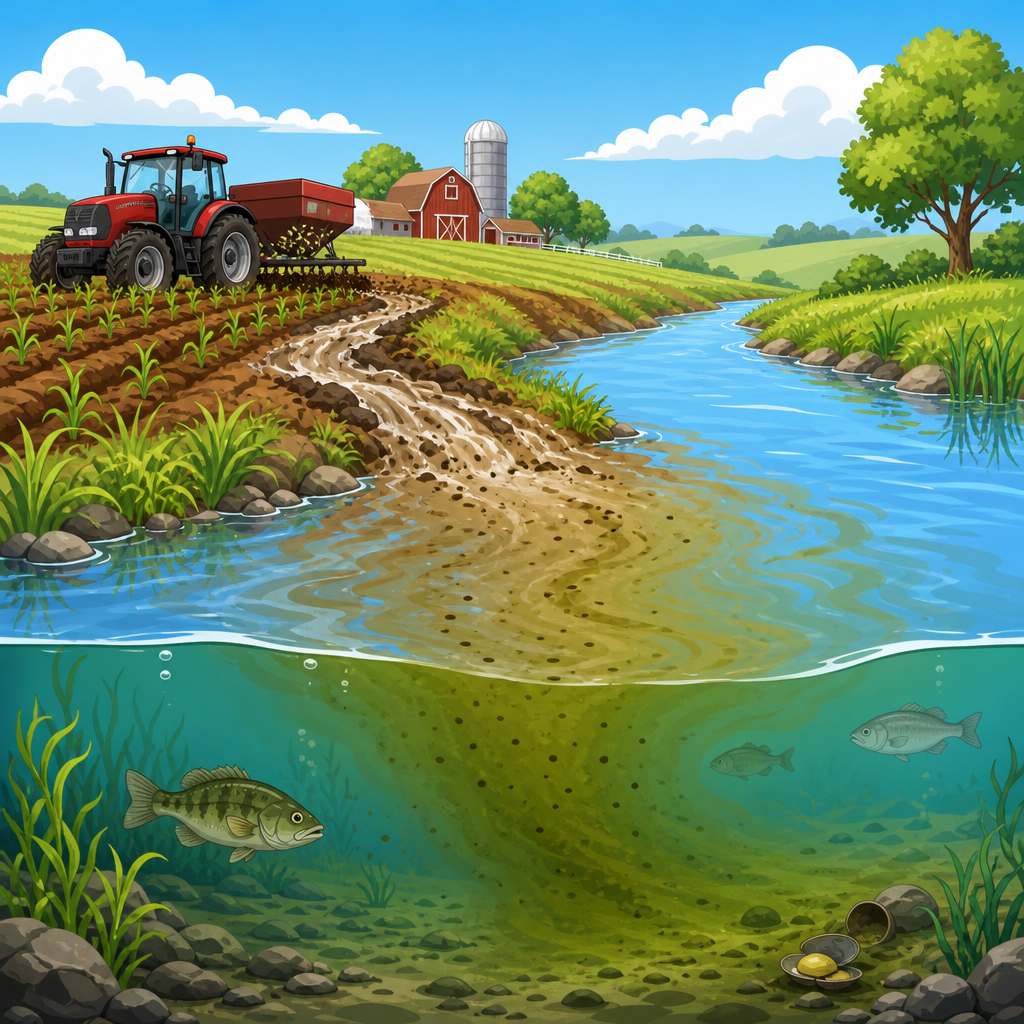
Water pollution is best understood by asking three questions: what enters the water, what form it takes there, and how that form changes ecological impact. Nutrients are among the most important water pollutants because they alter biological productivity. Nitrogen appears as ammonia, ammonium, nitrite, nitrate, and organic nitrogen; phosphorus appears mainly as phosphate and organic phosphorus compounds. Their speciation matters. Ammonia is more toxic to fish at higher pH because the un-ionized form becomes more prevalent. Nitrate is highly soluble and mobile, making it a common groundwater contaminant in agricultural regions. Phosphate often binds to sediments or precipitates with metals, yet under low-oxygen conditions in lakes and reservoirs, previously bound phosphorus can be released back into the water column.
Biochemical oxygen demand and chemical oxygen demand are central concepts in aquatic environmental chemistry. Biochemical oxygen demand measures how much dissolved oxygen microorganisms consume while degrading biodegradable organic matter, typically over five days. Chemical oxygen demand measures the oxygen equivalent required to chemically oxidize organic and some inorganic substances. High values indicate that a discharge can deplete dissolved oxygen, stressing aquatic organisms. Wastewater treatment plants are designed around reducing these loads before effluent reaches rivers or estuaries.
Sediment is also a pollutant because it changes light penetration, temperature, habitat quality, and contaminant transport. Fine particles can carry phosphorus, hydrophobic pesticides, and metals into streams during storm events. Salinity, thermal pollution, and acid mine drainage further show how water quality depends on chemistry. Acid mine drainage forms when sulfide minerals such as pyrite oxidize, producing sulfuric acid and dissolved iron; the resulting low pH can mobilize copper, zinc, manganese, and other metals over long distances.
Heavy Metals and Metalloids: Speciation Controls Risk
Heavy metals and metalloids are major environmental pollutants because they do not degrade into harmless end products. Instead, their toxicity depends on concentration, oxidation state, solubility, and biological availability. Arsenic, lead, mercury, cadmium, and chromium are among the most studied examples. Arsenic occurs naturally in some aquifers, but its mobility increases under specific redox conditions. Inorganic arsenite is generally more toxic and mobile than arsenate. Lead tends to adsorb to particulates and soils, yet acidic water can increase its release from pipes and plumbing fixtures, which is why corrosion control is essential in drinking water systems.
Mercury demonstrates why chemical form matters more than total concentration alone. Elemental mercury can volatilize, inorganic mercury can deposit to land and water, and microbial processes can convert it to methylmercury, a bioaccumulative neurotoxin that concentrates up aquatic food webs. This is the basis for fish consumption advisories. Chromium provides another textbook example: chromium(III) is less mobile and less toxic than chromium(VI), which is more soluble, more oxidizing, and more readily transported in groundwater. Cadmium is associated with batteries, pigments, electroplating, and phosphate fertilizers, and chronic exposure can damage kidneys and bones.
| Pollutant | Key Chemical Property | Main Environmental Concern | Typical Source |
|---|---|---|---|
| Ozone | Strong oxidant; secondary pollutant | Respiratory irritation, crop damage | Photochemical reactions of NOx and VOCs |
| Nitrate | Highly soluble and mobile | Groundwater contamination, eutrophication | Fertilizer, septic systems, manure |
| Lead | Persistent; particle-reactive | Neurotoxicity, drinking water risk | Legacy paint, pipes, industry |
| Mercury | Can transform to methylmercury | Bioaccumulation in fish | Coal combustion, mining |
| Benzene | Volatile aromatic hydrocarbon | Carcinogenic exposure by air and water | Petroleum, fuel storage, solvents |
In remediation and compliance, metals require careful sampling and interpretation. Total recoverable metals, dissolved metals, and bioavailable fractions can tell very different stories. pH, hardness, alkalinity, sulfide, and organic matter all influence whether a metal remains dissolved or precipitates, complexes, or adsorbs. That is why risk assessments use speciation, not just total mass, when determining actual hazard.
Organic Pollutants: Solvents, Fuels, Pesticides, and Persistent Compounds
Organic pollutants include thousands of carbon-based chemicals, but several categories dominate environmental chemistry. Volatile organic compounds such as benzene, toluene, ethylbenzene, and xylene, often grouped as BTEX, are common in petroleum releases. Their volatility allows vapor intrusion into buildings, while moderate solubility can contaminate groundwater. Benzene is especially important because it is a known human carcinogen. Chlorinated solvents such as trichloroethylene and perchloroethylene were widely used for degreasing and dry cleaning. They are denser than water and can sink below the water table as dense nonaqueous phase liquids, creating persistent source zones that are difficult to remediate.
Pesticides vary widely in behavior. Organophosphates tend to be less persistent than organochlorines, but they can be acutely toxic because they inhibit acetylcholinesterase. Legacy organochlorines such as DDT and industrial chemicals such as polychlorinated biphenyls are notable for hydrophobicity, persistence, and bioaccumulation. Their high octanol-water partition coefficients mean they prefer lipids and organic matter over water, which helps explain why they concentrate in fatty tissues and sediments. Polycyclic aromatic hydrocarbons, produced by incomplete combustion, also bind strongly to soot and sediments, and several are probable or known carcinogens.
Per- and polyfluoroalkyl substances, now central to environmental chemistry, are unusually persistent because carbon-fluorine bonds are among the strongest in organic chemistry. PFAS resist heat, oil, and water, which made them useful in firefighting foams, textiles, and industrial applications. The same stability makes them difficult to destroy and costly to remove. Conventional wastewater treatment does not eliminate them effectively. Activated carbon, ion exchange, and high-pressure membranes can reduce concentrations, but management of concentrated residuals remains a major challenge.
Soil Chemistry, Fate, and Transport
Soil is not just a storage medium; it is a reactive chemical system that controls pollutant retention and release. Texture, clay mineralogy, cation exchange capacity, organic carbon, moisture, and pH all influence contaminant fate. Hydrophobic organic compounds often sorb to soil organic matter, reducing immediate mobility but increasing persistence. Polar compounds may travel more readily with infiltrating water. Metals can adsorb onto iron and manganese oxides, precipitate as hydroxides or sulfides, or desorb when pH falls. These shifts explain why a contaminated site can appear stable for years and then begin releasing pollutants after drainage changes, acidification, or excavation.
Environmental chemists often evaluate partitioning using coefficients such as Kd and Kow, as well as Henry’s law constant for air-water exchange. A chemical with high vapor pressure and a favorable Henry’s law constant may volatilize from water or moist soil into air. A chemical with a high Kow is more likely to sorb to organic matter and bioaccumulate. Redox conditions are equally important. In saturated soils and sediments, low oxygen can promote reductive dechlorination of some solvents, but it can also mobilize iron, manganese, and arsenic. Landfills, agricultural fields, industrial sites, and brownfields each present distinct combinations of these processes.
From a practical standpoint, pollutant transport is controlled by advection, dispersion, diffusion, sorption, transformation, and biological uptake. Environmental site assessments, groundwater models, and remedial designs all depend on these mechanisms. Without understanding them, sampling data remain just numbers on a page.
Measurement, Standards, and Pollution Control
Environmental chemistry is applied science, so accurate measurement matters as much as theory. Air pollutants are monitored with instruments such as continuous gas analyzers, high-volume samplers, and optical particle counters. Water and soil contaminants are measured using techniques including gas chromatography, liquid chromatography, mass spectrometry, inductively coupled plasma mass spectrometry, and ion chromatography. Detection limits, holding times, preservation methods, and quality assurance procedures determine whether the data are defensible. In my field work, chain of custody, field blanks, duplicates, and calibration checks were never paperwork exercises; they were what separated credible conclusions from unusable data.
Standards translate chemistry into action. The World Health Organization, United States Environmental Protection Agency, and European Environment Agency publish guideline values, risk criteria, and technical methods that shape regulation and cleanup decisions. Pollution control then follows chemical logic. Particulate emissions are reduced with baghouses, cyclones, and electrostatic precipitators. Sulfur dioxide can be removed by flue gas desulfurization. Nitrogen oxides are reduced by combustion controls and selective catalytic reduction. In water treatment, coagulation, sedimentation, filtration, activated sludge, nutrient removal, activated carbon adsorption, advanced oxidation, and membrane systems target different contaminant classes. No single technology works for every pollutant because chemical properties determine treatability.
The central lesson of environmental chemistry is simple: pollutants are defined not just by where they come from, but by how they behave. Reactivity, solubility, persistence, volatility, and speciation determine exposure, ecological damage, and cleanup options. Air pollutants such as ozone and fine particles harm through atmospheric chemistry and inhalation. Water pollutants such as nitrate, phosphate, and oxygen-demanding wastes alter ecosystems through mobility and biological effects. Metals and metalloids persist, with risk controlled by chemical form. Organic pollutants range from volatile fuels to highly persistent PFAS, and their structures explain why some dissipate quickly while others remain for decades. Soil and sediment chemistry tie the system together by controlling storage, release, and transformation.
As a hub for environmental chemistry within environmental science, this article provides the framework needed to explore every related topic in greater depth, from air quality management and drinking water treatment to hazardous waste, remediation, and ecotoxicology. If you are building knowledge in environmental science, use these pollutant categories and chemical principles as your map. Follow each pathway, compare how properties affect fate, and apply that logic whenever you evaluate contamination, regulation, or pollution control.
Frequently Asked Questions
What are the most common environmental pollutants, and why do their chemical properties matter so much?
Common environmental pollutants usually fall into a few major groups: nutrients such as nitrates and phosphates, heavy metals like lead, mercury, cadmium, and arsenic, volatile organic compounds (VOCs) such as benzene and toluene, persistent organic pollutants (POPs) like PCBs and certain pesticides, petroleum hydrocarbons, particulate matter, and acidic or alkaline chemical wastes. What makes these substances important from an environmental chemistry standpoint is not just their identity, but how their chemical properties control their behavior after release. Properties such as solubility, volatility, acidity, oxidation state, reactivity, and affinity for organic matter determine whether a pollutant stays in air, dissolves into water, settles into sediment, or becomes available for uptake by plants, animals, and people.
These properties are central to predicting risk. A highly volatile chemical can move quickly into the atmosphere and affect air quality far from the original source. A water-soluble contaminant may migrate through soil into groundwater. A strongly hydrophobic compound may attach to sediments and fatty tissues, leading to long-term persistence and bioaccumulation. Even small chemical differences can have major consequences in real-world compliance and remediation work. For example, a slight pH change can alter whether a metal remains dissolved and mobile or precipitates into a less mobile form. That is why environmental professionals focus so heavily on chemical properties: they are the scientific basis for tracing pollutant movement, estimating exposure, and choosing the right control strategy before damage becomes difficult or impossible to reverse.
How do pH and chemical speciation affect the mobility and toxicity of pollutants?
pH and chemical speciation are two of the most important factors in environmental chemistry because they directly influence how pollutants behave in air, water, and soil. Speciation refers to the specific chemical form a substance takes, and that form often determines whether it is mobile, reactive, or toxic. Metals are a classic example. Lead, chromium, copper, and arsenic can exist in different ionic or complexed forms depending on pH, redox conditions, and the presence of other dissolved substances. In one form, a metal may be tightly bound to soil particles and relatively immobile; in another, it may dissolve into groundwater and become much more available for biological uptake.
pH controls many of these shifts. Under acidic conditions, some metals become more soluble, which can increase mobility and potential toxicity. Under more alkaline conditions, those same metals may precipitate as hydroxides or carbonates, reducing their dissolved concentrations. The opposite can also occur for certain compounds, which is why there is no one-size-fits-all rule. pH also affects weak acids and bases, including many organic pollutants, by changing whether they are ionized or neutral. Neutral molecules often cross biological membranes more easily, while ionized species may move differently through soils and water. In practical environmental work, this matters tremendously. A seemingly small change in pH from runoff, industrial discharge, or treatment chemicals can change whether a contaminant spreads, settles, or becomes more bioavailable. Understanding speciation is therefore essential for accurate monitoring, regulatory compliance, and effective remediation planning.
Why do some pollutants evaporate quickly while others persist in water or soil for years?
The answer comes down to a pollutant’s physical and chemical properties, especially vapor pressure, Henry’s law constant, water solubility, molecular structure, and tendency to sorb to organic matter or mineral surfaces. Chemicals with high vapor pressure and a strong tendency to partition from water into air are more likely to evaporate rapidly. Many VOCs behave this way, which is why spills involving solvents or fuels can quickly create air-quality concerns even when the release originally occurs on land or in water. Once in the atmosphere, those pollutants may also undergo photochemical reactions, contributing to smog or forming secondary contaminants.
By contrast, pollutants that are less volatile and more chemically stable may remain in soil or water for long periods. Hydrophobic organic compounds, for example, often have low water solubility and a strong affinity for sediments and organic-rich soils. Instead of evaporating or washing away, they can remain bound in the environment and act as long-term contamination sources. Persistence also depends on how easily a substance degrades through sunlight, microbial activity, oxidation, or hydrolysis. Some compounds break down relatively quickly; others resist natural degradation and can linger for years or decades. This is why two chemicals released under similar conditions may behave very differently. One may disperse rapidly into air, while the other remains in groundwater or sediment, requiring extended management and cleanup. For environmental decision-making, understanding that difference is critical because it affects exposure pathways, monitoring priorities, and the time scale of environmental risk.
What makes heavy metals and persistent organic pollutants especially concerning compared with other contaminants?
Heavy metals and persistent organic pollutants are especially concerning because they combine toxicity with long environmental residence times and, in many cases, the ability to accumulate in living organisms. Heavy metals such as mercury, lead, cadmium, and arsenic do not degrade the way many organic chemicals do. They may change chemical form, bind to minerals, dissolve, precipitate, or cycle between environmental compartments, but the elemental metal itself remains. Their risk depends heavily on speciation. Mercury provides a clear example: elemental mercury, inorganic mercury, and methylmercury differ greatly in mobility and toxicity, with methylmercury being particularly dangerous because it bioaccumulates in aquatic food webs.
Persistent organic pollutants raise similar concerns for different reasons. These compounds are often chemically stable, resistant to biodegradation, and strongly hydrophobic, meaning they tend to partition into sediments and fatty tissues rather than remain in water. That combination supports bioaccumulation in individual organisms and biomagnification up the food chain, where concentrations can increase in predators, including humans. Even when environmental levels appear low, long-term exposure can still be significant because these substances persist and concentrate over time. Many POPs are also linked to chronic health effects such as endocrine disruption, developmental harm, immune impacts, and cancer risk. From an environmental management perspective, these pollutants are challenging because they do not simply disappear after the initial release. They require careful source control, long-term monitoring, and remediation strategies designed around their persistence, toxicity, and movement through ecosystems.
How do scientists and environmental professionals use chemical properties to control pollution and choose the right cleanup method?
Chemical properties are the foundation of pollution control and remediation design. Before selecting any treatment approach, scientists evaluate how a contaminant behaves: whether it is dissolved or particulate, volatile or nonvolatile, acidic or basic, oxidized or reduced, biodegradable or persistent, and strongly adsorbed or freely mobile. Those characteristics help determine where the pollutant is likely to travel, how people or ecosystems might be exposed, and which control technologies are most likely to work. For example, air stripping may be useful for volatile compounds in water, while activated carbon is often better for organic contaminants that adsorb strongly. Metals may be treated through precipitation, pH adjustment, ion exchange, or stabilization, depending on their speciation and concentration.
The same principle applies to prevention and compliance. If a chemical is highly soluble and likely to migrate to groundwater, containment and early interception become priorities. If a pollutant binds tightly to soil, excavation or solidification may be more effective than pump-and-treat methods. If sunlight or oxidation breaks a compound down, advanced oxidation or photolytic treatment may be appropriate. If the substance is persistent and bioaccumulative, long-term source elimination and exposure reduction may be more important than short-term dilution. In real project settings, this often comes down to details that seem small but are chemically decisive. A minor shift in pH, temperature, or redox conditions can change treatment performance and pollutant mobility substantially. That is why environmental chemistry is so valuable: it turns raw contamination data into practical decisions that protect health, meet regulations, and reduce the chance of irreversible environmental damage.