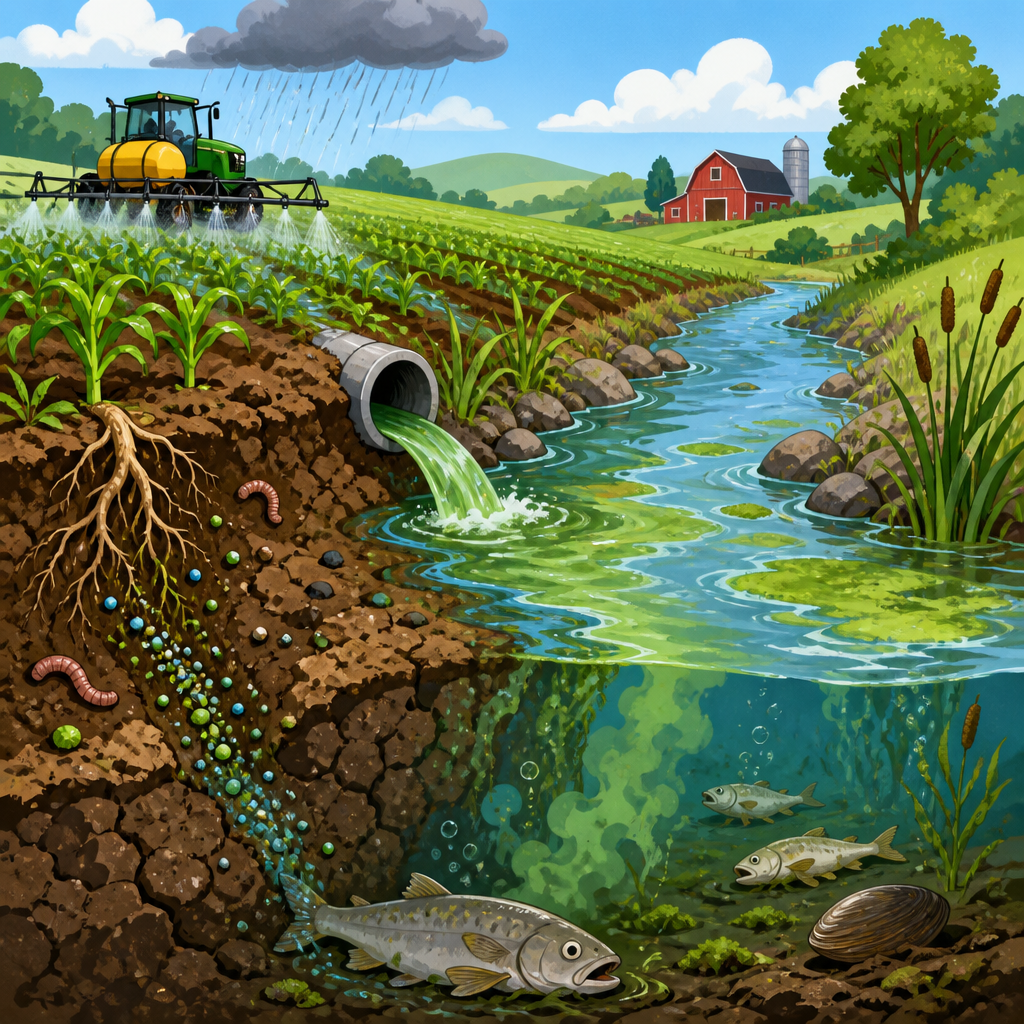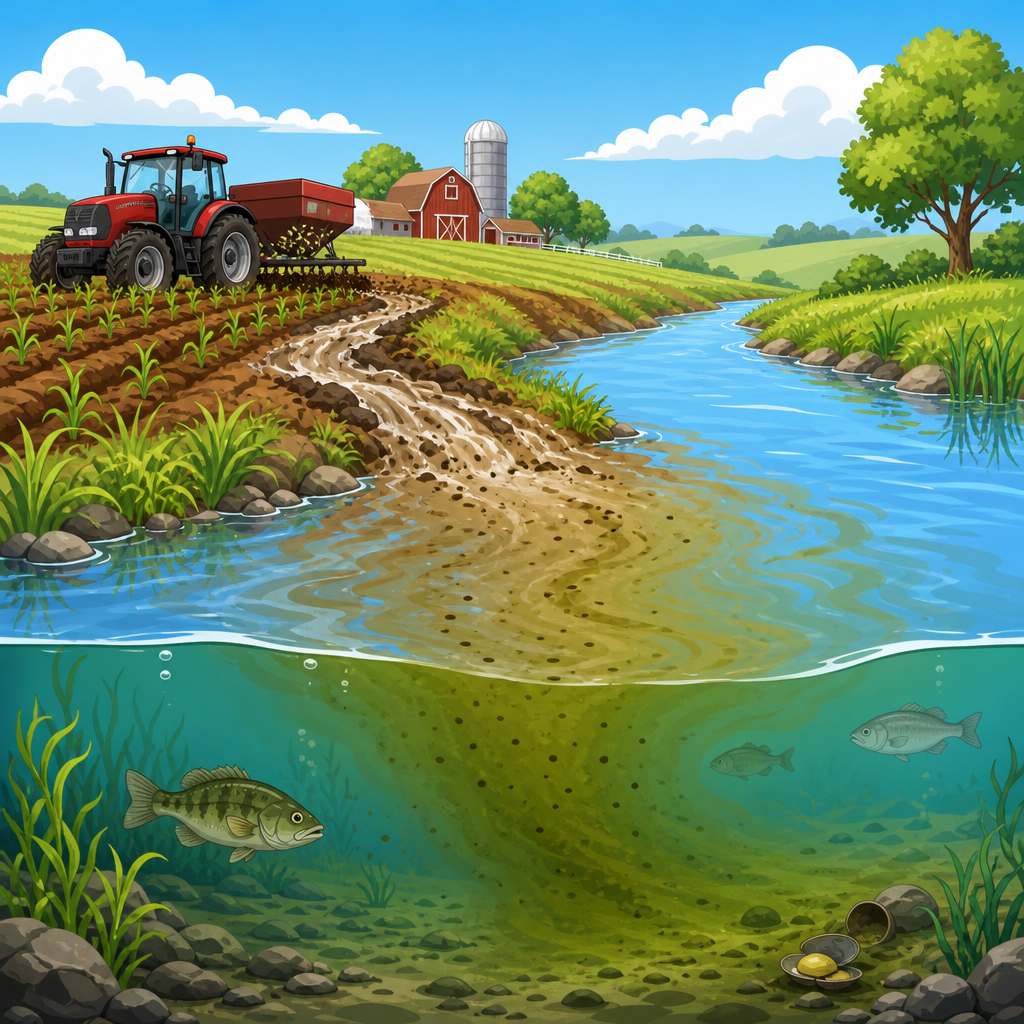
Agricultural runoff is water from rain, irrigation, snowmelt, or drainage that moves across farm fields or through farm soils and carries soil particles, nutrients, manure, pesticides, salts, and pathogens into streams, lakes, wetlands, reservoirs, and groundwater. In soil and water science, this process sits at the center of water quality management because farms occupy large land areas, food production depends on fertilizer and water inputs, and the substances leaving fields can alter aquatic ecosystems far beyond field boundaries. I have worked with watershed monitoring plans where a single storm after fertilizer application caused nitrate, phosphorus, and suspended sediment levels to spike within hours, illustrating how quickly field decisions translate into downstream impacts. Understanding agricultural runoff matters because it connects agronomy, hydrology, chemistry, microbiology, ecology, and public health in one chain of cause and effect. It also matters because many of the most persistent water quality problems, including eutrophication, harmful algal blooms, hypoxia, turbidity, and private well contamination, are linked directly or indirectly to poorly managed runoff and leaching.
Key terms help frame the issue clearly. Runoff is overland flow that occurs when rainfall or irrigation exceeds infiltration capacity or when soils are already saturated. Leaching is downward movement of dissolved substances through the soil profile to groundwater. Nonpoint source pollution refers to diffuse pollution from broad areas rather than a single discharge pipe. Sediment is detached soil transported by water. Nitrogen commonly appears as ammonium, organic nitrogen, or nitrate, while phosphorus often travels attached to eroded particles or dissolved in water. Best management practices are proven field, edge-of-field, or watershed measures designed to reduce pollutant losses while maintaining farm productivity. A strong hub article on soil and water science must cover all of these links, because real water quality outcomes depend on how soils store water, how land is managed, how contaminants move, and how receiving waters respond.
How agricultural runoff forms in soil and water systems
Agricultural runoff begins with hydrology. When rainfall intensity exceeds the soil’s ability to absorb water, infiltration-excess runoff develops. When the soil profile is already full, saturation-excess runoff occurs even under moderate rainfall. Soil texture, structure, organic matter, compaction, slope, surface residue, drainage systems, and crop cover all influence which pathway dominates. Fine-textured clays may have low infiltration when sealed at the surface, while compacted headlands often shed water quickly because machinery traffic reduces pore space. By contrast, well-aggregated soils with stable organic matter, active roots, and residue cover usually absorb more water and lose less sediment. In tiled landscapes, runoff can also move below the surface through drainage pipes, carrying dissolved nitrate rapidly into ditches and streams.
The timing of field operations matters as much as the storm itself. Fertilizer spread before a heavy rain, manure applied to frozen ground, or pesticides sprayed just before irrigation can create a short but intense transport window. In monitoring work, the highest concentrations often occur during the rising limb of a storm hydrograph, when freshly available material is mobilized first. That first flush can carry disproportionate pollutant loads even if the storm is not the largest of the season. This is why runoff management is not only about annual totals; it is about source, timing, transport, and vulnerability at event scale. The source-pathway-receptor concept used in watershed science captures this well: pollutants must exist, a transport route must connect them to water, and the receiving water must be susceptible to harm.
What pollutants agricultural runoff carries
The most important agricultural runoff pollutants are sediment, nitrogen, phosphorus, pesticides, pathogens, salts, and organic matter. Sediment is often the largest pollutant by mass. It clouds water, smothers fish spawning habitat, fills reservoirs, and transports attached phosphorus and hydrophobic chemicals. Nitrogen is essential for crops, but nitrate is highly mobile and can move into both streams and aquifers. Excess nitrate contributes to eutrophication in surface waters and can threaten drinking water safety in rural wells. Phosphorus is usually the limiting nutrient in freshwater systems, so even small losses can trigger algal growth. Dissolved reactive phosphorus is especially influential because algae can use it immediately.
Manure and livestock operations add another layer. Runoff from feedlots, heavily manured fields, or pastures with direct stream access can contain fecal bacteria such as Escherichia coli, protozoa, viruses, and oxygen-demanding organic material. Pesticides enter water either dissolved or sorbed to sediment, depending on their chemistry. Herbicides such as atrazine have been detected seasonally in agricultural watersheds, while insecticides can affect aquatic invertebrates at low concentrations. In irrigated regions, salts can accumulate in soils and then wash into streams, reducing water suitability for downstream irrigation or aquatic life. Every pollutant behaves differently, which is why soil and water science relies on transport mechanisms, sorption coefficients, redox conditions, and residence time rather than one generic runoff model.
How runoff changes rivers, lakes, and groundwater
Agricultural runoff degrades water quality through physical, chemical, and biological pathways. Physically, sediment increases turbidity, reduces light penetration, warms shallow waters, and buries benthic habitat. Chemically, nutrients fuel eutrophication, a process in which excessive nitrogen and phosphorus stimulate rapid algal and plant growth. When that biomass dies, microbial decomposition consumes dissolved oxygen, creating hypoxic conditions that stress or kill fish and invertebrates. This sequence is visible in many lakes and estuaries worldwide, including the Gulf of Mexico hypoxic zone, which is strongly influenced by nutrient exports from the Mississippi River Basin. Biologically, pathogens in runoff can contaminate recreational waters, shellfish beds, and drinking water sources.
Groundwater impacts are different but equally serious. Nitrate leaching is common in coarse-textured soils, shallow aquifers, and regions with heavy irrigation or drainage. Because groundwater moves slowly, contamination can persist for years or decades after field practices improve. Private wells are especially vulnerable where testing is infrequent and treatment is limited. The commonly referenced drinking water standard for nitrate in the United States is 10 milligrams per liter as nitrogen. Exceedance raises concern for infant health, particularly methemoglobinemia risk. Runoff and leaching therefore affect both ecosystem integrity and human use. Water quality is not only about whether a stream looks muddy after rain; it is also about unseen chemical changes, chronic exposure, and delayed responses across an entire watershed.
Factors that make some farms lose more pollutants than others
Not all farms contribute runoff equally. Research and field experience show that a relatively small portion of the landscape often accounts for a large share of losses during critical events. These critical source areas occur where high pollutant sources overlap with strong transport potential. Examples include sloping fields with recent manure application, compacted field entrances draining directly to a ditch, or poorly vegetated streambanks used by cattle. Soil test phosphorus, drainage class, slope length, residue cover, and proximity to water all change risk. Climate also matters. Intense rainfall is increasing in many regions, raising erosion and nutrient export potential even where annual rainfall totals change little.
Farm system differences are important too. Row crops on bare soil generally have higher erosion risk than perennial forage, though dissolved nutrient losses can still occur from any system if management is poor. Tile-drained corn and soybean landscapes often show elevated nitrate loads, while vegetable fields with frequent irrigation may lose both nutrients and pesticides. Orchards and vineyards on slopes can have serious runoff if interrows are bare. Grazing systems vary widely depending on stocking density, stream access, manure distribution, and pasture cover. This is why broad statements such as “fertilizer causes water pollution” are incomplete. The more accurate statement is that pollutant loss depends on rate, source, placement, timing, weather, soil condition, and hydrologic connectivity.
| Runoff factor | Why it increases risk | Practical example |
|---|---|---|
| Steep slope | Faster overland flow gains erosive energy | Cultivated hillside loses sediment during summer storms |
| Soil compaction | Lower infiltration and more surface ponding | Wheel tracks funnel water to a drainage ditch |
| Recent nutrient application | Fresh nitrogen and phosphorus are easily mobilized | Broadcast manure washed off by rain within twenty four hours |
| Tile drainage | Creates rapid subsurface transport to streams | Nitrate bypasses denitrification zones and enters a creek |
| Low residue or bare soil | Exposed surface detaches more readily under rainfall impact | Conventional tillage field erodes before crop canopy develops |
How scientists measure and assess runoff impacts
Water quality assessment combines field sampling, laboratory analysis, and watershed interpretation. Common indicators include total suspended solids, turbidity, nitrate, ammonium, total nitrogen, dissolved reactive phosphorus, total phosphorus, electrical conductivity, dissolved oxygen, chlorophyll a, and fecal indicator bacteria. Event-based monitoring is essential because grab samples taken only during dry weather miss the highest runoff loads. Automatic samplers, flow meters, and stage recorders allow calculation of pollutant loads, not just concentrations. That distinction matters because management goals usually target the total mass reaching water over time. Edge-of-field monitoring can isolate losses from individual practices, while watershed stations show cumulative effects from many farms and land uses.
Established frameworks guide interpretation. The Natural Resources Conservation Service uses soil surveys, hydrologic soil groups, erosion estimates, and nutrient management planning to identify vulnerabilities. The Revised Universal Soil Loss Equation remains a standard tool for estimating sheet and rill erosion risk, though it does not predict gully erosion or dissolved nutrient transport. The Soil and Water Assessment Tool is widely used to simulate watershed hydrology and management scenarios. In the laboratory, nutrient forms are measured using standardized colorimetric or chromatographic methods, and quality assurance protocols are critical because low-level phosphorus data can be highly sensitive to contamination. Good assessment answers practical questions: which fields are exporting pollutants, in what form, during which storms, and which interventions will reduce losses most efficiently.
Practices that reduce agricultural runoff and protect water quality
Effective runoff control follows a treatment train approach, reducing losses at the source, interrupting transport, and buffering receiving waters. Nutrient stewardship starts with matching application rates to realistic yield goals, crediting manure nutrients accurately, and placing fertilizer where crops can use it. Incorporation or injection often lowers dissolved phosphorus loss compared with surface broadcasting, though it can increase erosion risk if tillage buries residue on vulnerable slopes. Cover crops improve infiltration, protect soil from raindrop impact, capture residual nitrogen, and add root channels that enhance aggregation. Conservation tillage and no-till reduce sediment loss substantially when residue cover is maintained, but these systems may need careful phosphorus management because nutrients can accumulate near the surface.
Structural and edge-of-field practices provide additional protection. Grass waterways stabilize concentrated flow paths. Riparian buffers trap sediment, slow runoff, and create opportunities for nutrient uptake before water reaches a stream. Wetlands and retention ponds can store water and promote sedimentation and denitrification. Controlled drainage structures reduce nitrate export from tiled fields by raising the outlet level outside critical periods. Saturated buffers and woodchip bioreactors intercept tile flow and remove nitrate through microbial denitrification. Livestock exclusion fencing, off-stream watering systems, and hardened crossings reduce bank erosion and direct manure inputs. None of these practices is universal. The best results come from combining soil health measures, nutrient management, drainage control, and targeted placement in critical source areas rather than relying on one product or one conservation structure.
Why agricultural runoff is a watershed issue, not just a field issue
Runoff does not respect property lines. A farmer may manage one field carefully and still face downstream impairment driven by cumulative loads from an entire watershed. That is why successful water quality programs operate at multiple scales. On-field agronomy determines what is available to move. Ditches, drainage tiles, streams, floodplains, and reservoirs determine where it goes and how long it stays in the system. Local geology controls groundwater vulnerability. Regional climate sets the intensity and seasonality of runoff events. Policy and economics then shape adoption, from cost-share programs and nutrient regulations to crop insurance incentives and market pressure from food companies demanding documented stewardship.
A watershed perspective also explains why progress can feel slow. Legacy phosphorus stored in soils and stream sediments can continue feeding algal blooms years after applications decline. Groundwater nitrate can keep discharging to streams long after source reductions begin. Monitoring records therefore need patience and realism. Still, targeted interventions work. In watersheds where cover crops, nutrient planning, drainage management, and buffers are concentrated in high-risk areas, measurable reductions in sediment and nutrient export are achievable. The central lesson of soil and water science is practical: clean water depends on understanding how soils receive rainfall, how farming decisions affect transport pathways, and how conservation measures fit the landscape. If you manage land, advise growers, or study environmental science, use this hub as your starting point and apply its principles to every field-to-stream connection you assess.
Frequently Asked Questions
What is agricultural runoff, and why does it matter for water quality?
Agricultural runoff is water from rainfall, irrigation, snowmelt, or field drainage that moves over the land surface or through soil and carries materials away from farms. As that water travels, it can pick up soil particles, nitrogen and phosphorus from fertilizers, manure, pesticides, salts, and disease-causing microbes. Those pollutants can then enter nearby streams, lakes, wetlands, reservoirs, and groundwater supplies. This matters because agriculture covers large areas of land, so even small losses from many fields can add up to major water quality impacts across an entire watershed.
Once these substances reach water bodies, they can change how aquatic systems function. Sediment can make water cloudy, reduce sunlight penetration, and smother fish habitat. Excess nutrients can trigger algal blooms and lower oxygen levels, stressing or killing aquatic life. Pesticides may harm fish, insects, amphibians, and other non-target organisms. Pathogens from manure can create public health risks, especially where water is used for recreation or drinking. In short, agricultural runoff matters because it directly links day-to-day farming practices with the health of rivers, lakes, ecosystems, and community water supplies.
What pollutants are most commonly found in agricultural runoff?
The most common pollutants in agricultural runoff are sediment, nutrients, pesticides, salts, organic matter, and pathogens. Sediment comes from eroded soil and is often one of the largest pollutant loads leaving farm fields. Nutrients, especially nitrogen and phosphorus, are essential for crop growth, but when they are applied in excess or washed away before plants can use them, they become major water quality concerns. Manure and fertilizers are the main agricultural nutrient sources, and both can be transported in runoff or move downward into groundwater.
Pesticides are another important category. Herbicides, insecticides, and fungicides can be carried off fields in dissolved form or attached to soil particles. Even at low concentrations, some of these chemicals can affect aquatic organisms and disrupt ecosystem balance. Pathogens such as bacteria, viruses, and protozoa may be present when manure or livestock waste enters runoff, raising concerns for human health and livestock watering. In some regions, salts from irrigation water or soil amendments can also accumulate and move into surface water or groundwater, affecting both water usability and soil health. The specific mix of pollutants depends on local soils, climate, crops, livestock management, irrigation practices, and the timing of rainfall events.
How does agricultural runoff lead to algal blooms and low oxygen in lakes and streams?
Agricultural runoff contributes to algal blooms mainly by delivering excess nitrogen and phosphorus into water bodies. These nutrients act like fertilizer in aquatic systems, encouraging rapid growth of algae and aquatic plants. When nutrient inputs are high, especially during warm weather and calm water conditions, algae can multiply quickly and form dense blooms. Some blooms are simply a sign of nutrient imbalance, while others may involve harmful algal species that produce toxins dangerous to people, pets, livestock, and wildlife.
The oxygen problem usually develops after the algae die. As dead algae sink and decompose, bacteria consume dissolved oxygen in the water. If oxygen levels fall too low, fish and other aquatic organisms can become stressed or die. This condition is known as hypoxia, and in severe cases it can create “dead zones” where much of aquatic life cannot survive. Nutrient-rich runoff can also promote excessive plant growth in slow-moving streams and shallow lakes, further altering habitat and water chemistry. The result is not just greener water, but a chain reaction that affects water clarity, food webs, fish populations, recreational use, and the cost of water treatment.
Can agricultural runoff contaminate groundwater as well as rivers and lakes?
Yes, agricultural runoff and related leaching processes can affect groundwater as well as surface water. While runoff often brings to mind water flowing across the land into ditches, streams, and ponds, pollutants can also move downward through the soil profile. Nitrate is one of the most common groundwater concerns because it is highly soluble and can travel with infiltrating water beyond the root zone. In areas with sandy soils, shallow water tables, heavy irrigation, or high fertilizer and manure application rates, nitrate contamination can become a significant issue for wells and aquifers.
Groundwater can also be affected by certain pesticides, salts, and pathogens under the right conditions, though their movement depends on soil characteristics, chemical properties, drainage patterns, and land management. This is especially important because many rural communities rely on groundwater for drinking water. Unlike pollution in rivers or lakes, groundwater contamination can be difficult to detect early and expensive to correct once it occurs. That is why water quality management in agriculture looks at both surface pathways and subsurface movement, not just visible runoff after storms.
What farming practices help reduce agricultural runoff and protect water quality?
Reducing agricultural runoff usually requires a combination of practices rather than a single fix. One of the most effective approaches is better nutrient management: applying the right source of fertilizer at the right rate, right time, and right place so crops use more of it and less is lost to water. Cover crops can also play a major role by protecting bare soil, reducing erosion, capturing leftover nutrients, and improving soil structure. Conservation tillage or no-till systems help keep soil in place, improve infiltration, and reduce sediment loss during rainstorms.
Other important practices include grassed waterways, riparian buffer strips, contour farming, terraces, and wetlands that slow water movement and trap sediment and nutrients before they reach streams. Improved irrigation management can reduce excess water application and minimize both runoff and leaching. On livestock operations, proper manure storage, timing, and field application are essential to prevent nutrient and pathogen losses. Drainage water management and edge-of-field practices such as retention ponds or treatment systems can further reduce pollutant transport. The most successful water quality protection strategies are usually tailored to local conditions, because soil type, slope, crop system, weather, and farm economics all influence which measures will work best and be sustained over time.