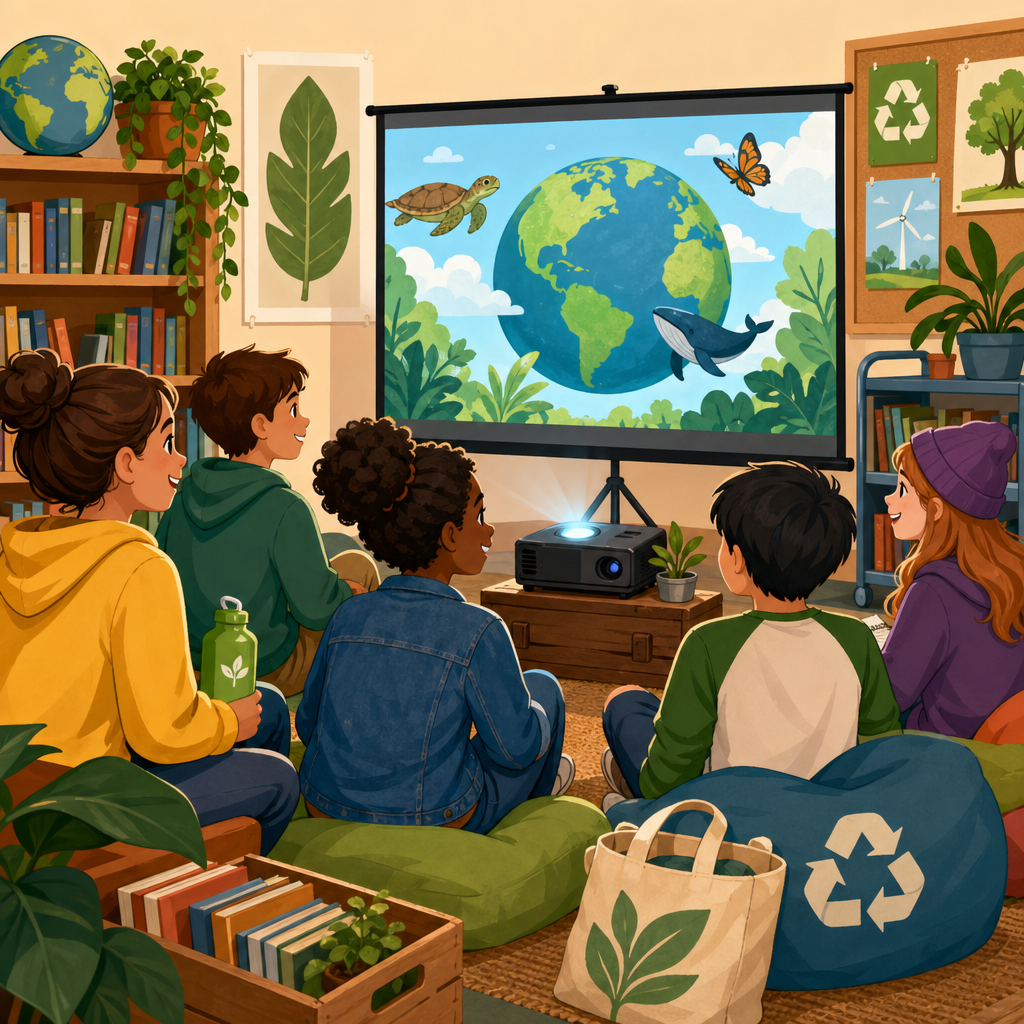
Starting an eco film club at your school or library is one of the most practical ways to turn environmental interest into shared learning, discussion, and action. An eco film club is a recurring program where students, educators, librarians, families, or community members watch documentaries, short films, and educational videos focused on nature, climate, conservation, food systems, waste, energy, and environmental justice. I have helped plan film-based learning programs in both school and public library settings, and the most successful clubs always do three things well: they choose the right films, create a structure that encourages discussion, and connect what viewers learn to local action. That combination matters because films can make complex issues understandable in a way textbooks alone often cannot. A well-chosen documentary can show coral bleaching, plastic pollution, wildfire risk, or urban farming with an immediacy that helps people remember both the problem and the possible solutions.
This topic matters for schools and libraries because both institutions are trusted community spaces for lifelong learning. Schools can use a film club to support science, social studies, media literacy, and civics goals. Libraries can use one to expand public programming, attract teens and families, and support community partnerships. Educational videos and documentaries are especially valuable because they work across age groups and reading levels. A ten-minute explainer from PBS, NASA Climate Kids, or TED-Ed can introduce a topic for younger audiences, while a feature-length documentary can support deeper discussion for teens and adults. Film clubs also fit current educational priorities. They encourage critical thinking, evidence-based discussion, and civic engagement. In practice, they can become a hub that links classroom learning, library programming, sustainability clubs, garden projects, repair events, recycling campaigns, and local expert talks.
To start an eco film club successfully, you need more than enthusiasm. You need a clear purpose, a workable schedule, appropriate licensing, accessible film selections, and a plan for facilitation. You also need to understand what counts as an educational video versus a documentary, and how each format serves different goals. Educational videos are usually shorter, more focused, and designed to explain a specific concept such as composting, renewable energy, biodiversity loss, or greenwashing. Documentaries are typically longer and more narrative, often using interviews, field footage, archival media, and reporting to explore a larger issue. Both belong in a strong eco film club. Short videos are useful for quick meetings, younger groups, and lesson tie-ins. Longer documentaries are best for special events, panel discussions, and monthly screenings. When you combine both formats, your club can serve as the central resource page and programming model for educational videos and documentaries across your broader education and resources efforts.
Set the club’s mission, audience, and format
The first step is deciding exactly who the eco film club is for and what success looks like. In a school, the audience might be middle school students interested in environmental science, a high school sustainability club, or a mixed group open to all grades. In a library, the audience might be teens, families, adult learners, or an intergenerational community group. The clearer the audience, the easier it is to choose films and discussion prompts. I usually recommend writing a one-sentence mission statement before choosing any titles. For example: “The club uses documentaries and educational videos to help students understand environmental issues and take informed local action.” That statement prevents the program from drifting into random movie nights with no learning outcome.
Format should match the audience’s attention span, transportation realities, and calendar. A school club often works best as a monthly forty-five to sixty-minute meeting using short films or selected clips, with one longer after-school screening each term. Libraries usually have more flexibility and can offer monthly feature screenings, family matinees, or themed series such as Oceans Month, Food Waste Week, or Climate Solutions in Cities. Keep logistics simple at launch. A predictable schedule such as “first Thursday of each month at 4 p.m.” builds attendance more reliably than irregular events. Decide whether the club is drop-in or member-based, whether registration is required, and whether discussions will be teacher-led, librarian-led, or shared among student facilitators.
You should also define the club’s tone. Some environmental films are urgent and emotionally heavy, especially those focused on climate disaster, species decline, or environmental injustice. Others are practical and solutions-oriented. Balanced programming is important. If every screening leaves viewers overwhelmed, attendance drops. A durable club mixes problem-focused content with examples of restoration, innovation, policy progress, and community action. That balance is especially important for younger viewers. In my experience, students stay engaged when each meeting ends with one concrete idea they can apply, whether that is reducing food waste, checking local water quality reports, planting pollinator species, or writing to a school administrator about energy use.
Choose educational videos and documentaries strategically
Good film selection is the core of the club. Start by organizing possible content into themes rather than choosing titles at random. Strong starter themes include climate change, plastic pollution, biodiversity, sustainable food, environmental justice, renewable energy, water systems, and green cities. Then choose a mix of formats within each theme. A short educational video can introduce vocabulary and basic concepts. A documentary can deepen understanding with stories, evidence, and human context. This layered approach helps both beginners and more advanced participants.
Use trusted sources when building your list. Public broadcasters such as PBS and BBC Earth regularly produce classroom-friendly environmental content. National Geographic, Smithsonian Channel, and NOVA also offer high-quality science storytelling. For shorter educational videos, look at TED-Ed, Crash Course, SciShow, NASA, NOAA, and many nonprofit conservation organizations. For documentaries, evaluate both editorial quality and age appropriateness. Some acclaimed films are visually powerful but contain advocacy framing, disturbing footage, or oversimplified claims. That does not mean you should avoid them; it means you should facilitate them carefully and pair them with discussion questions grounded in evidence.
Consider running a progression from local to global. A meeting on waste could begin with a short video explaining municipal recycling contamination, move to a documentary segment about global plastic trade, and end with a conversation about what your school cafeteria or library building actually throws away. That structure makes the topic real. Students and library patrons respond better when they can connect a global issue to their own street, lunchroom, bus route, or park. It also creates natural internal pathways to related educational resources such as reading lists, classroom guides, repair workshops, and sustainability project pages.
| Theme | Short educational video use | Documentary use | Local action idea |
|---|---|---|---|
| Plastic pollution | Explain microplastics, recycling limits, and source reduction | Show supply chains, ocean impact, and policy debates | Audit single-use plastics in school or library events |
| Food systems | Introduce composting, soil health, and food waste basics | Explore industrial agriculture, hunger, and regenerative farming | Start compost collection or a garden partnership |
| Climate change | Clarify greenhouse gases, adaptation, and mitigation | Present human stories, science reporting, and infrastructure risk | Map heat islands or promote energy-saving practices |
| Biodiversity | Define habitat loss, pollinators, and invasive species | Show ecosystem connections and conservation efforts | Create native planting or habitat awareness events |
One practical rule is to preview everything in full before screening it. I have seen well-meaning organizers rely on a trailer or recommendation list, only to discover pacing issues, factual gaps, or unsuitable scenes during the event. Previewing lets you identify where to pause, what terms need explanation, and what supplementary resources will help. It also helps you plan run time accurately. If your meeting window is fifty minutes, a forty-minute documentary with a ten-minute discussion will feel rushed. A better design might be two short videos totaling fifteen minutes followed by twenty minutes of guided discussion and ten minutes for planning a simple action.
Handle licensing, equipment, and accessibility correctly
One of the most overlooked parts of starting an eco film club is public performance licensing. In many cases, a personal streaming subscription does not permit a public showing in a school or library. Rules vary by platform, distributor, educational exception, and whether the screening is instructional or open to the public. The safest approach is to check the licensing terms for each title and obtain public performance rights when required. Libraries often work with vendors such as Swank Motion Pictures, Kanopy, or specific documentary distributors. Schools may have additional options through district agreements, classroom licenses, or direct educational distributors. Never assume that owning a DVD or having access to a streaming account automatically covers group screenings.
Equipment needs are straightforward but important. Test the room, projector, speakers, captions, internet connection, and playback device in advance. Environmental films often rely on subtle narration and field sound, so weak audio can ruin the experience. If possible, use external speakers instead of built-in projector audio. Keep a downloaded backup if the license permits it, or have a second title ready in case a stream fails. In libraries, room acoustics matter; in schools, bell schedules and custodial access matter. Build a simple checklist and use it before every event.
Accessibility should be treated as essential, not optional. Always enable captions when available. Choose materials with clear narration, readable visuals, and age-appropriate pacing. Provide a short written summary for participants who process information better through reading. If discussions are part of the program, use structured prompts so quieter participants can contribute. For multilingual communities, consider bilingual resources or subtitles. Libraries serving broad publics should also think about transportation timing, evening safety, and family-friendly scheduling. A film club grows faster when people can realistically attend and participate fully.
Facilitate strong discussions and connect films to action
A screening alone is not a film club. The discussion is where learning becomes meaningful. Good facilitation starts with specific questions that move from comprehension to analysis to action. Ask what the film claimed, what evidence it used, whose voices were included, and what perspectives may have been missing. Then ask what the issue looks like locally and what responses are practical. This approach strengthens both environmental understanding and media literacy. Participants learn not only about climate, waste, or habitat loss, but also how storytelling shapes public opinion.
In school settings, discussion prompts can align with curriculum standards. A science teacher might ask students to distinguish observational footage from expert interpretation. A social studies teacher might focus on policy, equity, and public decision-making. In libraries, discussion can be more community-centered. After a documentary on urban heat, for example, participants might compare tree cover in different neighborhoods or invite a city planner to a future meeting. The strongest clubs routinely bring in outside voices such as park staff, waste coordinators, master gardeners, local journalists, or environmental nonprofit leaders. Those guests make the leap from screen to community tangible.
Action should stay realistic. Avoid designing every meeting around a large campaign. Small, repeatable actions build momentum better than ambitious plans that stall. After a screening on food waste, the club might create signs for a share table, measure cafeteria leftovers, or host a leftovers recipe exchange. After a screening on biodiversity, members might map pollinator plants on campus or create a native species display near the circulation desk. These actions reinforce the club’s value to administrators, families, and funders because they produce visible outcomes.
Promote, evaluate, and grow the program over time
Promotion works best when it is tied to clear themes and recognizable benefits. Instead of advertising “documentary night,” promote “Plastic-Free Lunch Challenge Screening” or “How Cities Can Cool Down: Film and Discussion.” Specificity improves attendance because people know what they will learn. Use posters, morning announcements, school newsletters, library event calendars, social media, and partner organizations. Student-made trailers or book displays can be especially effective. In libraries, pair film nights with related books, seed library materials, local resource guides, or maker activities. In schools, connect screenings to science fairs, Earth Day, service learning, or classroom units.
Track a few simple metrics from the beginning. Attendance is useful, but it is not enough. Also record repeat participation, discussion quality, partnerships formed, actions completed, and participant feedback. A one-minute exit survey can ask what viewers learned, what confused them, and what topics they want next. That data will help you improve pacing, title selection, and scheduling. It also strengthens grant applications and budget requests. Many local foundations, Friends of the Library groups, PTAs, and environmental organizations are willing to support youth and community education when they can see a well-run plan with measurable impact.
As the club matures, build a resource hub around it. Create annotated film lists by age group and theme. Add discussion guides, lesson extensions, book recommendations, and links to reliable environmental data sources such as EPA, NOAA, USGS, or your local environmental agency. This turns the club into more than an event series; it becomes the central gateway for educational videos and documentaries within your education and resources section. That hub structure makes it easier to publish supporting pages on climate documentaries for teens, short sustainability videos for classrooms, family-friendly nature films, documentary discussion questions, and film-based project ideas.
An eco film club succeeds because it combines storytelling, evidence, and community participation in one accessible format. Start with a clear mission, choose educational videos and documentaries that fit your audience, handle licensing and accessibility responsibly, and plan discussions that lead to practical next steps. Schools can use the club to support curriculum and student leadership. Libraries can use it to expand public learning and community partnerships. In both settings, the film club can become a durable hub for environmental education resources, not just a one-time activity. The biggest benefit is simple: people learn better when they see real-world problems and solutions together, then discuss what those insights mean where they live. If you want to build environmental awareness that actually leads somewhere, start small, schedule your first screening, and let the conversation grow.
Frequently Asked Questions
What is an eco film club, and why is it a good fit for a school or library?
An eco film club is a recurring program built around watching and discussing films about environmental topics such as climate change, biodiversity, conservation, food systems, waste, water, energy, environmental justice, and community solutions. In a school or library setting, it works especially well because it combines education, discussion, and real-world engagement in a format that feels accessible and social rather than overly formal. Instead of asking people to absorb information passively, an eco film club creates a shared experience that helps students, families, educators, and community members connect ideas to everyday life.
Schools and libraries are ideal hosts because they already serve as trusted learning spaces. Schools can use an eco film club to support classroom goals in science, social studies, language arts, civics, media literacy, and service learning. Libraries can use it to expand public programming, welcome intergenerational audiences, and build community around timely topics. In both cases, films make complex environmental issues easier to understand by showing real places, people, and challenges. That visual storytelling often sparks stronger conversations than a lecture or reading alone.
Another reason an eco film club is such a strong fit is that it can be adapted to many age groups and budgets. A club might feature short films for younger students, documentary clips for middle grades, or full-length films and facilitated discussion for teens and adults. It can be held monthly, every quarter, or tied to special events like Earth Day, a sustainability week, or a summer reading program. Most importantly, an eco film club can move beyond awareness. When planned thoughtfully, it becomes a place where participants not only learn about environmental problems but also discuss practical responses, local resources, and meaningful actions they can take together.
How do I start an eco film club at my school or library step by step?
Start by defining the purpose of the club. Decide whether your main goal is environmental education, student leadership, family engagement, community dialogue, or action-oriented programming. A clear purpose will shape every other decision, including what films you select, who you invite, and how discussions are structured. It is also helpful to identify your audience early. An elementary school eco film club will look very different from a teen-led high school program or a public library series for mixed ages.
Next, get approval and identify partners. In a school, that may mean speaking with an administrator, department chair, teacher team, or student activities coordinator. In a library, it may involve a programming manager, branch supervisor, or outreach staff member. Ask who can help with scheduling, room reservations, technology, publicity, and attendance. Strong eco film clubs are rarely built by one person alone. They work best when there is shared ownership among teachers, librarians, student leaders, parent volunteers, or community partners.
After that, choose a realistic format. Decide how often the club will meet, how long each session will be, and whether you will show a full film, selected clips, or a short film plus discussion. For many schools and libraries, a monthly meeting is a manageable starting point. You will also want to choose a consistent structure, such as welcome and introduction, film screening, guided discussion, and a simple follow-up activity or resource share. Predictable structure makes the club easier to run and easier for participants to understand.
Once the format is clear, focus on logistics. Confirm your screening space, projector, speakers, internet access if needed, and seating arrangement. Check whether you need permission slips for students, registration for public participants, or accessibility supports such as captions. Then select films that are age-appropriate, engaging, and relevant to your audience. Build a short discussion guide for each screening with open-ended questions, key vocabulary, and a few local connections. Finally, promote the club consistently through announcements, flyers, newsletters, social media, classroom outreach, and staff recommendations. A simple launch with one strong event is often better than an ambitious series that is difficult to sustain.
How do I choose the right environmental films for different age groups?
The best environmental films are not simply the most famous documentaries. They are the ones that fit your audience’s age, attention span, emotional readiness, and learning goals. Start by asking what you want participants to gain from the screening. Are you introducing a broad topic like recycling or wildlife habitats? Are you exploring a more advanced issue like climate policy, environmental racism, or industrial agriculture? Are you trying to inspire action, encourage empathy, or support a classroom unit? Your answers will help narrow the field quickly.
For younger children, look for short, visually clear films with concrete themes and a hopeful tone. Topics such as pollinators, oceans, forests, gardens, animal habitats, litter prevention, or water conservation usually work well. Keep running times short and avoid films that are overly dense, abstract, or emotionally overwhelming. For middle school audiences, you can begin introducing bigger systems and cause-and-effect relationships, but it is still important to balance urgency with solution-focused storytelling. Students in this age group respond well to films that show young people making a difference and that connect global issues to local choices.
For high school students, college audiences, and adult community groups, you can go deeper into complex subjects such as climate justice, renewable energy, food systems, land use, corporate responsibility, policy, and activism. Even then, quality matters more than intensity. Choose films with credible sourcing, strong storytelling, and room for discussion rather than films designed only to shock. It is also wise to preview every film yourself in full. Check for language, imagery, pacing, political framing, and emotional impact so you know exactly how to prepare participants and guide the conversation afterward.
Whenever possible, build variety into your programming. A good eco film club does not focus only on environmental disasters. Include stories about restoration, innovation, Indigenous stewardship, local ecosystems, youth leadership, community gardens, zero-waste efforts, and practical solutions. This creates a more balanced experience and helps participants leave informed and motivated rather than discouraged. If you are unsure where to begin, start with one short, high-interest film and pair it with a simple discussion. That low-pressure approach often gives you the clearest sense of what your group wants to explore next.
Do I need public performance rights or special permission to show films at a school or library?
In many cases, yes. This is one of the most important parts of planning an eco film club, and it should never be treated as an afterthought. Just because a film is available on a streaming service, video platform, or personal DVD does not automatically mean it can be shown to a group in a school, library, or public program. Public screenings often require public performance rights, sometimes called PPR, licensing permission, or educational screening rights. The exact rules depend on the film, the venue, the size and nature of the audience, and whether the screening is connected to instruction or open community programming.
For schools, there may be limited educational exemptions in certain classroom settings, but those exemptions do not automatically cover clubs, assemblies, after-school events, or public programs. For libraries, public performance rights are especially important because screenings are often considered public exhibitions even when attendance is free. The safest and most professional approach is to verify screening rights before you advertise or show any film. This may involve contacting the distributor, checking the licensing terms from the film’s educational provider, or purchasing a screening license through an authorized source.
If your budget is limited, do not assume that legal screening options are out of reach. Many documentary distributors offer affordable educational licenses, and some filmmakers provide community screening options. You can also look for films specifically released for educational or library use, partner with local organizations that already have screening permission, or feature short films from creators who clearly allow educational sharing. Keep written records of permissions and licensing terms so your program remains compliant and easy to manage over time.
Beyond legality, handling rights properly builds trust and professionalism. It shows respect for filmmakers, protects your school or library, and helps establish your eco film club as a credible long-term program rather than an informal gathering. If you are ever unsure, ask your administration, legal or policy team, district media office, or library system leadership for guidance before moving forward.
How can an eco film club keep participants engaged and turn discussion into real action?
The strongest eco film clubs do more than screen films. They create a rhythm of reflection, conversation, and manageable next steps. To keep participants engaged, begin by making every meeting interactive. Instead of ending the event as soon as the credits roll, plan a thoughtful discussion with open-ended questions that invite observation, emotion, analysis, and connection. Ask what surprised people, what felt relevant locally, what solutions were presented, and what barriers still remain. Good facilitation helps participants move from “That was interesting” to “What does this mean for us?”
It also helps to make the club participatory in its planning. Invite students, teens, or regular attendees to help choose themes, vote on films, create posters, lead introductions, moderate discussions, or suggest follow-up projects. When people feel ownership, they are much more likely to return. In schools, student leadership is especially powerful. In libraries, partnerships with local educators, sustainability groups, conservation organizations, or youth volunteers can add expertise and energy. Even simple roles such as greeter, discussion host,