The water cycle explained for students and adults begins with a simple idea: water is always moving, changing form, and connecting the atmosphere, land, oceans, rivers, soil, plants, and living things. Scientists often call this continuous movement the hydrologic cycle. It includes evaporation, condensation, precipitation, infiltration, runoff, groundwater flow, and transpiration. In classrooms, the cycle is sometimes reduced to a neat circle with clouds and rain, but in practice it is a dynamic planetary system shaped by energy from the sun, gravity, landforms, vegetation, and human activity. Understanding it matters because every question about drinking water, farming, flooding, drought, wetlands, erosion, water quality, and climate depends on how water moves through the environment.
In soil and water science, the water cycle is not only about where water goes; it is also about timing, storage, and condition. A raindrop may fall on a forest, soak into soil, feed plant roots, recharge an aquifer, and emerge years later in a stream. Another raindrop may hit a parking lot, run into a storm drain within minutes, and carry oil, metals, or sediment into a river. I have found that students understand the cycle better when they stop thinking of it as a closed loop on paper and start seeing it as a set of linked reservoirs and pathways. The main reservoirs are oceans, ice, groundwater, lakes, rivers, soil moisture, the atmosphere, and living organisms. The pathways are the processes that transfer water between them.
This hub article covers the full picture of soil and water science by explaining the core stages of the water cycle, the role of soils, the importance of watersheds and groundwater, the effect of human land use, and the reasons the cycle is central to environmental science. If you want a working understanding of how rain becomes streamflow, why some soils flood while others absorb water, how plants return water to the air, or why climate change intensifies both heavy rainfall and drought, the answers start here. Once you grasp the water cycle, every related topic in environmental science becomes easier to understand.
The core stages of the water cycle
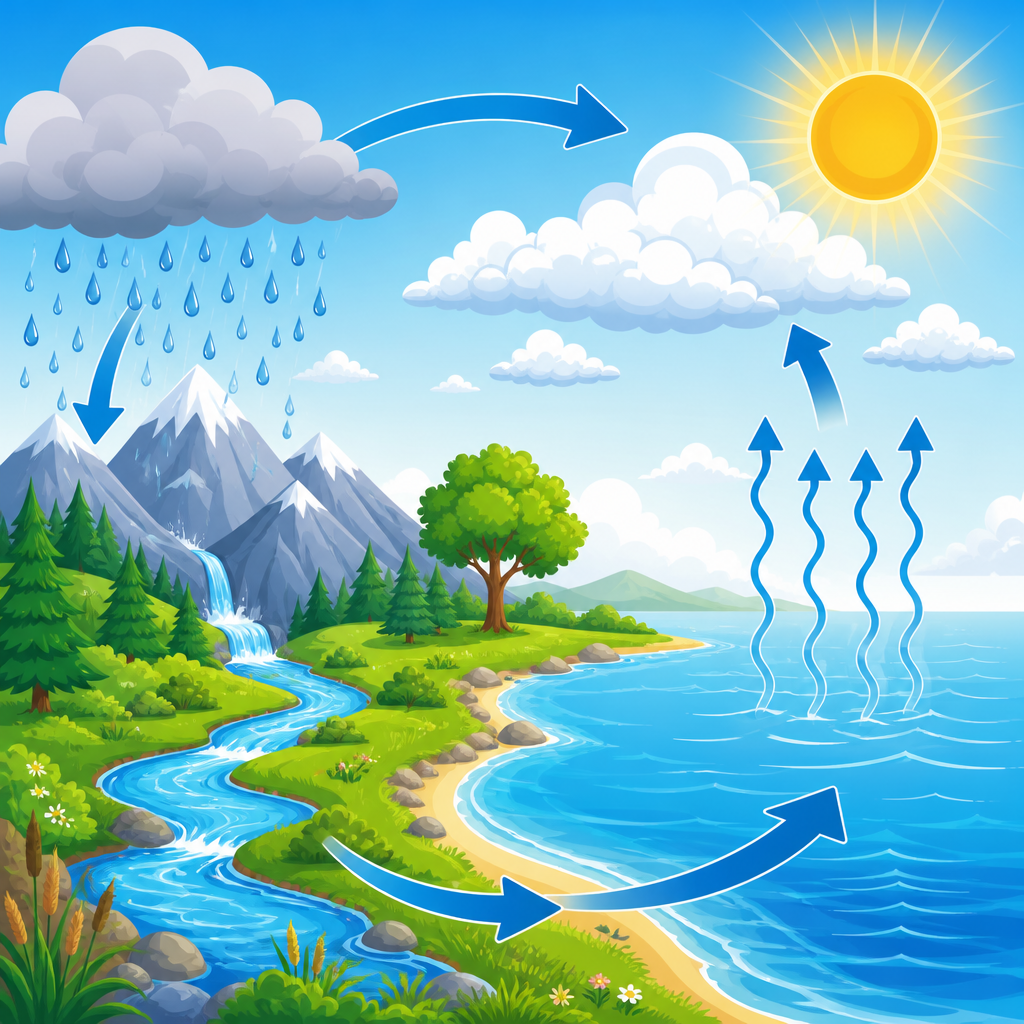
The water cycle has several primary stages, and each one can be observed in ordinary life. Evaporation happens when liquid water gains enough energy to become water vapor. This occurs from oceans, lakes, rivers, wet soil, and even puddles after a storm. Because the oceans cover about 71 percent of Earth’s surface, they supply most atmospheric water vapor. Transpiration is similar, but the vapor comes from plants. When roots absorb water from soil and plants release it through leaf pores called stomata, that transfer is transpiration. Together, evaporation and transpiration are often grouped as evapotranspiration, a key term in hydrology and agriculture.
Condensation happens when water vapor cools and changes into tiny liquid droplets or ice crystals, forming clouds or fog. Precipitation occurs when those droplets or crystals grow large enough to fall as rain, snow, sleet, or hail. Once precipitation reaches the ground, several things can happen. Some water infiltrates the soil surface. Some becomes runoff and flows downhill into ditches, streams, rivers, lakes, and eventually the ocean. Some is intercepted by leaves and evaporates back into the air before reaching the ground. In cold regions, some is stored temporarily as snowpack or ice, then released later during melt seasons. That delayed release is one reason mountain snow is such an important water source in the western United States and many other regions.
Gravity drives water downhill, but the path is rarely direct. Water may pond in wetlands, move laterally through shallow soil, sink deeper to groundwater, or be taken up by crops and forests. The same molecule can cycle quickly or slowly. Atmospheric water may remain aloft for only about a week on average, while groundwater can remain underground for years, centuries, or longer depending on the aquifer. This difference in residence time is essential. Fast pathways often shape flood risk, while slow pathways support streamflow during dry periods. Good soil and water science always asks not just where water is, but how long it stays there.
Why soil is central to the water cycle
Soil is the overlooked engine of the water cycle on land. It acts as a temporary reservoir, a filter, a biological habitat, and a control point that determines whether rainfall infiltrates or runs off. Soil is made of mineral particles, organic matter, air, water, and organisms. The relative amount of sand, silt, and clay is called soil texture, and texture strongly affects water movement. Sandy soils have larger pores and usually allow faster infiltration, while clay-rich soils have smaller pores and often hold more water but infiltrate more slowly. Structure matters too. A well-aggregated loam with stable crumbs and root channels can absorb water far better than a compacted clay loam.
In fieldwork, one of the clearest lessons is how land management changes soil behavior. A healthy soil with plant cover, earthworm channels, and organic matter can accept heavy rain surprisingly well. A compacted lawn, overgrazed pasture, or construction site often seals at the surface and sheds water quickly. This is why two neighboring fields can respond differently to the same storm. One stores water for crops; the other erodes. Infiltration rate, field capacity, wilting point, and available water holding capacity are not abstract terms. They determine whether roots can access moisture between rains and whether sediment ends up in a creek.
Soils also clean water as it moves downward. Fine particles trap sediment, organic matter can bind contaminants, and microbes transform nutrients. For example, nitrate from fertilizer may leach through some soils into groundwater, while phosphorus often attaches to eroded soil particles and travels in runoff. This is why soil conservation and water quality management are inseparable. Practices such as cover cropping, reduced tillage, contour farming, mulching, and riparian buffers improve infiltration, reduce erosion, and protect streams. When people ask how soil and water science fits into environmental science, this is the answer: soil controls the fate of water on land.
Surface water, groundwater, and watersheds
A watershed is the land area that drains to a common outlet such as a stream, river, lake, or estuary. Every place lies within a watershed. If rain falls on a school roof and enters a storm drain that empties into a creek, that water has joined the local watershed. Watersheds provide the practical framework for managing water because they connect uplands, soils, tributaries, floodplains, wetlands, and downstream communities. Hydrologists use stream gauges, rain gauges, and models to understand how a watershed responds to storms, snowmelt, and seasonal change.
Surface water includes rivers, lakes, reservoirs, ponds, and wetlands. Groundwater is water stored below the surface in pore spaces and fractures. An aquifer is a geologic unit that can store and transmit usable amounts of groundwater. Recharge happens when infiltrating water reaches the saturated zone. Discharge happens when groundwater emerges through springs, seeps, wetlands, or streambeds. Many streams depend on baseflow, the portion of streamflow supplied by groundwater between storms. When aquifers are overpumped, wells can decline and streams can lose this steady support, harming fish habitat and water availability.
| Water store or pathway | What it does | Example in daily life |
|---|---|---|
| Soil moisture | Supplies plant roots and delays runoff | A garden stays damp after rain |
| Runoff | Moves water quickly across land | Water rushing along a street curb |
| Groundwater | Stores water underground and feeds wells and streams | Drinking water from a municipal well field |
| Wetlands | Store water, filter pollutants, and reduce flood peaks | A marsh filling after a storm |
| Snowpack | Stores water seasonally and releases it during melt | Mountain snow feeding rivers in spring |
The connection between surface water and groundwater is one of the most important concepts in soil and water science. People often imagine rivers as separate from underground water, but they are usually linked. In gaining streams, groundwater flows into the channel. In losing streams, water moves from the stream into surrounding sediments. This interaction affects temperature, chemistry, and habitat. Trout streams, for example, often benefit from cool groundwater inputs. Understanding these links helps explain why upstream pumping, paving, drainage, or wetland loss can change downstream flow and water quality.
How climate, plants, and land use shape the cycle
Climate determines how much water enters and leaves a region through precipitation and evapotranspiration. Warm air can hold more moisture than cold air, which is one reason intense rainfall events can increase in a warming climate. Seasonal temperature patterns also control whether precipitation falls as rain or snow, affecting runoff timing. In snow-dominated basins, earlier snowmelt can shift river flows away from summer, when farms and cities often need water most. Drought, meanwhile, is not just a lack of rain. It can involve low soil moisture, stressed vegetation, reduced streamflow, and depleted groundwater.
Plants are major water managers. Forest canopies intercept rainfall, roots open pathways for infiltration, and transpiration returns large volumes of water to the atmosphere. Grasslands protect soil from erosion and often build organic matter that improves water storage. Crops can either conserve or deplete soil water depending on species, season, and management. In irrigation districts, farmers track crop water use with weather data, soil sensors, and evapotranspiration estimates from tools supported by agencies such as the FAO and the USDA. Those measurements turn the water cycle from a diagram into a daily management decision.
Land use can either work with the water cycle or disrupt it. Urbanization replaces absorbent ground with roofs, roads, and parking lots, increasing impervious surface area. That reduces infiltration, speeds runoff, raises flood peaks, and carries pollutants into waterways. Stormwater systems can move water away so quickly that streams become flashier and more erosive. By contrast, green infrastructure such as rain gardens, bioswales, permeable pavement, green roofs, and detention basins is designed to slow, spread, and soak water. In agriculture, tile drainage can improve field trafficability and yields but may also accelerate nutrient delivery to streams unless paired with nutrient management and edge-of-field controls.
Why the water cycle matters for people and ecosystems
The water cycle matters because it determines water supply, food production, ecosystem health, and hazard risk. Cities depend on reliable runoff, reservoir storage, aquifer recharge, and water treatment. Farmers depend on soil moisture, irrigation timing, and the balance between infiltration and drainage. Fisheries depend on stream temperature, dissolved oxygen, and steady seasonal flows. Wetlands depend on water levels that support specialized plants and wildlife. When the cycle is altered, the effects spread quickly across society. Floods damage homes and infrastructure, drought reduces crop yields, and polluted runoff can trigger algal blooms that close beaches and threaten drinking water sources.
One widely studied example is nutrient pollution in the Mississippi River Basin, where runoff carrying nitrogen and phosphorus contributes to low-oxygen conditions in the Gulf of Mexico. Another is groundwater depletion in heavily irrigated regions such as parts of the High Plains aquifer, where long-term pumping has lowered water levels. These cases show that water quantity and water quality are not separate issues. They are products of the same cycle interacting with soil, land use, climate, and management. The best solutions therefore combine hydrology, agronomy, ecology, and engineering rather than treating each problem in isolation.
For students and adults alike, the main lesson is practical: the water cycle is the operating system behind environmental science. Learn how water evaporates, falls, infiltrates, runs off, recharges groundwater, feeds plants, and returns to the atmosphere, and you can make sense of soil health, watersheds, irrigation, stormwater, flooding, erosion, wetlands, and climate impacts. Start by observing your own area after the next rainstorm. Watch where water collects, where it sinks in, and where it flows away. That habit turns a textbook diagram into real understanding, and it is the first step toward wiser water decisions.
Frequently Asked Questions
What is the water cycle, and why is it important?
The water cycle, also called the hydrologic cycle, is the continuous movement of water through Earth’s atmosphere, surface, and underground systems. Water does not stay in one place forever. It moves from oceans, lakes, rivers, and soil into the air through evaporation, forms clouds through condensation, falls back to Earth as precipitation, and then travels across the land or into the ground through runoff, infiltration, and groundwater flow. Plants also play a major role by releasing water vapor into the atmosphere through transpiration. Together, these processes connect the sky, land, oceans, ecosystems, and living things in one ongoing natural system.
This cycle is important because it constantly recycles and redistributes Earth’s water. It helps supply fresh water to rivers, lakes, soils, and underground aquifers. It shapes weather and climate, supports agriculture, sustains forests and wildlife, and provides the water people need for drinking, sanitation, and industry. Without the water cycle, water would not be naturally renewed across different regions. Understanding it helps both students and adults see that water is not simply “used up” and replaced on demand. Instead, it is part of a larger planetary system that must be protected and managed carefully.
What are the main steps of the water cycle?
The main steps of the water cycle include evaporation, condensation, precipitation, infiltration, runoff, groundwater flow, and transpiration. Evaporation happens when liquid water is warmed by the Sun and turns into water vapor, rising into the atmosphere. Condensation occurs when that vapor cools and changes back into tiny droplets, forming clouds. When those droplets or ice crystals become heavy enough, they fall as precipitation, which can include rain, snow, sleet, or hail. These are the stages most often shown in simple classroom diagrams, but they are only part of the full story.
After precipitation reaches the ground, water can take several paths. Some of it flows across the surface as runoff, eventually entering streams, rivers, lakes, and oceans. Some soaks into the ground through infiltration, where it may become soil moisture or move deeper to recharge groundwater. Groundwater can travel slowly through rocks and sediments before feeding springs, wetlands, streams, or wells. At the same time, plants absorb water from the soil and release some of it back into the atmosphere through transpiration. Because water can move through many routes at different speeds, the water cycle is better understood as a dynamic network rather than a perfect circle.
How do evaporation and transpiration differ?
Evaporation and transpiration both return water to the atmosphere, but they happen in different ways. Evaporation is a physical process in which liquid water from oceans, lakes, rivers, puddles, and wet soil changes into water vapor due to heat energy, mainly from the Sun. It can happen almost anywhere water is exposed to the air. Warm temperatures, dry air, and wind usually increase the rate of evaporation. This process is especially significant over the oceans, which provide a major share of the water vapor in the atmosphere.
Transpiration, by contrast, is a biological process involving plants. Roots take up water from the soil, the water moves through the plant, and some of it is released from tiny openings in leaves called stomata as water vapor. In this way, plants act as a bridge between the soil and the atmosphere. Scientists often combine evaporation and transpiration under the term “evapotranspiration” because both contribute moisture to the air. Understanding the difference matters because it shows that forests, grasslands, crops, and other vegetation are active participants in the water cycle, not just passive recipients of rain.
Why is the water cycle often shown as a simple circle when it is more complex?
The water cycle is often shown as a simple circle because that version is easy to teach and remember. It introduces the core idea that water moves from Earth’s surface into the atmosphere and back again. For younger students, a diagram with the Sun, clouds, mountains, and rain provides a useful starting point. It highlights major processes such as evaporation, condensation, and precipitation without overwhelming learners with every detail. Educational models often simplify natural systems so people can grasp the basic pattern before studying the more complicated reality.
In the real world, however, the water cycle is much more complex than a neat loop. Water can remain in glaciers for thousands of years, in groundwater for decades or centuries, or in the atmosphere for only a short time. It can move sideways through soil, collect in wetlands, be stored in lakes and reservoirs, or be taken up by living organisms. Human activities such as urban development, irrigation, deforestation, dam building, and groundwater pumping also change how water moves and where it is stored. So while the simple circle is useful for learning the fundamentals, a more accurate view is that the water cycle is a flexible, interconnected system with many pathways, storage locations, and timescales.
How do human activities affect the water cycle?
Human activities affect the water cycle in many direct and indirect ways. Cities and roads create hard surfaces that prevent water from soaking into the ground, which increases runoff and can raise the risk of flooding. Deforestation reduces transpiration and changes how water is stored in soils and released into the atmosphere. Agriculture alters infiltration, runoff, and evaporation, especially when irrigation is used heavily. Pumping groundwater faster than it can recharge lowers water tables and can reduce streamflow, dry out wetlands, or even cause land subsidence in some regions. Dams and reservoirs also change the natural timing and movement of water through river systems.
Climate change is another major influence. As global temperatures rise, evaporation patterns can shift, storms may become more intense in some places, and drought may become more severe in others. Snowpack and glaciers, which store freshwater and release it gradually, are changing in many parts of the world. These shifts affect ecosystems, farming, drinking water supplies, and flood risks. For students and adults alike, one of the most important lessons is that the water cycle is not separate from human life. People are part of the system, and decisions about land use, water conservation, energy, and environmental protection can have lasting effects on how water moves through the planet.