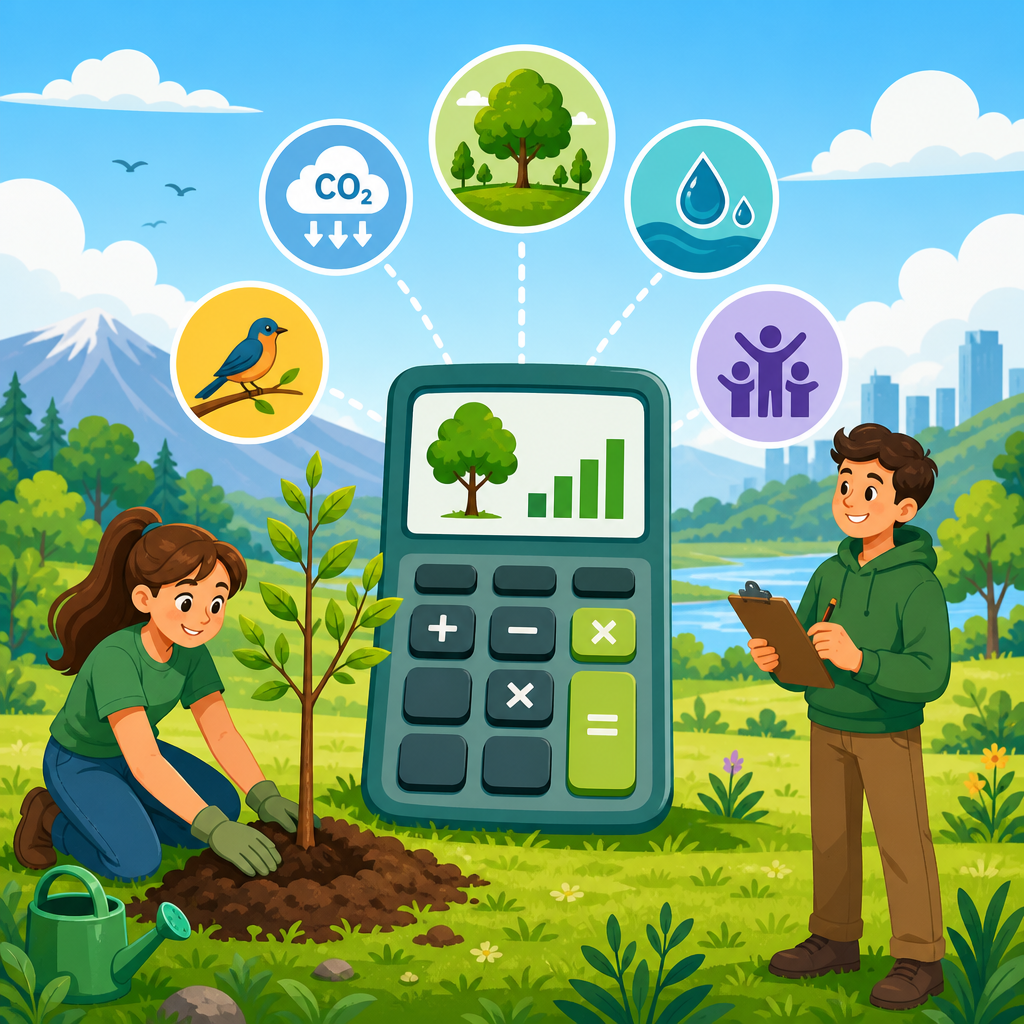
Tree planting impact calculators turn a simple question—“What difference will these trees make?”—into measurable estimates for carbon storage, shade, stormwater reduction, biodiversity support, and long-term financial value. In practice, these tools help nonprofits, municipalities, schools, landowners, and corporate sustainability teams move beyond broad claims and make defensible decisions about species selection, planting density, site design, maintenance budgets, and reporting. I have used them during urban greening plans, grant applications, and post-planting reviews, and the same pattern appears every time: good calculators create clarity, while weak ones create false confidence. That distinction matters because tree planting is often funded through public money, donor campaigns, or climate commitments, all of which require transparent assumptions.
At their core, tree planting impact calculators combine biological growth models, local climate data, species traits, and management assumptions to estimate outcomes over time. Depending on the tool, outputs may include annual carbon sequestration, lifetime carbon storage, avoided energy use from shade, interception of rainfall, air pollutant removal, canopy growth, survival rates, and replacement value. Some are built for urban forestry, where pavement, heat, and building proximity shape outcomes. Others are intended for reforestation, agroforestry, or restoration projects, where stand density, soil type, and regional ecology matter more than street-level infrastructure. A reliable calculator does not predict the future with certainty; it models plausible scenarios using stated variables and documented methods.
This topic matters because trees deliver benefits slowly, unevenly, and in context. A sapling planted today will not provide the same cooling, runoff reduction, or habitat value as a mature tree, and a tree planted in compacted soil beside a road will not grow like one protected in a park. Interactive tools and calculators help users account for those differences before money is spent and before claims are published. As the hub page for this subtopic, this guide explains how tree planting impact calculators work, what inputs and outputs matter most, where common errors appear, which tools are widely used, and how to interpret results responsibly. If you need a practical framework for choosing, using, and comparing tree calculators, start here.
How Tree Planting Impact Calculators Work
Most tree planting impact calculators follow the same logic chain: define the planting scenario, select species or forest type, apply growth assumptions, estimate survival over time, and convert projected tree size into environmental or economic benefits. In urban tools, diameter at breast height, crown spread, leaf area, and condition ratings are common intermediate variables. In restoration tools, users may work with stocking density, hectares planted, expected canopy closure, mortality rates, and regional biomass equations. The model then maps those variables to outputs such as carbon stored, kilograms of pollutants removed, cubic meters of runoff intercepted, or kilowatt-hours of building energy savings.
A well-built calculator depends on three layers of data. First is species-level or functional-group data, such as mature size, growth rate, wood density, and drought tolerance. Second is site data, including climate zone, precipitation, solar exposure, soil conditions, and surrounding land use. Third is management data, especially establishment care, replacement planting, pruning cycles, and survival assumptions. I have seen planners enter idealized values—high survival, fast growth, perfect maintenance—and generate impressive numbers that collapse under field reality. The stronger approach is to build conservative, base-case, and optimistic scenarios so stakeholders understand the range, not just the headline estimate.
Time horizon is another critical factor. Carbon and canopy benefits are cumulative, while establishment costs are front-loaded. A five-year model may show modest environmental returns because young trees are still small. A twenty- or forty-year model often reveals the real value, assuming survival and care are sustained. That is why experienced users read the assumptions page before they read the summary output. If a calculator cannot show the time period, mortality rate, or methodology used to convert tree growth into impact values, its estimates should be treated as directional at best.
What Inputs Matter Most
The quality of a tree planting impact estimate rises or falls on inputs. Species selection is usually the most visible choice, but it is only one part of the picture. Planting location matters just as much. The same red maple or plane tree will perform differently in a narrow streetside pit, a schoolyard, or a riparian buffer. Rooting volume, impervious surface, heat stress, irrigation access, and exposure to wind or salt all affect growth and survival. If a calculator allows species but not site constraints, users should interpret outputs cautiously.
Survival rate is often the most underestimated variable. Newly planted trees face transplant shock, drought, mowing damage, vandalism, and poor aftercare. In many urban programs, first-year mortality can be significant if watering is inconsistent. Reforestation projects can also lose seedlings to browsing, fire, invasive competition, or flood events. A model assuming ninety-five percent survival may look impressive on paper, but if comparable local projects have achieved seventy percent after three years, the forecast should be adjusted. Good calculators let users enter mortality or replacement rates explicitly.
Maintenance assumptions deserve equal attention. Mulching, structural pruning, watering schedules, staking removal, pest monitoring, and soil remediation influence growth trajectories. Mature benefits do not emerge from planting alone; they depend on establishment success and ongoing stewardship. This is one reason many municipalities pair impact calculators with asset management systems. The tree is not treated as a symbolic unit but as living infrastructure with performance tied to maintenance inputs.
| Input Category | Why It Matters | Common Mistake | Better Practice |
|---|---|---|---|
| Species or forest type | Drives growth rate, canopy size, wood density, and resilience | Choosing by popularity alone | Match species to site and climate tolerance |
| Location and site conditions | Affects survival, shade value, runoff capture, and rooting potential | Using generic urban or rural defaults | Enter local soil, sun, hardscape, and space constraints |
| Time horizon | Changes whether benefits appear modest or substantial | Reporting lifetime benefits without dates | Show annual and cumulative results by year range |
| Mortality and replacement | Prevents overstatement of total impact | Assuming all trees survive | Use observed local survival data and replacement plans |
| Maintenance regime | Influences growth, safety, and long-term performance | Ignoring watering and pruning | Model realistic care budgets and responsibilities |
Finally, geographic calibration matters. Temperature, rainfall, evapotranspiration, and pollution profiles vary widely. A calculator tuned for North American street trees may not transfer well to tropical restoration projects or dryland agroforestry systems. When I evaluate a tool, I first ask whether its default equations and climate datasets match the planting geography. If they do not, the outputs may still be useful for rough planning, but not for public claims or offset accounting.
Common Outputs and What They Really Mean
Users often focus on the biggest number a calculator produces, usually carbon, but each output has different meaning and limitations. Carbon sequestration refers to the rate at which a tree removes carbon dioxide from the atmosphere and stores carbon in biomass over time. Carbon storage refers to the amount already held in the tree at a given point. Those are not interchangeable. A young fast-growing tree may have meaningful annual sequestration but limited total storage compared with a mature tree. If a project reports only cumulative carbon decades into the future, readers should also ask about survival assumptions, disturbance risk, and whether emissions from planting, irrigation, or replacement were counted.
Stormwater interception estimates represent rainfall captured by leaves, bark, and canopy surfaces before water reaches the ground. In urban areas, this can reduce pressure on drainage systems, especially during smaller storms. However, interception is not the same as total watershed flood control. Soil infiltration, compaction, drainage design, and event intensity still matter. Air quality outputs usually estimate removal of pollutants such as ozone, nitrogen dioxide, sulfur dioxide, and particulate matter. These benefits can be real, but they vary by species, leaf traits, weather, and surrounding emission sources.
Energy savings outputs typically appear in urban forestry tools that model shade and windbreak effects on buildings. A properly placed deciduous tree can lower summer cooling demand by shading roofs, walls, and windows, while allowing winter sun after leaf drop. Conifers may reduce winter wind exposure in colder climates. These savings depend on orientation, building type, local energy mix, and mature canopy size. I have seen users claim utility savings from trees planted where no building is close enough to benefit. The calculator may allow that input, but the scenario is not physically meaningful.
Biodiversity outputs are less standardized. Some calculators estimate habitat potential based on canopy cover, native species mix, or structural diversity. Others use proxy indicators rather than direct measures of species richness. That makes them useful for screening but weaker for detailed ecological claims. Economic outputs, such as replacement value or avoided infrastructure costs, can be persuasive in budget conversations, yet they are highly method-dependent. Treat them as decision-support metrics, not universal truths.
Leading Tools, Methods, and Use Cases
Several tools dominate professional practice because they are transparent, tested, and aligned with specific use cases. i-Tree, developed with support from the USDA Forest Service and partners, remains the best-known suite for urban and community forestry. Different modules address inventory analysis, canopy assessment, species selection, and benefit estimation. i-Tree Eco is widely used to quantify structure and ecosystem services from measured tree data, while i-Tree Design helps estimate benefits for individual trees or small sites. Its strength is urban calibration and broad practitioner adoption. Its limitation is that users must understand the inventory and assumptions to avoid superficial outputs.
For broader carbon accounting in forestry and restoration, practitioners often turn to biomass equations, regional allometric models, and standards-informed calculators rather than general consumer tools. Methodologies can draw from Intergovernmental Panel on Climate Change guidance, national greenhouse gas inventories, Verra methodologies in project contexts, or peer-reviewed regional biomass studies. These approaches are more rigorous for carbon projects, but they are less intuitive for community engagement because they require species groups, plot measurements, and baseline definitions.
Municipalities and campus planners frequently combine tree calculators with GIS platforms such as ArcGIS, QGIS, or canopy analysis tools derived from LiDAR and aerial imagery. That combination lets teams map planting opportunities, estimate equitable canopy distribution, and compare scenarios by neighborhood. In one city planning workflow I supported, we paired canopy-gap mapping with i-Tree-style benefit estimates and local heat vulnerability data. The result was a stronger planting plan because the calculator outputs were tied to real streets, real residents, and real maintenance routes instead of abstract tree counts.
For education and donor engagement, simpler web-based calculators can still be useful if they disclose assumptions clearly. A school, for example, may use an interactive calculator to compare ten native shade trees with ten ornamental trees in terms of canopy growth, irrigation demand, and carbon benefit over twenty years. The educational value is not in claiming exact outcomes but in showing tradeoffs: right tree, right place, and right care determine impact more than tree count alone.
How to Use Calculators Responsibly in Planning and Reporting
The safest way to use tree planting impact calculators is to treat them as scenario tools, not proof generators. Start with a specific question. Are you comparing species? Estimating maintenance return on investment? Prioritizing neighborhoods for heat reduction? Building a grant narrative? The question determines the right tool and the right level of precision. If the purpose is program outreach, directional estimates may be enough. If the purpose is carbon claims, capital budgeting, or regulatory reporting, you need documented methods, local calibration, and auditable assumptions.
Always report the basics alongside any output: number of trees, species mix, location type, planting date or modeled year, survival assumption, time horizon, and calculator or method used. If outputs are cumulative, say so. If they are annual, say that too. Separate projected benefits from measured benefits. This distinction is critical. A newly planted project can responsibly report modeled future impact, but it should not present those values as already achieved. In public communications, I recommend wording such as “estimated 20-year carbon storage under stated survival assumptions” rather than “carbon captured” without context.
Ground-truthing improves credibility. Revisit sample sites, measure survival, compare canopy growth against projections, and update assumptions annually or every few years. Over time, organizations build their own local performance data, which makes future calculations stronger. It also reveals where models underperform, such as in low-soil-volume downtown corridors or drought-prone sites without irrigation. When the real world diverges from the model, revise the model. That discipline is what separates credible impact reporting from marketing language.
Hub readers exploring related resources should next look at species selection tools, urban canopy mapping guides, carbon accounting primers, and maintenance budgeting calculators. Together, these articles form the practical ecosystem around tree planting impact calculators and help translate estimates into better planting outcomes.
Conclusion
Tree planting impact calculators are valuable because they connect planting decisions to measurable outcomes, but their usefulness depends on transparent assumptions, appropriate methods, and realistic inputs. The best tools help users compare scenarios, understand tradeoffs, and communicate expected benefits in carbon, stormwater management, energy savings, canopy growth, and ecosystem support. They do not remove uncertainty, and they should never be used to inflate claims. Instead, they provide a structured way to ask better questions about species choice, site conditions, maintenance, survival, and time horizon.
If you remember one principle, make it this: a tree calculator is only as credible as the local data and judgment behind it. Use conservative assumptions, match the tool to the project type, and report estimates with clear context. Done well, interactive tools and calculators can improve planning, strengthen funding proposals, and make sustainability reporting more honest and useful. Explore the related articles in this Education & Resources hub to choose the right calculator, interpret results correctly, and turn projected impact into durable, well-managed canopy.
Frequently Asked Questions
What is a tree planting impact calculator, and what does it actually measure?
A tree planting impact calculator is a planning and reporting tool that estimates the environmental, social, and sometimes economic benefits a tree planting project is likely to generate over time. Rather than relying on vague statements such as “trees are good for the planet,” these calculators translate planting plans into measurable outcomes. Depending on the tool, that can include projected carbon sequestration, air pollutant removal, shade and energy savings, stormwater interception, urban heat reduction, habitat or biodiversity support, and even long-term property or infrastructure value.
Most calculators work by combining several inputs: tree species, planting size, site conditions, climate region, spacing, expected survival rate, and growth over time. The calculator then applies research-based growth models and benefit equations to estimate what those trees may do in 5, 10, 20, or more years. In urban settings, a tool may focus heavily on canopy cover, building shade, runoff reduction, and pollution removal. In reforestation or land restoration settings, it may emphasize biomass accumulation, carbon storage, erosion control, and ecosystem recovery.
The key point is that these tools estimate impact, not guarantee it. Their value comes from helping organizations compare scenarios and make better decisions before money is spent. For example, a municipality can compare two species mixes for stormwater benefit, a school can estimate how much shade its campus trees may provide over time, and a nonprofit can use modeled outcomes to support grant applications and donor communications. When used correctly, a tree planting impact calculator becomes a decision-support framework that turns planting plans into defensible projections.
How accurate are tree planting impact calculators?
Tree planting impact calculators can be very useful, but their accuracy depends on the quality of the inputs, the assumptions built into the model, and how closely real-world conditions match the tool’s underlying data. In other words, the calculator is only as strong as the information and methodology behind it. If you enter realistic species data, local climate conditions, expected maintenance levels, and survival assumptions, the results can be highly valuable for planning and comparison. If the inputs are generic or overly optimistic, the output may look impressive but be less reliable in practice.
One of the most important things to understand is that these calculators produce modeled estimates, not field measurements. They often rely on established forestry or urban tree research, allometric equations, canopy growth curves, and regional climate datasets. That gives them scientific credibility, but it also means they simplify reality. Soil quality, irrigation, pest pressure, pruning practices, compaction, vandalism, drought, heat stress, and species-site mismatch can all affect actual outcomes. A tree projected to thrive for 30 years may underperform if it is planted in poor soil and receives limited maintenance.
For most organizations, the best way to think about calculator accuracy is “directionally strong, precision varies.” These tools are excellent for comparing alternatives, setting expectations, prioritizing investment, and supporting transparent reporting. They are less suited to making exact claims without qualification. That is why responsible users document their assumptions, include survival and maintenance scenarios, and revisit estimates as projects mature. In many cases, the most credible approach is to use the calculator for forecasting and then pair it with periodic monitoring, canopy assessments, or survival surveys to validate and refine the projected results.
What inputs matter most when using a tree planting impact calculator?
Several inputs have an outsized influence on the results, and getting them right can dramatically improve the usefulness of the calculator. Species selection is one of the biggest factors because growth rate, mature size, canopy spread, lifespan, wood density, and tolerance to local conditions all influence projected benefits. A fast-growing species may show quicker short-term carbon or shade gains, while a slower-growing, longer-lived tree may deliver greater value over decades. Species also vary in how well they support pollinators, birds, and local biodiversity, which matters if ecological outcomes are part of the project goals.
Site conditions are just as important. Climate zone, rainfall patterns, temperature extremes, soil type, available rooting volume, sun exposure, slope, and surrounding land use can all change how a tree performs. A calculator may ask for location directly or may infer conditions from the project region. In urban projects, nearby pavement, buildings, utility conflicts, and building orientation can significantly affect shade, heat mitigation, and stormwater outcomes. In rural or restoration projects, factors like topography, existing vegetation, hydrology, and grazing pressure can be highly relevant.
Planting density, time horizon, and survival rate are also critical. A project with 1,000 trees sounds substantial, but the long-term impact depends on how many survive and reach maturity. If the model assumes a 95% survival rate when actual conditions suggest 70%, the projected benefits may be overstated. Maintenance assumptions matter too. Watering, mulching, pruning, pest management, and replacement planting influence both survival and growth. The most credible calculator results come from realistic inputs that reflect the actual planting plan, budget, and site constraints rather than aspirational numbers chosen to maximize impact totals.
How do tree planting impact calculators help with planning, budgeting, and reporting?
These calculators are valuable because they connect ecological outcomes to practical decisions. In planning, they help users compare scenarios before planting begins. A city can test whether larger shade trees along streets produce better long-term cooling than smaller ornamental species. A corporate sustainability team can estimate how many trees are needed to support a carbon or community greening target. A school or campus planner can identify where canopy expansion may provide the greatest benefit for comfort, runoff reduction, and student experience. By modeling outcomes in advance, organizations can move from “we should plant trees” to “here is the most effective planting strategy for this site and goal.”
For budgeting, calculators help reveal the difference between planting cost and project value. They can support decisions about whether to invest in larger nursery stock, irrigation, soil improvements, tree guards, or multi-year maintenance contracts. They also help stakeholders understand that tree benefits accumulate over time and depend on survival. That often leads to smarter budgets that prioritize establishment care rather than spending everything upfront on planting day. In some cases, projected benefits such as energy savings, stormwater reduction, or avoided infrastructure costs can also help justify funding requests and strengthen grant proposals.
In reporting, impact calculators give nonprofits, municipalities, landowners, and companies a consistent way to communicate results. Instead of simply reporting the number of trees planted, they can report estimated carbon stored over time, gallons of stormwater intercepted, canopy added, or habitat supported. That makes project outcomes more meaningful to donors, boards, regulators, employees, and community members. It also improves credibility when reports clearly explain the methodology and assumptions used. The strongest reporting does not treat calculator results as marketing slogans; it presents them as evidence-based estimates that guide decisions and can be refined through ongoing monitoring.
What are the limitations of tree planting impact calculators, and how should results be interpreted?
Tree planting impact calculators are powerful tools, but they do not capture every variable that determines real-world success. One major limitation is that many models simplify biological and site complexity. Trees do not grow on perfect curves in every location, and they do not all survive to maturity. Local management practices, climate extremes, invasive pests, wildfire risk, soil degradation, construction damage, and water availability can all cause actual outcomes to differ from projected ones. A calculator may estimate strong benefits over 25 years, but those benefits depend on trees staying healthy and in place over that full time period.
Another limitation is that calculators often focus on measurable benefits more easily than broader ecosystem and social outcomes. Carbon, canopy, runoff, and shade can often be modeled with reasonable confidence. Community attachment, mental health benefits, cultural value, educational impact, and neighborhood identity are much harder to quantify, even though they may be central to the project’s purpose. Biodiversity estimates can also vary widely depending on whether the tool uses generalized habitat assumptions or location-specific ecological data. As a result, no calculator should be treated as a complete picture of tree value.
The best way to interpret results is as scenario-based estimates that support better decisions, not as fixed promises. Use them to compare alternatives, stress-test assumptions, and communicate likely outcomes with transparency. It is wise to review what the tool includes, what it excludes, the time horizon used, and whether the assumptions match actual maintenance capacity and local conditions. When possible, pair calculator outputs with field verification, survival tracking, canopy monitoring, and periodic updates. That approach keeps the results both credible and useful, and it helps organizations turn projected impact into genuine long-term performance.