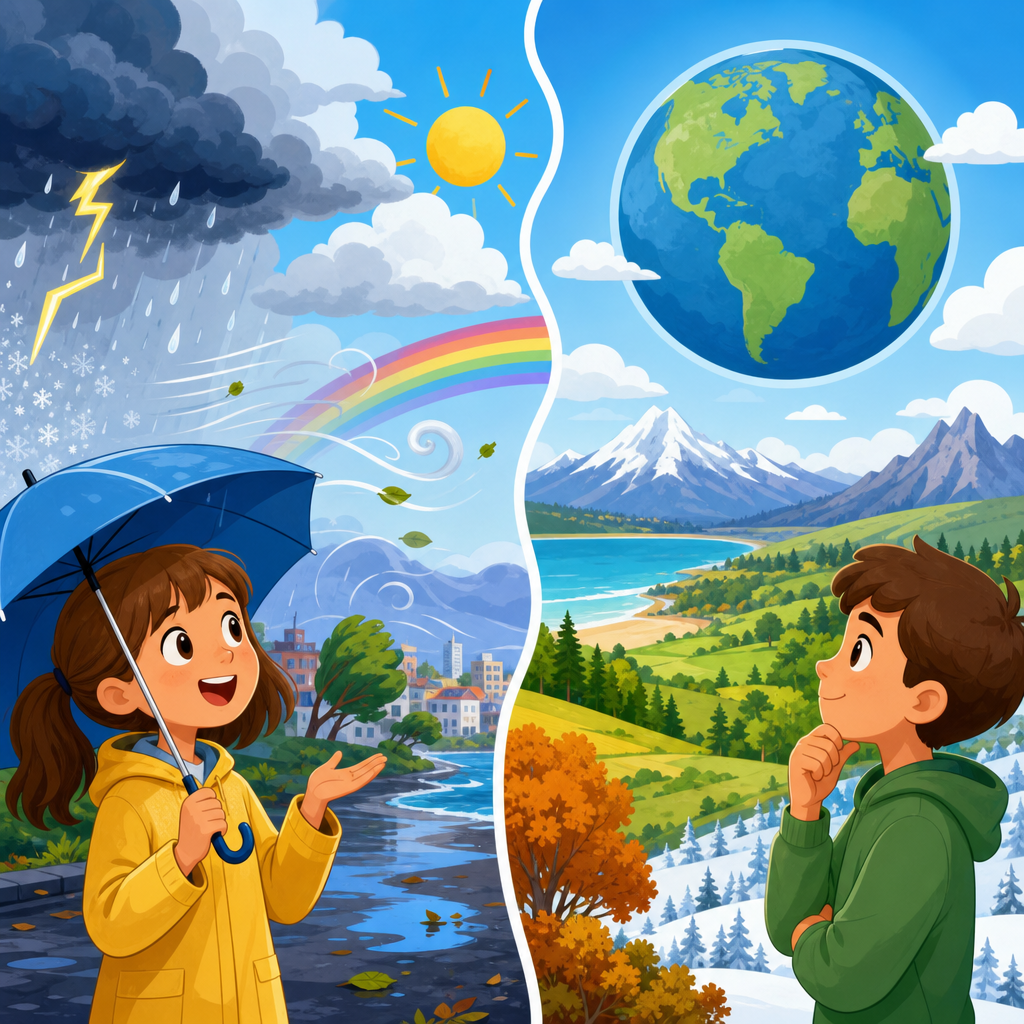
Weather and climate are related but not interchangeable: weather describes short-term atmospheric conditions at a specific time and place, while climate describes the long-term pattern of those conditions across decades. People often use the words casually, yet the distinction matters for daily decisions, public safety, agriculture, infrastructure, insurance, and environmental policy. In classrooms, news reports, and planning meetings, confusion between weather and climate leads to weak reasoning, such as assuming a cold week disproves global warming or that one heat wave defines a permanent trend. In practice, professionals separate immediate conditions from long-term averages, variability, and extremes because the tools, timescales, and decisions involved are different.
In my own work explaining environmental topics to non-specialists, this is usually the first term pair I clarify. Once people understand the timescale difference, many other environmental concepts become easier to grasp, including seasons, drought, heat waves, climate zones, climate change, resilience, adaptation, and mitigation. Weather is measured hour by hour through observations such as temperature, humidity, precipitation, wind speed, wind direction, cloud cover, and air pressure. Climate is built from those measurements over long records, typically at least thirty years, a standard used by the World Meteorological Organization to establish climate normals. That benchmark helps scientists compare one period with another using a common frame of reference.
This article serves as a hub within a broader glossary of environmental terms, so it explains the core definitions and connects them to the surrounding vocabulary people encounter in science education, media coverage, and public debate. You will see how meteorology differs from climatology, why variability is not the same as long-term change, how averages can hide extremes, and why both weather and climate must be understood together. If you want the shortest accurate definition, use this: weather tells you what the atmosphere is doing now or over the next few days; climate tells you what conditions are expected, how much they usually vary, and how those patterns are changing over time.
Weather: the atmosphere in real time
Weather refers to the condition of the atmosphere over short periods, from minutes to days, and sometimes up to a couple of weeks in forecasting contexts. When a meteorologist says a thunderstorm is likely this afternoon, fog will reduce visibility before sunrise, or a cold front will arrive tonight, that is weather. The key point is immediacy. Weather is local, dynamic, and often unstable because the atmosphere is constantly responding to changing energy, moisture, and air movement. Two nearby towns can have different weather on the same day if topography, elevation, coastlines, or storm tracks differ.
Common weather elements include air temperature, atmospheric pressure, relative humidity, dew point, precipitation type and amount, wind speed, wind direction, cloud type, and visibility. These variables are observed with weather stations, radar, satellites, weather balloons, ocean buoys, aircraft instruments, and increasingly dense sensor networks. Forecasting models such as those run by NOAA, the European Centre for Medium-Range Weather Forecasts, and national meteorological agencies assimilate these observations to estimate how the atmosphere is evolving. Forecast skill is strongest in the near term and declines with time because the atmosphere is a chaotic system. Small errors in initial conditions can grow quickly, which is why a seven-day forecast is less certain than tomorrow’s forecast.
Real-world examples make the definition concrete. A snowstorm hitting Chicago this weekend is weather. A week of temperatures above 100 degrees Fahrenheit in Phoenix is weather, though it may also contribute to climate records. Heavy rainfall that causes flash flooding in a mountain valley is weather. An afternoon sea breeze cooling a coastal city is weather. These events can be severe, costly, and life-threatening, but they are still short-term atmospheric conditions rather than climate itself.
Climate: long-term patterns, averages, and extremes
Climate describes the statistical character of weather over long periods, usually thirty years or more. It includes average conditions, but averages alone are not enough. Climate also includes variability, seasonality, frequency of extremes, and the range of what is normal for a location. A city’s climate answers questions like these: How hot are summers usually? How cold are winters? When does the rainy season begin? How much snow falls in a typical year? How often do droughts occur? How likely are heat waves, hurricanes, or hard freezes? Those patterns shape ecosystems, building design, farming calendars, water systems, and human behavior.
Climatology relies on long observational records and standardized datasets. Climate normals, often calculated over 1991–2020 or other thirty-year periods, provide a baseline for comparison. If a region’s average annual temperature rises significantly compared with earlier normals, that indicates climate change rather than a random daily fluctuation. Likewise, if heavy rainfall events become more frequent over decades, scientists treat that as a shift in climate statistics. A single storm does not define climate, but repeated changes in the behavior of storms can.
Consider examples. The Mediterranean climate is known for hot, dry summers and mild, wetter winters. The tropical rainforest climate near the equator is warm and humid year-round, with abundant rainfall. The Arctic climate is cold, with long winters and short cool summers. These are not descriptions of one day’s conditions. They summarize long-term atmospheric patterns linked to latitude, oceans, landforms, circulation patterns, and energy balance. Climate gives a place its environmental identity.
Climate can also change. Earth’s climate has shifted naturally across geologic time due to volcanic activity, orbital cycles, solar variability, continental arrangements, and feedbacks involving ice, oceans, and greenhouse gases. Today, the dominant driver of rapid global climate change is the increase in heat-trapping greenhouse gases from human activities, especially the burning of fossil fuels, deforestation, and certain industrial processes. That statement is supported by assessments from the Intergovernmental Panel on Climate Change, NASA, NOAA, and national academies of science.
Weather vs. climate: the simplest way to compare them
The clearest difference between weather and climate is timescale, but there are other practical distinctions that help people remember it. Weather is what you experience day to day; climate is what you expect based on long records. Weather changes quickly; climate changes slowly, though not always harmlessly. Weather forecasts guide immediate choices such as what to wear, whether to delay a flight, or when to evacuate before a storm. Climate information guides long-term choices such as where to build roads, which crops to plant, how large a stormwater system should be, and how communities prepare for future heat risk.
| Aspect | Weather | Climate |
|---|---|---|
| Timescale | Minutes to days, sometimes up to weeks | Usually 30 years or longer |
| Main question | What is happening now or soon? | What is typical over time? |
| Examples | Thunderstorms, cold fronts, fog, daily temperature | Average seasonal rainfall, heat wave frequency, climate zones |
| Primary field | Meteorology | Climatology |
| Key use | Short-term decisions and warnings | Planning, design, risk assessment, policy |
A common teaching analogy is that weather is your mood and climate is your personality. It is useful because it captures short-term fluctuation versus long-term tendency, though it oversimplifies the science. A better practical analogy is that weather is one game, while climate is a team’s performance across many seasons. One unexpected upset does not erase a long-standing trend, and one record-breaking day does not by itself establish a new climate pattern.
Why people confuse the two, and why the distinction matters
People confuse weather and climate for understandable reasons. First, weather is what we directly feel. If today is unusually cold, rainy, or windy, that experience is vivid. Climate, by contrast, is statistical and accumulates over long records, so it is less intuitive. Second, media coverage often centers on dramatic events such as hurricanes, blizzards, and heat waves. Those events are weather stories, but they are frequently discussed alongside climate trends, which can blur the line for audiences. Third, climate change is experienced partly through changes in weather extremes, so the two subjects are connected even though they are not identical.
The distinction matters because bad reasoning leads to bad decisions. A mayor designing a drainage system cannot rely only on last month’s weather; the city needs rainfall intensity data across decades, land-use projections, and updated risk estimates. A farmer deciding which crop varieties to plant needs seasonal climate patterns, frost dates, soil moisture outlooks, and drought probabilities, not just tomorrow’s forecast. Insurance companies price risk using long-term loss patterns tied to climate hazards, while emergency managers use immediate weather forecasts for deployment decisions. Mixing the two leads either to short-sighted planning or to exaggerated conclusions from isolated events.
This is also why statements like “It snowed today, so global warming is false” are scientifically incorrect. Global warming describes a long-term increase in Earth’s average surface temperature, not the disappearance of winter weather. A warmer climate can still produce snowstorms if enough cold air and moisture are present. In some regions, warming can even intensify heavy precipitation because warmer air can hold more water vapor. The right question is not whether one cold event occurred, but whether long-term temperature, precipitation, and extreme-event statistics are shifting.
Key environmental terms linked to weather and climate
Because this page functions as a glossary hub, several related terms need clear definitions. Meteorology is the science of the atmosphere focused mainly on short-term processes and forecasting. Climatology studies long-term atmospheric patterns, averages, variability, and trends. Climate variability refers to natural fluctuations around average conditions across months, years, or decades, such as El Niño and La Niña effects in the Pacific Ocean. Climate change refers to persistent changes in climate statistics over extended periods, whether due to natural causes, human activity, or both.
Another important term is climate normal, the standardized thirty-year average used as a baseline. An anomaly is the difference between observed conditions and that baseline, such as a month that is 2 degrees Celsius warmer than the long-term average. A heat wave is a prolonged period of unusually hot weather relative to local norms, while drought is a sustained deficit in water availability, often shaped by both low precipitation and high evaporation. Mitigation refers to actions that reduce the drivers of climate change, such as cutting greenhouse gas emissions. Adaptation means adjusting systems and behaviors to reduce harm from climate impacts that are already occurring or expected.
Other glossary terms commonly connected to this topic include greenhouse gases, albedo, urban heat island, resilience, hazard, exposure, vulnerability, and extreme weather. Urban heat island describes the tendency of cities to be warmer than nearby rural areas because pavement and buildings absorb and re-radiate heat, while vegetation is limited. Resilience is the capacity of a community or system to prepare for, withstand, recover from, and adapt to disruptions. Hazard is the potentially damaging event, exposure is what lies in harm’s way, and vulnerability describes how susceptible people or assets are to damage. These terms help explain why the same weather event can produce very different outcomes in different places.
How weather and climate are measured, modeled, and used
Measurements begin with observations. Surface stations record temperature, rainfall, wind, humidity, and pressure. Radiosondes attached to weather balloons profile the atmosphere vertically. Doppler radar tracks precipitation intensity and movement. Satellites measure cloud properties, sea surface temperatures, atmospheric moisture, ice cover, and more, especially in places with sparse ground instruments. For climate analysis, data quality control is essential because station moves, instrument changes, and urban development can affect records. Scientists homogenize datasets so that trends reflect real atmospheric change rather than measurement artifacts.
Weather models and climate models share physical foundations, including equations for fluid motion, thermodynamics, radiation, and moisture processes, but they are used differently. Weather models aim to predict specific atmospheric states over short periods. Climate models simulate long-term behavior under different forcings, such as rising carbon dioxide or volcanic aerosols. They are evaluated not by predicting the exact weather on a future day decades from now, which is impossible, but by reproducing large-scale climate statistics, observed trends, and known responses to external drivers. That distinction is often misunderstood in public discussions.
These tools inform major decisions. Building codes use historical climate data and forward-looking projections to set standards for insulation, flood elevation, and wind resistance. Water managers use snowpack, streamflow, and precipitation records to plan reservoir operations. Public health agencies track heat indices and long-term warming trends to protect vulnerable populations. Airlines depend on weather forecasts for routing and safety, while energy providers use both weather and climate information to estimate demand peaks, renewable generation potential, and wildfire risk. In each case, the best decisions come from matching the timescale of the information to the timescale of the decision.
Conclusion: understanding both leads to better decisions
The difference between weather and climate is simple in definition but powerful in practice. Weather is the short-term state of the atmosphere: today’s temperature, tomorrow’s rain, this weekend’s storm. Climate is the long-term pattern of those conditions over decades, including averages, seasonal cycles, variability, and extremes. Weather tells you what is happening now. Climate tells you what is typical, what is possible, and how those patterns are shifting.
Understanding that distinction improves environmental literacy and helps people interpret everything from daily forecasts to global warming reports. It prevents misleading conclusions based on isolated events, clarifies why scientists use long records, and shows why planners, farmers, engineers, and health officials rely on climate data for long-range decisions. It also provides a foundation for related glossary terms such as climate variability, anomaly, drought, resilience, mitigation, and adaptation. Once these terms are clear, the broader environmental conversation becomes much easier to follow.
If you are building your knowledge in environmental science, keep this rule in mind: short term is weather, long term is climate. Use that framework whenever you read the news, compare local conditions, or evaluate claims about climate change. Then continue through the rest of the glossary to deepen your understanding of the terms that shape modern discussions about ecosystems, risk, energy, and sustainability.
Frequently Asked Questions
1. What is the main difference between weather and climate?
The main difference is time scale. Weather refers to short-term atmospheric conditions in a specific place at a specific time. It includes things like today’s temperature, humidity, cloud cover, wind, and whether it is raining, snowing, or sunny. Weather can change quickly, sometimes within hours. Climate, by contrast, describes the long-term pattern of weather in a region, usually measured over decades. It tells us what conditions are typical, what ranges are normal, and how often certain events tend to happen over time.
A simple way to think about it is this: weather is what you get today, while climate is what you expect over many years. For example, a single cold day in July is weather. The fact that summers in a region are generally warm is climate. This distinction matters because one isolated event does not define a long-term pattern. To understand climate, scientists look at many years of data to identify averages, seasonal cycles, variability, and trends.
Although the two are closely connected, they are not interchangeable. Weather is the day-to-day expression of the atmosphere, and climate is the broader statistical picture built from countless weather observations over long periods. When people confuse the two, they may draw inaccurate conclusions, especially when discussing issues like drought, flood risk, crop planning, infrastructure design, or climate change.
2. Why do people so often confuse weather and climate?
People often confuse weather and climate because both involve the same basic elements of the atmosphere: temperature, precipitation, wind, and storms. In casual conversation, it is common to hear the terms used loosely, especially in news reports, classrooms, and everyday talk. If someone says, “The climate today is terrible,” they usually mean the weather is unpleasant. That casual usage can blur the distinction and make it harder to think clearly about longer-term patterns.
Another reason for the confusion is that personal experience is usually based on weather, not climate statistics. People feel today’s heat, this week’s storm, or this winter’s snowfall directly. Climate, however, is built from many years of observations and cannot be judged by one day, one season, or even one unusual year. Because individual weather events are vivid and memorable, they can seem more important than long-term data, even when they are not representative of the overall climate pattern.
This confusion matters because it can weaken reasoning and decision-making. A single snowstorm does not disprove a warming climate, and one hot week does not define an entire region’s climate future. Public safety agencies, farmers, engineers, insurers, and policymakers all need to separate short-term conditions from long-term expectations. Knowing the difference helps people ask better questions, interpret headlines more accurately, and make choices based on evidence rather than on isolated experiences.
3. Can one unusual storm, heat wave, or cold snap tell us anything about climate?
One unusual event can be important, but by itself it does not define climate. A major storm, a record-breaking heat wave, or an unexpected cold snap is first and foremost a weather event. It shows what happened at a particular time and place. Climate is determined by examining many such events over long periods to understand patterns, frequency, intensity, and trends. In other words, a single event is a data point, not the whole story.
That said, individual extreme events can still be studied in a climate context. Scientists often ask whether certain kinds of events are becoming more common, more intense, longer-lasting, or more likely because of long-term climate shifts. For example, one heavy rainfall event does not prove a region’s climate has changed, but repeated increases in extreme rainfall over decades may indicate an important climate trend. The same logic applies to droughts, wildfire conditions, marine heat waves, and prolonged periods of unusually high temperatures.
This is why experts rely on long-term records rather than anecdotes. They compare current observations with historical averages, look for statistically meaningful changes, and analyze regional differences. A single cold day in a warming world is still possible because weather naturally fluctuates. Climate helps explain the background conditions within which those fluctuations occur. So while one event alone cannot answer big climate questions, many events studied together can reveal how a climate is behaving and whether it is changing.
4. Why does the difference between weather and climate matter in real life?
The difference matters because people make different kinds of decisions depending on whether they are responding to weather or planning for climate. Weather helps with immediate choices: what to wear, whether to delay a flight, when to issue a severe storm warning, or how to prepare for a dangerous freeze overnight. Climate supports long-term planning: what crops are suitable for a region, how to design drainage systems, where flood defenses are needed, how to price insurance risk, and what building standards are appropriate over the coming decades.
In agriculture, for example, weather forecasts help farmers decide when to irrigate, fertilize, or harvest, while climate data helps them choose crop varieties, planting calendars, and long-term land management strategies. In infrastructure, weather alerts guide emergency response during a storm, while climate projections influence how roads, bridges, power grids, and water systems should be built to remain reliable under future conditions. In public health, weather warnings can protect people during heat emergencies, while climate trends inform preparation for changing disease patterns, heat exposure, and water stress.
The distinction also matters for communication and policy. If a planning meeting treats a short-term weather event as if it were a climate pattern, the result may be poor decisions. Likewise, if long-term climate risks are ignored because current weather seems normal, communities may be left unprepared. Understanding the difference allows people to respond appropriately in the moment while also planning wisely for the future. That is why the terms are more than vocabulary; they shape how societies think about risk, resilience, and responsibility.
5. How do scientists measure weather and climate differently?
Scientists measure weather through real-time or near-real-time observations of atmospheric conditions. These include temperature, air pressure, humidity, wind speed and direction, precipitation, cloud cover, and visibility. Data comes from weather stations, satellites, radar, ocean buoys, balloons, aircraft, and other monitoring systems. Meteorologists use this information to describe current conditions and to forecast what is likely to happen over the next hours, days, or weeks.
Climate measurement uses many of the same kinds of observations, but the goal is different. Instead of focusing on immediate conditions, climate scientists analyze long-term records to identify averages, seasonal patterns, variability, extremes, and trends over decades. A common benchmark is 30 years, which is long enough to smooth out much of the short-term noise and reveal what is typical for a region. Scientists also compare different time periods to see whether a place is becoming warmer, drier, wetter, stormier, or more prone to certain extremes.
In practice, this means weather science asks questions like, “Will it rain tomorrow?” while climate science asks, “How has rainfall in this region changed over the last 50 years, and what does that suggest for the future?” Both rely on careful observation and analysis, but they answer different kinds of questions. Weather forecasting is about short-term atmospheric behavior. Climate analysis is about long-term patterns and shifts in the Earth system. Keeping those purposes separate is essential for accurate reporting, sound education, and informed decisions at every level.