
Aligning environmental lessons with STEM education gives schools a practical way to make science, technology, engineering, and math more relevant while building environmental literacy. In schools that do this well, students are not memorizing isolated facts about ecosystems or equations. They are using data to test air quality, applying engineering design to reduce waste, modeling energy systems, and interpreting evidence about climate, water, and biodiversity. An environmental curriculum for schools is a structured approach that embeds sustainability topics, local ecological issues, and systems thinking into classroom instruction, projects, assessment, and community partnerships. STEM education provides the methods: investigation, measurement, computation, design, and problem solving. Environmental learning provides the context: real places, real constraints, and real consequences.
This matters because schools are being asked to prepare students for a labor market shaped by clean energy, resilient infrastructure, advanced agriculture, conservation technology, and data-rich decision making. At the same time, educators face pressure to improve engagement and demonstrate standards alignment. I have worked with teachers who struggled to make STEM feel meaningful until environmental themes gave students an authentic reason to care. Attendance rose during watershed projects. Math scores improved when students analyzed actual school energy bills. Families paid attention when students presented waste audit findings to district leaders. A strong environmental curriculum for schools does not sit beside STEM as an optional enrichment. It strengthens core instruction by connecting academic standards to observable problems students can investigate and influence.
For a hub page under Education & Resources, the goal is comprehensive guidance. Schools need to know what an environmental curriculum includes, how it aligns to STEM standards, what instructional models work, how to assess learning, which tools and partnerships add value, and what barriers commonly derail implementation. They also need clear examples that can link to deeper articles on climate education, outdoor learning, project-based learning, school gardens, energy monitoring, and community science. Done carefully, aligning environmental lessons with STEM education helps schools teach rigorous content, build transferable skills, and create a curriculum that feels immediately useful to students’ lives.
What an environmental curriculum for schools should include
An effective environmental curriculum for schools is not a single unit on recycling or a one-week celebration of Earth Day. It is a coherent sequence of learning experiences tied to grade-level expectations and organized around key environmental concepts. Those concepts usually include ecosystems, biodiversity, climate systems, natural resources, pollution, water quality, energy use, land use, waste management, and human impact. In elementary grades, this often begins with observation, classification, simple data collection, and local habitat study. In middle school, students move into systems models, cause-and-effect relationships, and evidence-based arguments. In high school, the curriculum should include quantitative analysis, tradeoff evaluation, engineering design constraints, and policy or economic dimensions.
Coherence matters more than volume. Schools often collect disconnected activities from nonprofit providers, field trip centers, and online lesson banks. The result is high enthusiasm but weak progression. A better model maps environmental themes across grades and subjects so knowledge and skills build over time. For example, a district might introduce weather observation in grade 2, watersheds in grade 4, human impacts on local ecosystems in grade 6, carbon cycling in grade 8, and renewable energy design in high school physics. In that sequence, students revisit related ideas with increasing complexity instead of starting from zero every year.
Curriculum quality also depends on local relevance. Students understand environmental systems better when they can see them. A coastal school may focus on erosion, stormwater, fisheries, and sea level rise. An urban district may prioritize air quality, heat islands, green infrastructure, and waste streams. A rural community may center soil health, forestry, irrigation, and habitat fragmentation. Local context does not replace broader scientific principles; it makes them concrete. When students sample runoff behind their own campus or compare tree canopy coverage across neighborhoods, abstract standards become measurable realities.
How environmental lessons strengthen STEM learning
Environmental topics naturally support STEM because they are interdisciplinary and evidence driven. In science, students investigate ecological relationships, matter cycling, Earth systems, and human impacts using observation and experimentation. In technology, they use sensors, mapping platforms, spreadsheets, simulations, and data loggers to collect and interpret information. In engineering, they define problems such as runoff control or energy loss, develop prototypes, test materials, and iterate designs. In math, they calculate rates, graph trends, model scenarios, estimate uncertainty, and compare variables across time. This integration is not forced. Environmental systems are already quantitative, dynamic, and design dependent.
One reason this approach works is that it creates authentic problem framing. Students are more willing to learn statistics when they need to determine whether cafeteria waste changed after a composting intervention. They are more open to physics when solar panel angle affects measured output. They understand computational thinking more quickly when coding a sensor to monitor soil moisture in a school garden. I have seen reluctant learners become highly persistent once the task moved beyond worksheets to evidence that affected a visible outcome on campus.
Environmental STEM also develops systems thinking, a skill employers increasingly value. Students learn that changing one variable can shift an entire system. Replacing pavement with permeable surfaces affects runoff, temperature, maintenance, and cost. Planting native species influences pollinators, irrigation demands, and biodiversity. Switching lighting technologies changes energy consumption, budget allocations, and carbon emissions. These are not simplistic win-win stories. Good instruction includes constraints, unintended effects, and competing goals, which is exactly what mature STEM problem solving requires.
| STEM area | Environmental lesson example | Skills students practice |
|---|---|---|
| Science | Testing stream pH, turbidity, and dissolved oxygen | Hypothesis formation, measurement, evidence-based explanation |
| Technology | Using GIS or ArcGIS StoryMaps to map tree canopy | Data visualization, spatial analysis, digital communication |
| Engineering | Designing a rain garden for campus stormwater control | Constraint analysis, prototyping, iterative testing |
| Mathematics | Analyzing school energy bills across seasons | Graphing, ratios, trend interpretation, forecasting |
Instructional models that make environmental STEM work
The most effective instructional model is usually project-based learning supported by explicit standards mapping. Students need a driving question, access to data, a defined audience, and checkpoints for disciplinary learning. A weak version of environmental instruction asks students to make posters about pollution. A strong version asks them to investigate whether storm drains near school contribute to creek contamination, collect field data, compare results with state water quality thresholds, consult municipal staff, and propose mitigation strategies. The project has a public purpose, but the academic expectations remain rigorous and visible.
Inquiry-based instruction also plays a central role, especially in elementary and middle school. Students begin with observations and questions, then gather evidence before reaching conclusions. This process mirrors established science practices and reduces the tendency to present environmental topics as moral lessons detached from analysis. Schools should resist oversimplified messaging. Students deserve to evaluate data, understand uncertainty, and discuss tradeoffs. That is how environmental learning earns credibility within STEM.
Outdoor learning strengthens retention when it is structured rather than incidental. Schoolyards, nearby parks, retention ponds, gardens, and campus buildings can function as living laboratories. I recommend schools conduct an asset inventory before purchasing new programs. Many campuses already have surfaces to measure heat differences, drains to trace stormwater pathways, habitats to survey, and utility data to analyze. With clear protocols, these everyday features become repeatable instructional resources rather than occasional field trip scenery.
Cross-curricular planning improves results. English classes can support technical writing and argumentation from evidence. Social studies can address land use, public policy, and environmental justice. Art can contribute visual communication for community presentations. Still, the STEM core must remain strong. The best interdisciplinary work does not dilute disciplinary knowledge. It organizes it around a shared problem that students can explore from multiple angles.
Standards alignment, assessment, and measurable outcomes
For schools, alignment determines whether environmental learning survives beyond a few enthusiastic teachers. Lessons should map directly to required standards, especially science practices, engineering design expectations, mathematical modeling, and data analysis. Many districts use frameworks influenced by the Next Generation Science Standards, state environmental literacy plans, and career and technical education pathways. The practical question teachers ask is simple: what standard does this lesson teach better than a textbook-only approach? Environmental STEM succeeds when the answer is specific and defensible.
Assessment should combine content mastery with performance evidence. Traditional quizzes remain useful for vocabulary, concepts, and calculation fluency, but they are not enough. Students should also produce lab reports, design briefs, datasets, reflection logs, and presentations to authentic audiences. A good rubric measures scientific accuracy, quality of evidence, reasoning, method, and feasibility of proposed solutions. If students are designing a water filtration prototype, for example, teachers should assess not only whether the device worked but whether students justified material choices, controlled variables, and interpreted results correctly.
Schools should track outcomes at multiple levels. Student indicators may include engagement, attendance during project periods, course performance, and persistence in advanced STEM classes. Program indicators may include the number of standards-aligned units, teacher participation, partnership quality, and integration across grades. Campus indicators can also matter when projects affect operations, such as reduced waste contamination, lower irrigation demand, or improved habitat areas. These operational wins should not replace academic evidence, but they can reinforce program value for administrators and families.
Reliable measurement requires a baseline. Before launching a schoolwide environmental curriculum, collect current data: teacher confidence, available materials, utility usage, waste volumes, outdoor assets, and student perceptions. Without a baseline, schools often overstate success because any new activity feels like progress. Strong programs document change over time and use that evidence to refine instruction.
Tools, partnerships, and implementation challenges
Schools do not need expensive equipment to start, but they do need dependable tools and realistic planning. Useful core resources include probeware from Vernier or PASCO, simple air quality monitors, light meters, soil test kits, weather stations, spreadsheets, and mapping tools such as Google Earth or ArcGIS. For younger students, clipboards, quadrats, measuring tapes, and hand lenses still matter. The best toolset is the one teachers can use repeatedly, maintain easily, and connect to clear learning goals. Technology should expand inquiry, not distract from it.
Partnerships can accelerate quality. Local universities, nature centers, watershed groups, extension offices, municipal utilities, parks departments, and conservation nonprofits often provide expertise, datasets, and field access. The strongest partnerships are reciprocal. Schools are not passive recipients of guest speakers; students contribute observations, monitoring data, design ideas, or public communication products. Community science platforms such as iNaturalist, eBird, or Globe Observer can also give student work a broader audience when data quality protocols are followed.
Implementation challenges are predictable. Teachers need planning time, not just one-off professional development. Administrators need to see standards alignment and risk management plans for outdoor learning. Facilities teams need advance communication when student projects involve campus infrastructure. Equity issues must be addressed directly. Some students have abundant access to outdoor experiences, while others do not. Some schools have green campuses, while others have limited space and aging buildings. A strong environmental curriculum for schools does not assume ideal conditions. It adapts through neighborhood walks, mobile kits, virtual datasets, and community partnerships so every student can participate in rigorous environmental STEM learning.
Another common obstacle is treating sustainability as branding rather than instruction. Recycling bins, garden beds, and solar panels do not teach by themselves. Schools benefit when operational features are intentionally integrated into curriculum, with data access, teacher support, and repeated use across grade levels. That shift turns facilities into instructional assets and gives students a chance to work on meaningful, observable systems.
Aligning environmental lessons with STEM education gives schools a durable framework for rigorous, relevant learning. A high-quality environmental curriculum for schools is coherent across grades, tied to standards, grounded in local context, and built around measurable inquiry rather than slogans. It helps students practice science through investigation, mathematics through data analysis, technology through digital tools, and engineering through design under real constraints. Just as important, it improves engagement because students can see the systems they are studying and understand why the work matters.
The strongest programs use project-based and inquiry-driven instruction, assess both knowledge and performance, and rely on practical tools, community partnerships, and documented outcomes. They acknowledge tradeoffs, teach students to evaluate evidence, and connect campus operations to classroom learning. From water testing and habitat surveys to energy analysis and waste audits, environmental STEM turns schools into places where academic content and civic relevance meet. That combination prepares students not only for tests and graduation requirements, but for emerging careers and informed participation in their communities.
If your school is building or improving an environmental curriculum, start by mapping local environmental themes to existing STEM standards, identifying usable campus assets, and selecting one project that produces real data and a public-facing result. Then expand deliberately. A well-designed hub for Education & Resources can guide that growth by linking teachers and leaders to deeper articles, unit plans, tools, and examples that make environmental STEM both manageable and effective.
Frequently Asked Questions
1. What does it mean to align environmental lessons with STEM education?
Aligning environmental lessons with STEM education means teaching science, technology, engineering, and math through real-world environmental challenges and investigations. Instead of treating environmental topics as a separate unit or enrichment activity, schools integrate them into core academic learning so students build STEM knowledge while also developing environmental literacy. For example, students might collect and analyze local water quality data in science, use digital tools to map pollution sources in technology, apply engineering design to create waste-reduction solutions, and use mathematics to interpret trends, compare variables, and make evidence-based conclusions.
This approach helps students see that STEM is not just theoretical. It is a practical toolkit for understanding and improving the world around them. Environmental issues naturally invite inquiry, problem-solving, modeling, testing, and iteration, which are all central to high-quality STEM instruction. When teachers align the two, students gain a deeper understanding of academic concepts because they are applying them in meaningful contexts. They are not simply memorizing definitions about ecosystems, climate, energy, or biodiversity. They are using STEM practices to investigate causes, evaluate impacts, and design informed responses.
2. Why is environmental learning such a strong fit for STEM classrooms?
Environmental learning is a strong fit for STEM because it is inherently interdisciplinary, data-rich, and grounded in observable systems. Most environmental topics involve scientific processes, measurable outcomes, technical tools, engineering constraints, and mathematical reasoning. A lesson on air quality, for instance, can include chemistry and atmospheric science, sensor technology, data collection methods, statistical analysis, and design thinking around reducing emissions or improving school environments. That makes environmental content one of the most natural and effective ways to bring STEM subjects together.
It also improves relevance and student engagement. Many learners respond more strongly when they can connect classroom content to issues they can see in their own communities, such as recycling practices, stormwater runoff, school energy use, urban heat, habitat loss, or access to clean water. These topics give students a reason to ask questions, gather evidence, and test solutions. In strong programs, environmental learning turns abstract concepts into practical investigations. Students understand not only how to calculate, model, or design something, but why those skills matter. That relevance can increase curiosity, persistence, and ownership of learning while preparing students for future academic pathways and careers connected to sustainability, engineering, environmental science, public health, and data analysis.
3. What are some examples of environmental lessons that support STEM standards?
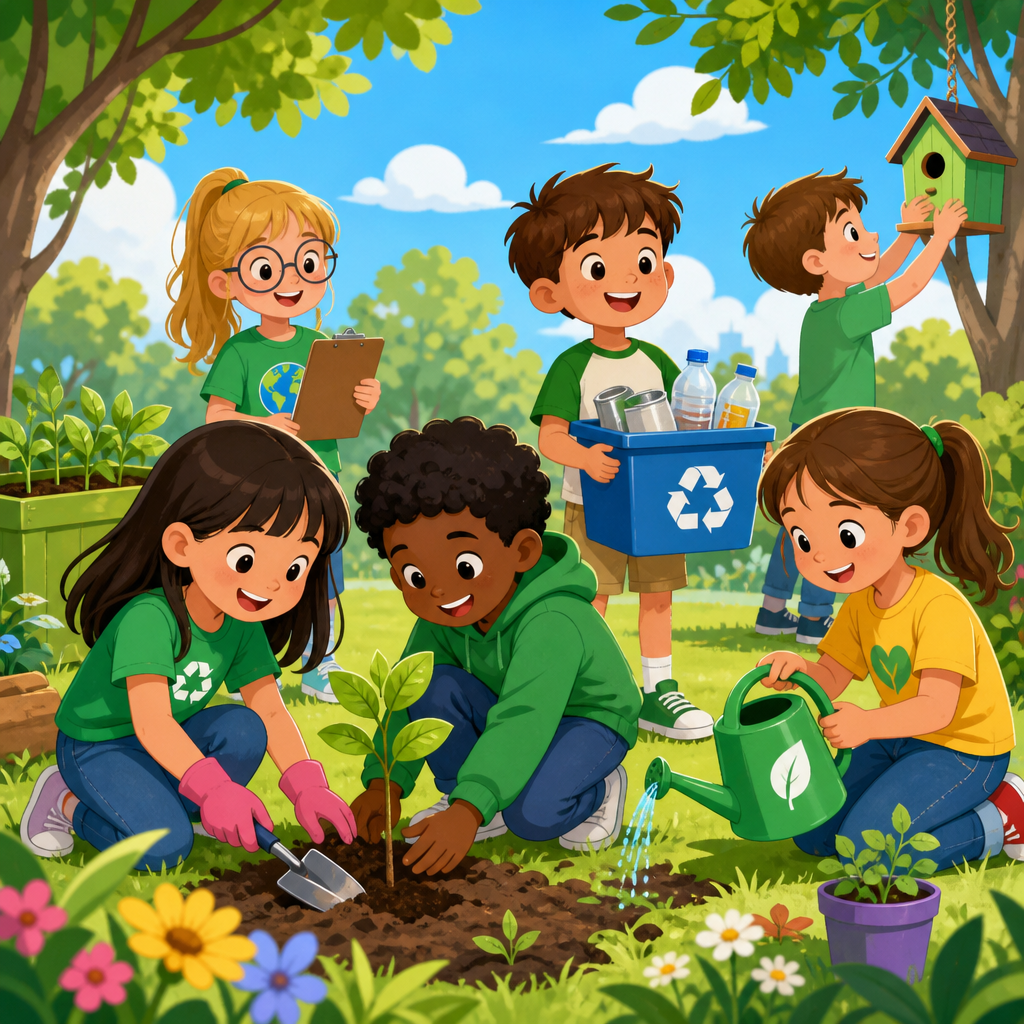
There are many effective examples, and the best ones usually begin with a question, a local problem, or a system students can investigate directly. In elementary grades, students might study plant growth under different light or soil conditions, monitor schoolyard biodiversity, or measure how weather affects water collection in a school garden. These activities support observation, prediction, measurement, and basic data interpretation. In middle school, students might test water samples for pH or turbidity, compare waste streams in the cafeteria, design composting systems, or model how land use affects runoff and erosion. In high school, they may analyze long-term climate data, build and test renewable energy prototypes, evaluate building efficiency, or use geographic information systems and spreadsheets to investigate environmental patterns.
What makes these lessons aligned with STEM standards is not simply the topic, but the structure of the learning. Students should be asking investigable questions, collecting valid data, using appropriate tools, analyzing evidence, constructing explanations, and refining solutions. A lesson on energy, for example, becomes powerful when students calculate usage, compare efficiencies, model trade-offs, and design a more effective system rather than only reading about energy sources. A lesson on biodiversity gains rigor when students use sampling methods, quantify findings, and interpret ecosystem change through evidence. Well-designed environmental lessons support science inquiry, mathematical application, engineering design, technological fluency, and communication skills all at once.
4. How can schools implement an environmental curriculum without sacrificing core academic goals?
Schools do not need to choose between environmental learning and academic rigor. In fact, when implemented thoughtfully, an environmental curriculum can strengthen core goals by giving students richer opportunities to apply standards-based content. The key is integration rather than addition. Teachers and curriculum leaders can start by identifying where existing science, math, engineering, and technology standards already intersect with environmental themes. Topics such as ecosystems, energy transfer, weather and climate, data analysis, measurement, systems modeling, and problem-solving are already embedded in most academic frameworks. Environmental contexts simply make those expectations more concrete and usable.
Successful implementation often begins with a manageable scope. A school might launch one interdisciplinary unit per grade level, build a local investigation around campus waste or water use, or connect existing lab work to environmental case studies. Professional collaboration is also important. Science, math, and technology teachers can work together to design shared tasks, common vocabulary, and performance assessments. Administrators can support this by investing in teacher planning time, community partnerships, and simple tools such as sensors, probes, spreadsheets, and observation protocols. The goal is to create learning experiences where students meet academic benchmarks through authentic inquiry. When that happens, environmental curriculum becomes a vehicle for stronger instruction rather than an extra demand on an already full schedule.
5. What are the long-term benefits of aligning environmental lessons with STEM education?
The long-term benefits are academic, practical, and civic. Academically, students develop stronger conceptual understanding because they are applying knowledge in realistic settings. They become more skilled at analyzing data, evaluating evidence, modeling systems, and solving open-ended problems. These are high-value competencies across STEM fields. Students also tend to retain learning more effectively when it is connected to tangible experiences and meaningful questions. A student who has tested water samples, designed a low-waste prototype, or analyzed school energy consumption is more likely to remember the underlying scientific and mathematical principles than a student who encountered those ideas only through textbook exercises.
Beyond academics, this alignment helps students build habits of mind that matter in college, careers, and community life. They learn to think in systems, weigh trade-offs, collaborate across disciplines, and make decisions based on evidence. They also begin to understand environmental issues not as distant or abstract problems, but as challenges that can be investigated and addressed with informed action. That perspective is especially valuable in a world where sustainability, climate adaptation, resource management, and environmental health increasingly shape public policy and workforce needs. In the best cases, aligning environmental lessons with STEM education prepares students to be both capable problem-solvers and responsible participants in the future of their communities.