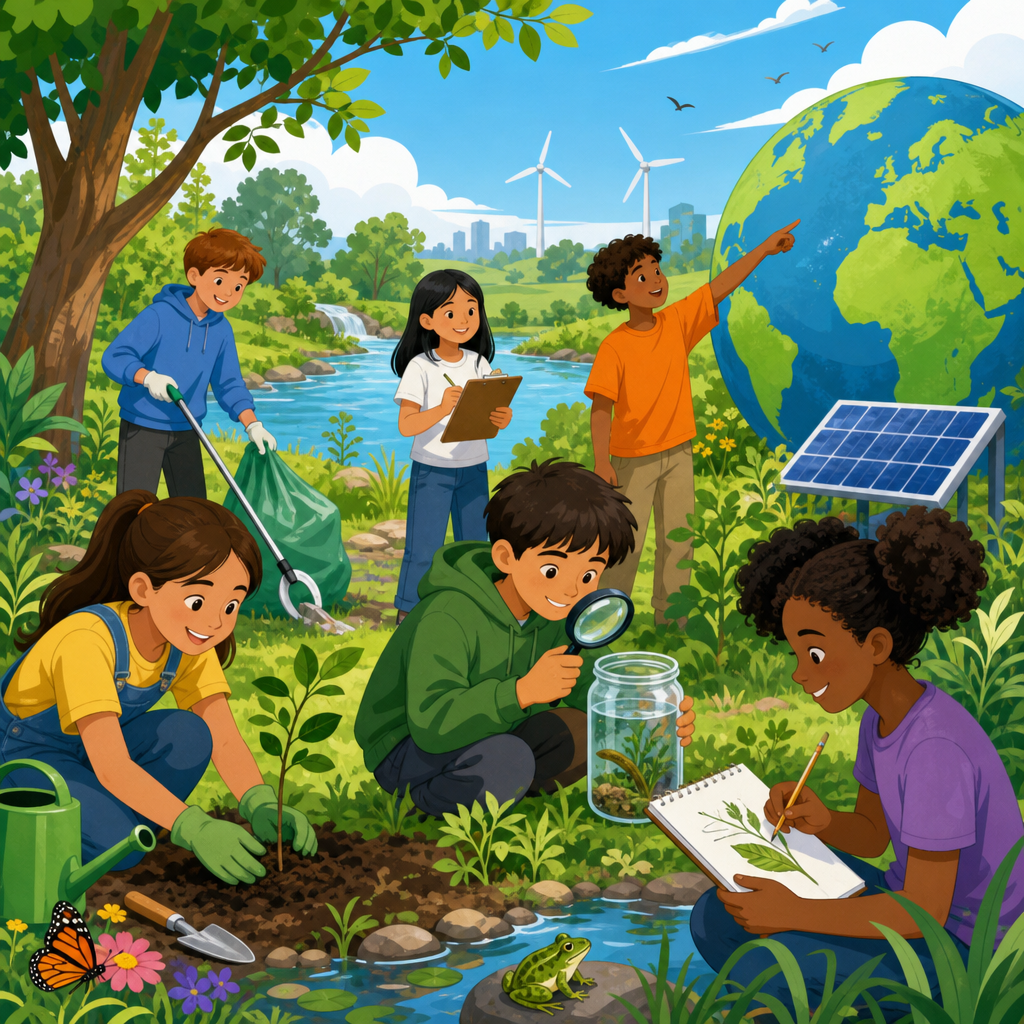

Environmental literacy gives students the knowledge, skills, and habits needed to understand how natural systems work, how human choices affect those systems, and how communities can respond wisely. In schools, environmental curriculum means more than adding a recycling lesson or celebrating Earth Day. It is a structured approach that connects science, geography, civics, economics, health, and local problem solving. I have seen the difference firsthand in curriculum planning meetings: when schools treat environmental learning as a core competency, students ask better questions, read data more carefully, and connect classroom content to real life. That matters because today’s students will make decisions about water, energy, food, transportation, public health, and land use in a world shaped by climate change, biodiversity loss, pollution, and resource constraints. Environmental literacy equips them not only to care, but to analyze evidence, weigh tradeoffs, and act responsibly.
Strong environmental curriculum for schools starts with a clear definition. An environmentally literate student can explain basic ecological concepts, identify environmental issues at local and global scales, evaluate sources, interpret data, and participate in solutions. This includes understanding terms such as ecosystem, watershed, carbon cycle, environmental justice, resilience, and sustainability. It also includes practical competencies: measuring waste, reading air quality dashboards, understanding school energy use, and recognizing how policy and consumer behavior shape outcomes. The goal is not activism without substance. The goal is informed judgment. When this content is taught well, students learn that environmental issues are rarely simple. A wetland can support biodiversity, reduce flood risk, and compete with development pressure. A solar project can cut emissions and raise questions about cost, grid capacity, and land use. Environmental literacy prepares students to navigate that complexity with confidence.
This hub article explains how schools can build environmental literacy through curriculum design, teaching practice, assessment, and community partnerships. It covers what belongs in an environmental curriculum for schools, how the content should progress across grade levels, which instructional models work, and how to avoid common mistakes such as treating the topic as an occasional add-on. It also serves as a foundation for deeper articles on project-based learning, outdoor education, climate education, green school operations, and interdisciplinary lesson planning. Schools that invest in environmental literacy improve academic relevance and civic readiness at the same time. Students begin to see that the quality of their drinking water, the heat around their playground, the food in their cafeteria, and the transportation systems in their neighborhood are all part of the same educational landscape. That is why every student needs it.
What an environmental curriculum for schools should include
An effective environmental curriculum for schools is built around core concepts, recurring practices, and local relevance. At the content level, students should learn ecology, Earth systems, weather and climate, energy, biodiversity, pollution, conservation, and resource management. They also need exposure to human systems: public policy, community planning, agriculture, public health, and economics. In my experience, programs fail when they stay trapped inside one subject area. If environmental literacy lives only in science class, students miss the role of persuasive writing, historical land use, data analysis, and civic decision making. The best curriculum maps create vertical alignment so concepts deepen over time. Early grades focus on observation, habitats, seasons, plants, animals, and stewardship routines. Middle grades add systems thinking, watersheds, food webs, waste streams, and human impact. High school expands into climate science, environmental justice, energy transitions, risk assessment, and policy tradeoffs.
Schools also need to define the practices students will use repeatedly. These include asking investigable questions, collecting field data, analyzing trends, evaluating claims, comparing sources, and designing realistic interventions. For example, a fourth-grade class might track cafeteria waste for two weeks and graph the results. An eighth-grade class might test runoff patterns around school grounds after heavy rain. A high school class might compare local tree canopy coverage with neighborhood heat data using municipal maps and satellite tools. These activities are not extras. They are the mechanism through which environmental understanding becomes durable. Curriculum should specify where students engage in field observation, where they work with public datasets such as EPA air quality reports or NOAA climate normals, and where they communicate findings to authentic audiences.
Local context is essential. A strong environmental curriculum for schools in Arizona will not look identical to one in coastal North Carolina or urban Michigan. Drought, wildfire risk, sea level rise, stormwater management, industrial legacy pollution, agricultural runoff, and urban heat islands vary by place. The common framework remains the same, but examples should reflect the lived environment of students. When students can connect content to a nearby creek, transit corridor, wetland, farm, or manufacturing district, attention rises and retention improves. Local relevance also makes equity visible. Students quickly understand that environmental burdens and benefits are not distributed evenly across neighborhoods, which opens the door to serious discussion about planning, health, and fairness.
How environmental literacy strengthens academic outcomes
Environmental education is often defended on moral grounds, but schools should also recognize its academic value. Well-designed environmental curriculum improves comprehension, quantitative reasoning, writing quality, and transfer of learning across subjects. This happens because environmental topics are inherently integrative. Students read informational texts, interpret charts, conduct investigations, debate evidence, and write arguments with claims supported by data. In districts where I have reviewed unit plans, the strongest student work often came from interdisciplinary environmental projects because the purpose was clear. Students were not completing isolated exercises; they were solving a visible problem.
Research has consistently shown benefits from hands-on and place-based instruction. Programs that combine outdoor investigation with classroom analysis often increase engagement and science achievement, especially when teachers use structured inquiry rather than unplanned activities. Attendance can improve as well when students perceive lessons as relevant and active. Environmental themes also support social studies standards by connecting government, public resources, zoning, infrastructure, and community participation. In English language arts, students can analyze arguments about renewable energy, conservation, or transportation planning, then write evidence-based responses. In mathematics, they can model population change, calculate energy consumption, compare emissions scenarios, or assess the cost savings from efficiency upgrades.
Another academic benefit is systems thinking. Many school tasks reward linear reasoning, but real environmental issues require students to understand feedback loops, delayed effects, unintended consequences, and uncertainty. Consider a school replacing disposable lunchware with reusable trays. The immediate goal is reducing solid waste, but students can also examine water use, labor implications, sanitation protocols, procurement costs, and behavior change. This kind of analysis strengthens judgment in ways that transfer beyond environmental topics. Students learn to ask what data is missing, who is affected, and what tradeoffs matter. Those are foundational habits for college, careers, and citizenship.
Core design principles for a strong school program
Schools need a coherent design, not a collection of disconnected green activities. The table below outlines the components that consistently produce stronger outcomes in environmental curriculum for schools.
| Program element | What it looks like in practice | Why it matters |
|---|---|---|
| Vertical alignment | Concepts revisit yearly with greater complexity from K-12 | Prevents repetition and builds mastery over time |
| Place-based learning | Lessons use local ecosystems, infrastructure, and community issues | Makes learning concrete and relevant |
| Interdisciplinary integration | Science, ELA, math, social studies, and art share common themes | Improves transfer and protects instructional time |
| Data-rich instruction | Students use field observations, sensors, maps, and public datasets | Builds analytical skill and credibility |
| Student action projects | Classes propose realistic solutions such as waste audits or habitat plans | Turns knowledge into applied competence |
| Community partnerships | Parks, utilities, universities, farms, and nonprofits support instruction | Expands expertise and authentic audiences |
| Assessment alignment | Rubrics measure content knowledge, reasoning, and communication | Ensures environmental literacy is treated seriously |
Several design choices deserve emphasis. First, integration beats isolation. If a school creates one elective and assumes the job is done, only a fraction of students benefit. Core courses should carry the work. Second, action projects must stay evidence-based. Students should not be pushed toward predetermined conclusions without examining alternatives. A waste reduction project, for instance, should include baseline measurement, contamination checks, implementation constraints, and post-project evaluation. Third, school operations can function as a living laboratory. Energy bills, landscaping plans, transportation patterns, and procurement policies create real datasets. I have seen students produce stronger analysis from a campus stormwater map than from a generic textbook case because the problem belongs to them.
Teacher support is another nonnegotiable element. Environmental curriculum fails when schools hand teachers broad themes without planning time, vetted resources, or standards alignment. Teachers need usable unit maps, age-appropriate local case studies, clear safety protocols for fieldwork, and formative assessments that measure both knowledge and reasoning. Professional development should cover content accuracy as well as pedagogy. Climate and sustainability topics evolve quickly, and teachers deserve current, credible material from sources such as the National Oceanic and Atmospheric Administration, the Environmental Protection Agency, NASA Earth science resources, Project Learning Tree, and state environmental education networks.
Teaching methods that move beyond awareness
Awareness is a starting point, not an endpoint. Too many school programs stop at posters, pledges, and themed assemblies. Students need repeated opportunities to investigate, deliberate, and create. Project-based learning works especially well when the question is bounded and measurable. Instead of asking students to “save the planet,” ask how the school can reduce edible food waste by 20 percent, increase pollinator habitat in a defined area, or improve stormwater infiltration near a parking lot. Those questions force attention to evidence, constraints, and implementation.
Outdoor learning is equally important, but it must be purposeful. A field experience should include pre-teaching, observation protocols, data collection tools, and follow-up analysis. A schoolyard habitat study might begin with species identification and quadrat sampling, continue with biodiversity counts, and end with a recommendation for native planting. Technology can strengthen, not replace, fieldwork. GIS platforms, handheld sensors, iNaturalist, eBird, and water testing kits help students move from general impressions to documented findings. When students compare their own observations with public data, they begin to understand scale, uncertainty, and validation.
Discussion and writing matter just as much as experiments. Environmental topics can trigger emotion, but classrooms need disciplined reasoning. Students should learn to evaluate source credibility, distinguish correlation from causation, and identify misleading claims. Structured academic controversy is useful here. For example, students can examine multiple options for reducing school transportation emissions: electric buses, anti-idling enforcement, walk-to-school infrastructure, or schedule changes. Each option has costs, timelines, and equity implications. The point is not to avoid values; the point is to ground values in evidence. That habit protects environmental education from becoming shallow or partisan.
Implementation challenges and how schools can solve them
The most common barriers are time, funding, teacher confidence, and curriculum crowding. Schools often assume environmental curriculum requires a new standalone program with expensive equipment. Usually it does not. The practical path is to embed environmental literacy into existing standards and use the campus and community as instructional assets. A math teacher can use utility data for graphing. An English teacher can assign op-ed analysis on local land use debates. A social studies teacher can examine environmental regulation and public participation. Small shifts, when coordinated, create a robust program.
Funding remains a real issue, especially for field experiences and teacher training. Schools can address this through phased implementation and partnerships. Municipal water departments, conservation districts, botanic gardens, state parks, local universities, and waste haulers often provide education support, guest expertise, or materials. Grants from environmental education foundations and utility efficiency programs can cover sensors, gardens, composting systems, and transportation. The important principle is alignment. Schools should not chase grants that create isolated projects without curricular continuity.
Assessment is another weak spot. If environmental learning is not assessed, it gets sidelined. Effective assessment combines content knowledge with application. Students should explain concepts, interpret evidence, and justify recommendations. Good rubrics reward accuracy, use of data, awareness of tradeoffs, and communication quality. Schools should also measure program-level outcomes: participation rates, project completion, teacher implementation, and changes in student confidence. Over time, leaders can connect these indicators to attendance, course performance, and civic engagement opportunities. That is how environmental literacy moves from a nice idea to a durable part of school improvement.
Environmental literacy is no longer optional because the systems shaping daily life are environmental systems. Students already live with extreme heat, smoke events, flooding, waste, food insecurity, and unequal access to healthy spaces. A serious environmental curriculum for schools helps them understand those realities without simplification and respond with skill rather than confusion. The strongest programs teach core science, connect it to local conditions, integrate multiple subjects, and give students structured chances to investigate real problems. They do not rely on slogans. They build competence.
For school leaders, the main lesson is straightforward: start with a coherent framework, map learning across grade bands, support teachers with credible resources, and use the campus as a living laboratory. For teachers, the opportunity is just as clear: environmental topics can raise engagement while strengthening reading, writing, math, and civic reasoning. For families and community partners, this work creates visible pathways between schooling and the places students inhabit every day. That is the central benefit of environmental literacy. It makes education more relevant, more rigorous, and more useful.
If your school is building an education and resources strategy, make environmental literacy the hub rather than the sideline. Audit current units, identify local issues students can study, and create a progression of concepts and skills from elementary through high school. Then connect those lessons to projects students can measure and explain. When every student learns how environmental systems function and how informed decisions are made, schools prepare graduates for the real world they are entering, not the simpler world textbooks once described.
Frequently Asked Questions
What is environmental literacy, and why does it matter for every student?
Environmental literacy is the ability to understand how natural systems work, how human activity affects those systems, and how individuals and communities can make informed decisions in response. For students, this means more than memorizing facts about climate, pollution, or conservation. It includes learning how water systems function, how food production connects to land use, how energy choices affect air quality, and how local policies influence public health and neighborhood resilience. A student who is environmentally literate can ask better questions, evaluate evidence, recognize tradeoffs, and participate thoughtfully in real-world problem solving.
This matters for every student because environmental issues are not separate from daily life. They influence the air students breathe, the water they drink, the transportation systems they use, the costs families pay for energy and food, and the safety of their communities during extreme weather events. Environmental literacy prepares students for citizenship, careers, and responsible decision-making in a world where ecological and human systems are deeply connected. It helps students move beyond awareness and toward practical understanding, which is exactly what schools should aim to develop.
How is environmental literacy different from occasional environmental activities like Earth Day projects or recycling lessons?
Occasional activities can be valuable, but they are not the same as environmental literacy. A one-time recycling lesson or an Earth Day celebration may raise awareness, but environmental literacy requires a structured, consistent approach built into learning across subjects and grade levels. It is not a single event or a checklist topic. It is a framework that helps students understand systems, analyze causes and consequences, and apply their learning in meaningful ways over time.
In practice, that means students might study ecosystems in science, land use and resource distribution in geography, public policy and community decision-making in civics, costs and incentives in economics, and environmental impacts on well-being in health education. When schools treat environmental learning as interdisciplinary rather than optional, students gain a fuller picture of how environmental challenges actually work. They learn that solutions are rarely simple and that effective action depends on knowledge, collaboration, and context. That depth is what separates true environmental literacy from isolated activities.
What skills do students gain from an environmental literacy curriculum?
Students gain both academic and practical skills. Academically, environmental literacy strengthens observation, research, data interpretation, critical thinking, reading comprehension, and evidence-based writing. Students learn how to analyze maps, interpret graphs, compare sources, identify patterns, and draw conclusions supported by facts. Because environmental topics often involve real and current issues, students also become better at asking relevant questions and connecting classroom learning to the world around them.
Just as important, students build habits of mind that support lifelong learning and responsible citizenship. They learn systems thinking, which means understanding how one change can affect many parts of a larger whole. They develop problem-solving skills by examining local issues such as stormwater runoff, waste management, school energy use, or access to green space. They practice communication and collaboration when working on projects with classmates, teachers, and community partners. Over time, environmental literacy also encourages agency. Students begin to see that informed choices matter and that they can contribute to healthier schools, stronger communities, and better public decisions.
How does environmental literacy connect to core school subjects and academic goals?
Environmental literacy fits naturally into core academics because environmental topics are inherently interdisciplinary. In science, students can investigate ecosystems, weather patterns, biodiversity, water quality, and energy systems. In geography, they can examine landforms, natural resources, settlement patterns, and the relationships between people and place. In civics, they can explore how laws, public institutions, and community participation shape environmental decisions. In economics, they can study supply chains, resource allocation, costs, incentives, and long-term sustainability. In language arts, students can read informational texts, evaluate arguments, and write persuasive or analytical responses based on evidence.
This cross-curricular value makes environmental literacy especially useful for schools trying to improve engagement and relevance without sacrificing standards. Well-designed environmental lessons support academic goals by giving students authentic contexts for learning. A math lesson becomes more meaningful when students analyze local energy consumption data. A writing assignment becomes stronger when students research a community issue and present recommendations. A social studies discussion becomes richer when students examine who benefits, who bears costs, and how decisions are made. Rather than competing with academic priorities, environmental literacy can strengthen them by making learning coherent, applied, and memorable.
Why should schools prioritize environmental literacy now, and what are the long-term benefits?
Schools should prioritize environmental literacy now because today’s students are growing up in a time when environmental challenges affect nearly every sector of society. Climate change, water security, food systems, public health, energy transitions, habitat loss, and disaster preparedness are no longer niche topics. They shape local economies, public policy, infrastructure planning, and quality of life. Students will encounter these realities as voters, workers, parents, and community members. If schools want to prepare young people for the future, environmental literacy is no longer optional. It is part of a complete education.
The long-term benefits are broad and significant. Students who are environmentally literate are better prepared for careers in fields such as education, healthcare, agriculture, engineering, urban planning, public service, business, and environmental science. They are also better equipped to make informed personal decisions about consumption, transportation, energy use, and civic participation. For schools and communities, environmental literacy can lead to stronger local partnerships, more relevant curriculum, and student projects that improve real conditions in neighborhoods and campuses. Perhaps most importantly, it helps students develop informed hope. Instead of feeling overwhelmed by environmental problems, they learn how knowledge, responsibility, and collective action can lead to practical solutions.