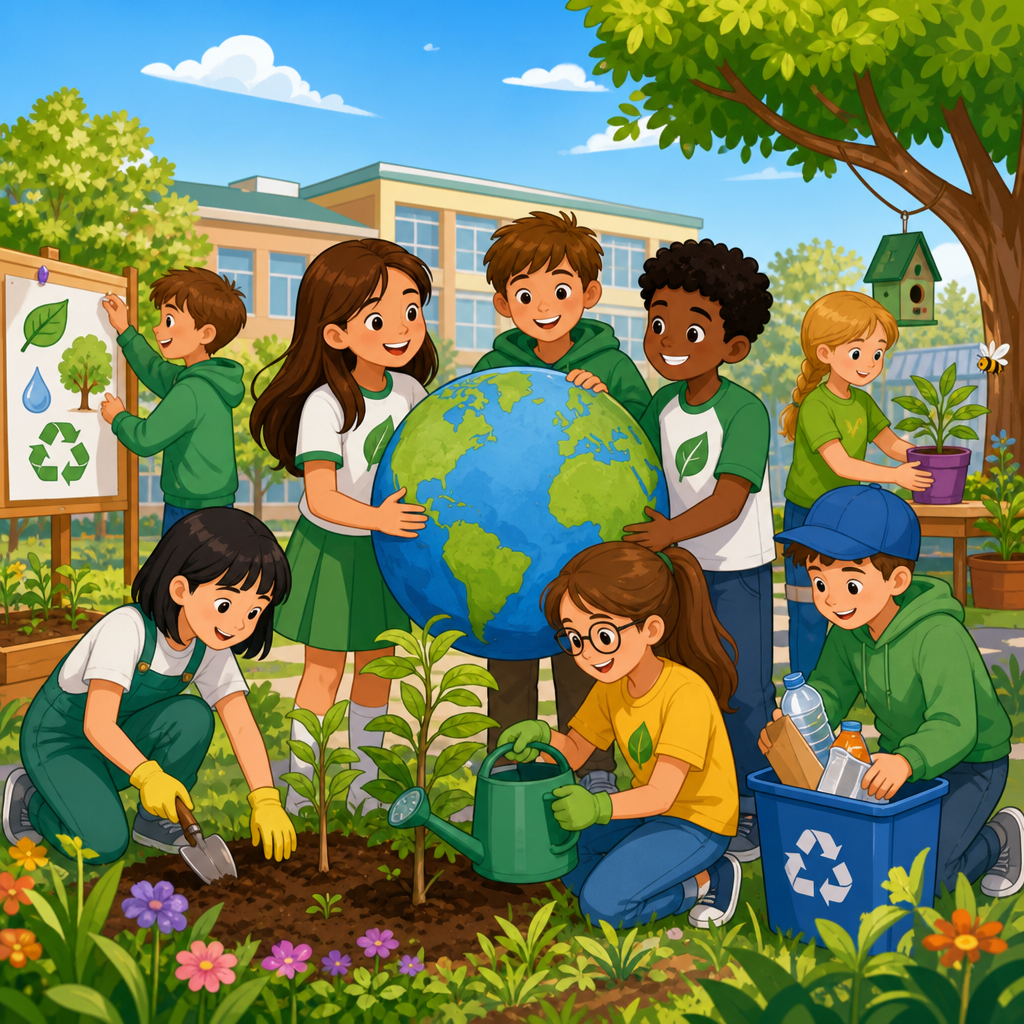
Eco clubs in schools turn environmental curriculum for schools into daily practice, giving students a structured way to learn, lead, and improve their campus. An eco club is a student-centered group that plans projects related to waste reduction, energy use, biodiversity, water conservation, climate awareness, and community action. In my work with school sustainability programs, the strongest clubs were never just recycling teams; they became practical learning labs that connected science, citizenship, literacy, data analysis, and local problem solving. That is why this topic matters so much for educators building an environmental curriculum for schools. Classroom lessons explain ecosystems, pollution, and climate systems, but clubs help students test ideas in real settings, measure results, and see that environmental responsibility is not abstract.
Schools need this combination of theory and action because environmental learning is most effective when students can observe systems around them. A campus produces waste, consumes electricity, uses water, manages grounds, purchases supplies, and influences family habits. Each of those systems can become a learning opportunity. A well-run eco club supports curriculum goals across grade levels, strengthens student voice, and helps schools meet sustainability targets without creating a separate subject from scratch. It also builds transferable skills: project management, public speaking, teamwork, auditing, research, and basic budgeting.
For school leaders, eco clubs offer a practical entry point into broader environmental education. They can begin small, with a litter audit or classroom energy campaign, then expand into gardening, habitat restoration, composting, citizen science, and policy recommendations. For students, they provide ownership. For teachers, they create authentic assessment opportunities. For families and communities, they show that schools are preparing young people to act responsibly in a resource-constrained world. When designed carefully, an eco club becomes the hub that links lessons, campus operations, and community partnerships into one coherent environmental curriculum for schools.
Why eco clubs are the backbone of environmental curriculum for schools
An environmental curriculum for schools works best when it combines knowledge, skills, values, and action. Eco clubs support all four. Knowledge comes from research on topics such as food waste, renewable energy, local species, and water cycles. Skills develop when students collect data, write campaign messages, present findings, and manage events. Values are shaped through repeated participation in stewardship. Action happens when ideas become projects with measurable outcomes.
I have seen schools struggle when environmental topics sit only inside occasional lesson plans. Students may remember definitions, but they do not always connect them to daily behavior. Eco clubs fix that gap by making sustainability visible. A recycling station, pollinator garden, switch-off campaign, or refill initiative turns the campus into a living case study. This is especially useful for interdisciplinary planning. Science classes can study decomposition through composting. Math classes can graph waste audit results. Language arts classes can produce persuasive posters and speeches. Social studies can examine environmental justice and local policy. Art classes can support signage and exhibitions.
There is also a school culture benefit. Clubs create peer influence, which is often stronger than top-down instruction. When students lead announcements, assemblies, or challenges, participation rises. Younger pupils see older students modeling practical habits. Staff become more willing to cooperate when they can see organized student leadership rather than one-off requests. In other words, the eco club is not an extracurricular add-on; it is an operating center for environmental curriculum for schools.
How to start an eco club with clear goals and strong support
The most successful launches start with a simple question: what environmental issues on this campus can students realistically influence in the next six months? Avoid beginning with a broad mission statement alone. Start with observable systems. Walk the school site and note bins, lights, taps, cafeteria waste, green spaces, transport patterns, and purchasing habits. Then recruit a small founding team of students and at least one committed staff advisor. Administrative support matters early because access to data, meeting space, permissions, and small budgets can determine whether projects move beyond enthusiasm.
Define a purpose in plain language. For example: the club will reduce waste, improve biodiversity, and build environmental literacy through student-led projects. Set two or three annual goals, not ten. Good goals are specific and measurable, such as reducing landfill waste in the cafeteria by 20 percent, creating a native planting area, or delivering one environmental awareness activity per term. A written charter helps. Include membership rules, meeting frequency, student leadership roles, project approval steps, and expectations for respectful participation.
Recruitment should be broad, not limited to students already interested in science. Some of the best eco club leaders come from art, media, technology, agriculture, or student council backgrounds. Promote the club through assemblies, tutor groups, posters, and direct teacher recommendations. Make the first meeting practical. Show students a real problem with photos or quick data, then ask them to choose priorities. That creates immediate ownership.
It is also wise to map the club to existing school plans. Link activities to attendance incentives, wellbeing initiatives, service learning, or campus improvement targets. When the club helps solve recognized school problems, it earns legitimacy quickly. That legitimacy sustains the environmental curriculum for schools because projects become part of school improvement, not side activities vulnerable to staff turnover.
Building projects that students can measure and sustain
Students stay engaged when projects produce visible results. Start with baseline data before launching any initiative. Conduct a waste audit, count single-use bottles, measure litter hotspots, record biodiversity observations, or collect monthly electricity figures from facilities staff. Baseline data allows students to compare before and after conditions and makes reporting credible.
Choose projects using three filters: educational value, operational feasibility, and measurable impact. A school garden may have high educational value but requires maintenance during holidays. A switch-off energy campaign is easy to launch but may deliver smaller learning depth unless students also track meter data and analyze behavior. Composting can be excellent, but only if contamination control and collection routines are realistic. Matching the project to available supervision, site conditions, and student age is essential.
| Project type | Best for | What students measure | Common challenge |
|---|---|---|---|
| Waste audit and recycling improvement | Quick wins and visible change | Bag counts, contamination rates, landfill volume | Incorrect sorting after initial enthusiasm |
| Energy saving campaign | Whole-school participation | Meter readings, classroom checks, device use | Access to reliable utility data |
| Native garden or habitat area | Biodiversity learning | Species counts, plant survival, pollinator visits | Long-term maintenance |
| Composting and food waste reduction | Cafeteria-focused learning | Food waste weight, compost output, participation | Contamination and odor management |
Once a project is selected, break it into phases: audit, plan, pilot, communicate, implement, review. This structure keeps meetings focused and mirrors professional sustainability work. Students learn that environmental progress depends on systems, not slogans. They also learn to adapt. If a pilot fails, that is not a wasted effort; it is feedback. In practice, sustainable eco clubs normalize iteration and evidence.
Connecting club activities to teaching, standards, and assessment
If this page is the hub for environmental curriculum for schools, the central principle is alignment. Eco clubs are strongest when they reinforce classroom objectives rather than compete with them. Begin by mapping projects to standards already used in your setting. In many schools, that means science inquiry, geography fieldwork, data handling in mathematics, persuasive writing in language arts, and civic participation outcomes in social studies. International frameworks can also help structure learning, including Education for Sustainable Development approaches and whole-school sustainability models such as Eco-Schools or Green Flag pathways.
Teachers often ask whether club work can count toward assessment. The answer is yes, if evidence is planned. Students can keep field journals, produce audit reports, create data dashboards, design campaign materials, present proposals to leadership, or evaluate project outcomes. A biodiversity survey can support scientific observation skills. A cafeteria waste study can become a statistics task. A student presentation on fast fashion can address research and speaking standards. This integration reduces duplication and shows students that environmental learning is rigorous, not extra.
Use recognized tools where possible. iNaturalist supports species logging. Google Sheets or Excel helps students build simple trend charts. ENERGY STAR resources, local utility dashboards, or facilities meter data can anchor energy studies. GIS tools, even basic ones, help map litter hotspots or tree cover. The point is not to overwhelm students with software but to use authentic tools that mirror how environmental professionals work.
One caution matters here: do not let the club become unpaid facilities labor. Students should investigate and influence systems, not simply be assigned cleanup tasks with no learning design. The educational value comes from inquiry, analysis, communication, and reflection. That is what turns eco clubs into a durable part of environmental curriculum for schools.
Growing the club through leadership, partnerships, and communication
Growth depends less on adding more activities and more on building reliable structures. Student leadership should be distributed. A president can coordinate, but project leads, communications leads, data leads, and event leads create continuity and reduce burnout. Succession planning is critical. Each year, older students should mentor younger members, document contacts, and hand over project files. Schools that skip this step often restart from zero annually.
Partnerships expand capacity. Grounds staff can advise on planting plans. Cafeteria teams can help redesign waste stations. Local councils may support litter picks or tree planting. Environmental nonprofits often provide workshops, citizen science opportunities, or grants. Parents with expertise in horticulture, engineering, architecture, or conservation can offer practical input. The best partnerships are specific. Instead of asking a community group to “support sustainability,” ask for help with a water audit, a pollinator survey, or compost system training.
Communication should be regular and evidence based. Share goals, actions, and results through assemblies, newsletters, corridor displays, and social media channels approved by the school. Before-and-after photos matter, but data matters more. Report that mixed recycling contamination dropped from 35 percent to 12 percent, or that native planting increased observed pollinator visits over a term. Clear reporting builds trust with administrators because it demonstrates impact, not just enthusiasm.
Funding is usually modest but manageable. Many clubs begin with mini-grants, PTA support, fundraiser revenue, or operational savings from reduced waste. Keep budgets simple and transparent. Show how spending on refill stations, compost bins, or seeds connects to educational outcomes and cost avoidance. Practical stewardship of money strengthens the club’s credibility and helps sustain the wider environmental curriculum for schools.
Common mistakes and how schools avoid them
The first mistake is trying to do everything at once. A club that launches recycling reform, gardening, uniforms swaps, Earth Day events, and climate advocacy in the same term usually fragments. Start with one or two priorities and complete them well. The second mistake is poor measurement. Without baseline data, claims of improvement remain anecdotal. The third is overreliance on one enthusiastic teacher. Build a small staff network and documented systems so the club survives timetable changes.
Another frequent problem is symbolic action with no operational follow-through. For example, schools install labeled recycling bins but never retrain students or cleaners, so contamination remains high and material still goes to landfill. Or they build a garden without irrigation, mulch, or holiday care. Environmental projects fail when logistics are ignored. Students should learn this directly: sustainability succeeds through design, routines, and accountability.
There is also a messaging risk. If communication focuses only on guilt or catastrophe, participation can drop, especially among younger students. Effective clubs combine honest explanation of environmental challenges with agency. Students need to understand climate change, biodiversity loss, and waste impacts, but they also need realistic actions that improve their immediate environment. Agency is what keeps eco clubs educational and emotionally sustainable.
Finally, avoid treating environmental work as politically uniform or scientifically simplistic. Some issues involve tradeoffs. Reusable products require washing and procurement. Solar projects depend on capital cost and site conditions. Tree planting must consider species choice and long-term care. Good environmental curriculum for schools teaches students to examine evidence, compare options, and explain decisions clearly. That intellectual honesty is a strength, not a weakness.
Eco clubs in schools work because they make environmental curriculum for schools visible, practical, and memorable. Students do not just hear about sustainability; they audit waste, test ideas, influence behavior, restore habitats, and report outcomes. That combination of knowledge and action is what builds lasting understanding. A strong club starts with a clear purpose, a small set of measurable goals, and support from staff and school leaders. It grows through structured projects, curriculum links, student leadership, and partnerships that add real expertise.
The main benefit is not only a greener campus, though that matters. The deeper benefit is that students learn how change happens in real organizations. They gather evidence, work with constraints, communicate with different audiences, and improve systems over time. Those skills transfer far beyond environmental topics. They prepare students for civic life, further study, and future work in a world where resource use, climate resilience, and ecological literacy will shape every sector.
If your school wants a practical starting point, begin with one audit, one student team, and one achievable project this term. Measure the baseline, share the results, and build from there. That is how an eco club becomes the engine of a lasting environmental curriculum for schools.
Frequently Asked Questions
What is an eco club in a school, and why does it matter?
An eco club is a student-led or student-centered group that turns environmental learning into visible, practical action on campus. Instead of keeping sustainability topics only inside classroom lessons, an eco club gives students a structured way to apply what they are learning through projects focused on waste reduction, energy conservation, biodiversity, water stewardship, climate awareness, and community involvement. In strong school sustainability programs, eco clubs do much more than organize occasional recycling drives. They become hands-on learning labs where students investigate real problems, collect data, propose solutions, communicate with school leaders, and help shape everyday habits across the campus.
This matters because students learn best when they can connect knowledge to action. An eco club helps bridge science, citizenship, leadership, and service. Students begin to understand how environmental systems affect their school and community, and they also see that their choices can create measurable improvements. For schools, the benefits are equally important. A well-run club can support environmental curriculum goals, improve student ownership of campus spaces, strengthen school culture, and often reduce waste or resource use over time. Just as importantly, eco clubs help students build confidence, teamwork, project management, and problem-solving skills that extend far beyond sustainability work.
How do you start an eco club in a school from scratch?
Starting an eco club works best when you begin with a simple structure and a clear purpose. The first step is usually finding a committed staff advisor who can support student leadership, help navigate school procedures, and keep the club connected to school goals. From there, define the club’s mission in practical terms. For example, the club might aim to reduce cafeteria waste, improve campus biodiversity, increase environmental awareness, and create student-led sustainability projects tied to learning. A short mission statement helps students, families, and administrators understand that the club is about action, education, and leadership, not just occasional events.
Next, recruit a core group of interested students and hold an initial meeting focused on listening and idea generation. Ask students what environmental issues they notice at school, what kinds of projects interest them, and what changes feel realistic in the short term. At this stage, it is smart to start small. A new eco club does not need to solve every sustainability challenge at once. In fact, early momentum often comes from one or two visible, achievable projects, such as a lunch waste audit, a classroom energy-saving campaign, a native planting area, or a water conservation awareness week. Small wins help build credibility and attract more members.
It is also helpful to create a basic operating plan. Decide how often the club will meet, how students will take on leadership roles, how projects will be selected, and how progress will be tracked. If possible, connect the club to school improvement priorities, science curriculum, service learning, or student leadership initiatives. That makes it easier to gain approval and long-term support from administrators. Finally, communicate clearly. Use announcements, posters, assemblies, newsletters, and social media if appropriate to share the club’s purpose and invite participation. The strongest clubs begin with enthusiasm, but they grow because they also have structure, student ownership, and realistic goals.
What kinds of projects should a school eco club focus on first?
The best first projects are visible, manageable, relevant to the school’s daily life, and easy for students to understand and explain. A good starting point is often a simple campus sustainability review. Students can observe where waste is generated, whether lights and devices are left on unnecessarily, how outdoor spaces are used, where water may be wasted, and what opportunities exist for greener routines. This kind of review helps the club choose projects based on evidence rather than assumptions. It also teaches students to think like investigators and problem-solvers.
From there, waste reduction is often one of the most practical entry points. Students can conduct a waste audit in the cafeteria or classrooms, improve labeling on bins, create peer education campaigns, or encourage reuse systems for supplies. Energy awareness is another strong option because it is easy to connect to daily behavior. A campaign that encourages turning off lights, closing doors, unplugging unused devices, or monitoring classroom energy habits can involve many students across the school. Water conservation projects, school garden initiatives, pollinator habitats, tree planting, and biodiversity mapping can also work well, especially when they tie into science learning and stewardship of the school grounds.
The key is to choose projects with a balance of visibility and feasibility. Students need to see results, whether that means cleaner sorting stations, lower waste volumes, improved campus greenery, or stronger awareness among peers. It is also important to avoid launching too many projects at once. A club that focuses on one to three well-planned initiatives is more likely to build momentum than a club that starts with a long list and struggles to follow through. As the club matures, it can expand into larger efforts such as sustainability policies, partnerships with local organizations, climate education events, or student presentations to school leadership.
How can an eco club stay active and keep students engaged over time?
Long-term success comes from making the club meaningful, organized, and genuinely student-driven. One of the most common reasons eco clubs lose momentum is that too much responsibility stays with one teacher or a small group of students. To prevent that, build a leadership structure early. Assign roles such as project lead, communications lead, data tracker, event coordinator, and outreach representative. Students are more likely to stay involved when they know their contributions matter and when responsibilities are shared rather than concentrated.
It also helps to maintain a steady rhythm of activity. Regular meetings, clear agendas, and short-term milestones give the club a sense of direction. Students should be able to answer three basic questions at any point: what are we working on, who is responsible, and how will we know if it worked? Tracking progress is especially important. If students collect data on waste diverted, energy-saving participation, garden growth, biodiversity observations, or event attendance, they can see the impact of their work. That evidence builds motivation and makes it easier to report successes to school leaders and families.
Engagement also improves when the club combines action with creativity and community. Not every meeting should feel like administration. Mix project work with student brainstorming, campaigns, campus challenges, assemblies, guest speakers, field experiences, or collaboration with art, science, and service groups. Celebrate wins publicly, even small ones. A before-and-after display, a short assembly update, a bulletin board of results, or recognition for student leaders can make a big difference. Finally, plan for continuity. Older students should mentor younger members, and each project should leave behind notes, resources, and lessons learned. Sustainable eco clubs are not built on one enthusiastic year alone; they are built on systems that help new students step in and keep the work moving forward.
How can an eco club connect with the curriculum and the wider school community?
An eco club is most effective when it supports learning across the school rather than operating as a separate activity on the margins. The strongest clubs reinforce environmental curriculum for schools by turning academic topics into real-world practice. Science classes can connect with biodiversity surveys, soil health, energy monitoring, water testing, or waste analysis. Math can support data collection, graphing, and impact measurement. Language arts can contribute persuasive writing, campaign messaging, and student reflection. Social studies and civics can connect to community action, environmental justice, and policy discussions. When teachers see that the eco club strengthens learning outcomes, the club becomes more valuable to the school as a whole.
Connection to the wider school community is just as important. Eco clubs grow faster when they build relationships with administrators, custodial teams, cafeteria staff, grounds staff, families, and local partners. These groups often have practical knowledge and influence over how campus systems actually work. For example, a waste reduction project will be far more successful if custodial and cafeteria teams are included from the beginning. Families can support reuse drives, garden workdays, or home energy awareness challenges. Community organizations, local environmental groups, and municipal sustainability offices may provide guest speakers, materials, technical advice, or partnership opportunities that make student projects more ambitious and credible.
To build these connections, students should learn to communicate their work clearly and respectfully. Encourage them to present findings, share goals, ask informed questions, and propose realistic solutions. That process teaches advocacy and collaboration in a very concrete way. Over time, the eco club can become a visible hub for school improvement, showing that sustainability is not just a topic to study but a shared practice that shapes how the whole school learns and operates. When that happens, the club moves from being an extracurricular group to becoming a meaningful part of school culture.