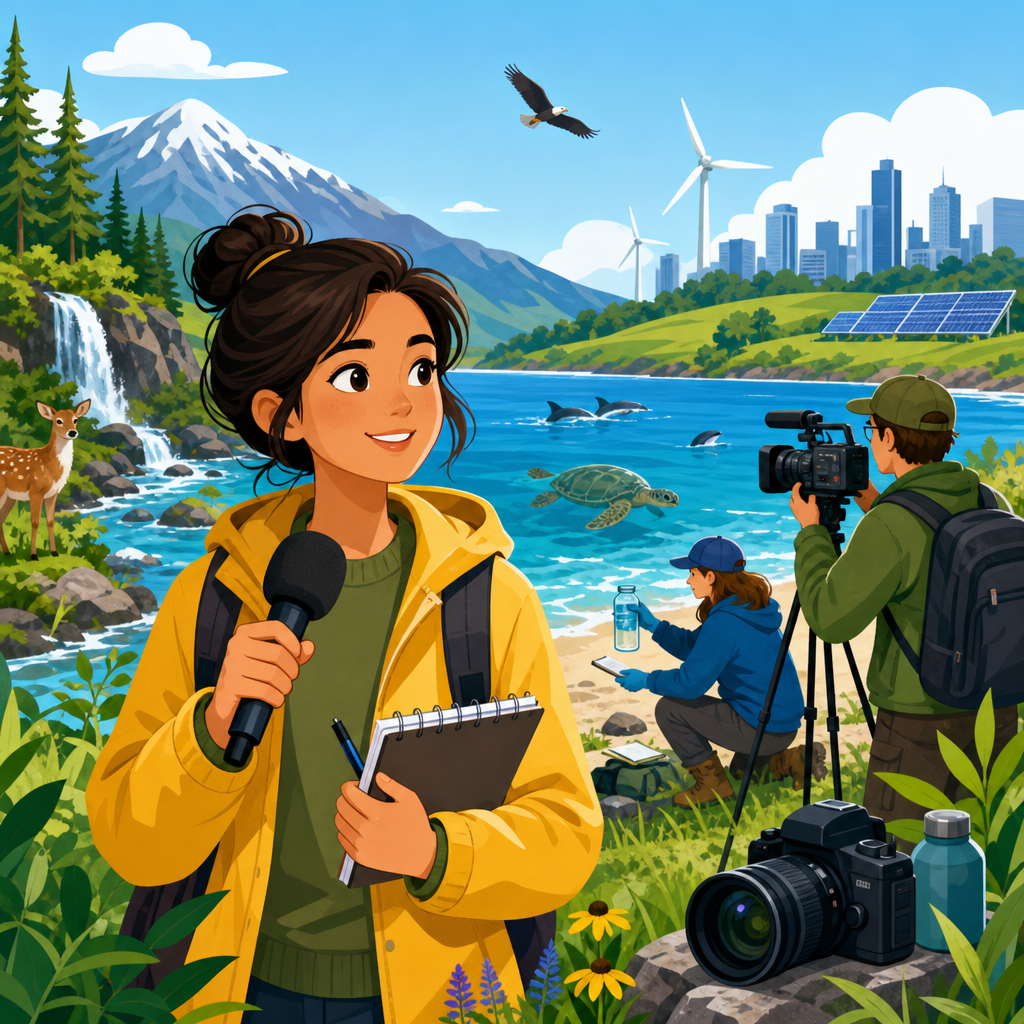
Environmental journalism careers sit at the intersection of reporting, science, policy, and public service, making them one of the most consequential paths in modern media. Environmental journalism means gathering, verifying, and explaining information about climate change, biodiversity, pollution, energy, conservation, public health, agriculture, and environmental justice for a public audience. In practice, that can include breaking news on wildfires, investigations into toxic waste, explanatory pieces on carbon markets, data stories about heat risk, or local accountability reporting on water systems. I have worked with reporters covering regulatory hearings, field visits, scientific papers, and emergency events, and the pattern is consistent: this beat rewards curiosity, rigor, and the ability to translate technical material into clear language. It matters because environmental decisions shape housing, food prices, insurance costs, drinking water, transportation, employment, and disaster preparedness. As audiences seek trustworthy environmental news and reports, newsrooms need journalists who can understand evidence, question institutions, and connect global systems to local lives.
For aspiring reporters, the field offers more routes than many people realize. Some environmental journalists begin in traditional reporting and develop subject expertise over time. Others arrive through degrees in biology, geology, public policy, environmental studies, or data science, then learn newsroom craft. The core job is not activism, although the work often examines power and accountability. It is journalism grounded in verification, fairness, sourcing, and context. Strong environmental reporting asks basic questions with unusual discipline: What happened, who is affected, what does the evidence show, what remains uncertain, and which institutions are responsible? This article serves as a hub for the broader environmental news and reports landscape, explaining roles, required skills, common beats, portfolio-building strategies, employers, pay realities, and long-term career growth. If you want a practical understanding of environmental journalism careers, start here and use each section as a map for deeper exploration.
What environmental journalists actually do
Environmental journalists report on systems that are scientifically complex and politically contested. On any given week, a reporter may read an Intergovernmental Panel on Climate Change summary, attend a city council meeting on stormwater infrastructure, interview residents living near an industrial corridor, analyze emissions data from the Environmental Protection Agency, and fact-check claims made by a utility company. That range is why this beat demands both reporting fundamentals and subject fluency. The daily work usually includes source development, public records requests, document analysis, interviews, field reporting, and collaboration with editors, photojournalists, videographers, or graphics desks. In larger organizations, one reporter may focus narrowly on climate policy, while another covers weather extremes, wildlife, or energy transition finance.
The best environmental news and reports do more than summarize studies. They establish significance, test claims, and show consequences. A drought story should explain water rights, reservoir levels, agricultural impacts, and who bears the cost of restrictions. A plastics piece should distinguish between polymer types, waste streams, recycling economics, and health evidence around additives or microplastics. A climate migration article should define whether displacement is temporary, seasonal, or permanent, and identify the legal and economic pressures involved. Readers depend on reporters to sort signal from spin. That means understanding confidence intervals, peer review, attribution science, permit processes, and environmental impact assessments well enough to explain them plainly without distorting meaning.
There is also a strong accountability function. Environmental reporters routinely examine whether laws are enforced, whether agencies are transparent, and whether companies disclose risks accurately. Investigations often start with a narrow lead: an unusual cancer cluster, permit violations, unexplained fish die-offs, delayed cleanup timelines, or discrepancies between corporate sustainability claims and regulatory filings. From there, journalists build evidence through inspection reports, procurement records, lawsuits, satellite imagery, and expert interviews. When done well, this reporting changes policy, informs voters, and helps communities act on credible information rather than rumor.
Core beats within environmental news and reports
Environmental journalism is not one beat but a network of overlapping specialties. Climate reporting covers mitigation, adaptation, carbon accounting, extreme weather, insurance, infrastructure, and international negotiations. Energy reporting often focuses on utilities, grid reliability, fossil fuel markets, renewables, transmission, batteries, nuclear power, and permitting conflicts. Conservation and biodiversity reporting examines habitat loss, endangered species law, fisheries, forests, invasive species, and land management by agencies such as the U.S. Forest Service or National Park Service. Environmental health reporting investigates air quality, drinking water contamination, lead, PFAS, pesticides, occupational exposure, and links between pollution and disease.
Another major area is environmental justice, which looks at how environmental burdens and benefits are distributed across communities. In practical terms, that can mean documenting why highways, refineries, landfills, or petrochemical plants are concentrated in lower-income neighborhoods, or examining who receives flood protection and who does not. Agriculture and food systems form another robust beat, especially around soil degradation, fertilizer runoff, irrigation, methane emissions, crop insurance, and supply chain resilience. Business-oriented environmental journalists track sustainability disclosures, transition finance, ESG regulation, litigation risk, and how climate exposure affects corporate strategy. Local reporters may blend several of these themes because environmental impacts rarely stay in one category.
Choosing a specialty early can help you build expertise, but broad literacy remains essential. A wildfire story touches climate, forestry, housing, insurance, public health, and emergency management. A coastal erosion story may involve engineering, zoning, tourism, ecosystems, and federal disaster funding. In newsroom hiring, editors often value candidates who can demonstrate one area of depth plus the flexibility to connect related issues quickly and accurately.
Skills, tools, and training that make candidates competitive
Environmental journalism careers reward a mix of classic reporting skill and technical competence. First, you need reporting fundamentals: interviewing, source vetting, attribution, document reading, deadline writing, and ethical decision-making. Second, you need basic scientific literacy. You do not need a PhD, but you must be comfortable reading journal abstracts, identifying study limitations, distinguishing correlation from causation, and asking researchers how they know what they know. Third, data literacy is increasingly nonnegotiable. Many important environmental stories emerge from datasets on emissions, weather, water quality, land use, health outcomes, or corporate disclosures.
In my experience, the most effective early-career reporters learn a practical tool stack rather than chasing every platform. At minimum, know spreadsheets well, especially filtering, pivot tables, cleaning messy fields, and basic chart logic. Learn public records workflows, including how to frame requests narrowly enough to avoid delays. Familiarity with QGIS, Google Earth, NOAA databases, EPA Envirofacts, EJScreen, NASA Earth Observatory resources, and the U.S. Energy Information Administration gives you a serious advantage. For audio or video roles, field recording and mobile shooting matter. For digital text roles, content management systems, headline testing, and newsletter writing can improve employability.
| Skill area | Why it matters | Useful tools or methods |
|---|---|---|
| Scientific literacy | Helps reporters interpret studies accurately and challenge overstated claims | Peer-reviewed journals, methodology review, expert source triangulation |
| Data reporting | Reveals trends in pollution, heat, flooding, and regulation that anecdotes miss | Excel, Google Sheets, QGIS, Census data, EPA datasets |
| Public records | Supports accountability reporting with inspection reports, permits, and emails | FOIA requests, state open records laws, docket tracking |
| Field reporting | Adds on-the-ground evidence, sensory detail, and community voices | Site visits, safety planning, photo logs, geolocation notes |
| Audience translation | Turns technical findings into usable public information | Plain-language writing, FAQs, explainers, visual collaboration |
Formal education can help, but clips and reporting judgment carry more weight than pedigree alone. Journalism schools with science reporting courses, data journalism labs, and student publications are strong training grounds. So are environmental studies programs that teach policy analysis and statistics. Fellowships from organizations such as the Society of Environmental Journalists, Solutions Journalism Network, and university-based climate reporting initiatives can provide mentorship, travel support, and specialized coursework. If you are changing careers, targeted continuing education in data analysis, GIS, remote sensing, or environmental law can close gaps fast.
How to build a portfolio and break into the field
Breaking into environmental journalism usually starts with published work, not a perfect résumé. Editors want evidence that you can find a story, report it fairly, and explain why it matters. Student newspapers, local news sites, nonprofit outlets, community radio, and freelancing are all viable entry points. The smartest early strategy is to produce a small set of clips that demonstrate range: one breaking news piece, one explanatory article, one accountability story built on documents, and one feature grounded in field reporting. If all four touch environmental issues, even better. A concise portfolio beats a large but unfocused archive.
Start local. Some of the strongest environmental reporting opportunities are close to home: aging water infrastructure, floodplain development, landfill expansion, air monitoring near schools, transit emissions, pesticide use near farms, or heat exposure in neighborhoods with limited tree canopy. These stories are often undercovered and highly relevant to readers. They also teach you essential habits: reading permits, attending public meetings, asking agencies for data, and building trust with residents who may have valid reasons to distrust media. Editors notice reporters who can connect technical policy to everyday life.
Freelancers should study outlet needs before pitching. A good environmental pitch identifies the news peg, the specific question the story will answer, the likely sources, and why the topic matters now. For example, instead of proposing a vague article about urban heat, pitch a reported analysis of which neighborhoods in one city face the highest nighttime temperatures, how canopy disparities emerged, and what local adaptation funding is doing. Include possible datasets, community voices, and expert context. Publications are far more likely to assign a story that feels reported before it is written.
Networking is practical in this field, not performative. Join the Society of Environmental Journalists, attend public webinars from Columbia Climate School or local press associations, and follow reporters whose bylines appear in major environmental news and reports. Read their work closely. Notice how they structure nut grafs, where they place data, and how they explain uncertainty. Reach out with specific questions, not generic requests for mentorship. Many experienced reporters will help serious newcomers who show preparation and respect for time.
Where environmental journalists work and what careers can become
Environmental journalism careers exist in more places than legacy newspapers. Large national outlets employ climate, energy, science, and investigative reporters. Local newspapers and public radio stations often need reporters who can cover weather disasters, land use, utilities, and public health with environmental context. Digital-native publications, nonprofit newsrooms, magazines, documentary teams, newsletters, and trade publications all hire environmental specialists. Some reporters build careers through freelancing across multiple outlets, especially if they have a niche such as methane regulation, fisheries, or satellite-based climate verification.
There are also adjacent roles. Research editors verify scientific claims and citations. Data journalists build interactives around flood risk, wildfire spread, or emissions. Producers create podcasts and video explainers on environmental policy and climate adaptation. Audience editors package environmental news and reports into newsletters, social clips, and homepage presentations that improve reach without sacrificing accuracy. Career progression may move from general assignment to beat reporter, then to senior correspondent, investigations, editing, or cross-functional roles that combine reporting with product or strategy.
Compensation varies widely by market and employer. National outlets and unionized newsrooms may offer stronger salaries and benefits, while local and freelance pathways can be less stable. Nonprofit organizations sometimes provide mission alignment and reporting support but may have smaller teams. Tradeoffs are real: a local newsroom may pay less yet give a young reporter more byline opportunities, deeper source access, and faster responsibility. The strongest long-term careers usually come from repeatedly producing accurate work on difficult stories, not from chasing prestige alone.
Challenges, ethics, and staying credible on a polarized beat
Environmental reporting can be emotionally demanding. Reporters cover disasters, displacement, illness, ecosystem loss, and policy failures that affect vulnerable people first. They also operate in an information environment crowded with lobbying, greenwashing, ideological framing, and technical jargon. Credibility depends on disciplined methods. Verify every claim, especially numerical ones. Ask companies for evidence behind sustainability statements. Read the methods section of studies, not just the press release. Distinguish between model projections, observed trends, and political promises. Explain uncertainty clearly without creating false balance where the evidence is strong.
It is equally important to avoid flattening communities into symbols. Residents living near a refinery are not just victims; they are workers, parents, organizers, tenants, and business owners with competing pressures. Rural communities facing wildfire policy changes may value conservation and still oppose specific regulations. Indigenous reporting requires historical context, consent-based sourcing practices, and respect for sovereignty. Good environmental journalism keeps people at the center while preserving analytical precision.
Burnout is a practical concern, so sustainable work habits matter. Build source lists before emergencies. Maintain reporting templates for permits, inspections, and scientific papers. Collaborate with editors on safety protocols for storms, fires, protests, and remote fieldwork. Keep detailed notes and organized files; environmental stories often evolve over months or years. The reporters who last in this field are not the loudest. They are the most methodical, curious, and trustworthy.
Environmental journalism careers offer a meaningful way to inform the public on issues that shape daily life, economic stability, and long-term resilience. The field combines breaking news, deep reporting, science translation, public records work, and accountability in a beat that reaches from neighborhood drainage problems to international climate negotiations. For anyone exploring education and resources around environmental news and reports, the essential takeaway is simple: this is a real profession with multiple entry points, clear skill requirements, and strong public value. You do not need to know everything at the start. You need reporting discipline, subject curiosity, data comfort, and a willingness to keep learning.
If you want to pursue this path, begin by building four strong clips, choosing one local environmental issue to own, and learning the documents, datasets, and institutions behind it. Study excellent work, join professional networks, and practice explaining complex evidence in plain language. Over time, that combination creates the expertise editors trust and audiences remember. Use this hub as your starting point, then explore related articles on climate reporting, environmental justice, investigative methods, data tools, and freelance pitching to build a durable environmental journalism career.
Frequently Asked Questions
What does an environmental journalist actually do day to day?
An environmental journalist reports on how the natural world, public policy, science, industry, and communities affect one another. On a typical day, that can mean reading scientific studies, interviewing researchers, government officials, advocates, industry representatives, and residents, reviewing public records, attending hearings, tracking breaking news, and turning complex information into clear stories for the public. The beat is broad: climate change, biodiversity loss, pollution, water quality, energy transitions, agriculture, public health, conservation, land use, and environmental justice can all fall under the same umbrella.
In practice, the work often mixes several forms of journalism. One story may be a fast-turn breaking news piece on a wildfire or chemical spill, while another may be a long investigation into toxic waste, weak regulation, or corporate misconduct. Environmental journalists also write explanatory stories that help audiences understand difficult topics such as carbon markets, drought, extreme weather attribution, methane emissions, or the health effects of air pollution. Because the consequences of environmental issues are local, national, and global at the same time, the job often requires connecting science and policy to everyday life in a way that feels relevant and accurate.
Many environmental reporters also spend significant time verifying claims and resisting oversimplification. Environmental topics are frequently politicized, technically dense, and full of uncertainty, so strong reporting requires careful sourcing, context, and precision. Good environmental journalism is not advocacy dressed up as reporting; it is rigorous, evidence-based public service journalism that helps people understand risk, accountability, and the real-world stakes of environmental decisions.
What skills and qualifications are most important for an environmental journalism career?
The core qualifications are the same ones required in strong journalism generally: reporting, interviewing, fact-checking, source development, news judgment, clear writing, and ethical decision-making. What makes environmental journalism distinct is the need to understand scientific evidence, policy systems, and technical language without losing the audience. You do not necessarily need an advanced science degree to do this work well, but you do need to be comfortable reading studies, asking experts smart follow-up questions, spotting weak claims, and translating specialized material into plain English.
Curiosity and skepticism are especially important. Environmental journalists regularly encounter competing narratives from scientists, agencies, companies, nonprofits, and political actors. That means you need to know how to evaluate data, distinguish peer-reviewed research from spin, interpret uncertainty responsibly, and identify what is still unknown. Familiarity with public records requests, environmental impact documents, regulatory processes, and basic data analysis can be a major advantage, particularly for investigative or enterprise reporting.
Just as important are communication and framing skills. The strongest environmental journalists know how to make abstract issues concrete by connecting them to housing, health, jobs, food systems, transportation, disaster recovery, and community inequality. Multimedia abilities can also strengthen your career prospects. Employers increasingly value reporters who can work across digital formats, including newsletters, podcasts, social video, maps, data visualizations, and photo or field reporting. A journalism degree can help, but a strong portfolio, solid clips, and demonstrated beat knowledge often matter just as much in hiring decisions.
How do you break into environmental journalism if you are just starting out?
The most practical way to enter the field is to start publishing reported work as early as possible. Student newspapers, local news outlets, nonprofit publications, freelance pitches, internships, and fellowships can all help you build a portfolio. If you are new to the beat, begin with stories that have clear local relevance: drinking water concerns, zoning and land use disputes, heat waves, flooding, wildfire preparedness, air quality alerts, industrial emissions, recycling systems, or conservation conflicts. Local stories often provide the best training because they force you to understand policy, science, and community impact all at once.
It also helps to develop a beat focus without becoming too narrow too soon. For example, you might begin by covering climate and extreme weather, energy and utilities, public lands, environmental justice, agriculture, or health impacts from pollution. Over time, you can deepen your expertise and become known for a specific area. Read widely from established environmental reporters, learn how they frame stories, and pay attention to how they use evidence, interviews, and accountability reporting. Building relationships with editors and joining professional journalism organizations can also open doors to mentorship, training, and job leads.
For early-career journalists, fellowships and internships can be especially valuable because they provide structure, clips, and access to experienced editors. Freelancing is another viable path, but it works best when approached strategically: pitch stories with a clear news hook, a defined angle, and strong sourcing plans. Editors want to see that you can report, not just summarize. Even if your first stories are small, consistency matters. A portfolio that shows accuracy, persistence, and the ability to explain environmental issues clearly is often the most convincing credential you can have.
What kinds of jobs and career paths exist within environmental journalism?
Environmental journalism is not limited to one job title or one type of newsroom. You may work as a beat reporter at a local newspaper, a national correspondent for a major publication, a data reporter, an investigative journalist, a magazine writer, a podcast host, a documentary producer, a newsletter writer, or an editor overseeing climate and environment coverage. Public radio, digital-native outlets, nonprofit investigative newsrooms, trade publications, wire services, and science-focused publications all hire people who report on environmental topics in different ways.
The career path often depends on your strengths. Reporters who thrive on daily news may gravitate toward breaking coverage of extreme weather, regulation, courts, and public agencies. Those who prefer long-form work may specialize in investigations, narrative features, or documentary storytelling. Journalists with quantitative skills may move into data-driven climate and pollution reporting, while others build careers around audio, visual, or cross-platform storytelling. There are also roles that combine editing with beat expertise, such as climate editor, environment editor, or audience editor for science and environment desks.
As the field evolves, many environmental journalists also find opportunities in specialized sub-beats. Energy transition reporting, environmental justice, food and agriculture, adaptation and resilience, water, biodiversity, and public health are all growing areas. Some journalists move between local, national, and international coverage over time, while others choose to stay deeply rooted in one region and become indispensable experts on its ecosystems, industries, and policy battles. The path is rarely linear, but there is room for reporters, investigators, explainers, editors, and multimedia storytellers who can produce credible, nuanced coverage of issues that increasingly shape public life.
What challenges should you expect in an environmental journalism career, and is it a good long-term field?
Environmental journalism is rewarding, but it can also be demanding in ways that are both intellectual and emotional. The subject matter often involves crisis, loss, risk, and conflict. Reporters may cover disasters, contamination, displacement, political inaction, and long-term ecological damage, sometimes while communities are actively experiencing harm. The beat also requires patience with complexity. Scientific findings can be nuanced, policy outcomes can unfold slowly, and major environmental changes do not always fit neatly into a daily news cycle. That tension between urgency and accuracy is one of the field’s defining challenges.
There are also practical career realities to consider. Like journalism more broadly, environmental reporting can involve freelance instability, competitive hiring, tight deadlines, and limited newsroom resources. Some stories require extensive document work, travel, technical learning, or legal review. Sources may be highly polarized, and powerful institutions may resist scrutiny. Because environmental issues intersect with economics and politics, reporters often need to withstand pressure from activists, industry groups, and officials who all believe the stakes are exceptionally high. Strong editors, careful reporting habits, and a commitment to fairness are essential.
Even with those challenges, it is a strong long-term field for journalists who care about accountability and public understanding. Environmental issues now influence nearly every major area of civic life, from insurance and infrastructure to migration, health, energy prices, and food security. That makes environmental journalism increasingly central rather than peripheral. Skilled reporters who can explain science, investigate power, and tell human-centered stories are likely to remain in demand across many types of media. For people who want a career that combines rigorous reporting with meaningful public impact, environmental journalism can be one of the most important and lasting paths in modern news.