
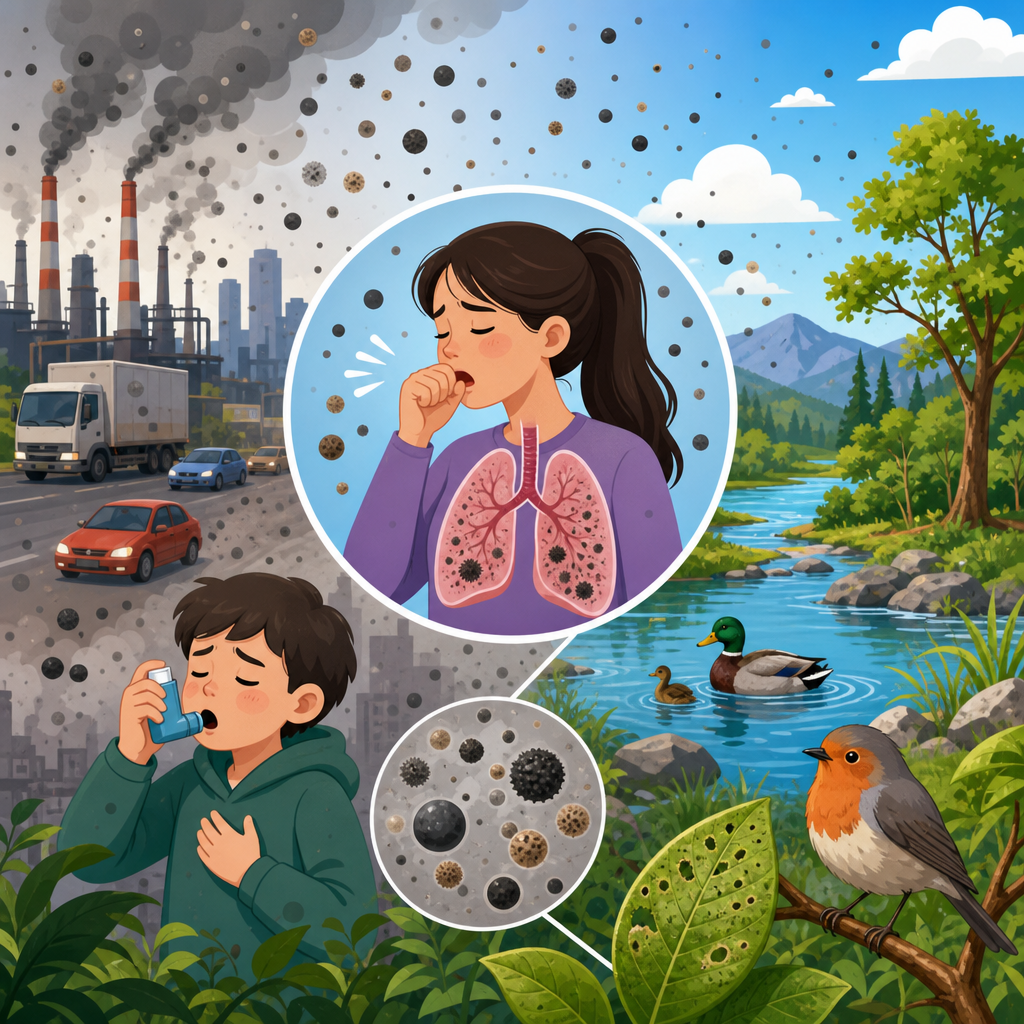
Particulate matter is one of the most consequential topics in atmospheric science because it links air chemistry, weather, public health, ecosystems, climate forcing, and environmental policy in a single measurable pollutant. In practical terms, particulate matter, often shortened to PM, refers to a mixture of solid particles and liquid droplets suspended in air, including dust, soot, smoke, sulfates, nitrates, metals, sea salt, pollen fragments, and organic compounds. Scientists classify it mainly by aerodynamic diameter because size determines how long particles remain airborne, how deeply they penetrate the lungs, how far they travel, and how they interact with sunlight and clouds. The most widely used categories are PM10, particles with diameters of 10 micrometers or smaller, and PM2.5, fine particles 2.5 micrometers or smaller; ultrafine particles are generally below 0.1 micrometer and behave differently again.
This matters because particulate pollution is not just dirty air that reduces visibility. It is a complex atmospheric hazard associated with asthma attacks, chronic obstructive pulmonary disease, cardiovascular disease, stroke, adverse birth outcomes, premature mortality, crop damage, acidification, material corrosion, and altered regional climate. In fieldwork and reporting, I have seen how PM episodes are rarely isolated events. A wildfire plume can push city air quality into unhealthy ranges, deposit black carbon on mountain snow, close schools, and increase emergency department visits in the same week. A dust storm can carry minerals and microbes across continents. Winter inversions can trap traffic exhaust and wood smoke near the ground, exposing entire neighborhoods to concentrations far above annual averages. Understanding particulate matter therefore provides a practical hub for atmospheric science: it connects emissions, transport, transformation, exposure, and impact in ways that both specialists and the public can act on.
What particulate matter is and where it comes from
Particulate matter includes both primary particles emitted directly into the atmosphere and secondary particles formed in air through chemical reactions. Primary PM comes from sources such as diesel engines, brake and tire wear, coal combustion, construction dust, agricultural tilling, industrial processes, sea spray, and wildfire smoke. Secondary PM forms when precursor gases react after emission. Sulfur dioxide can oxidize into sulfate aerosols, nitrogen oxides can form nitrate particles, ammonia from agriculture can neutralize acidic species, and volatile organic compounds can produce secondary organic aerosol through photochemical reactions. This distinction is central in atmospheric science because controlling visible smoke alone will not necessarily solve fine-particle pollution if precursor gases remain high.
Source profiles vary by region and season. In many urban areas, traffic and industry dominate local primary emissions, while regional PM2.5 may be driven by sulfate, nitrate, and organic aerosol transported from power generation, agriculture, or wildfire zones hundreds of kilometers away. In arid regions, coarse mineral dust can account for much of PM10. In coastal settings, sea salt is significant but often less toxic than combustion-derived particles. Indoors, particulate matter also comes from cooking, candles, fireplaces, cleaning products, and infiltration from outdoor air. This is why atmospheric scientists combine emissions inventories, receptor modeling, and direct monitoring to answer a practical question: not just how much PM is present, but which sources are contributing and which are most harmful.
How particulate matter behaves in the atmosphere
Once emitted, particles do not stay chemically or physically unchanged. They disperse, coagulate, absorb water, react with oxidants, and deposit onto land and water. Meteorology strongly influences these processes. Wind speed affects dilution and transport. Atmospheric stability determines whether emissions mix upward or remain trapped near the surface. Temperature and humidity influence secondary aerosol formation and particle growth. Precipitation can remove particles through wet deposition, while dry deposition settles them onto vegetation, buildings, and soil. Thermal inversions, especially during winter, often create severe urban pollution episodes because a warm air layer aloft prevents vertical mixing.
Particle size determines residence time and exposure pattern. Coarse particles settle more quickly and often stay closer to sources. Fine and ultrafine particles can remain suspended for days to weeks and travel across state or national boundaries. Satellite imagery regularly shows smoke from Canadian or Siberian wildfires crossing oceans, while Saharan dust reaches the Caribbean and the Americas. These long-range transport events demonstrate that atmospheric science cannot treat particulate matter as only a local issue. Airshed management, climate interactions, and public health surveillance all require regional and sometimes global perspectives.
Particles also affect atmospheric optics. They scatter and absorb sunlight, reducing visibility and contributing to haze. Sulfates generally scatter radiation and can cool the atmosphere at the surface, while black carbon strongly absorbs solar energy and warms the air. Aerosols can act as cloud condensation nuclei or ice nuclei, altering cloud droplet number, cloud brightness, cloud lifetime, and precipitation patterns. These effects are scientifically important because they introduce one of the largest uncertainties in estimates of human influence on climate.
How particulate matter harms human health
Particulate matter affects human health through inhalation, systemic inflammation, oxidative stress, and in some cases direct translocation of ultrafine particles or particle-associated chemicals into the bloodstream. PM10 can irritate the eyes, nose, and throat and worsen respiratory symptoms. PM2.5 is more dangerous because it reaches deep into the bronchioles and alveoli, where gas exchange occurs. Ultrafine particles may penetrate cellular barriers even more readily. The World Health Organization and major public health agencies consistently identify PM exposure as a leading environmental risk factor because there is strong evidence linking it to increased hospital admissions, reduced lung function, heart attacks, arrhythmias, stroke, lung cancer, and premature death.
Short-term exposure can trigger acute events, especially in children, older adults, pregnant people, and individuals with asthma, heart disease, or diabetes. During wildfire seasons, I have watched daily PM2.5 charts rise from moderate to hazardous in hours, followed by immediate spikes in complaints of chest tightness, coughing, and eye irritation. Long-term exposure is equally important. Living for years in areas with elevated fine-particle concentrations increases the risk of chronic cardiovascular and respiratory disease even when daily peaks are not dramatic. Research from large cohort studies, including the Harvard Six Cities Study and the American Cancer Society analyses, helped establish that lower annual PM2.5 concentrations correspond to lower mortality risk, shaping modern air-quality standards.
Not all particles are equally toxic. Composition matters. Black carbon, transition metals, polycyclic aromatic hydrocarbons, and certain secondary organics are associated with stronger oxidative and inflammatory responses than relatively inert crustal dust or sea salt. Exposure also depends on microenvironments. A regional monitor may report one concentration, but personal exposure for a bus driver, kitchen worker, or resident near a freight corridor can be much higher. This is why health assessments increasingly combine fixed-site monitoring, low-cost sensors, land-use regression, and personal exposure studies rather than relying on a single citywide average.
Environmental effects on ecosystems, water, and climate
Particulate matter affects ecosystems through deposition, shading, chemistry changes, and climate feedbacks. When nitrate, sulfate, and ammonium particles deposit onto forests, grasslands, lakes, and estuaries, they can alter nutrient balances and contribute to acidification or eutrophication. Sensitive alpine lakes and high-elevation soils are especially vulnerable because they have limited buffering capacity. Dust can deliver iron and phosphorus that stimulate marine productivity, yet excessive deposition near croplands or natural reserves can also introduce contaminants such as arsenic, lead, or persistent organic compounds. On leaves, deposited particles can block stomata, reduce photosynthesis, and affect plant-water relations.
Visibility impairment is another environmental and social impact. Fine particles are the main cause of regional haze in national parks and wilderness areas. In the United States, the Clean Air Act visibility program specifically targets this issue because scenic degradation has ecological, cultural, and economic costs. Particles also influence cryosphere processes. Black carbon deposited on snow and ice lowers surface albedo, causing more solar absorption and faster melting. This mechanism has been documented in the Himalaya, the Arctic, and mountain watersheds where snowpack timing matters for downstream water supply.
Climate effects are mixed and depend on particle type. Sulfate aerosols generally cool by scattering sunlight and brightening clouds, whereas black carbon warms by absorbing radiation and darkening snow. Organic aerosols can cool or warm depending on composition and atmospheric context. Because particles are short-lived compared with carbon dioxide, reducing them can produce relatively rapid health benefits and near-term climate responses. However, there is a tradeoff: cutting reflective aerosols without reducing greenhouse gases can unmask warming. Good atmospheric policy therefore targets both air pollutants and climate forcers together rather than treating them as separate problems.
How particulate matter is measured, monitored, and regulated
Particulate matter is measured using mass concentration, number concentration, chemical speciation, and optical properties. Regulatory networks commonly report PM10 and PM2.5 in micrograms per cubic meter. Federal reference and equivalent methods include filter-based gravimetric sampling, beta attenuation monitors, and tapered element oscillating microbalances. For research and source apportionment, scientists use aerosol mass spectrometers, nephelometers, aethalometers, scanning mobility particle sizers, and X-ray fluorescence for metals analysis. Satellite instruments such as MODIS, VIIRS, and geostationary sensors infer aerosol optical depth, which can be combined with ground data and chemical transport models to estimate surface PM across regions lacking dense monitoring.
| Metric or tool | What it measures | Why it matters |
|---|---|---|
| PM2.5 mass | Fine particle concentration in micrograms per cubic meter | Core indicator for health standards and daily air-quality reporting |
| PM10 mass | Coarse plus fine particles up to 10 micrometers | Useful for dust, construction, and mechanical sources |
| Aerosol optical depth | Columnar particle loading from satellites | Tracks smoke and dust over large areas |
| Chemical speciation | Sulfate, nitrate, carbon, metals, and other components | Identifies sources and toxicity patterns |
| Air Quality Index | Public-facing scale based partly on PM concentrations | Supports immediate risk communication |
Regulation relies on standards, monitoring networks, emissions inventories, and enforcement. In the United States, the Environmental Protection Agency sets National Ambient Air Quality Standards for PM2.5 and PM10. The European Union uses ambient air directives, while the World Health Organization provides health-based guideline values that are often stricter than national standards. These frameworks matter because particulate matter can decline substantially when policy addresses both direct emissions and precursors. The United States saw major PM reductions after tighter controls on sulfur in fuels, power-plant emissions, diesel engines, and industrial sources. Yet compliance remains uneven, and wildfires, ammonia emissions, and environmental justice disparities continue to challenge progress.
Reducing exposure and building a complete atmospheric science strategy
Effective particulate-matter management works at multiple scales. At the policy level, the most reliable interventions are cleaner energy, industrial controls, low-sulfur fuels, vehicle emission standards, electrified transport, dust suppression, and agricultural ammonia management. For wildfire smoke, prescribed burning, fuel reduction, resilient building design, and better smoke forecasting are increasingly necessary as climate change lengthens fire seasons. Cities can also reduce local exposure through freight routing, transit investment, street design that separates heavy traffic from homes and schools, and stronger building ventilation standards.
At the household and institutional level, exposure reduction is practical and measurable. High-efficiency particulate air filtration can markedly reduce indoor PM2.5 when outdoor air is smoky or when indoor combustion sources are present. Portable air cleaners, well-fitted respirators during severe events, induction cooking, and avoiding wood burning on poor-air days all make a difference. Schools and hospitals benefit from indoor air plans tied to local air-quality alerts. The most important point is that atmospheric science is not abstract. It translates directly into decisions about where monitors are placed, which emissions are controlled first, how warnings are communicated, and which communities receive protection.
Particulate matter sits at the center of atmospheric science because it reveals how emissions, chemistry, weather, ecosystems, and human health interact in real time. The key facts are clear: smaller particles usually pose greater health risks, composition influences toxicity, meteorology controls concentration and transport, and the same pollution episode can damage lungs, reduce visibility, alter clouds, and stress ecosystems. PM is both a local exposure problem and a regional to global transport problem, which is why comprehensive monitoring and cross-sector policy are essential.
The strongest benefit of understanding particulate matter is that it turns a complex environmental issue into actionable priorities. Communities can identify major sources, agencies can enforce standards that reflect current evidence, health systems can prepare for high-pollution events, and households can take steps that reduce exposure immediately. If you are building deeper knowledge in environmental science, use particulate matter as your starting point for exploring air chemistry, meteorology, climate interactions, and environmental justice, then apply that understanding to the air where you live and work.
Frequently Asked Questions
What is particulate matter, and why is it such an important air pollution issue?
Particulate matter, or PM, is a broad term for tiny solid particles and liquid droplets suspended in the air. These particles can come directly from sources such as vehicle exhaust, wildfire smoke, construction dust, industrial emissions, and road wear, or they can form in the atmosphere when gases like sulfur dioxide, nitrogen oxides, ammonia, and volatile organic compounds react chemically. PM is not a single substance but a complex mixture that may include soot, sulfates, nitrates, metals, mineral dust, sea salt, organic chemicals, and biological fragments such as pollen pieces.
What makes particulate matter especially important is that it connects many parts of environmental science and public health at once. It affects what people breathe every day, influences visibility and weather, damages crops and forests, alters soil and water chemistry after deposition, and can even change the Earth’s energy balance by interacting with sunlight and clouds. Because PM can be measured, tracked, regulated, and linked to specific health and environmental outcomes, it has become one of the most studied and policy-relevant pollutants in atmospheric science.
Scientists also classify PM by size, because particle size strongly affects behavior and health risk. PM10 includes inhalable particles with diameters of 10 micrometers or smaller, while PM2.5 refers to fine particles 2.5 micrometers or smaller. Ultrafine particles are even smaller and can behave differently in the body and atmosphere. In general, the smaller the particle, the longer it can stay airborne and the deeper it can travel into the respiratory system, which is one reason particulate matter remains such a major concern worldwide.
How does particulate matter affect human health?
Particulate matter affects human health primarily through inhalation. When people breathe polluted air, larger particles may be trapped in the nose or throat, but fine and ultrafine particles can penetrate deep into the lungs. PM2.5 is especially concerning because it can reach the small air sacs where gas exchange occurs, and some very small particles or particle-associated chemicals may enter the bloodstream. Once inside the body, these particles can trigger inflammation, oxidative stress, irritation, and changes in cardiovascular and respiratory function.
Short-term exposure can worsen asthma, trigger coughing and wheezing, increase shortness of breath, irritate the eyes and throat, and raise the risk of emergency room visits for respiratory and heart-related conditions. During periods of elevated PM, such as wildfire events or winter inversion episodes, even otherwise healthy people may notice chest tightness, reduced exercise tolerance, or unusual fatigue. People with existing lung disease, heart disease, or allergies often experience more severe symptoms because their bodies are already managing underlying stress.
Long-term exposure is linked to more serious outcomes, including chronic bronchitis, reduced lung development in children, worsening of chronic obstructive pulmonary disease, heart attacks, stroke, and premature death. Research has also associated extended PM exposure with adverse pregnancy outcomes, metabolic effects, and possible impacts on cognitive health. The exact effect depends on the particle size, chemical composition, concentration, and duration of exposure, but the overall scientific consensus is clear: particulate matter is one of the most harmful forms of air pollution for human populations.
Certain groups face higher risks than others. Children breathe more air relative to their body size and have developing lungs, older adults may have less physiological resilience, and outdoor workers can experience higher cumulative exposure. Communities located near highways, ports, industrial sites, or wildfire-prone regions may also bear a disproportionate burden. That is why particulate matter is not only a medical issue but also an environmental justice concern.
What are the differences between PM10 and PM2.5, and why does particle size matter?
The difference between PM10 and PM2.5 is mainly particle diameter, but that size difference has major implications for how particles behave in the air and in the human body. PM10 includes particles 10 micrometers or smaller, often called inhalable particles. These may come from dust, construction activities, agricultural operations, road debris, and certain industrial processes. PM2.5 includes particles 2.5 micrometers or smaller, often called fine particles, and these are commonly produced by combustion sources such as car and truck exhaust, power plants, wood burning, industrial emissions, and wildfire smoke. Fine particles can also form secondarily in the atmosphere through chemical reactions.
Particle size matters because it determines how long particles stay suspended, how far they travel, and where they deposit in the respiratory system. Coarser particles in the PM10 range are more likely to settle out of the air relatively sooner and tend to deposit in the upper airways, including the nose, mouth, and throat. Fine particles, by contrast, can remain airborne longer, travel greater distances, and penetrate much deeper into the lungs. This deeper penetration increases the likelihood of systemic health effects, especially for the cardiovascular and respiratory systems.
Smaller particles also often have a higher surface area relative to their mass, which allows them to carry or adsorb toxic chemicals such as metals, acidic compounds, and organic pollutants. That means PM2.5 is not just smaller; it can also be chemically more reactive and biologically more harmful. In many air quality discussions, PM2.5 receives special attention for this reason, though PM10 still matters significantly, especially in dusty environments and areas with strong mechanical particle sources.
From an environmental monitoring and regulatory perspective, size categories help agencies establish health-based standards and communicate risk to the public. They also help researchers identify likely sources and design appropriate control strategies. For example, reducing road dust may help lower coarse particle exposure, while cleaner combustion technologies and emission controls are more important for reducing fine particulate pollution.
How does particulate matter affect the environment, ecosystems, and climate?
Particulate matter has wide-ranging environmental effects that extend far beyond human breathing exposure. One of the most visible impacts is reduced visibility. Fine particles scatter and absorb light, creating haze that can obscure city skylines, mountain views, and national park landscapes. This effect is especially noticeable when sulfate, nitrate, organic aerosols, and smoke particles accumulate under stagnant atmospheric conditions.
PM also affects ecosystems after particles settle onto land or water, a process known as deposition. Deposited particles can alter soil chemistry, acidify lakes and streams, add excess nutrients such as nitrogen to sensitive ecosystems, and introduce toxic metals or organic contaminants into food webs. In forests and agricultural systems, particulate pollution can stress plants directly by coating leaf surfaces and indirectly by changing nutrient balances, water chemistry, and exposure to other pollutants. Some particles may even influence microbial communities that are essential to healthy soils and aquatic environments.
The climate effects of particulate matter are complex because different particles influence the atmosphere in different ways. Some particles, such as sulfates, tend to reflect incoming sunlight and can produce a cooling effect. Others, especially black carbon or soot, absorb sunlight and contribute to atmospheric warming. Particles can also affect cloud formation by acting as cloud condensation nuclei, which changes cloud brightness, lifetime, and precipitation patterns. These interactions make aerosols a major area of climate research because they can either mask or amplify aspects of greenhouse warming depending on their composition and location.
In addition, particulate matter can reshape regional environmental conditions by moving across borders and over long distances. Smoke from wildfires, dust from drylands, industrial haze, and agricultural emissions do not always stay near their source. This long-range transport means particulate pollution is often a local, regional, and global issue at the same time, requiring coordinated monitoring, scientific analysis, and policy responses.
What can be done to reduce particulate matter exposure and pollution?
Reducing particulate matter requires action at both the personal and policy levels. On a broad scale, the most effective solutions focus on cutting emissions from major sources. These include cleaner vehicle standards, improved public transportation, electrification of transport, stricter industrial controls, cleaner power generation, dust management at construction and mining sites, agricultural best practices, and better regulation of open burning and residential wood smoke. Because some particulate matter forms in the atmosphere from precursor gases, controlling emissions of sulfur dioxide, nitrogen oxides, ammonia, and volatile organic compounds is also essential.
Air quality monitoring and forecasting play a crucial role in protecting public health. Governments and environmental agencies use monitoring stations, satellite data, and atmospheric models to track PM levels and issue advisories when concentrations become unhealthy. These systems help schools, healthcare providers, employers, and individuals respond appropriately during pollution episodes. In regions affected by wildfire smoke, seasonal preparedness has become particularly important, including public communication, clean air shelters, and filtration strategies for homes and community buildings.
At the household and individual level, people can reduce exposure by paying attention to local air quality reports, limiting strenuous outdoor activity during high-PM periods, using high-efficiency indoor air filtration when possible, and keeping windows closed during severe smoke or pollution events. Properly fitted respirators, such as N95-type masks, can help in some situations, especially during short-term smoke exposure, while ordinary cloth face coverings generally provide much less protection against fine particles. People with asthma, heart disease, or other chronic conditions should also work with healthcare providers to have an action plan for poor air quality days.
Long-term progress depends on integrating science, urban planning, health policy, and environmental justice. Communities need cleaner transportation corridors, better land-use


