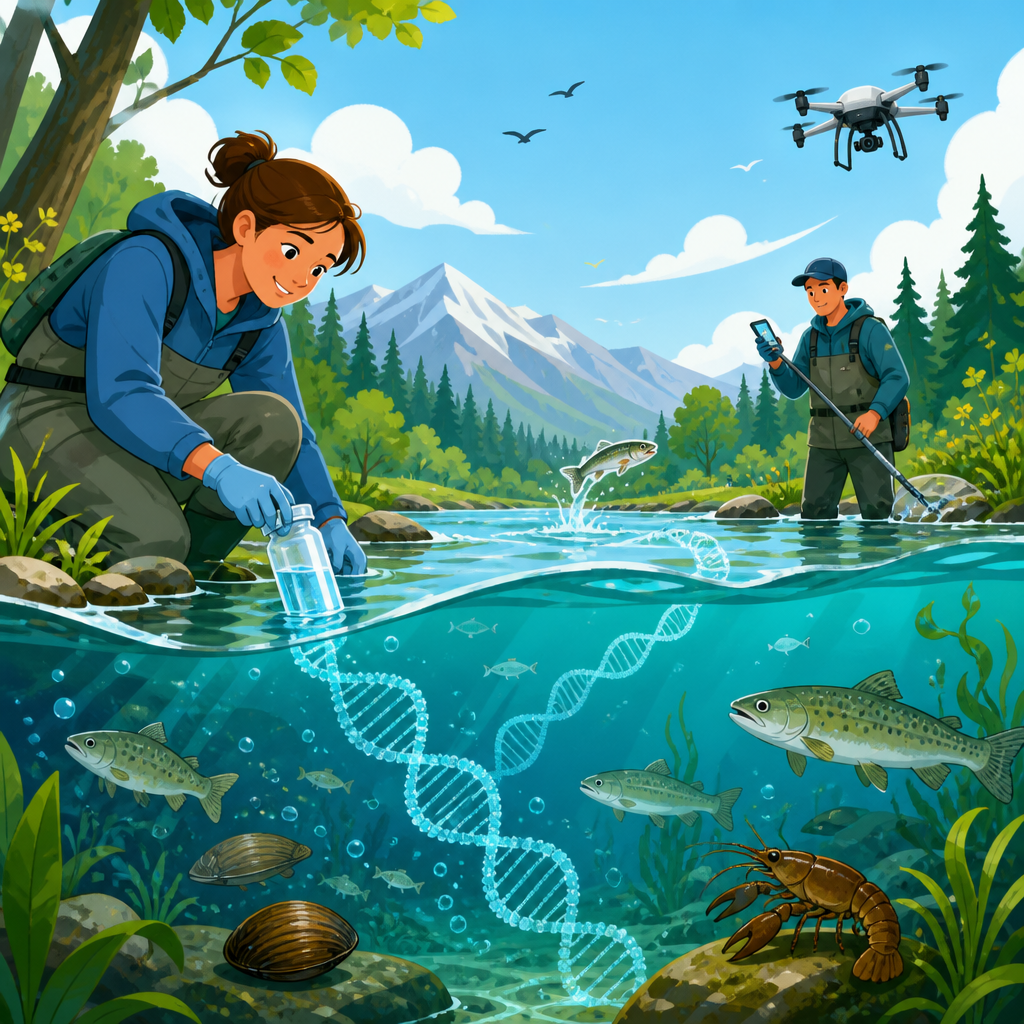
Environmental DNA, usually shortened to eDNA, is reshaping how scientists detect, map, and protect life across land and water. The term refers to genetic material that organisms leave behind in their environment through skin cells, mucus, scales, feces, pollen, spores, saliva, or decaying tissue. Instead of capturing a fish, trapping an amphibian, or visually identifying a rare plant, researchers can collect water, soil, sediment, snow, or even air samples and test them for traces of DNA. In biodiversity research, that simple shift changes the scale, speed, and sensitivity of ecological monitoring.
I have worked with field teams that spent days surveying wetlands with nets, call surveys, and camera traps, only to confirm in a few liters of filtered water what traditional methods missed. That practical contrast explains why eDNA matters. It can detect elusive, nocturnal, low-density, or early-stage invasive species before they are easily observed. It can also reduce disturbance to sensitive habitats, lower survey costs over time, and broaden monitoring to places where visual identification is difficult, such as turbid rivers, deep lakes, groundwater systems, and complex microbial communities.
eDNA is not one method but a family of approaches. Targeted assays, often based on quantitative PCR or digital PCR, search for one species at a time with highly specific primers and probes. Metabarcoding uses broadly conserved genetic markers, such as mitochondrial 12S, COI, or chloroplast regions, to identify many taxa from a single sample through high-throughput sequencing. Shotgun metagenomics goes further by sequencing all recoverable DNA, potentially revealing species presence, pathogens, population signals, and functional genes. Each approach answers different research questions, and each has different strengths, detection limits, and quality-control requirements.
The future of environmental DNA in biodiversity research matters because the central challenge in conservation is no longer simply describing nature; it is tracking change fast enough to respond. Climate-driven range shifts, habitat fragmentation, biological invasions, disease emergence, and rapid land-use change are all moving faster than many traditional survey programs. A hub article on research and discoveries therefore needs to connect methods, applications, standards, and likely next steps. eDNA now sits at the center of that conversation because it translates biological presence into scalable data that can feed species inventories, restoration monitoring, protected-area planning, fisheries management, and global biodiversity reporting.
How eDNA Works in Modern Biodiversity Research
At its core, an eDNA workflow follows a disciplined chain: sample collection, preservation, filtration or extraction, laboratory amplification or sequencing, bioinformatic processing, taxonomic assignment, and ecological interpretation. The science sounds straightforward, but reliable results depend on strict controls at every step. Field blanks test contamination during sampling. Extraction blanks check laboratory cleanliness. Positive controls verify that reagents and assays are functioning. Replicates measure detection consistency. Without those safeguards, especially in low-concentration samples, false positives and false negatives can quickly undermine conclusions.
Different environments influence DNA persistence and transport. In rivers, DNA can move downstream, meaning detection indicates upstream presence but not always exact location. In lakes, stratification, UV exposure, and microbial activity affect how long signals remain detectable. In soil, DNA may bind to particles and persist longer, complicating distinctions between recent and historical presence. Marine systems add dilution, currents, and depth effects. Airborne eDNA, an emerging area, introduces particle size, ventilation, and deposition as key variables. Good biodiversity interpretation therefore requires coupling molecular data with hydrology, geomorphology, and species ecology rather than treating DNA results as isolated facts.
The strongest current use case is presence detection. eDNA regularly outperforms conventional surveys for rare amphibians, invasive carp, freshwater mussels, and cryptic fish. For example, agencies in North America have used targeted assays to monitor invasive silver and bighead carp in waterways connected to the Great Lakes. In Europe and Japan, eDNA metabarcoding has transformed fish community assessments by recovering more taxa per sampling event than electrofishing in some settings. These outcomes do not make traditional methods obsolete, but they prove that molecular surveillance can become a first-line screening tool.
Major Research Discoveries and Why They Matter
The most important research discovery is that biodiversity can be measured from traces rather than direct encounters. That principle has opened entire categories of study. Scientists have reconstructed vertebrate communities from pond water, tracked seasonal migration through river samples, and identified endangered species in habitats where handling individuals would be risky or unlawful. Sedimentary ancient DNA has extended this logic into the past, helping reconstruct historical ecosystems and long-term community shifts. That matters because modern conservation increasingly relies on baselines, and many ecosystems lack complete historical observation records.
Another breakthrough is improved sensitivity at low abundance. In practical monitoring, early detection is the difference between manageable intervention and expensive crisis response. When invasive species are caught during establishment, eradication remains possible. When pathogens are identified before mass mortality, managers can impose biosecurity measures. eDNA has been explored for amphibian chytrid surveillance, salmonid parasite detection, and ballast-water monitoring. Its value lies in amplifying weak biological signals into actionable information before ecological damage becomes obvious.
A third discovery is that community-level inference is now feasible at operational scale. Metabarcoding studies can profile fishes, macroinvertebrates, plankton, fungi, and terrestrial vertebrates from shared landscapes, offering a more integrated picture of biodiversity than single-taxon surveys. This supports ecosystem-based management. A restoration project, for instance, should not be judged only by whether one flagship species returns. eDNA can show whether the broader food web is reassembling, whether invasive taxa are suppressed, and whether seasonal turnover resembles healthy reference sites.
| eDNA application | Typical method | Main benefit | Common limitation |
|---|---|---|---|
| Rare species detection | qPCR or digital PCR | High sensitivity for low-abundance targets | Requires validated species-specific assay |
| Whole community surveys | Metabarcoding | Many taxa from one sample | Primer bias and incomplete reference databases |
| Historical ecosystem reconstruction | Sedimentary ancient DNA | Extends biodiversity baselines into the past | DNA degradation and dating uncertainty |
| Pathogen and functional gene screening | Shotgun metagenomics | Broad biological context beyond species lists | Higher cost and heavier bioinformatics |
Where eDNA Is Headed Next
The future of environmental DNA in biodiversity research will be defined by integration, not isolation. The field is moving from simple yes-or-no detection toward abundance modeling, occupancy estimation, population assignment, and near-real-time monitoring. One major advance is the use of digital PCR, which partitions samples into thousands of microreactions and improves precision for low-copy targets. Another is nanopore sequencing, which brings portable sequencing closer to field deployment. Although error profiles and workflow constraints still require caution, faster turnaround could make eDNA useful for border inspections, emergency response, and adaptive management decisions made within hours rather than weeks.
Artificial intelligence will also shape the next phase, especially on the bioinformatics side. Taxonomic assignment depends on clean reference libraries and robust classification methods. Machine learning can help resolve ambiguous reads, flag contamination patterns, and connect molecular detections with environmental covariates such as temperature, flow, conductivity, or habitat structure. The output will not be meaningful unless the ecological model is sound, but as pipelines mature, biodiversity managers will move from raw sequence files to decision-ready dashboards far more efficiently than they do today.
Another frontier is multi-source sampling. Water is already mainstream, but soil eDNA is becoming central for plants, fungi, and invertebrates. Airborne eDNA has shown that vertebrate signals can be recovered from zoos, forests, and enclosed spaces, suggesting future applications in cave surveys, roost monitoring, and urban biodiversity assessment. Marine researchers are pairing eDNA with autonomous vehicles, moored samplers, and remote observatories. In time, continuous or repeated autonomous sampling networks could function like ecological weather stations, providing standardized biodiversity data streams across regions.
Limits, Standards, and the Need for Careful Interpretation
Despite its promise, eDNA is not magic, and the future of the field depends on honest treatment of limitations. Detection does not automatically equal live local occupancy. DNA can drift, persist after an organism leaves, or arrive through predators, sewage, runoff, boats, and gear. A positive result should be interpreted through site context, hydrology, and species behavior. Likewise, non-detection is not proof of absence. Poor sampling design, inhibitors, low shedding rates, warm temperatures, ultraviolet exposure, and laboratory failure can all suppress signals.
Standardization is therefore essential. The Minimum Information for Publication of Quantitative Real-Time PCR Experiments, commonly known as MIQE, remains a foundational benchmark for assay reporting. In sequencing workflows, researchers increasingly document primer sets, read thresholds, contamination controls, database versions, and filtering criteria so studies can be reproduced and compared. International Organization for Standardization efforts and agency protocols are gradually bringing consistency to collection, filtration, storage, and analytical reporting. This may sound procedural, but it determines whether eDNA becomes a trusted regulatory tool or remains a promising research niche.
Reference databases are another bottleneck. A sequence is only as useful as the library used to match it. Many fish and vertebrate groups are well represented, but invertebrates, fungi, tropical taxa, and regionally endemic species are still under-sampled. Misidentified voucher specimens can propagate errors. Closely related species may share markers that fail to resolve them cleanly. In practice, I have seen teams spend more effort validating reference sequences than running the laboratory assays themselves. That work is tedious, but it is what turns interesting molecular signals into defensible biodiversity evidence.
How eDNA Will Change Conservation Practice and Research Hubs
As this environmental science hub expands, eDNA belongs at the center because it links nearly every research and discovery theme under biodiversity. It connects invasive species surveillance, restoration ecology, freshwater science, marine monitoring, wildlife disease, landscape genomics, protected-area management, and climate adaptation. For conservation agencies, the biggest operational change will be triage. Instead of deploying labor-intensive surveys everywhere, teams can use eDNA to identify hotspots, confirm absences in lower-risk areas, and direct field crews where follow-up effort is most justified. That improves both efficiency and ecological coverage.
eDNA will also change how success is measured. A river restoration project can be evaluated through repeated molecular sampling before, during, and after intervention. A reintroduction program can test whether released animals are persisting undetected between sightings. Urban biodiversity planning can compare stormwater ponds, green roofs, and remnant woodlands using standardized protocols. Indigenous-led stewardship programs can pair local ecological knowledge with molecular tools to monitor culturally important species at broader scales while minimizing disturbance. The common thread is not replacement of expert observation, but sharper targeting of it.
The most likely future is hybrid monitoring. Camera traps, acoustic sensors, satellite imagery, occupancy models, and eDNA will increasingly be combined into a single evidence framework. That combination is powerful because each method compensates for the others. Camera traps show behavior and timing; eDNA reveals hidden presence; acoustics capture vocal species; remote sensing maps habitat change. Biodiversity research advances when these signals are interpreted together. If you are building an environmental science reading path on research and discoveries, start with eDNA, then explore monitoring design, genomic tools, invasive species case studies, and restoration outcomes to see where the next breakthroughs are emerging.
Environmental DNA has moved from experimental novelty to core biodiversity infrastructure. It offers faster detection, broader taxonomic reach, lower disturbance, and better coverage of elusive species than many conventional methods alone. Its future lies in better standards, stronger reference databases, portable sequencing, autonomous sampling, and integration with ecological models and complementary monitoring tools. Just as important, its value depends on disciplined sampling design, transparent reporting, and cautious interpretation of what a DNA signal truly means in place and time.
For researchers, policymakers, and conservation practitioners, the main benefit is clearer ecological insight at the speed modern environmental change demands. eDNA helps answer the practical questions that matter most: what is here, what is changing, what arrived early, what disappeared quietly, and where limited resources should go next. That makes it more than a laboratory technique. It is becoming a decision system for biodiversity research and management.
If you want to follow the most important research and discoveries in environmental science, use this hub as your starting point and continue into linked topics on invasive species monitoring, habitat restoration, wildlife disease, freshwater ecology, and conservation technology. The future of biodiversity research will be built on better data, and environmental DNA is one of the clearest paths to getting it.
Frequently Asked Questions
What is environmental DNA (eDNA), and why is it becoming so important in biodiversity research?
Environmental DNA, or eDNA, refers to genetic material that organisms shed into their surroundings through skin cells, mucus, scales, feces, saliva, spores, pollen, hair, and decaying tissue. Instead of needing to directly see, catch, or handle a species, researchers can analyze water, soil, sediment, snow, or even air samples to detect traces of life that were recently present in that environment. This shift is important because it expands how scientists study biodiversity, especially in places where traditional surveys are slow, expensive, invasive, or likely to miss rare and elusive organisms.
Its growing importance comes from the fact that eDNA can dramatically improve detection sensitivity. In many ecosystems, especially aquatic ones, a single sample may reveal fish, amphibians, invertebrates, microbes, and even terrestrial animals that interacted with the habitat. That makes eDNA a powerful tool for mapping species distributions, tracking invasive organisms, identifying endangered species, and monitoring ecosystem change over time. As sequencing technology becomes faster and more affordable, eDNA is moving from a specialized research method to a core part of conservation science, ecological monitoring, and biodiversity assessment.
How does eDNA sampling work in practice, and what kinds of species can it detect?
In practice, eDNA sampling starts with collecting material from the environment rather than from the organism itself. In lakes, rivers, wetlands, or oceans, researchers often collect water and filter it to capture microscopic genetic fragments. On land, they may gather soil, sediment, leaf litter, or snow. In some newer applications, scientists even sample air to detect birds, mammals, insects, and other organisms that leave trace biological particles behind. Once collected, the sample is preserved carefully to prevent contamination or DNA breakdown, and then taken to a laboratory for extraction and analysis.
There are several ways to analyze the DNA. If researchers are looking for one specific species, such as an invasive carp or a threatened amphibian, they may use targeted molecular tests like quantitative PCR. If they want a broader picture of the biological community, they may use metabarcoding, which sequences DNA from many organisms at once and compares it against reference databases. This allows a single sample to reveal a wide range of life forms, including fish, amphibians, mollusks, crustaceans, plants, fungi, and microorganisms. The exact species detected depends on the sample type, the quality of DNA in the environment, the lab methods used, and how complete the reference database is for that region and taxonomic group.
What are the biggest advantages of eDNA compared with traditional biodiversity surveys?
One of the biggest advantages of eDNA is that it is far less invasive than conventional field methods. Scientists do not always need to net fish, trap animals, disturb nests, or uproot plants to confirm a species is present. That is especially valuable when working with threatened, cryptic, or highly sensitive organisms. eDNA can also reduce risk to field teams in remote or hazardous environments by limiting the need for repeated direct observation efforts. In many cases, it can detect species that traditional surveys miss because those species are nocturnal, rare, secretive, or present only in low numbers.
Another major advantage is efficiency. A relatively small number of samples can cover large areas and provide a broad snapshot of biodiversity. That makes eDNA highly useful for early detection of invasive species, long-term monitoring of restoration projects, and rapid ecological assessments after disturbances such as floods, fires, pollution events, or habitat fragmentation. It can also improve standardization across monitoring programs because sampling protocols can be repeated consistently over time. As laboratory workflows and bioinformatics tools continue to improve, eDNA is helping researchers gather more information at lower cost and with greater sensitivity than many traditional approaches alone.
What are the main limitations and challenges scientists still face with eDNA?
Although eDNA is powerful, it is not a perfect substitute for all traditional survey methods. One of the main challenges is interpreting what a positive signal actually means. Detecting DNA does not always confirm that a living organism is currently present at that exact location. DNA can move through water, persist in sediment, or remain detectable for varying amounts of time depending on temperature, sunlight, pH, microbial activity, and other environmental conditions. That means researchers must be cautious when translating a detection into conclusions about abundance, breeding populations, or precise habitat use.
Another challenge is contamination and methodological bias. Because eDNA analysis is extremely sensitive, poor handling in the field or laboratory can introduce false positives. At the same time, false negatives can occur if sampling volume is too low, DNA is too degraded, or primers do not amplify certain species well. Results also depend heavily on reference databases; if the DNA sequence of a local organism is missing or mislabeled, identification may be incomplete or inaccurate. For these reasons, the future of eDNA research depends not only on better sequencing tools, but also on stronger sampling standards, validated workflows, robust bioinformatics, and close integration with conventional ecological knowledge.
What does the future of eDNA look like for conservation, ecosystem monitoring, and biodiversity policy?
The future of eDNA is exceptionally promising because the field is moving toward faster, more scalable, and more precise biodiversity monitoring. Researchers are developing portable sequencing platforms and automated sampling systems that could make near real-time environmental surveillance possible in rivers, coastlines, forests, and urban habitats. As methods improve, eDNA may play a larger role in detecting endangered species before populations collapse, identifying invasive organisms at the earliest stages of spread, and tracking how ecosystems respond to climate change, habitat restoration, and human development.
Just as important, eDNA is likely to influence conservation policy and management decisions. Because it can generate repeatable, high-resolution biodiversity data across large geographic areas, it offers a practical way to strengthen environmental impact assessments, protected area planning, and long-term monitoring programs. In the coming years, the most effective use of eDNA will probably come from combining it with field observations, remote sensing, acoustic monitoring, and ecological modeling rather than treating it as a standalone solution. In that integrated role, eDNA has the potential to transform how scientists, governments, and conservation organizations understand and protect life on Earth.