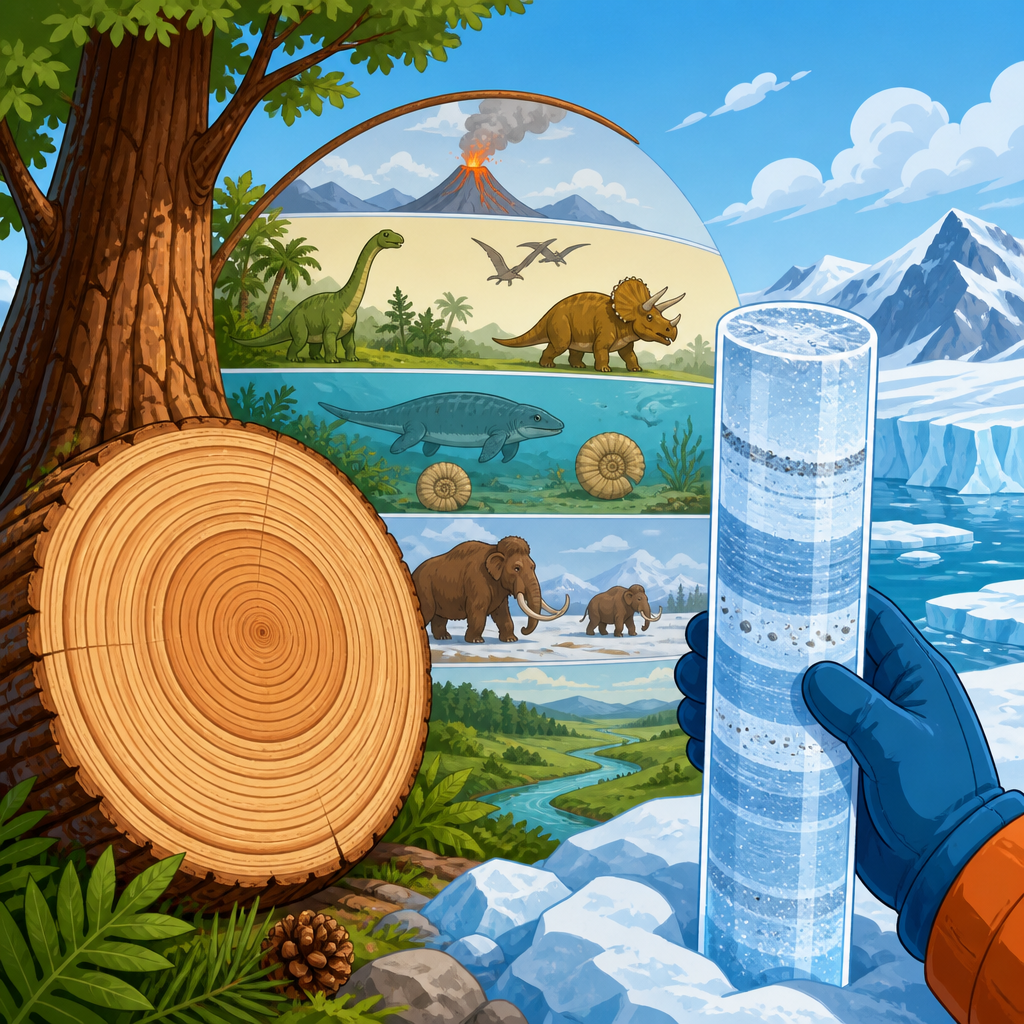
Tree rings and ice cores reveal Earth’s history by preserving annual, and sometimes even seasonal, records of climate, ecosystems, fires, volcanism, and human impact. In environmental science, these natural archives are central to research and discoveries because they extend observations far beyond modern weather stations and satellite measurements. When scientists study a tree trunk or drill a cylinder of ancient ice from Greenland or Antarctica, they are reading a layered timeline formed by biological growth and atmospheric deposition. That timeline helps answer practical questions: how unusual today’s warming is, how droughts unfolded before written records, when major eruptions darkened the sky, and how greenhouse gases changed through time.
The key terms are straightforward. Dendrochronology is the science of dating and interpreting annual growth rings in trees. Paleoclimatology is the reconstruction of past climates using evidence preserved in natural materials. Ice core analysis examines compacted snow layers that became glacier ice and trapped bubbles of ancient air, dust, ash, sea salt, and chemical isotopes. Both methods are proxy records, meaning they do not measure past temperature or rainfall directly in the way a modern thermometer or rain gauge does. Instead, they preserve physical and chemical signals that correlate with environmental conditions. Used carefully, those signals can reconstruct climate with remarkable precision.
This matters because instrumental climate records are short. In many regions, reliable thermometer observations begin in the late nineteenth or early twentieth century. Satellite records are shorter still. Yet environmental problems unfold over centuries to millennia. Water managers need to know how often severe megadroughts occurred before reservoirs existed. Fire ecologists need to understand whether current fire seasons exceed the natural range of variability. Climate researchers need long baselines to test models, identify tipping points, and compare recent changes with past events such as the Little Ice Age, the Medieval Climate Anomaly, or abrupt warming at the end of the last ice age.
I have worked with paleoclimate datasets in environmental reporting and research planning, and the most important lesson is that tree rings and ice cores are powerful precisely because they are different. Tree rings often deliver annual resolution, exact calendar dating, and strong local to regional signals for moisture or temperature. Ice cores often extend much farther back, preserve atmospheric chemistry directly, and connect regional climate to global processes such as volcanic forcing and greenhouse gas change. Together they form the backbone of research and discoveries across environmental science, linking forests, mountains, ice sheets, oceans, and the atmosphere into one interpretable Earth system record.
How tree rings record climate, disturbance, and ecological change
Tree rings form because trees in seasonal climates grow at different rates during the year. In temperate and boreal regions, rapid spring and early summer growth creates lighter, larger-celled earlywood, while slower late-season growth creates darker, denser latewood. One year usually produces one ring. Scientists extract narrow cores with an increment borer or examine cross sections from dead wood, then measure ring width, density, anatomy, and chemistry. The basic principle is simple: conditions that favor growth, such as adequate moisture or warm summers at cold sites, often produce wider rings, while stress can produce narrow rings. The interpretation, however, depends on species and location.
Crossdating makes tree-ring science unusually precise. Researchers match distinctive patterns of wide and narrow rings among many trees from the same area. If one tree has an extremely narrow ring caused by a severe drought, neighboring trees often show the same marker year. By matching those patterns, scientists assign every ring to an exact calendar year, detect missing rings, and eliminate many dating errors that affect other archives. This exact dating is why tree rings are used not only for climate reconstruction but also for dating archaeological timbers, historic buildings, and past disturbances such as fires, insect outbreaks, and landslides.
Different tree-ring variables answer different questions. Ring width often reflects water availability in dry environments, which is why bristlecone pine, Douglas-fir, and ponderosa pine have been widely used in drought studies across western North America. Maximum latewood density is especially useful in high-latitude or high-elevation settings where summer temperature limits growth; long density series from northern Europe have helped reconstruct past warm and cool intervals. Stable isotopes in cellulose, including carbon-13 and oxygen-18, can add further information about photosynthesis, humidity, and source water. Fire scars preserved in rings show not just that a fire occurred, but the exact year, and sometimes the season, when it burned.
One of the best-known discoveries from dendrochronology is the identification of multidecadal megadroughts. Research using tree rings has shown that western North America experienced droughts in the Medieval Climate Anomaly that were longer and, in some regions, more severe than twentieth-century dry periods. That finding matters for present-day water planning because infrastructure was built during an unusually wet slice of history. Tree rings have also revealed changing fire regimes: many dry forests historically burned frequently at low to moderate severity, but fire suppression altered those patterns, increasing fuel loads and the risk of larger high-severity fires. In short, tree rings turn living and dead wood into an annual environmental ledger.
How ice cores preserve ancient air, chemistry, and abrupt climate shifts
Ice cores come from places where snow survives summer melt and accumulates year after year, chiefly Greenland, Antarctica, and some high mountain glaciers. Fresh snow gradually compresses into firn and then into solid glacier ice. During that transition, pore spaces close off and trap tiny bubbles of ancient atmosphere. Layers also capture windblown dust, volcanic sulfate, sea salt, soot, pollen, and isotopic signatures linked to temperature. A deep core can preserve tens of thousands to hundreds of thousands of years of environmental history, making ice one of the most important archives for long-term climate research and discoveries.
The chemistry of an ice core is especially valuable because it preserves both local snowfall conditions and signals from the wider Earth system. Ratios of oxygen isotopes, commonly expressed as delta-18O, and hydrogen isotopes such as deuterium vary with temperature and moisture pathways, providing a proxy for past climate. Concentrations of carbon dioxide, methane, and nitrous oxide measured in air bubbles show how greenhouse gases changed through glacial and interglacial cycles. Sulfate spikes can mark volcanic eruptions, while dust layers reflect windiness, aridity, and source-region conditions. Black carbon can indicate biomass burning or industrial pollution. These measurements make ice cores a chemical archive, not just a frozen calendar.
Several landmark findings come directly from ice cores. Antarctic cores such as EPICA have shown that carbon dioxide and temperature rose and fell together across multiple ice age cycles, establishing the tight coupling between greenhouse gases and climate. Greenland cores from projects including GISP2 and NGRIP revealed abrupt climate shifts known as Dansgaard-Oeschger events, where regional temperatures changed dramatically over decades. That speed changed scientific understanding of climate stability. Ice cores also recorded volcanic episodes like the 1815 eruption of Tambora, which contributed to the “Year Without a Summer,” and they help synchronize climate events across continents when ash or sulfate appears in multiple archives.
Ice cores are not perfect everywhere. In areas with summer melting, layers can blur. Ice flow deep within an ice sheet can thin or distort the oldest layers. Gas ages and ice ages are not identical because air bubbles are trapped after snow has already aged in the firn column. Skilled teams account for those issues using firn densification models, layer counting, volcanic markers, and radiometric constraints. Despite those complexities, no other archive gives such direct evidence of ancient atmospheric composition. That is why ice core science has been foundational in confirming the scale of modern greenhouse gas increase relative to natural background variability.
How scientists build timelines and compare records
The strength of environmental science does not come from any single proxy; it comes from building coherent timelines across many datasets. Tree-ring chronologies are assembled by sampling multiple trees, standardizing growth trends related to age and size, and averaging the shared climate signal into a site chronology. Ice core chronologies are built through annual layer counting where possible, combined with volcanic horizons, known radionuclide markers, flow modeling, and gas synchronization techniques. In both fields, replication matters. If a result appears in one tree or one section of one core, it is suggestive. If it appears across many samples and aligns with independent evidence, it becomes robust.
Calibration is the bridge between proxy data and climate reconstruction. Scientists compare recent tree-ring or ice-core signals with overlapping instrumental records to quantify relationships with temperature, precipitation, snow accumulation, or atmospheric composition. They then test those relationships using verification statistics on withheld data. Common tools include regression, principal components analysis, and Bayesian approaches that estimate uncertainty explicitly. The final product is not a perfect replay of past weather; it is a statistically grounded reconstruction of likely conditions with confidence intervals. Good studies make those uncertainties visible rather than hiding them.
| Archive | Typical resolution | Main strengths | Common limitations |
|---|---|---|---|
| Tree rings | Annual, sometimes seasonal | Exact dating, strong local climate signal, disturbance history | Limited to lifespan of trees and preserved wood, site specific response |
| Ice cores | Annual to multi-year, deeper layers lower resolution | Ancient air, long duration, volcanic and chemical records | Remote sampling, layer thinning, melt and flow effects |
| Lake sediments | Annual to centennial | Regional ecosystem and erosion history | Dating can be less precise, mixing may occur |
| Corals | Seasonal to annual | Ocean temperature and salinity signals | Restricted geography, diagenesis risk |
Comparing records is where many of the most important discoveries emerge. A drought reconstructed from tree rings can be checked against lake levels, speleothems, and historical documents. A volcanic sulfate layer in an ice core can be matched with narrow frost-damaged rings in high-latitude trees, showing how an eruption affected growing seasons. Greenhouse gas rises measured in Antarctic ice can be compared with marine sediments and climate model simulations. This multi-proxy approach is the standard because each archive answers a different part of the same question. Agreement across methods strengthens causal interpretation and exposes regional differences that a single record might miss.
What these archives reveal about Earth’s history and today’s climate risks
Tree rings and ice cores have transformed understanding of Earth’s history in ways that directly inform current environmental decisions. First, they show that climate varies naturally across years, decades, and millennia, but they also show that current warming is unusual in timing, rate, and global coherence. Tree-ring reconstructions across continents identify long drought histories and temperature variability before industry. Ice cores show that present carbon dioxide concentrations are far above the range seen in ice-core records covering hundreds of thousands of years. Together, those findings separate natural variability from modern human-driven change without denying that both exist.
Second, these archives reveal how climate extremes affect ecosystems and societies. Tree rings document crop-stressing drought, repeated insect defoliation, post-fire recovery, and forest growth declines under heat and moisture stress. In the American Southwest, long reconstructions have helped explain why water scarcity is not an anomaly but a recurring feature intensified today by warming. Ice cores record dust increases linked to aridity and stronger winds, and they preserve pollution histories from lead, sulfate, and black carbon that track mining, coal burning, and industrial growth. Those records connect environmental change to human activity in measurable, dateable ways.
Third, natural archives sharpen climate models. Modelers test whether simulations reproduce past cooling after major eruptions, past drought persistence, or abrupt transitions seen in Greenland ice. If a model cannot capture known past behavior, confidence in future projections should be lower. If it performs well against reconstructed history, it earns credibility. This is one reason paleoclimate evidence is regularly assessed by institutions such as the Intergovernmental Panel on Climate Change. Past climates are not academic curiosities; they are validation cases for forecasting sea-level rise, hydroclimate shifts, wildfire risk, and ecosystem resilience under continued warming.
The practical benefit for readers exploring research and discoveries within environmental science is clear. Tree rings provide annual, exactly dated records of forest response, drought, temperature, and fire. Ice cores provide long, chemically rich records of atmospheric composition, volcanic events, and abrupt climate change. Together they let scientists reconstruct Earth’s history with enough detail to test ideas, challenge assumptions, and improve decisions. If you want a strong foundation for the wider environmental science topic, start with these archives, then follow related work on sediments, corals, glaciers, and climate models to see how the full evidence base fits together.
Frequently Asked Questions
How do tree rings and ice cores act like natural archives of Earth’s history?
Tree rings and ice cores are considered natural archives because they build up in layers over time, with each layer preserving information about the environmental conditions present when it formed. In trees, a new growth ring usually forms each year. The width, density, and chemical makeup of that ring can reflect temperature, rainfall, drought stress, wildfire damage, insect outbreaks, and even changes caused by nearby human activity. In ice sheets and glaciers, snow falls year after year, compressing into ice and trapping tiny bubbles of ancient air, dust, ash, sea salts, and other particles. Those layers can often be counted much like pages in a history book.
What makes these records especially valuable is that they often preserve annual, and sometimes seasonal, detail. That level of resolution allows scientists to reconstruct past climates with impressive precision. Instead of relying only on modern weather stations, which cover a relatively short period, researchers can use tree rings to look back hundreds to thousands of years and use deep ice cores to examine climate conditions stretching back hundreds of thousands of years. Together, these archives help scientists understand long-term patterns in temperature, precipitation, atmospheric composition, ecosystem change, volcanism, and human influence.
What can scientists learn from tree rings specifically?
Tree rings offer a surprisingly rich record of environmental history. The most familiar clue is ring width: wider rings often indicate favorable growing conditions, such as adequate moisture and suitable temperatures, while narrow rings may point to drought, cold, poor soil conditions, or other forms of stress. But scientists do not stop at width alone. They also study ring density, wood anatomy, scars left by fires, and the isotopic composition of the wood to uncover details about past climate and ecological events.
For example, dendrochronologists, scientists who study tree rings, can identify years of severe drought, periods of abundant rainfall, insect infestations, wildfire frequency, and shifts in growing seasons. In some regions, tree-ring records have been used to reconstruct river flow, monsoon variability, and long-term climate cycles such as El Niño influences. Trees can also preserve evidence of human impact. Logging, land-use change, pollution, and altered fire regimes may all leave detectable signatures in ring patterns. Because tree-ring dating can often be matched year by year with exact calendar dates, it is one of the most precise tools available for reconstructing recent environmental history.
Why are ice cores so important for understanding ancient climate change?
Ice cores are among the most powerful tools in climate science because they preserve direct and indirect evidence of past atmospheric and environmental conditions over immense spans of time. As snow accumulates in places like Greenland and Antarctica, it gradually compresses into layered ice. During this process, tiny air bubbles become sealed inside. Those bubbles are extraordinarily important because they contain samples of ancient atmospheres, allowing scientists to measure past concentrations of greenhouse gases such as carbon dioxide, methane, and nitrous oxide.
Beyond trapped gases, ice cores also contain dust, volcanic ash, soot, pollen, sea-salt particles, and isotopic signals related to temperature. By analyzing these materials, scientists can reconstruct glacial and interglacial cycles, detect major volcanic eruptions, track shifts in wind patterns, and study how the atmosphere and oceans responded to natural climate changes. Some ice cores extend back more than 800,000 years, offering a long-term perspective that no human record can provide. This is crucial for understanding how unusual current climate change is, how greenhouse gases have influenced global temperatures in the past, and how Earth’s climate system behaves over long timescales.
How do researchers determine the age of tree rings and ice core layers?
Dating is one of the reasons these natural archives are so scientifically valuable. In trees, researchers typically use a method called crossdating. They compare patterns of wide and narrow rings across many trees from the same region. Because unusual climate events affect multiple trees at the same time, those ring patterns can be matched like overlapping barcodes. This allows scientists to assign exact calendar years to each ring and to extend records further back by linking living trees with older dead wood preserved in buildings, sediments, or dry environments.
Ice core dating is more complex but still highly reliable when multiple methods are combined. Scientists may count visible annual layers in younger sections, much like counting tree rings. They also analyze seasonal changes in chemistry, dust, and isotopes that repeat year by year. For deeper, older ice where layers become compressed, researchers use known volcanic ash horizons, chemical markers, flow models, and comparisons with other dated climate records. In both tree-ring and ice-core research, accuracy improves when several independent dating methods agree. That careful layering of evidence is what allows scientists to build robust timelines of past environmental change.
How do tree rings and ice cores help scientists understand modern environmental problems?
Tree rings and ice cores are essential for putting today’s environmental changes into historical context. Modern instruments have recorded weather and atmospheric conditions for only a small fraction of Earth’s history. Without longer records, it would be difficult to know whether a heat wave, drought trend, wildfire pattern, or rise in greenhouse gases is part of a natural cycle or something more unusual. These natural archives provide the baseline scientists need to make that comparison.
For instance, tree-ring studies have revealed “megadroughts” in the past and helped researchers compare them with recent drought events intensified by warming temperatures. Ice cores show how atmospheric carbon dioxide and methane levels changed naturally over many thousands of years, making it possible to see just how rapid and exceptional modern increases are. They also document the climatic effects of volcanic eruptions, industrial pollution, and large-scale biomass burning. In practical terms, this information improves climate models, strengthens predictions about future change, and helps governments, communities, and resource managers plan for water shortages, ecosystem stress, wildfire risk, and other environmental challenges. In short, tree rings and ice cores do not just tell us about the past; they help society respond more intelligently to the present and prepare for the future.