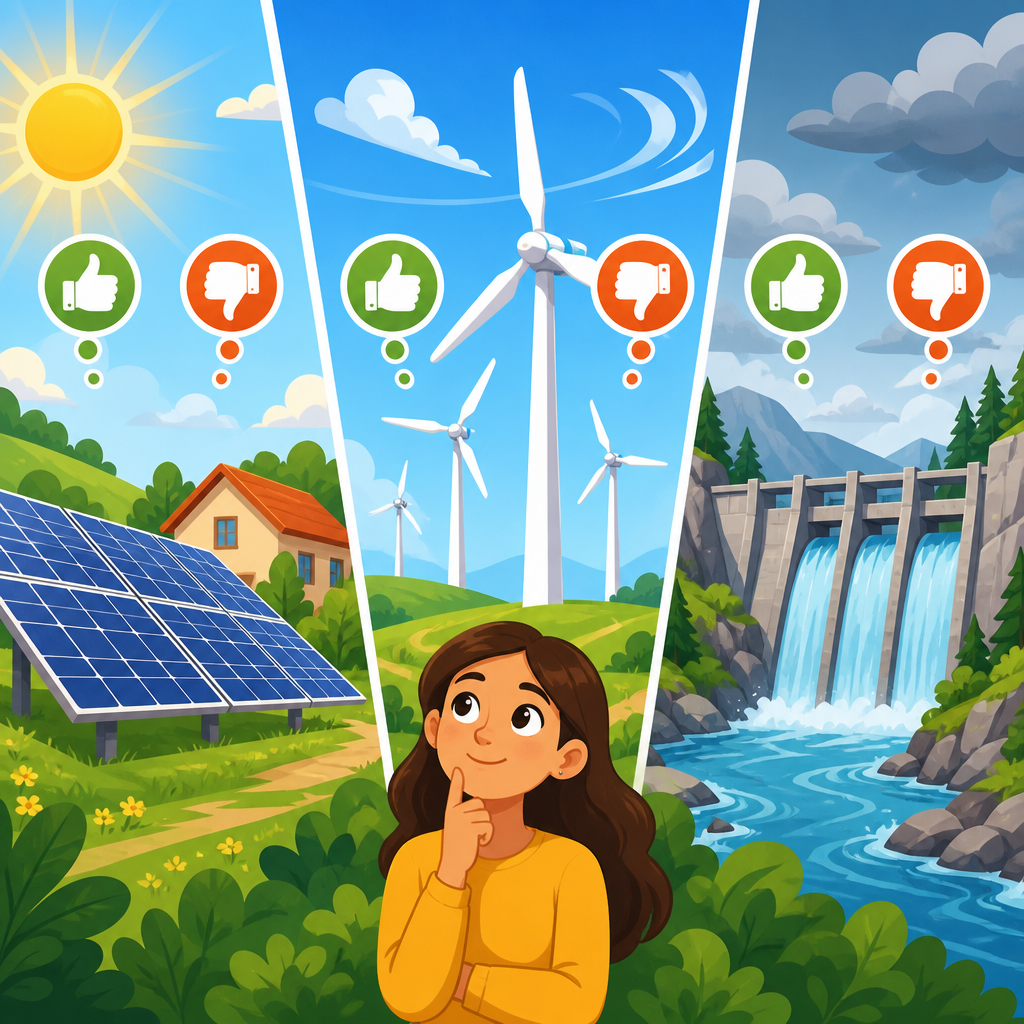
Renewable energy is central to any serious discussion of environmental science because it sits at the intersection of resource use, climate policy, land management, and economic development. In this hub article, I will compare the pros and cons of solar, wind, and hydropower while placing them within the broader context of renewable vs. nonrenewable resources. A renewable resource is replenished on a human timescale through ongoing natural processes, such as sunlight, moving air, flowing water, biomass growth, and geothermal heat. A nonrenewable resource is finite on practical timescales because it forms far more slowly than people consume it; coal, oil, natural gas, and uranium fit that definition, even though some remain abundant in absolute terms.
The distinction matters because energy systems shape emissions, public health, electricity prices, water use, and geopolitical risk. Burning fossil fuels releases carbon dioxide, methane, sulfur dioxide, nitrogen oxides, and particulates, with well-documented effects on climate and respiratory disease. By contrast, renewable technologies generate electricity with much lower operational emissions, but they are not impact free. They require land, materials, transmission lines, and careful siting. Hydropower can alter river ecosystems. Wind turbines can affect birds and bats. Solar farms can compete with habitat or agriculture unless designed thoughtfully. In other words, the renewable vs. nonrenewable question is not simply about good versus bad resources; it is about choosing systems with lower long-term environmental costs and managing their tradeoffs competently.
From years of reviewing project proposals and utility resource plans, I have seen the same pattern repeatedly: the best energy decisions compare full life cycles, not just fuel labels. A coal plant may appear compact at the smokestack, yet its impacts extend to mining, rail transport, ash disposal, and cumulative emissions. A solar array may seem land intensive, but its operating footprint, water demand, and emissions profile are usually far lower over decades of service. That is why this article treats solar, wind, and hydropower as the core renewable electricity options while also explaining how they differ from nonrenewable energy sources in reliability, cost structure, scalability, and environmental burden.
This page is designed as a hub for the wider subtopic. If you are comparing renewable vs. nonrenewable resources for a class, policy brief, or business case, the essential questions are straightforward. Which resources replenish naturally? Which emit greenhouse gases during use? Which depend on weather or water cycles? Which require storage or backup generation? Which create the least damage per unit of energy delivered? The sections below answer those questions directly and then break down the distinct strengths and limitations of solar, wind, and hydropower in plain terms, using the standards and terminology used by utilities, engineers, and environmental scientists.
Renewable vs. Nonrenewable Resources: The Core Differences
The simplest definition is this: renewable resources regenerate continuously enough to support repeated use without being exhausted by normal human consumption, while nonrenewable resources are depleted as they are extracted and burned or otherwise consumed. In energy planning, that difference affects fuel security, price volatility, and environmental externalities. Sunlight, wind, and river flow are not purchased as fuels, so their operating costs are relatively stable once infrastructure is built. Coal and gas plants, by contrast, depend on continuous fuel supply chains and are exposed to commodity price swings, transport constraints, and geopolitical disruption.
Environmental performance is another major dividing line. Life-cycle assessments published by organizations such as the Intergovernmental Panel on Climate Change consistently show that wind, solar, and hydropower have much lower greenhouse gas emissions per kilowatt-hour than coal and natural gas. The exact values vary by technology design, location, and supply chain, but the order of magnitude difference is clear. A modern coal plant emits far more carbon dioxide during operation than a solar or wind installation emits over its entire life cycle. That fact is why power-sector decarbonization plans prioritize renewable deployment even when other low-carbon options, including nuclear power, remain part of the conversation.
However, renewability does not automatically mean sustainability in every context. A river can be renewable, yet a poorly designed dam can still degrade fisheries, trap sediment, displace communities, and change downstream temperature regimes. Likewise, nonrenewable does not always mean immediately unavailable or uniquely harmful in every metric. Natural gas plants, for example, can ramp output quickly and help balance variable generation, though methane leakage and carbon emissions remain serious drawbacks. Sound analysis compares resources across multiple criteria: emissions, reliability, water demand, land use, biodiversity effects, cost, and system integration.
Solar Power: Advantages, Limitations, and Best Uses
Solar power converts sunlight into electricity, most commonly through photovoltaic panels. Its greatest advantage is abundance. In many regions, the solar resource arriving on rooftops, parking canopies, brownfields, and open land vastly exceeds local electricity demand. Solar is modular, which means it can scale from a small residential installation to a utility-scale plant supplying hundreds of megawatts. That flexibility is one reason solar deployment has accelerated worldwide. In practical terms, I have seen schools cut summer peak demand with rooftop systems, warehouses use solar carports to offset daytime loads, and utilities pair large solar arrays with batteries to reduce dependence on expensive peaking plants.
Solar also has strong environmental benefits during operation. It produces no direct air pollution, uses relatively little water compared with thermoelectric power plants, and creates very low operating noise. Costs have dropped sharply over the last decade due to manufacturing scale, improved module efficiency, better inverters, and more competitive installation markets. For many customers, the economic case now depends less on technology novelty and more on tariff design, interconnection rules, and financing terms. Net metering, power purchase agreements, and investment tax incentives have all played major roles in adoption.
The main limitation is intermittency. Solar output falls with clouds and goes to zero at night, so it does not match demand perfectly without storage, demand response, or complementary generation. Capacity factor, a standard metric in power engineering, is lower for solar than for dispatchable fossil plants because panels operate only when sunlight is available. Land use is another concern for utility-scale projects, though agrivoltaics, dual-use grazing, and siting on disturbed land can reduce conflict. There are also supply chain questions involving polysilicon, aluminum, glass, silver, and end-of-life recycling. These issues are manageable, but they are real and should be addressed early in project planning rather than after permitting disputes begin.
Wind Power: Advantages, Limitations, and Best Uses
Wind power uses turbines to convert the kinetic energy of moving air into electricity. Onshore wind is often among the lowest-cost sources of new electricity generation, especially in regions with strong, consistent wind regimes such as the Great Plains, parts of northern Europe, and certain coastal corridors. Offshore wind expands the resource base further because ocean winds are typically stronger and steadier than land winds. In grid planning, wind is valuable because its production profile often complements solar; in many systems, wind output is stronger overnight or during seasons when solar production is lower.
Operational emissions from wind are very low, and turbines consume almost no water to generate electricity. The land beneath many onshore wind farms remains usable for farming or grazing, which is a significant advantage over some other utility-scale developments. I have visited rural projects where turbine lease payments provided farmers with stable income that buffered bad crop years. That kind of local economic diversification is often overlooked in high-level debates, yet it can determine whether communities view renewable energy as an external imposition or a practical asset.
Wind power has tradeoffs that require serious attention. Output varies with weather and can drop unexpectedly, so transmission planning, regional grid interconnection, and balancing resources are essential. Turbine siting can raise concerns about visual impact, shadow flicker, noise, and wildlife mortality, particularly for birds and bats. The scale of those effects depends heavily on location and mitigation measures. Modern siting uses radar studies, migration mapping, curtailment during peak activity periods, and turbine placement rules to reduce collisions. Offshore wind also faces higher installation and maintenance costs, complex marine permitting, and possible conflicts with fisheries, navigation, and coastal viewsheds. Wind is highly effective, but it works best when integrated into a broader system rather than treated as a standalone replacement for every conventional plant.
Hydropower: Advantages, Limitations, and Best Uses
Hydropower generates electricity from flowing or falling water, usually through dams and turbines, though run-of-river systems use less storage. Its biggest strength is controllability. Unlike solar and wind, many hydropower facilities can ramp output quickly, provide peaking power, offer frequency regulation, and support grid stability. Reservoir-based hydro can also store energy indirectly by holding water until demand rises. In countries with large hydro fleets, this dispatchability makes hydropower a backbone resource that helps integrate variable renewables. Pumped-storage hydropower extends that role by moving water uphill when electricity is abundant and releasing it later, effectively acting as grid-scale storage.
Hydropower’s low operational emissions and long asset life are significant benefits. Some dams have produced electricity for generations, making them durable infrastructure investments. Existing facilities can often be upgraded with more efficient turbines, better controls, or improved fish passage without building entirely new projects. From a system perspective, hydro’s ability to provide inertia, voltage support, black start capability, and flexible output is exceptionally valuable. Those attributes are technical, but they matter because a reliable grid needs more than annual energy production; it needs minute-by-minute stability.
The disadvantages are substantial and site specific. Large dams can inundate habitats, block fish migration, alter sediment transport, and displace communities. In warm climates, some reservoirs emit methane from decomposing organic matter, which complicates simple claims about zero emissions. Drought and changing snowpack can also reduce generation, as seen in hydro-dependent regions during prolonged dry periods. New dam construction often faces legal, ecological, and social opposition for good reason. In my experience, the strongest hydropower strategies today focus less on building massive new dams and more on modernizing existing assets, adding generation to nonpowered dams, improving environmental performance, and using pumped storage where geography and permitting conditions support it.
Comparing Solar, Wind, and Hydropower in Real Energy Systems
No single renewable source solves every energy challenge, which is why modern power systems combine technologies. Solar excels at daytime production and distributed generation. Wind performs well at utility scale and often complements solar temporally. Hydropower provides dispatchable capacity and balancing services. Together, they can reduce fuel consumption from nonrenewable sources while improving resilience. Grid operators think in terms of resource adequacy, load curves, transmission constraints, ancillary services, and seasonal variability, not just headline generation totals.
| Resource | Main Strength | Main Limitation | Best System Role |
|---|---|---|---|
| Solar | Modular, abundant, low operating cost | Nighttime and weather dependence | Daytime generation, rooftops, paired storage |
| Wind | Low-cost bulk power in strong wind regions | Variable output, siting conflicts | Utility-scale generation, seasonal diversity |
| Hydropower | Dispatchable output and grid services | Ecosystem disruption, drought exposure | Balancing, peaking, storage, reliability support |
When compared with nonrenewable resources, the key advantage of this mix is reduced dependence on mined or drilled fuels. That lowers operational emissions and limits exposure to fuel price volatility. The key challenge is integration. High renewable penetration usually requires transmission expansion, better forecasting, energy storage, flexible demand, and market rules that reward fast-ramping and reliability services. California’s duck curve is a well-known example: midday solar can push net demand down sharply, then evening demand ramps up as solar fades. Batteries, demand response, regional power trading, and hydro flexibility are all practical responses.
For students and decision-makers, the most accurate conclusion is not that renewables are impact free, but that they generally deliver far lower long-term environmental damage per unit of electricity than fossil fuels when planned responsibly. The best projects are sited carefully, connected to strong grids, and paired with conservation and efficiency measures. The best policies support cleaner generation while also protecting rivers, wildlife, and communities.
Conclusion
Solar, wind, and hydropower each play a distinct role in the shift from nonrenewable to renewable resources. Solar offers scalable, low-emission electricity where sunlight is available. Wind provides cost-effective bulk power and complements solar in many regions. Hydropower adds controllability, storage potential, and critical grid services. Their limitations are real: solar and wind are variable, and hydropower can impose serious ecological costs. Yet compared with coal, oil, and natural gas, these renewable resources usually provide a far better long-term path for climate stability, air quality, and energy security.
The broader lesson in environmental science is that renewable vs. nonrenewable resources should be evaluated through full-system thinking. Ask how a resource is replenished, what emissions it causes, how much land and water it uses, what habitats it affects, and how reliably it serves people over time. That approach leads to better answers than simple labels. If you are building out this subtopic, use this hub as your starting point, then explore deeper questions around energy storage, grid modernization, life-cycle analysis, and conservation to understand how cleaner energy systems actually work in practice.
Frequently Asked Questions
What makes solar, wind, and hydropower renewable, and how are they different from nonrenewable energy sources?
Solar, wind, and hydropower are considered renewable because they rely on natural processes that are continuously replenished on a human timescale. Solar energy comes from sunlight, wind energy comes from atmospheric movement driven largely by uneven heating of the Earth’s surface, and hydropower depends on the water cycle, including precipitation and flowing rivers. Unlike coal, oil, and natural gas, these resources are not extracted from finite underground reserves that take millions of years to form. That distinction is central to environmental science because renewable resources can, in principle, provide ongoing energy without being permanently depleted by use.
That said, renewable does not automatically mean impact-free. Solar farms require land, materials, and manufacturing inputs. Wind turbines need steel, concrete, transmission access, and careful siting to reduce ecological disruption. Hydropower can dramatically alter river ecosystems, fish migration, and sediment flow. In contrast, nonrenewable sources often offer high energy density and dispatchable power but generally come with major drawbacks such as greenhouse gas emissions, air pollution, habitat destruction from extraction, and long-term resource depletion. The real advantage of renewables is that they can reduce dependence on fuels that are both finite and climate-intensive, especially when paired with good planning, grid upgrades, and storage technologies.
What are the main advantages and disadvantages of solar power?
Solar power’s biggest advantage is its versatility. It can be deployed at many scales, from small rooftop systems on homes and schools to large utility-scale solar farms that supply electricity to entire regions. It produces electricity without direct air pollution during operation, uses no fuel once installed, and can lower long-term energy costs in sunny areas. Solar is also especially attractive because it can be distributed close to where electricity is used, which may reduce transmission losses and increase energy resilience. In many markets, solar has become one of the lowest-cost sources of new electricity generation, making it both an environmental and economic option.
Its limitations are mostly tied to variability and space requirements. Solar generation depends on daylight and is affected by weather, season, latitude, and cloud cover. It does not produce at night, and output can fluctuate throughout the day, which means storage, demand management, or backup generation is often needed to maintain grid reliability. Large-scale solar development can also compete with other land uses if not carefully sited, though rooftop and brownfield installations can reduce that concern. There are also environmental considerations associated with panel manufacturing, mining of raw materials, and end-of-life disposal or recycling. So while solar is a major part of a low-carbon energy future, it works best when integrated into a broader, well-managed energy system rather than treated as a standalone solution.
How does wind power compare to solar and hydropower in terms of benefits and challenges?
Wind power is one of the most efficient and cost-effective renewable technologies in areas with strong, consistent wind resources. It generates electricity without combustion, has relatively low operating costs after installation, and can be deployed both onshore and offshore. In some regions, wind complements solar well because wind speeds may be stronger at night or during seasons when solar production is lower. This makes wind a valuable tool for diversifying renewable energy portfolios and smoothing total power output across the grid.
The drawbacks of wind power usually center on variability, location, and local impacts. Wind resources are not evenly distributed, so the best sites may be far from cities and industrial demand centers, requiring new transmission infrastructure. Turbines can also raise concerns about visual change, noise, shadow flicker, and wildlife impacts, especially for birds and bats, although careful siting and improved technology can reduce these effects. Compared with hydropower, wind generally has a smaller impact on aquatic ecosystems and no need for river impoundment, but it lacks hydropower’s ability in some cases to provide more controllable generation. Compared with solar, wind often requires fewer panels or surface installations for equivalent output, but turbine placement can be more controversial in densely populated or scenic areas. Overall, wind is highly valuable, but like solar, it is most effective as part of a diversified system supported by forecasting, storage, and grid coordination.
What are the pros and cons of hydropower, and why is it often debated in environmental science?
Hydropower is often praised because it can produce large amounts of electricity with very low direct carbon emissions during operation, and in many cases it can provide more reliable and controllable output than solar or wind. Reservoir-based hydropower can help balance grids by adjusting generation in response to demand, which is especially useful when integrating intermittent renewable sources. Some facilities also contribute to water storage, flood control, irrigation, and recreation, depending on how they are designed and managed. Because of this flexibility, hydropower has historically played a major role in electricity systems around the world.
At the same time, hydropower is one of the most environmentally contested renewable resources. Dams can flood large land areas, displace communities, alter river temperature and flow patterns, interrupt fish migration, and trap sediments that downstream ecosystems rely on. These changes can reshape entire watersheds. In some tropical reservoirs, decomposing organic matter can also release methane, which complicates the assumption that all hydropower is uniformly low-impact. Hydropower’s performance may also become less predictable under climate change if drought, shifting snowpack, or altered rainfall patterns reduce water availability. For these reasons, hydropower occupies a complicated position in environmental science: it is renewable and often low-carbon, but its ecological and social consequences can be substantial if projects are poorly planned or located in sensitive river systems.
Which renewable energy source is best overall: solar, wind, or hydropower?
There is no universal “best” option, because the strongest choice depends on geography, climate, existing infrastructure, ecological sensitivity, and energy demand patterns. Solar may be the best fit in regions with high sunlight, available rooftops, and a need for scalable distributed generation. Wind may be superior in coastal plains, offshore zones, or open inland areas with reliable wind speeds. Hydropower may be especially valuable where suitable river systems already support infrastructure and where grid operators need flexible generation to complement variable renewables. Each technology performs differently depending on local conditions, so good energy planning is less about picking a single winner and more about matching the right resource to the right place.
From a systems perspective, the best answer is usually a mix. Solar, wind, and hydropower often complement one another in ways that improve reliability and reduce environmental tradeoffs when compared with heavy dependence on fossil fuels. A diversified energy portfolio can lower emissions, improve energy security, stabilize long-term costs, and reduce vulnerability to any one resource’s weaknesses. The most responsible approach also considers land use, water impacts, biodiversity, community consent, and lifecycle emissions rather than looking only at electricity output. In other words, the most effective renewable strategy is not simply the cheapest or the most abundant technology, but the combination that delivers dependable energy while minimizing environmental and social harm over time.