Ecological succession is the gradual, predictable process through which ecosystems change in species composition, structure, and function over time. In environmental science, it explains how bare rock can become forest, how a burned landscape can recover, and why abandoned farmland does not remain a field forever. When people ask, “What is ecological succession?” they usually mean two related questions: how communities develop after disturbance, and what separates primary succession from secondary succession. The short answer is that primary succession begins where no soil exists, while secondary succession begins where a biological community has been disrupted but soil remains.
That definition matters because succession sits at the center of ecology and ecosystems. It connects organismal ecology, population dynamics, community ecology, nutrient cycling, disturbance regimes, habitat restoration, conservation biology, and climate adaptation. In practice, I have seen succession shape everything from post-fire management plans to wetland mitigation sites. If you cannot explain who arrives first, how soils develop, and what limits later species, you miss the logic behind ecosystem recovery.
Ecology is the study of relationships between organisms and their environment. An ecosystem includes living organisms, physical conditions, energy flow, and nutrient movement. Succession describes how those relationships reorganize through time. Early communities alter light, moisture, temperature, and soil chemistry, making conditions suitable for later species. Those later species can outcompete the pioneers, creating a sequence often called a sere. The sequence is not random. It is shaped by climate, topography, disturbance frequency, seed sources, hydrology, and the traits of species present in the regional pool.
Understanding succession also improves real decisions. Foresters use it to predict stand development after harvest. Restoration ecologists use it to choose nurse plants, manage invasive species, and rebuild soil structure. Urban planners use it when converting brownfields or stormwater basins into habitat. Farmers and range managers recognize it in old-field transitions and grazing recovery. Even public health can intersect with succession, because changing vegetation can affect wildfire behavior, flood control, allergens, and vector habitat.
For a hub page on ecology and ecosystems, succession is one of the best organizing concepts because it brings together food webs, biodiversity, resilience, ecosystem services, and human disturbance. Once you understand primary and secondary succession, other topics become easier: why pioneer species matter, how keystone interactions shift over decades, why invasive species can redirect recovery, and why ecosystems rarely return to a simplistic “balance of nature.”
How ecological succession works in ecosystems
Ecological succession works through a series of ecological filters and feedbacks. A disturbance or newly exposed surface creates open space. Species then arrive by dispersal: windblown spores, animal-carried seeds, dormant seed banks, resprouting roots, or surviving microbes. Whether they establish depends on abiotic conditions such as moisture, nutrient availability, pH, salinity, temperature extremes, and substrate stability. The earliest successful organisms are called pioneer species. They are usually stress tolerant, fast growing, and effective colonizers.
Once pioneers establish, they modify the environment. Lichens secrete acids that help weather rock. Mosses trap dust and organic matter. Grasses stabilize sediment with roots. Nitrogen-fixing plants such as alders or lupines enrich nutrient-poor sites. Shade from shrubs lowers soil temperature and reduces evaporation. Leaf litter increases organic matter, water-holding capacity, and microbial activity. These changes can facilitate establishment of later species, a mechanism formalized in the facilitation model proposed by Frederic Clements and later refined by many community ecologists.
Succession does not always proceed by facilitation alone. In some cases, early species inhibit later arrivals by monopolizing light or nutrients. In others, any species able to tolerate current conditions may establish, known as the tolerance model. Real ecosystems often show all three patterns at different times. On a recovering sand dune, beach grasses may facilitate soil stabilization, shrubs may later inhibit tree seedlings through competition, and some late-successional trees may establish only because they tolerate low-light understories.
The endpoint of succession is often described as a climax community, but modern ecology uses that term cautiously. Landscapes are not static. Fire, storms, floods, insect outbreaks, and human land use create shifting mosaics. Instead of one permanent endpoint, ecologists usually expect dynamic states influenced by disturbance regime and climate. A mature oak-hickory forest, peat bog, salt marsh, or coral reef can persist for long periods, yet each remains subject to change if conditions shift.
Primary succession: ecosystem development from bare substrate
Primary succession begins on surfaces where no true soil exists and often where no previous terrestrial biological community was present. Classic examples include lava flows, volcanic ash deposits, land exposed after glacial retreat, newly formed sand dunes, and fresh rock left by landslides. Because soil is absent, primary succession is slower and more constrained than secondary succession. The first challenge is not competition. It is survival on a harsh substrate with limited water retention, minimal nutrients, and severe temperature fluctuations.
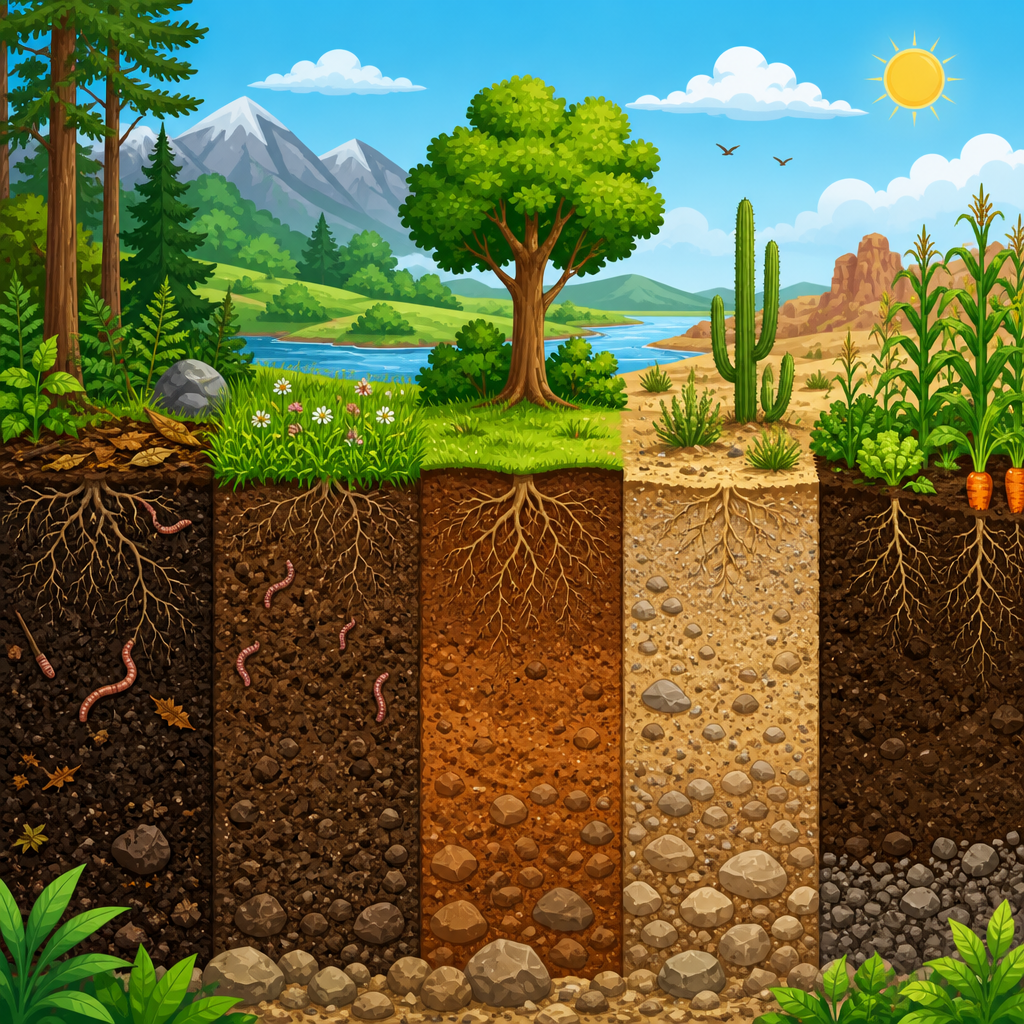
Pioneer organisms in primary succession are typically microbes, cyanobacteria, lichens, and mosses. Their importance is disproportionate to their size. Lichens can tolerate desiccation, adhere to rock, and contribute to chemical weathering. Mosses trap particulate matter and retain moisture. Microbial biofilms begin nutrient cycling long before vascular plants become common. As these organisms die and decompose, they add organic material. Combined with fragments of weathered rock, that material slowly forms the first thin soil horizons.
A well-known real-world example comes from Glacier Bay in Alaska, where retreating glaciers have exposed chronosequences used to study ecosystem development. Researchers documented a sequence beginning with pioneer species such as Dryas drummondii and Alnus, both of which improve nitrogen conditions, followed over decades by spruce and hemlock forest development. The exact pathway varies with drainage, slope, and distance from seed sources, but the pattern demonstrates a central principle: early colonizers reshape the environment in ways that influence who comes next.
Volcanic landscapes show the same principle under different constraints. After the 1980 eruption of Mount St. Helens, some surfaces were sterilized while others retained biological legacies such as buried seeds, surviving roots, and remnant patches. Where substrate was truly barren, colonization was slow and patchy. Lupines became especially important because they stabilized ash and added nitrogen, allowing more species to establish. These observations changed management thinking by showing that even in dramatic disturbances, recovery is guided both by harsh abiotic filters and by the few organisms capable of engineering the site.
Secondary succession: recovery after disturbance
Secondary succession occurs when a disturbance removes part or all of an existing community but leaves the soil, and usually some biological legacies, intact. Typical triggers include wildfire, hurricanes, flooding, logging, agriculture abandonment, insect outbreaks, and moderate volcanic ashfall. Because soil remains, along with microbes, seeds, roots, fungal networks, and nutrient pools, recovery is usually faster than in primary succession.
Old-field succession is one of the clearest examples. When a farm field is abandoned in a temperate region, annual weeds often appear first because they grow quickly in full sun and exploit disturbed ground. They are followed by perennial grasses and herbaceous plants, then shrubs such as sumac or blackberry, then pioneer trees such as aspen, birch, or pine, and eventually by slower-growing, shade-tolerant species such as maple, beech, or oak, depending on region. The exact sequence varies, but the pattern from herbaceous cover to woody dominance is common.
Post-fire forests provide another practical example. In many conifer systems, some trees die while others survive. Serotinous cones in species such as lodgepole pine open in heat, releasing seeds onto nutrient-rich ash beds. Resprouting shrubs recover from belowground structures. Mycorrhizal fungi may persist in the soil. Within a few growing seasons, the area can support dense regeneration. That speed is why calling every burned area “destroyed” is ecologically inaccurate. Fire can be catastrophic for people and infrastructure, yet still function as a natural driver of succession in fire-adapted ecosystems.
Secondary succession can also stall or shift into an alternative state. Repeated overgrazing may convert grassland into shrubland. Severe erosion can strip topsoil so extensively that a site begins to resemble primary conditions. Invasive species such as cheatgrass can alter fire frequency, locking ecosystems into repeated early-successional cycles. These cases are important in restoration because they show that recovery is not guaranteed simply because disturbance ends.
Primary vs. secondary succession: key differences
The difference between primary and secondary succession is straightforward in definition but significant in ecological consequences. Primary succession starts without soil; secondary succession starts with soil present. That single distinction affects colonization speed, nutrient availability, survival rates, and management options. In field assessments, I usually begin by asking three practical questions: Is there intact topsoil? Are seed banks or root crowns present? Are microbial and mycorrhizal communities still functioning? The answers reveal which process better describes the site.
| Feature | Primary Succession | Secondary Succession |
|---|---|---|
| Starting condition | Bare substrate, no developed soil | Existing soil remains after disturbance |
| Typical causes | Lava flow, glacial retreat, new dunes, exposed rock | Fire, storm damage, logging, farming abandonment |
| First colonizers | Lichens, mosses, microbes, hardy pioneers | Weeds, grasses, resprouts, surviving seedlings |
| Nutrient status | Very low, develops gradually | Higher, with existing organic matter |
| Recovery speed | Slow, often decades to centuries | Faster, often years to decades |
| Biological legacies | Usually minimal | Often substantial |
These distinctions explain why land managers intervene differently. A mined site stripped to subsoil may require grading, soil amendments, erosion control blankets, and inoculation with appropriate vegetation. A burned woodland may only need invasive species control and protection from repeated disturbance. Confusing the two can waste money and harm recovery. If managers assume a primary site will rebound like a secondary one, restoration may fail. If they overengineer a resilient secondary site, they may disrupt natural regeneration already underway.
Succession, biodiversity, and ecosystem function
Succession influences biodiversity by changing habitat structure and resource availability. Early-successional ecosystems often support sun-loving plants, pollinators, ground-nesting birds, and grazing animals. Mid-successional stages can produce dense shrub cover valuable for songbirds and small mammals. Late-successional systems often add canopy layering, coarse woody debris, stable microclimates, and specialized fungi, amphibians, and cavity-nesting species. No single stage is best for all life. Heterogeneity across the landscape usually supports the highest regional biodiversity.
Ecosystem functions also change with succession. Primary productivity often rises quickly as vegetation establishes, then may stabilize. Soil carbon generally increases as litter inputs accumulate. Nutrient cycling becomes more internally regulated as plant biomass, decomposers, and mycorrhizae develop. Hydrology shifts too: root systems improve infiltration, organic matter increases water retention, and canopy cover alters evapotranspiration. These changes affect ecosystem services people rely on, including erosion control, carbon storage, timber production, forage, habitat quality, and water filtration.
Food webs become more complex over time as additional trophic levels and niches appear. A bare substrate with microbial crusts supports a sparse web; a mature forest or marsh supports herbivores, predators, decomposers, scavengers, and mutualists linked through many pathways. This matters for resilience. Systems with richer structure often better absorb moderate shocks, although even complex ecosystems can be vulnerable if disturbance intensity exceeds historical ranges or if climate change pushes conditions beyond species tolerances.
Why ecological succession matters for conservation and restoration
Succession is not just a textbook sequence; it is a management framework. In restoration projects, one of the first tasks is diagnosing the site’s successional stage and barriers to progression. Is compacted soil limiting root growth? Has altered hydrology prevented wetland plants from establishing? Are deer browsing suppressing tree recruitment? Is an invasive grass capturing the site after disturbance? Effective restoration solves those constraints instead of planting species blindly.
Conservation planning also depends on successional knowledge because many rare species are tied to particular stages. Some orchids need specific mycorrhizal conditions found in mature habitats. Certain butterflies depend on early-successional host plants created by periodic disturbance. Grassland birds may decline if all sites are allowed to proceed to shrubland or forest. For that reason, conservation is not always about preventing change. Sometimes it means reintroducing controlled fire, managed grazing, or selective cutting to maintain a desired stage.
Climate change adds another layer. Warming temperatures, altered precipitation, stronger storms, and shifting fire regimes can redirect successional pathways. Treelines move, coastal marshes drown or migrate, and drought can prevent forest regeneration after fire. Managers increasingly use adaptive strategies such as assisted migration, seed sourcing from climate-matched regions, and resilience-based restoration. The goal is no longer to recreate a single historical snapshot everywhere. It is to sustain ecosystem function and biodiversity under changing conditions.
Ecological succession explains how ecosystems assemble, recover, and transform, making it one of the most useful concepts in environmental science. Primary succession starts on bare substrate without soil and proceeds slowly as pioneer organisms build the foundation for later life. Secondary succession begins after disturbance where soil and biological legacies remain, so recovery is usually faster and more predictable. Across both processes, species do not simply appear in isolation; they modify light, nutrients, moisture, and habitat, shaping the next stage of community development.
As a hub for ecology and ecosystems, this topic connects directly to biodiversity, food webs, nutrient cycling, disturbance ecology, restoration, and climate adaptation. It clarifies why landscapes are mosaics rather than static scenes, why early-successional habitats deserve protection alongside mature systems, and why successful restoration depends on reading site conditions accurately. Whether you are studying a glacier foreland, a post-fire forest, an abandoned field, or an urban wetland, succession provides the framework for understanding what happened, what is happening now, and what is likely to happen next.
The practical benefit is simple: when you understand succession, you can make better environmental decisions. You can predict recovery, identify barriers, choose appropriate interventions, and evaluate ecosystem health with more precision. Use this article as your starting point for the wider ecology and ecosystems topic, then explore connected subjects such as biomes, trophic interactions, nutrient cycles, resilience, and restoration ecology to build a complete understanding.
Frequently Asked Questions
What is ecological succession in simple terms?
Ecological succession is the natural, gradual process by which an ecosystem changes over time. It describes how one community of living things is replaced by another as environmental conditions shift and as plants, animals, fungi, and microbes interact with one another. In simple terms, succession explains why a bare or disturbed area does not stay the same forever. Instead, it moves through a series of stages, often beginning with hardy pioneer species and eventually developing into a more complex and stable ecological community.
This process is considered predictable because certain kinds of species are usually the first to arrive, while others tend to appear later once soil, shade, moisture, and nutrient levels change. For example, lichens and mosses may colonize exposed rock, grasses may take hold in open ground, shrubs may follow, and trees may eventually dominate if the climate supports forest growth. Each stage changes the habitat in ways that make it easier for some species to thrive and harder for others to remain.
Ecological succession is important because it helps scientists understand how ecosystems recover after disturbance, how biodiversity develops, and how landscapes respond to events such as fires, floods, farming, volcanic eruptions, and glacial retreat. It is a foundational concept in environmental science because it connects species interactions, habitat change, soil formation, nutrient cycling, and long-term ecosystem development.
What is the difference between primary succession and secondary succession?
The main difference between primary succession and secondary succession is whether soil is already present when the process begins. Primary succession starts in a lifeless area where there is no developed soil, such as newly exposed rock after a lava flow cools, land uncovered by retreating glaciers, or fresh sand deposits in certain coastal environments. Because no soil exists at the start, the process is typically slow. Early colonizers must first help break down rock, trap organic matter, and begin building the thin layers of soil that later species need.
Secondary succession happens when an existing ecosystem has been disturbed but the soil remains in place. This is common after wildfires, storms, floods, logging, or abandonment of farmland. Because soil, seeds, roots, microorganisms, and nutrients are often still present, secondary succession usually proceeds more quickly than primary succession. The land does not have to start from bare rock; instead, it rebuilds from an earlier ecological stage.
Another key distinction is the starting biological legacy. In primary succession, life must establish almost from scratch, often under harsh conditions. In secondary succession, many biological components survive the disturbance or return quickly. That is why a burned forest can recover over years or decades, while a barren lava field may take far longer to develop into a mature ecosystem. Both are forms of ecological succession, but they differ in their starting point, pace, and early stages.
What are pioneer species, and why are they important in succession?
Pioneer species are the first organisms to colonize a newly exposed or disturbed environment. They are especially important because they can survive in difficult conditions where other species cannot yet live. In primary succession, pioneer species often include lichens, mosses, certain bacteria, and hardy grasses. In secondary succession, pioneer species may include fast-growing weeds, grasses, and herbaceous plants that quickly occupy open ground.
These early colonizers play a major ecological role because they begin transforming the habitat. Lichens, for example, can slowly break down rock surfaces through physical and chemical weathering. As they live and die, they add small amounts of organic matter. Mosses can trap moisture and dust, helping build the first thin layers of soil. In disturbed areas that already have soil, pioneer plants stabilize the ground, reduce erosion, and improve conditions for later-arriving species.
Pioneer species also influence temperature, shade, nutrient availability, and moisture retention. By altering these environmental conditions, they create opportunities for more demanding plants to establish. Over time, shrubs, young trees, and other species outcompete the pioneers or grow alongside them, leading to the next stage of succession. Without pioneer species, ecosystem development would be far slower because there would be no biological bridge between a harsh starting environment and a more hospitable one.
Does ecological succession always end in a stable climax community?
Ecological succession is often taught as a process that moves toward a final, stable endpoint sometimes called a climax community, but modern ecology treats this idea more cautiously. In many cases, ecosystems do become more complex over time, with relatively long-lasting communities forming under stable climate and soil conditions. However, nature is not always moving toward one fixed final stage. Disturbances, seasonal variation, invasive species, climate shifts, and human activity can interrupt or redirect succession at any point.
Rather than assuming every ecosystem reaches a single permanent climax, many ecologists view succession as dynamic and context-dependent. A forest may persist for a long time, but storms, pests, drought, or fire can create openings that reset parts of the system. Grasslands may remain grasslands not because they are unfinished forests, but because regular fire, grazing, and climate conditions maintain them. Wetlands, dunes, and riverbanks also change in ways that do not always fit a simple one-direction sequence.
The most accurate way to think about succession today is as a pattern of ecological change shaped by both internal processes and external forces. Some ecosystems may move toward a relatively stable mature community, while others remain in a constant state of renewal and disturbance. That does not make succession unpredictable; it means the outcome depends on environmental conditions, disturbance history, species interactions, and time.
Why is ecological succession important for environmental science and conservation?
Ecological succession is important because it helps explain how ecosystems form, recover, and function over time. In environmental science, it provides a framework for understanding the development of habitats after disturbance, the rebuilding of biodiversity, and the long-term interaction between organisms and their physical environment. It shows that ecosystems are not static. They are living systems that change as species colonize, compete, cooperate, and modify conditions around them.
For conservation and land management, succession is especially valuable because it helps guide restoration decisions. If scientists know the stage of succession a landscape is in, they can make better choices about replanting, erosion control, wildfire recovery, invasive species management, and habitat protection. For example, a recently burned area may recover naturally through secondary succession, while a heavily degraded site may need active restoration to reestablish native species and rebuild soil health.
Succession also matters in agriculture, forestry, urban planning, and climate adaptation. Abandoned fields gradually shift from grasses to shrubs to woodland if left unmanaged. Forest managers use succession knowledge to predict regrowth after harvest. Conservationists use it to restore wetlands, prairies, and forests. Even in cities, empty lots and disturbed edges undergo successional change. Understanding ecological succession allows people to work with natural processes instead of against them, making environmental management more effective, realistic, and sustainable.