
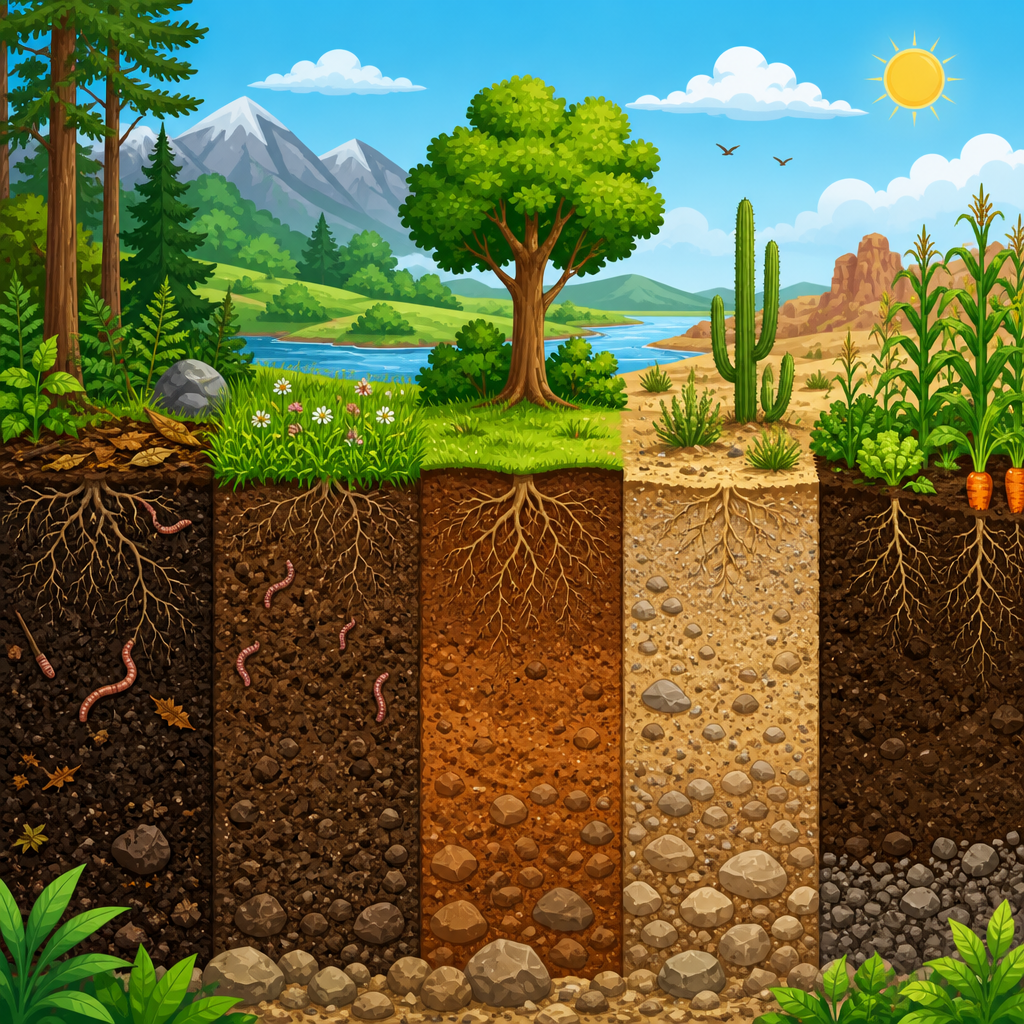
Soil types shape ecosystems, regulate water, store carbon, support agriculture, and influence everything from flood risk to biodiversity, which is why understanding soil and water science is fundamental to environmental science. Soil is not just dirt; it is a dynamic natural body made of mineral particles, organic matter, water, air, and living organisms interacting across time. In practice, when I evaluate a site for restoration, farming, or stormwater planning, the first questions are always about texture, structure, drainage, depth, and chemistry because those traits determine how the land will behave. Soil types are the recurring patterns in those traits, and they provide a practical framework for predicting environmental performance.
The major soil types commonly discussed in environmental science include sandy, silty, clayey, loamy, peaty, chalky, and saline soils, though formal classification systems such as the USDA Soil Taxonomy and the World Reference Base use more detailed categories. Texture refers to the proportion of sand, silt, and clay particles. Structure describes how those particles bind into aggregates. Porosity is the amount of pore space, while permeability is the ease with which water moves through the soil. These terms matter because the movement and storage of water control plant growth, nutrient cycling, erosion, and contaminant transport. A coarse soil may drain quickly but struggle to retain nutrients, while a fine soil may hold water and fertility yet become compacted and poorly aerated.
This sub-pillar hub covers soil and water science as an integrated field because soil cannot be understood apart from hydrology. Rainfall infiltrates soil, percolates to groundwater, runs off into streams, or evaporates back to the atmosphere, and soil properties govern each pathway. The environmental significance is enormous. Healthy soils can reduce flooding, buffer drought, filter pollutants, and sequester substantial amounts of organic carbon. Degraded soils do the opposite: they accelerate erosion, contribute sediment to waterways, release greenhouse gases, and lower resilience in both rural and urban landscapes. Whether the issue is wetland conservation, crop productivity, septic suitability, landslide risk, or urban stormwater design, soil type is usually one of the first limiting factors.
For readers using this page as a hub, the key idea is simple: soil and water science links physical properties, biological processes, and land management decisions. The sections below explain the major soil types, how they form, how they interact with water, and why they matter for conservation, agriculture, infrastructure, and climate strategy. If you need a working overview before diving into narrower topics such as infiltration, groundwater recharge, salinization, erosion control, wetland soils, or soil contamination, this article provides that foundation in plain terms without losing scientific precision.
How Soil Forms and Why Classification Matters
Soils form through five classic factors: parent material, climate, organisms, topography, and time. Parent material supplies the original minerals, whether from granite, limestone, alluvium, volcanic ash, or glacial deposits. Climate drives weathering and organic matter decomposition. Organisms, including roots, fungi, earthworms, and microbes, mix material and transform nutrients. Topography affects drainage, erosion, and exposure. Time allows horizons to develop as materials move downward, accumulate, or break apart. In the field, I have seen two sites only a few hundred meters apart produce very different soils simply because one sat on a convex slope with rapid runoff and the other on a toe slope receiving sediments and moisture.
Classification matters because it turns that complexity into prediction. A soil survey can indicate likely depth to restrictive layers, seasonal water tables, shrink-swell potential, runoff class, and agricultural capability. In the United States, the USDA Natural Resources Conservation Service provides mapped soil series and interpretations through Web Soil Survey. Internationally, the World Reference Base offers comparable diagnostic categories used in research and planning. These systems are not academic labels alone. Engineers use them to assess foundations, agronomists to guide crop choices, and watershed managers to estimate infiltration and nutrient losses. A soil map will never replace on-site testing, but it is one of the most cost-effective environmental planning tools available.
Major Soil Types and Their Core Environmental Traits
Sandy soils contain large particles, large pores, and high permeability. Water infiltrates rapidly, aeration is strong, and root penetration is usually easy. The tradeoff is low water-holding capacity and weak nutrient retention because cation exchange capacity is often low. In dry climates or coarse coastal plains, sandy soils can increase drought stress and nitrate leaching to groundwater. Silty soils feel smooth, hold more water than sand, and are often fertile, but they are highly erodible when left bare. Clayey soils have very small particles, high surface area, and strong nutrient-holding capacity. They can be productive, yet slow drainage, compaction, and poor aeration are frequent limitations. Expansive clays can also damage roads and foundations through shrink-swell cycles.
Loam is often considered ideal because it balances sand, silt, and clay, combining workable structure with decent drainage and water storage. Many productive agricultural regions are built on loamy topsoils, especially where organic matter is maintained. Peaty soils are rich in partially decomposed organic matter and usually form under saturated conditions. They store large amounts of carbon but are vulnerable to oxidation and subsidence if drained. Chalky or calcareous soils contain free calcium carbonate, tend to be alkaline, and can limit micronutrient availability, especially iron and zinc. Saline soils accumulate soluble salts that impair plant water uptake and reduce productivity. Sodic soils, a related but distinct problem, have high exchangeable sodium that disperses aggregates and destroys structure.
| Soil type | Water behavior | Main strengths | Main environmental concerns |
|---|---|---|---|
| Sandy | Fast infiltration, low storage | Good drainage, easy rooting | Drought stress, nutrient leaching |
| Silty | Moderate infiltration, moderate storage | Often fertile, easy cultivation | High erosion risk |
| Clayey | Slow infiltration, high storage | High nutrient retention | Waterlogging, compaction, runoff |
| Loamy | Balanced infiltration and storage | Versatile for plants and land use | Degradation if organic matter declines |
| Peaty | Very high storage, often saturated | Major carbon storage | Subsidence, carbon loss when drained |
| Saline/Sodic | Variable, often impaired structure | Manageable with careful reclamation | Reduced crop growth, poor infiltration |
These broad categories are useful, but texture alone never tells the whole story. Organic matter, aggregation, mineralogy, depth, biological activity, and land use can dramatically change soil behavior. A well-aggregated clay loam under long-term cover crops may infiltrate water better than a crusted silt loam under intensive tillage. That is why soil science always combines classification with measurement. Common field and laboratory indicators include bulk density, infiltration rate, pH, electrical conductivity, available water capacity, and soil organic carbon. Together they translate a soil type into an environmental diagnosis.
Soil, Water Movement, and Watershed Function
Water movement through soil is the central link between soil science and hydrology. When rain reaches the ground, it can infiltrate, pond, run off, or be intercepted by vegetation and residue. The infiltration rate depends on surface cover, antecedent moisture, texture, structure, and compaction. Once water enters the soil, gravity pulls it downward while capillary forces hold some in smaller pores. Field capacity is the amount of water remaining after free drainage, and the permanent wilting point is the threshold below which plants cannot extract enough water. The difference between the two is plant-available water, one of the most practical measures for agriculture and restoration planning.
At watershed scale, soil type strongly influences hydrographs, baseflow, and flood response. Coarse, deep, well-structured soils often promote infiltration and groundwater recharge, which can sustain streamflow during dry periods. Fine or compacted soils tend to generate more surface runoff, especially during high-intensity storms. In urban areas, topsoil removal and construction compaction can reduce infiltration so severely that even naturally permeable soils behave like near-impervious surfaces. I have worked on redevelopment sites where restoring only 15 to 20 centimeters of amended topsoil measurably improved infiltration and reduced nuisance flooding. Soil management, not just soil type, often decides whether rainfall becomes a resource or a hazard.
Soils also act as filters. As water passes through pore networks, sediments are strained, phosphorus may sorb to mineral surfaces, and microbes transform nitrogen through nitrification and denitrification. This filtering capacity protects groundwater and downstream ecosystems, but it has limits. Sandy soils may transmit nitrates quickly. Cracked clays can create preferential flow paths that bypass much of the matrix. Saturated soils may release phosphorus or generate reducing conditions that mobilize metals such as iron and manganese. Septic systems, bioswales, rain gardens, and managed aquifer recharge projects all depend on matching design to the soil’s hydraulic and chemical behavior.
Environmental Significance: Carbon, Nutrients, Biodiversity, and Pollution
Soil is one of the planet’s largest terrestrial carbon reservoirs. Organic carbon enters through roots, litter, and microbial biomass, then becomes stabilized within aggregates or bound to minerals. Peatlands are especially important because waterlogged conditions slow decomposition, allowing carbon to accumulate over centuries. When peat soils are drained for agriculture or extraction, oxygen enters, decomposition accelerates, and carbon dioxide emissions rise sharply. Mineral soils also matter. Practices that maintain cover, reduce disturbance, and add organic inputs can increase soil carbon modestly but meaningfully across large areas. The climate benefit is real, though it varies by soil type, climate, and management history.
Nutrient cycling is equally tied to soil properties. Nitrogen transforms through mineralization, immobilization, nitrification, and denitrification, all influenced by moisture, temperature, and aeration. Phosphorus availability depends strongly on pH and mineral interactions; it can become fixed in highly weathered soils or precipitate in calcareous soils. Potassium, calcium, magnesium, and micronutrients are affected by cation exchange capacity, clay mineralogy, and organic matter. From a water-quality perspective, the concern is not just fertility but loss pathways. Eroded sediment carries phosphorus, while dissolved nitrate moves with percolating water. The Gulf of Mexico hypoxic zone and many eutrophic lakes illustrate how poor soil and nutrient management can scale into regional environmental damage.
Biologically, soils are habitat. A teaspoon of healthy soil can contain billions of microorganisms, including bacteria, fungi, archaea, and protozoa, along with nematodes and microarthropods. These communities decompose organic matter, build aggregates, suppress some pathogens, and form symbioses such as mycorrhizae that improve plant nutrient uptake. Disturbance, contamination, acidification, salinity, and prolonged saturation can alter these communities and weaken ecosystem function. Pollution also behaves differently by soil type. Heavy metals may bind strongly to clays or organic matter, while some pesticides move readily through coarse soils. Remediation strategies therefore depend on texture, pH, redox conditions, and sorption capacity, not simply on the contaminant itself.
Managing Soil Types for Agriculture, Conservation, and Urban Land Use
Good soil management starts with matching use to capability. Sandy soils benefit from organic matter additions, mulches, and frequent but efficient irrigation because their main limitation is retention, not infiltration. Clayey soils often need traffic control, cover crops, drainage planning, and reduced tillage intensity to protect structure. Silty soils require residue cover and contour practices to limit erosion. On calcareous soils, growers may select crop varieties tolerant of iron chlorosis or use chelated micronutrients. In saline and sodic soils, reclamation may involve improved drainage, leaching with good-quality water, and calcium amendments such as gypsum where sodium dispersion is the problem. There is no universal prescription because each soil type fails differently under stress.
Conservation planning follows the same logic. Riparian buffers work best when they reflect local hydrology and rooting depth. Wetland restoration depends on identifying hydric soils and reestablishing the water regime that created them. Erosion control on sloping silt loams may require cover crops, terracing, strip cropping, or perennial vegetation. In grazing systems, stocking rates should reflect soil moisture sensitivity because trampling damage on wet clay soils can persist for years. Urban land use adds another layer. Compacted subsoils beneath turf, parking lot islands, and street trees often limit infiltration and rooting more than the regional soil type itself. Soil volume, organic amendments, and decompaction can substantially improve urban ecosystem performance.
For readers exploring soil and water science further, this hub points to several essential subtopics: soil texture and structure, infiltration and runoff, groundwater recharge, erosion and sediment transport, wetland and hydric soils, salinization, soil fertility, contamination and remediation, and climate-smart soil management. The main takeaway is straightforward. Soil types are environmental controls. They govern how water moves, how nutrients cycle, how plants grow, how pollutants travel, and how landscapes respond to stress. The best decisions in agriculture, conservation, and development begin with soil knowledge, verified by field observation and site testing. Use this foundation to examine your local soils, consult a soil survey, and build management choices around what the land can sustainably support.
Frequently Asked Questions
What are the main soil types, and why do they matter environmentally?
The main soil types are often described by texture and composition, including sandy, silty, clayey, loamy, and organic-rich soils. Sandy soils have large particles and drain quickly, which can reduce waterlogging but also limit water and nutrient retention. Clay soils have very small particles that hold water and nutrients well, yet they can drain slowly and increase runoff when compacted. Silty soils are smoother and often fertile, but they can be prone to erosion if left unprotected. Loam, which is a balanced mix of sand, silt, and clay, is widely valued because it combines drainage, moisture retention, and fertility in a way that supports many ecosystems and agricultural uses. Organic soils, such as peat-rich soils, contain high amounts of decomposed plant material and are especially important for carbon storage.
Environmentally, these differences matter because soil type influences how water moves through a landscape, how much carbon is stored below ground, what kinds of plants can grow, and how resilient an area is to drought, flooding, and erosion. Soil also shapes habitat quality for microbes, insects, fungi, and roots, all of which support larger food webs. In environmental science, understanding soil type is essential because the soil beneath our feet helps regulate water cycles, nutrient cycles, and ecosystem health. That is why site planning for restoration, agriculture, conservation, or stormwater management almost always starts with identifying the soil and understanding how it behaves.
How does soil affect water infiltration, drainage, and flood risk?
Soil plays a central role in determining whether rainfall soaks into the ground, moves slowly through the subsurface, or runs off the land surface. Coarse-textured soils such as sand usually allow rapid infiltration because their larger pore spaces let water move downward more easily. Fine-textured soils such as clay can absorb water too, but they often do so more slowly, especially when the soil is compacted or already saturated. Soil structure matters just as much as texture. A well-aggregated soil with stable pores and healthy organic matter can absorb and store much more water than a disturbed or compacted soil of the same basic type.
This directly affects flood risk and stormwater behavior. When soil cannot absorb water efficiently, rainfall becomes surface runoff, which can overwhelm drainage systems, erode streambanks, and carry sediment and pollutants into rivers and lakes. In urban and agricultural settings, degraded soils often increase these problems because compaction reduces pore space and limits infiltration. By contrast, healthy soils can function like a sponge, storing water during storms and releasing it more gradually over time. That buffering effect is extremely valuable for reducing flash flooding, recharging groundwater, supporting streamflow during dry periods, and improving overall watershed resilience.
Why is soil important for carbon storage and climate regulation?
Soil is one of the planet’s largest carbon reservoirs, storing more carbon than the atmosphere and vegetation combined in many global estimates. Carbon enters soil through plant roots, leaf litter, decomposing organisms, and microbial activity. Some of that carbon is rapidly recycled, while some becomes stabilized in organic matter or associated with mineral particles, allowing it to remain in the soil for long periods. This makes soil a major part of the global carbon cycle and a key factor in climate regulation.
The amount of carbon a soil can store depends on its type, mineral content, moisture conditions, biological activity, and land management history. Organic soils and wetlands can hold especially large carbon stocks, but they can also release significant greenhouse gases if drained or disturbed. Likewise, intensive tillage, erosion, deforestation, and poor land management can reduce soil carbon over time. Practices such as cover cropping, reduced tillage, compost application, reforestation, and wetland protection can help maintain or rebuild soil carbon. From an environmental perspective, soil conservation is not only about fertility or erosion control; it is also about climate mitigation, ecosystem stability, and protecting one of Earth’s most important long-term carbon sinks.
How do different soil types influence agriculture and ecosystem productivity?
Different soil types affect plant growth by controlling root penetration, nutrient availability, aeration, moisture retention, and biological activity. Sandy soils are easier to work and warm up quickly in spring, but they often require more frequent irrigation and careful nutrient management because water and soluble nutrients can leach quickly. Clay-rich soils can be highly fertile because they hold nutrients well, but they may become dense, poorly drained, or hard for roots to penetrate if not managed properly. Loamy soils are often considered ideal for agriculture because they provide a useful balance of drainage, structure, and nutrient-holding capacity.
In natural ecosystems, these same properties determine what plant communities can establish and persist. Soil pH, salinity, depth, organic matter, and moisture regime all help shape habitat suitability for grasses, shrubs, forests, and wetland vegetation. Productive ecosystems depend not only on the physical soil but also on the living community within it, including bacteria, fungi, earthworms, and other organisms that cycle nutrients and build structure. This is why two areas with similar climate can support very different ecosystems if their soils differ. For agriculture and land restoration alike, understanding soil type helps guide crop selection, irrigation planning, amendment strategies, and realistic expectations about what the land can sustainably support.
Why is soil classification important for restoration, conservation, and land-use planning?
Soil classification provides a practical framework for predicting how land will respond to disturbance, management, and environmental change. When professionals assess a site for farming, habitat restoration, construction, septic suitability, or stormwater planning, soil information helps answer fundamental questions about drainage, compaction risk, erosion hazard, fertility, shrink-swell behavior, and water-holding capacity. It also helps identify constraints that may not be obvious from surface appearance alone, such as restrictive layers, seasonal saturation, salinity, or low biological activity.
For restoration and conservation work, this matters enormously. A planting plan that ignores soil conditions may fail because the selected species are not adapted to the site’s moisture regime or nutrient profile. A stormwater system placed in slowly permeable soil may underperform. A conservation strategy that overlooks erosion-prone soils may allow sediment loss and declining water quality. Soil classification helps land managers match goals with the actual capabilities of the land, which leads to more durable outcomes and fewer unintended consequences. In short, understanding soil is foundational to environmental decision-making because soil connects hydrology, vegetation, biodiversity, and long-term landscape function.


