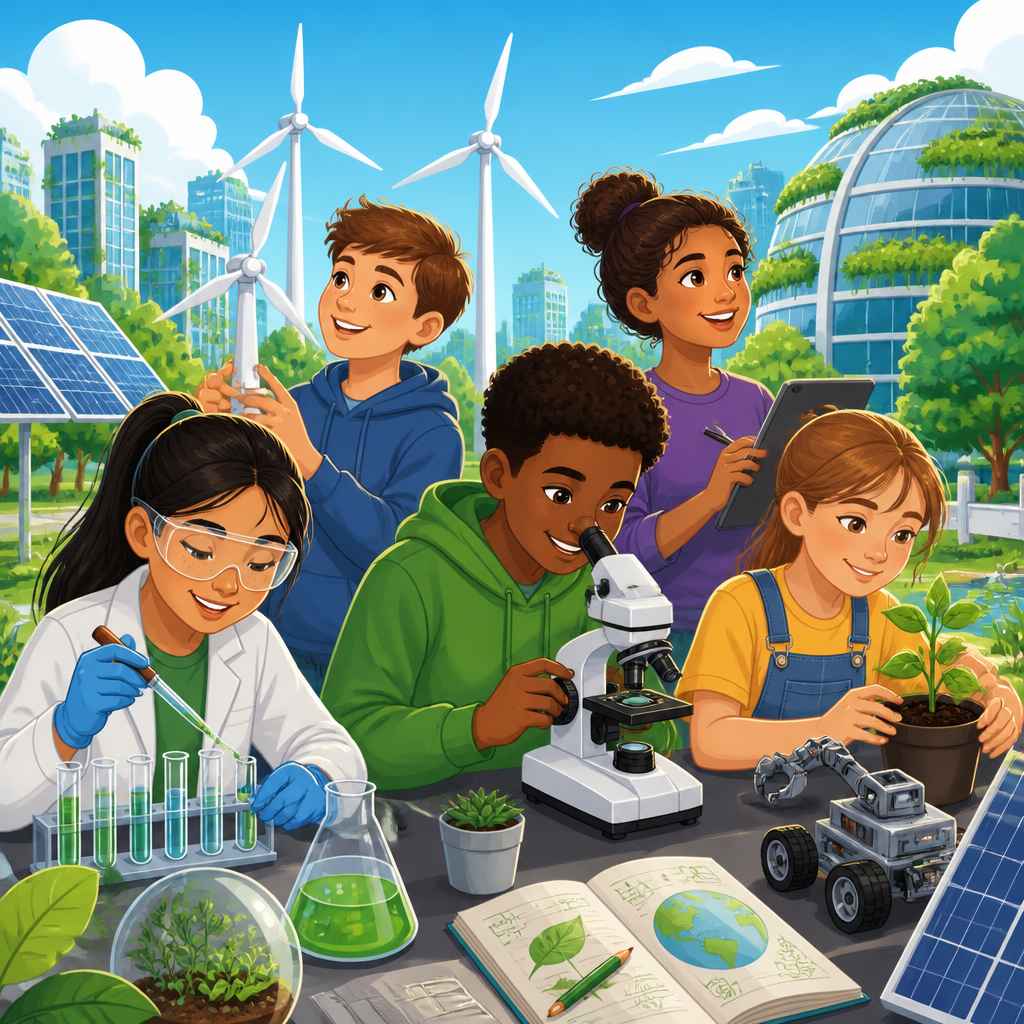
Youth in STEM matters because the future of environmental science will be shaped by students who can connect climate data, ecology, engineering, and community action into practical solutions. In this context, STEM means science, technology, engineering, and mathematics, while green scientists are researchers and innovators focused on sustainability, conservation, clean energy, climate adaptation, pollution reduction, and biodiversity protection. Research and discoveries are the engine of that work. They turn curiosity into evidence, evidence into tools, and tools into decisions that improve air, water, soil, and public health. I have worked with student researchers, teachers, and nonprofit science programs long enough to see a consistent pattern: when young people are given real problems, real datasets, and real mentors, they rise to the challenge quickly.
This topic matters now because environmental problems are becoming more technically complex and more urgent at the same time. Wildfire smoke affects cities far from the fires themselves. Heat islands raise urban temperatures by several degrees. Plastic pollution moves from rivers into oceans and into food chains. Energy systems must decarbonize without compromising reliability. Each of these challenges depends on discovery: measuring conditions accurately, testing interventions, and scaling what works. Youth in STEM is not a side conversation within environmental science; it is the talent pipeline that will sustain future research labs, public agencies, startups, field stations, and policy teams. A hub article on research and discoveries should therefore explain not only what green science studies, but also how students enter the field and why their participation improves the science itself.
Young people bring three valuable advantages to environmental research. First, they are often early adopters of digital tools such as coding platforms, sensors, GIS software, and collaborative data notebooks. Second, they notice local environmental changes that larger institutions can overlook, from stormwater flooding at a school entrance to declining pollinators in a neighborhood park. Third, they will live longest with the consequences of today’s decisions, so they have a direct stake in long-term solutions. Inspiring the next generation of green scientists therefore means more than promoting STEM careers. It means building scientific literacy, field skills, ethical judgment, and the confidence to ask rigorous questions. Done well, this creates stronger environmental science research and a more resilient society.
What research and discoveries mean in environmental science
Environmental science research asks how natural and human systems interact, then uses evidence to solve measurable problems. The work spans atmospheric chemistry, hydrology, ecology, geoscience, toxicology, environmental engineering, remote sensing, and data science. Discoveries may be basic, such as identifying how soil microbes store carbon, or applied, such as designing better membrane filters for wastewater treatment. In practice, students should understand that discovery is rarely a dramatic single moment. It is usually a disciplined process: define a question, review prior studies, select methods, collect data, analyze results, test uncertainty, and communicate findings clearly enough for others to evaluate and build upon.
For youth entering the field, this process is empowering because it makes environmental challenges understandable. A student studying urban heat can compare temperatures on asphalt, grass, and shaded sidewalks using handheld sensors and then map results with geographic information systems. Another can analyze public air quality records from the Environmental Protection Agency and compare local patterns with traffic density. A robotics student can build an Arduino-based water monitor to test pH, turbidity, or conductivity in a stream. These projects are not simulations of real science; they are real science when they follow sound methods. That distinction matters because authenticity is what turns interest into commitment.
Environmental discoveries also rely on collaboration. Ecologists work with statisticians. Engineers partner with public health researchers. Climate scientists use satellites operated by national space agencies and validate observations with ground instruments. Students should see early that green science is interdisciplinary by design. The strongest hub pages in environmental science connect these disciplines, helping readers understand where climate research meets materials science, where conservation biology meets computer vision, and where environmental justice meets public policy. That broad view helps young researchers choose entry points without feeling that they must master every specialty at once.
How young people participate in real environmental research
The most effective way to inspire youth in STEM is to move from abstract career talk to direct participation. In my experience, interest spikes when students handle samples, calibrate instruments, or clean messy datasets themselves. Schools, museums, universities, and nonprofits already create these entry points through citizen science, capstone projects, summer institutes, science fairs, and lab internships. Programs linked to iNaturalist, eBird, GLOBE Observer, and NASA Earthdata let students contribute observations that researchers can actually use. These platforms teach a critical lesson: field notes, metadata, and consistency matter as much as enthusiasm.
Citizen science has become especially important in biodiversity and climate monitoring. Students photographing pollinators can help document shifts in flowering and insect activity. Community teams measuring rainfall or creek depth can support local flood awareness. In coastal areas, youth-led beach surveys often generate useful records of marine debris, erosion, and habitat change. These projects work best when adults explain quality control clearly. Data need timestamps, location accuracy, standardized units, and repeatable methods. Once students see why one missing variable can weaken a conclusion, they start thinking like scientists rather than volunteers.
Formal research experiences deepen that learning. A high school student interning in a university lab might extract DNA for environmental barcoding, use R to visualize stream chemistry trends, or compare solar panel output under different conditions. Community college students often enter field sampling, environmental compliance, and water treatment pathways through technical courses with immediate labor market value. Undergraduate research expands further into hypothesis design and publication. The point for this hub topic is simple: the path into green science is not linear. It includes classrooms, field sites, maker spaces, coding clubs, restoration projects, and applied technical training.
Core discovery areas shaping the next generation of green scientists
Youth engagement becomes stronger when students can see the major research frontiers clearly. Environmental science is broad, but several discovery areas consistently attract and retain emerging talent because they combine urgency, visible impact, and practical tools.
| Research area | Core question | Typical youth entry point | Example of discovery |
|---|---|---|---|
| Climate and atmosphere | How are temperature, emissions, and extreme weather changing? | Weather stations, emissions data analysis, heat mapping | Identifying urban heat island hotspots for tree planting |
| Water science | What affects water quality, supply, and aquatic health? | Stream testing, watershed mapping, sensor building | Tracing nutrient runoff linked to algal blooms |
| Biodiversity and conservation | How are species and habitats responding to land use and climate? | Species observations, camera traps, habitat surveys | Documenting pollinator declines and habitat recovery |
| Clean energy | How can energy be generated and used with lower emissions? | Solar design challenges, energy audits, battery experiments | Comparing building efficiency upgrades that cut electricity demand |
| Pollution and materials | How do contaminants move, persist, and affect health? | Microplastics sampling, waste audits, filtration prototypes | Testing bio-based materials that reduce single-use plastic waste |
Climate and atmospheric research often gives students fast feedback because data are abundant and visible. NASA, NOAA, and the Intergovernmental Panel on Climate Change have made climate indicators widely accessible. Students can compare local heat records, wildfire smoke indexes, or precipitation anomalies and connect global trends to neighborhood conditions. Water science is equally powerful because rivers, reservoirs, storm drains, and treatment plants are tangible parts of daily life. When students test dissolved oxygen or nitrate levels and then connect those results to land use upstream, they see systems thinking in action.
Biodiversity research offers another compelling route because direct observation builds emotional investment without sacrificing rigor. Camera traps, acoustic monitors, and drone imagery now complement traditional field notebooks. I have seen students who were initially intimidated by chemistry become deeply engaged through habitat restoration and then move into data analysis once they understood why the numbers mattered. Clean energy attracts students interested in engineering and entrepreneurship, while pollution and materials research appeals to those who want to redesign products, packaging, or industrial processes. Together, these areas form the backbone of environmental science research and discoveries.
Tools, methods, and standards that make youth research credible
Credible research depends on methods, not good intentions. Students need to learn early how scientists reduce error and document decisions. In environmental science, that means understanding calibration, controls, replication, chain of custody for samples, geolocation accuracy, and basic statistics. A water quality sensor is only useful if it is calibrated against known standards. A biodiversity survey is only comparable across time if the sampling route, duration, and weather conditions are recorded. A climate analysis is only persuasive if the data source, time range, and assumptions are explicit.
Modern green science also depends heavily on digital literacy. Geographic information systems such as ArcGIS and QGIS help students map land cover, flooding risk, and habitat fragmentation. Programming languages such as Python and R support cleaning, modeling, and visualization. Remote sensing platforms like Landsat and Sentinel provide free satellite imagery for tracking vegetation, fire scars, surface temperature, and coastline change. Laboratory methods remain essential too, from spectrophotometry and microscopy to chromatography and microbial assays. The lesson for young researchers is not that they must master every tool immediately. It is that environmental discovery increasingly combines field observation, lab technique, and computational analysis.
Standards matter because environmental data often influence decisions with real consequences. Schools and youth programs should align projects with recognized protocols whenever possible, whether from the EPA, USGS, NOAA, or validated citizen science frameworks. Ethical standards are equally important. Students collecting neighborhood data must consider privacy, informed consent, and equitable community engagement. Researchers working in conservation should respect Indigenous knowledge, land access rights, and habitat sensitivity. These are not optional add-ons. They are part of being a trustworthy scientist and are especially important when encouraging young people to see research as public service rather than personal achievement alone.
What educators, families, and institutions can do next
Inspiring the next generation of green scientists requires infrastructure, not slogans. Educators can start by designing projects around local environmental questions with measurable outcomes. Families can reinforce curiosity by visiting wetlands, science centers, recycling facilities, botanical gardens, or public lectures. Universities and research institutes can open pathways through shadow days, loaner equipment, paid internships, and mentorship that includes students from underrepresented communities. Funding matters as well. Small grants for sensors, field transportation, and teacher training often produce outsized returns because they transform passive interest into sustained inquiry.
Institutions should also be honest about barriers. Not every student has transportation to a field site, a laptop capable of running GIS software, or time for unpaid extracurricular work. Practical support makes participation more equitable. That can mean stipends, accessible lab schedules, bilingual materials, and projects relevant to community concerns such as asthma, drinking water, flooding, or food access. Environmental justice should be embedded in youth STEM efforts because many future green scientists first encounter environmental science through unequal exposure to risk. Recognizing that reality strengthens research questions and broadens who feels entitled to ask them.
The central benefit of youth in STEM is not simply workforce development, though that matters. It is the creation of informed, capable problem-solvers who can carry environmental science research and discoveries forward with skill and integrity. When students learn to test a hypothesis, question a dataset, and communicate findings responsibly, they gain tools that last far beyond one project. If you lead a classroom, a lab, a community group, or a family conversation, make room for genuine investigation. Give young people access to mentors, methods, and meaningful questions, and they will do more than inherit environmental challenges. They will produce the discoveries that help solve them.
Frequently Asked Questions
Why is it so important to encourage youth to pursue STEM for environmental careers?
Encouraging young people to pursue STEM is essential because many of the world’s biggest environmental challenges are complex, interconnected, and rapidly evolving. Issues such as climate change, habitat loss, water scarcity, pollution, and clean energy development cannot be solved by passion alone. They require scientific understanding, technical skills, creative problem-solving, and the ability to work across disciplines. When students build strong foundations in science, technology, engineering, and mathematics, they are better prepared to understand how ecosystems function, how climate data is collected and interpreted, how sustainable technologies are designed, and how environmental solutions can be tested and improved in real-world settings.
Youth also bring something especially valuable to the future of green science: fresh perspective. Younger generations are growing up in a world where environmental concerns are not abstract ideas but daily realities. They are seeing the effects of extreme weather, rising temperatures, changing biodiversity, and resource pressures firsthand. That experience often gives students a strong sense of urgency and purpose. When that motivation is paired with STEM education, it can lead to meaningful innovation in areas like renewable energy, climate adaptation, conservation biology, sustainable agriculture, and waste reduction.
Just as importantly, investing in youth in STEM strengthens the long-term environmental workforce. Tomorrow’s green scientists, environmental engineers, data analysts, ecologists, and clean technology innovators are today’s students. If they are inspired early, supported consistently, and given access to quality education and mentorship, they can become the researchers and problem-solvers who help communities respond to environmental risks and build more sustainable systems. In that sense, encouraging youth in STEM is not only about career development. It is about preparing society with the knowledge and talent needed to protect the planet for generations to come.
What does “green scientists” mean, and what kinds of work do they actually do?
Green scientists are researchers, analysts, engineers, and innovators who focus their work on environmental sustainability and the protection of natural systems. The term includes professionals across many fields, not just traditional environmental science. A green scientist might be a marine biologist studying coral reef resilience, a climate scientist modeling future weather patterns, a chemical engineer developing cleaner industrial processes, or a data scientist using satellite imagery to track deforestation. What connects them is a shared goal: using evidence, experimentation, and innovation to reduce environmental harm and create practical solutions.
Their work spans a wide range of issues. Some green scientists focus on conservation and biodiversity, studying species populations, habitat restoration, and ecosystem health. Others work in clean energy, developing better solar panels, battery storage systems, wind technologies, or biofuels. Some specialize in pollution reduction by monitoring air and water quality, designing safer materials, or improving waste management systems. Others contribute to climate adaptation by helping communities prepare for rising sea levels, drought, wildfire risk, or heat stress. There are also green scientists working in agriculture, urban planning, public health, and environmental policy, showing just how broad and interdisciplinary the field has become.
What is especially important for students to understand is that green science is not limited to lab work. While research is central, many professionals also collaborate with governments, schools, local communities, nonprofits, and private companies. They may collect field data, build computer models, test prototypes, publish studies, advise decision-makers, or design technologies that can be used at scale. In other words, green scientists help turn knowledge into action. Their discoveries and innovations drive progress, making them a critical force in building a more sustainable and resilient future.
How can students get interested and involved in environmental STEM at an early age?
Students often become interested in environmental STEM when they can connect scientific ideas to the world around them. That connection can start very simply: observing local wildlife, testing water quality in a nearby stream, growing plants, tracking weather patterns, learning how recycling systems work, or asking questions about where energy and food come from. Hands-on experiences make STEM feel relevant and exciting because they show students that science is not just something in textbooks. It is a way of understanding and improving the places where they live.
Schools, families, libraries, museums, and community organizations can all help build that interest. Science clubs, robotics teams, environmental service projects, coding programs, citizen science initiatives, and sustainability competitions can give students opportunities to explore real problems and develop practical skills. For example, a student who joins a school garden may become curious about soil health and sustainable agriculture. A student who learns basic coding might later use data analysis to study climate trends. A student who participates in a neighborhood cleanup may begin asking deeper questions about pollution sources, waste systems, and environmental justice. These early experiences can spark long-term curiosity and confidence.
Mentorship also makes a major difference. When students meet scientists, engineers, and environmental professionals, they begin to see green careers as tangible and achievable. Internships, guest speakers, summer camps, online courses, and research programs can all expand a student’s sense of what is possible. The most effective approach is often one that combines encouragement with access: access to tools, role models, experiments, field experiences, and inclusive learning environments. When young people are invited to ask questions, test ideas, and take part in meaningful projects, they are far more likely to see themselves as future contributors to environmental science and sustainability.
What STEM skills are most valuable for the next generation of green scientists?
The next generation of green scientists will need a mix of technical knowledge, analytical ability, and collaborative problem-solving skills. Strong foundations in biology, chemistry, physics, earth science, and mathematics remain extremely important because environmental systems are built on these core disciplines. Students need to understand how living systems interact, how energy and materials move through natural and human-made systems, and how scientific methods are used to test ideas and evaluate evidence. These fundamentals are what allow future scientists to make sense of complex environmental challenges.
At the same time, modern green science increasingly depends on technology and data. Skills in coding, statistics, geographic information systems, remote sensing, modeling, and data visualization are becoming more valuable across many environmental fields. Climate research, conservation planning, pollution tracking, and renewable energy design all rely on the ability to collect, interpret, and communicate large amounts of information. Engineering and design thinking are also critical, especially for students interested in creating tools, systems, and infrastructure that improve sustainability. Whether designing water filtration systems, energy-efficient buildings, or low-emission transportation solutions, students benefit from learning how to move from problem identification to practical implementation.
Equally important are the skills that connect science to society. Communication, teamwork, ethical reasoning, and community awareness are vital because environmental solutions must work not only in theory but also in real communities. Green scientists often need to explain findings to the public, collaborate across disciplines, and understand how environmental issues affect different populations in different ways. Students who can combine scientific literacy with creativity, adaptability, and a commitment to public impact will be especially well prepared. The most effective green scientists are not just technically capable. They are also able to translate knowledge into action that is thoughtful, inclusive, and lasting.
How does youth participation in STEM help create real environmental solutions in communities?
Youth participation in STEM helps create real environmental solutions because students are not only future leaders; they can be active contributors right now. When young people learn how to collect data, analyze evidence, design experiments, and build prototypes, they gain tools that can be applied directly to local environmental problems. In schools and communities, students often work on projects involving energy conservation, urban gardening, habitat restoration, waste reduction, air quality monitoring, or stormwater management. These projects may seem small at first, but they teach the process of turning observation into action, which is at the heart of meaningful environmental problem-solving.
Young people are also often highly effective at seeing connections adults may overlook. They move easily between technology, communication, and social engagement, which can make them powerful participants in community-based sustainability efforts. A student might use sensors to measure school energy use, create data visualizations to explain findings, and then help lead a campaign for efficiency improvements. Another might participate in biodiversity mapping, identify local conservation concerns, and present recommendations to community leaders. These examples show how STEM learning can extend beyond the classroom and influence real decisions, behaviors, and policies.
Perhaps most importantly, youth involvement helps build a culture of long-term environmental responsibility. When students are invited to investigate problems and propose solutions, they begin to understand that science is not distant or exclusive. It is a practical, empowering tool for public good. Their participation can energize schools, inform families, and strengthen community action. Over time, this creates a pipeline of informed, skilled, and motivated individuals who are prepared to continue advancing sustainability through research, innovation, and civic engagement. In that way, youth in STEM do not simply inherit environmental challenges. They help shape the solutions that move communities forward.