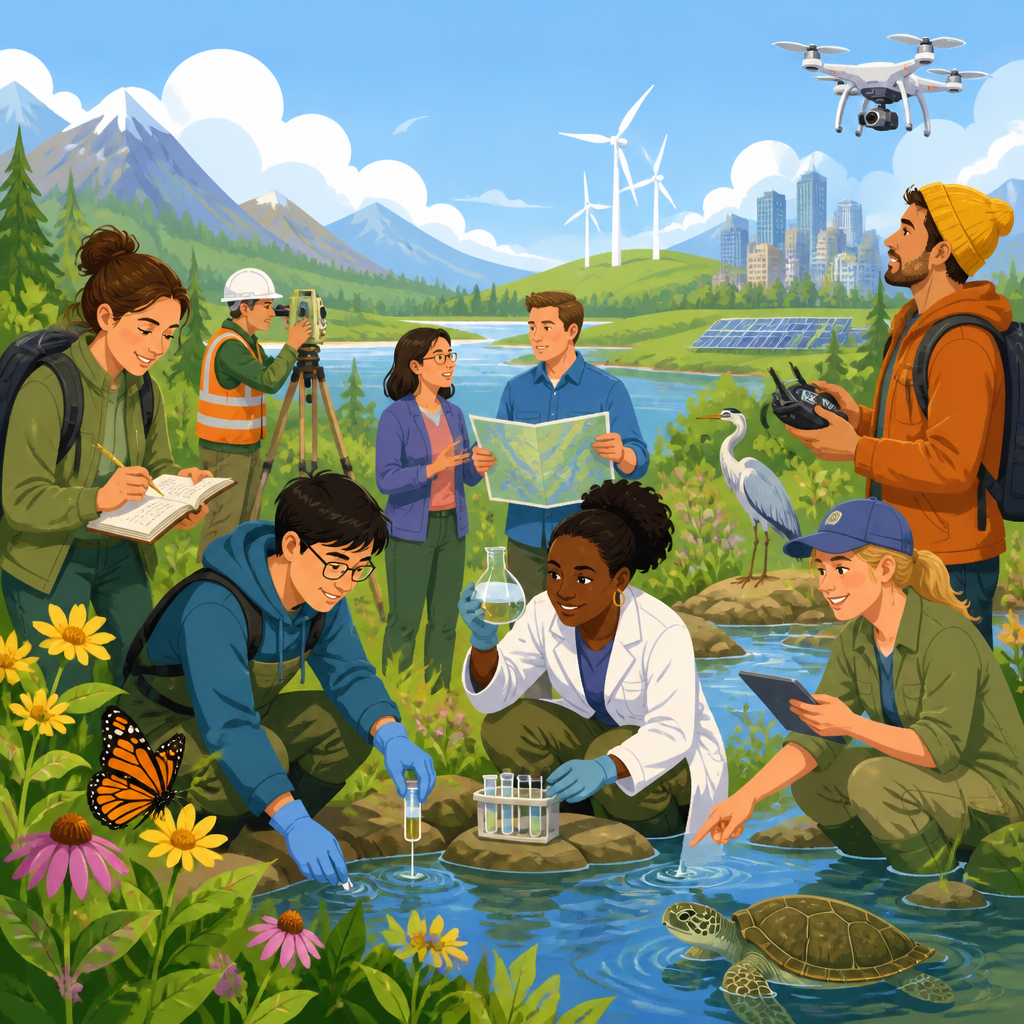
Interdisciplinary approaches in environmental science combine methods, data, and theories from multiple fields to solve environmental problems that no single discipline can address alone. In practice, that means ecologists working with chemists, hydrologists, economists, public health researchers, geographers, engineers, and policy specialists to understand how natural systems and human systems interact. I have seen this firsthand in environmental research projects where a question that looked biological at first, such as declining fish populations, quickly expanded into land use mapping, water quality analysis, climate records, infrastructure design, and community behavior. That breadth is not academic fashion. It is a practical response to the complexity of environmental change.
Environmental science sits at the intersection of the atmosphere, water, land, living organisms, and society. Research and discoveries in this field increasingly depend on integration because major issues such as climate change, biodiversity loss, air pollution, soil degradation, plastics contamination, and water scarcity unfold across scales. A local wetland restoration project can involve satellite imagery, microbial testing, Indigenous knowledge, zoning law, and cost-benefit analysis. A global climate assessment can require atmospheric physics, oceanography, statistics, economics, and behavioral science. When these perspectives are combined well, researchers move beyond description and can identify causes, predict outcomes, and design solutions that actually work outside the laboratory.
This matters because environmental decisions affect health, food systems, infrastructure, energy security, and economic resilience. Governments rely on integrated assessments to set emissions standards, companies use environmental risk models to plan supply chains, and communities depend on science that reflects lived conditions rather than isolated variables. As the research & discoveries hub within environmental science, this article maps the major interdisciplinary approaches, explains how they generate credible findings, and shows why they are central to both foundational research and applied problem solving.
Why Environmental Research Requires Interdisciplinary Thinking
Environmental problems are coupled systems problems. A forest fire is not only a vegetation event; it is also a climate event, a public health event, a hydrological event, an infrastructure event, and often a social equity event. During wildfire studies, for example, researchers may combine fuel load measurements from forestry, particulate monitoring from atmospheric science, hospital admission data from epidemiology, and evacuation modeling from urban planning. The discovery does not emerge from one dataset alone. It emerges from the relationships among datasets.
That systems orientation is now standard in major research programs. The Intergovernmental Panel on Climate Change synthesizes physical science, impacts research, adaptation studies, and mitigation economics because climate outcomes cannot be understood through atmospheric measurements alone. Similarly, watershed research often integrates stream gauging, nutrient chemistry, land cover classification, and agricultural practice surveys. When nitrate levels rise downstream, the explanation may involve fertilizer timing, rainfall intensity, tile drainage, soil structure, and municipal treatment limits. Interdisciplinary work allows scientists to distinguish correlation from mechanism.
It also reduces the risk of narrow solutions creating new problems. A technology that lowers carbon emissions may increase mineral extraction pressure. A flood-control structure may protect one district while worsening downstream erosion. Effective environmental research examines tradeoffs early, using multiple forms of expertise to test interventions before they scale.
Core Disciplines That Shape Environmental Discoveries
The strongest environmental science research usually begins with disciplinary depth and then builds outward. Ecology contributes knowledge of species interactions, population dynamics, habitat structure, and ecosystem function. Chemistry explains contaminant transport, nutrient cycling, acidity, oxidation, and the behavior of compounds in air, water, and soil. Geology and soil science reveal substrate composition, erosion processes, aquifer characteristics, and the long history recorded in sediments and landforms. Atmospheric science tracks circulation, aerosol formation, radiative forcing, and precipitation patterns.
Hydrology connects climate, land cover, groundwater, and surface water through flow processes that determine flood risk and water availability. Geography and geographic information systems provide spatial analysis, remote sensing, and landscape-scale pattern detection. Engineering turns findings into treatment systems, monitoring networks, renewable energy infrastructure, and resilient design. Economics measures incentives, externalities, valuation, and policy efficiency. Sociology, anthropology, and political science explain behavior, governance, institutional constraints, and environmental justice. Public health links exposures to human outcomes through toxicology, epidemiology, and risk assessment.
In my experience, the breakthroughs often happen when specialists are precise about what their discipline can and cannot infer. A chemist can identify PFAS compounds and their persistence, but exposure pathways may require household surveys and municipal records. A satellite analyst can detect vegetation stress, but attributing that stress may require field ecology and soil moisture measurements. Interdisciplinary research is most productive when each discipline brings rigorous methods rather than broad assumptions.
Methods That Connect Fields and Produce Stronger Evidence
Interdisciplinary environmental research depends on shared methods that make different kinds of evidence comparable. One common approach is integrated monitoring: collecting physical, chemical, biological, and social data from the same site over time. Long Term Ecological Research networks are a good example because they pair ecosystem observations with climate measurements, land use records, and increasingly human dimensions data. This design helps researchers detect thresholds, lag effects, and cumulative impacts that short studies often miss.
Modeling is another core bridge. Watershed models such as SWAT connect precipitation, soils, topography, and land management to streamflow and nutrient loss. Climate models link atmospheric dynamics, ocean circulation, ice processes, and land surface feedbacks. Life cycle assessment compares environmental impacts across a product’s full chain, from raw material extraction to disposal, which is essential when evaluating batteries, plastics, concrete, or biofuels. Environmental impact assessment brings together baseline surveys, scenario analysis, and stakeholder input before major projects proceed.
Remote sensing has transformed discoveries by allowing researchers to track deforestation, urban heat islands, algal blooms, glacier retreat, and drought stress at regional and global scales. Pairing satellite products from Landsat, Sentinel, or MODIS with ground-truth sampling improves reliability. Statistical methods also matter. Bayesian models, time-series analysis, spatial autocorrelation tests, and machine learning can reveal patterns, but they only become trustworthy when linked to clear mechanisms and validated observations.
| Approach | What It Combines | Typical Research Use | Example Discovery |
|---|---|---|---|
| Integrated monitoring | Field sampling, sensors, lab analysis, surveys | Track change across time and place | Identifies how rainfall, fertilizer use, and stream ecology interact |
| GIS and remote sensing | Satellite imagery, mapping, ground observations | Measure land cover and environmental trends | Reveals urban expansion linked to habitat fragmentation |
| Process-based modeling | Physics, chemistry, biology, computing | Simulate scenarios and forecast outcomes | Projects flood risk under changing rainfall patterns |
| Life cycle assessment | Engineering, energy data, supply chains, waste analysis | Compare full-system impacts of products | Shows one low-carbon option may have higher water demand |
| Community-based research | Local knowledge, social science, environmental monitoring | Define problems and test realistic interventions | Improves heat mitigation plans for vulnerable neighborhoods |
Major Research Areas and What Interdisciplinary Work Has Revealed
Climate research is one of the clearest examples of interdisciplinary environmental science. Physical measurements established warming trends, but impacts research showed what those trends mean for crops, coastlines, disease patterns, and infrastructure. Attribution science now combines climate modeling with observational datasets to estimate how much human-caused warming increased the likelihood or intensity of heatwaves, floods, or wildfire conditions. That work informs adaptation planning, insurance pricing, and disaster preparedness.
Water research has also advanced through integration. Scientists studying harmful algal blooms combine nutrient chemistry, lake physics, weather data, watershed land use, and microbial ecology. Discoveries in the Great Lakes and many inland reservoirs show that phosphorus loading, warmer water, and stratification can interact to intensify bloom conditions. Those findings changed management from a narrow focus on one pollutant source to broader nutrient, runoff, and land management strategies.
Biodiversity research increasingly links conservation biology with genetics, landscape ecology, and climate projections. Corridor design for wildlife movement now often uses species occurrence records, topographic connectivity, land ownership patterns, and projected temperature shifts. Pollution research has moved the same way. Air quality studies now connect emissions inventories, atmospheric chemistry, exposure mapping, and health outcomes. Fine particulate matter, PM2.5, is understood not merely as a pollutant concentration but as a driver of cardiovascular and respiratory harm shaped by transportation systems, fuel use, and neighborhood inequality.
In circular economy and waste research, interdisciplinary work has exposed hidden burdens. Plastic pollution studies unite polymer chemistry, marine ecology, toxicology, and consumer behavior. Researchers can now trace how larger products fragment into microplastics, move through rivers and oceans, sorb chemicals, and enter food webs. The strongest discoveries are not only about presence, but about sources, transport pathways, and policy levers.
The Human Dimension: Policy, Economics, and Environmental Justice
Environmental discoveries become useful when they account for people. Policy research helps translate findings into regulations, incentives, and planning standards. Economists contribute cost-effectiveness analysis, carbon pricing design, natural capital valuation, and market behavior insights. Political scientists examine institutional capacity and why some policies succeed in one jurisdiction but stall in another. Without these perspectives, technically sound solutions often fail during implementation.
Environmental justice research has sharpened this point. Studies in many countries show that low-income communities and communities of color are more likely to face higher exposure to air pollution, extreme heat, flood risk, and industrial hazards. That conclusion came from combining emissions data, census data, health statistics, historical zoning maps, and qualitative community research. It changed the standard of evidence. Researchers no longer ask only whether pollution exists; they ask who bears it, who benefits, and who has decision-making power.
Community-engaged research is especially important here. Residents often know flood pathways, odor patterns, seasonal contamination, or infrastructure failures before they appear in official datasets. In urban heat studies, pairing temperature sensors with interviews and mobility patterns can reveal why two neighborhoods with similar average temperatures have very different health risks. Tree cover, housing quality, work conditions, and access to cooling centers all matter. Interdisciplinary environmental science becomes more accurate when local knowledge is treated as evidence rather than anecdote.
Tools, Standards, and Emerging Frontiers in Research & Discoveries
The quality of interdisciplinary work depends on standards and tools that support reproducibility. Open data platforms, version-controlled code, metadata standards, and quality assurance protocols are now essential. The United States Environmental Protection Agency, NASA, the European Environment Agency, and the World Meteorological Organization all provide datasets or frameworks widely used in environmental research. Tools such as ArcGIS, QGIS, R, Python, Google Earth Engine, and specialized models for hydrology or air dispersion make cross-disciplinary analysis more feasible than it was a decade ago.
Emerging frontiers are expanding both scale and speed. Environmental DNA allows researchers to detect species presence from water or soil samples without direct observation, strengthening biodiversity monitoring. Low-cost sensor networks are improving air quality and urban heat mapping, though calibration remains critical. Artificial intelligence can classify land cover, detect anomalies, and process large image archives, but expert validation is still necessary because biased training data can produce false confidence. Stable isotope analysis, high-resolution mass spectrometry, and improved climate downscaling are opening new paths for tracing pollutants, understanding food webs, and planning local adaptation.
For a research & discoveries hub, the key point is this: environmental science advances fastest when disciplines are connected through careful design, shared standards, and a clear decision context. Readers exploring related articles should look for studies that define the system boundary, name the datasets, explain uncertainty, and show how findings translate into management, technology, or policy choices.
Interdisciplinary approaches in environmental science are not optional extras; they are the foundation of credible modern research. Complex environmental problems cross ecological, chemical, physical, technical, and social boundaries, so the strongest discoveries come from studies built to cross those boundaries as well. From climate attribution and watershed management to biodiversity monitoring, pollution control, and environmental justice, integrated research produces explanations that are more complete and solutions that are more realistic.
The main benefit is better decisions. When scientists combine field observations, laboratory methods, spatial analysis, modeling, economics, and community knowledge, they can identify root causes, test tradeoffs, and design interventions that hold up in the real world. That approach improves policy, strengthens infrastructure planning, reduces health risks, and supports conservation outcomes that last. It also helps readers evaluate research quality by asking practical questions about methods, uncertainty, and relevance.
Use this hub as a starting point for deeper exploration across environmental science research & discoveries. Follow the connected topics, compare methods, and focus on studies that integrate evidence instead of isolating it. That is where the most useful environmental knowledge is being built today.
Frequently Asked Questions
What does an interdisciplinary approach in environmental science actually mean?
An interdisciplinary approach in environmental science means combining the tools, concepts, and perspectives of multiple fields to study and solve environmental problems. Instead of looking at an issue through only one lens, researchers bring together expertise from areas such as ecology, chemistry, hydrology, geology, geography, engineering, economics, public health, sociology, and public policy. This matters because environmental challenges rarely fit neatly within a single discipline. Water pollution, for example, is not just a chemistry problem. It also involves land use, watershed dynamics, infrastructure, regulatory frameworks, economic incentives, and human behavior.
In practical terms, interdisciplinary work often involves teams asking broader questions than any one field could answer alone. An ecologist may study how a wetland functions, while a hydrologist examines water flow, a chemist measures contaminants, an engineer evaluates treatment options, and a policy expert assesses what regulations are feasible. Together, they can build a more complete picture of how natural and human systems interact. This is especially important in environmental science because causes and consequences are often connected across scales, from microscopic processes in soil to global climate patterns and community-level health outcomes.
The goal is not simply to place experts from different fields in the same room. True interdisciplinary work integrates methods and knowledge in a way that produces new insight. It helps researchers move beyond isolated findings and toward solutions that are scientifically sound, socially realistic, and more likely to work in the real world.
Why are interdisciplinary approaches so important for solving environmental problems?
Interdisciplinary approaches are important because most environmental problems are complex, interconnected, and shaped by both ecological and human systems. Issues such as climate change, biodiversity loss, water scarcity, air pollution, soil degradation, and urban heat are driven by multiple factors at once. They involve physical processes, biological responses, technological systems, economic pressures, governance structures, and community behavior. If researchers examine only one part of that system, they risk missing the mechanisms that actually determine whether a solution succeeds or fails.
For example, a technically effective pollution-control strategy may not be adopted if it is too expensive, poorly regulated, or unsupported by local communities. Likewise, a conservation plan that looks strong on paper may struggle if it ignores agricultural livelihoods, infrastructure needs, or public health priorities. Interdisciplinary research helps identify these trade-offs early. It allows scientists and decision-makers to evaluate not just what is happening in the environment, but why it is happening, who is affected, and what interventions are realistic over time.
This kind of integration also improves the quality of evidence. Data from remote sensing can be paired with field ecology, health records, economic modeling, and policy analysis to reveal patterns that would otherwise remain hidden. As a result, interdisciplinary environmental science supports more resilient planning, better risk assessment, and more durable solutions. It is especially valuable when the goal is to move from understanding a problem to actually managing it in a changing world.
Which disciplines are commonly involved in interdisciplinary environmental science?
Interdisciplinary environmental science commonly brings together a wide range of natural sciences, social sciences, technical fields, and applied professions. On the natural science side, ecology, biology, chemistry, atmospheric science, geology, oceanography, and hydrology are often central. These fields help explain how ecosystems function, how pollutants move, how water cycles operate, and how climate and land processes shape environmental conditions. Geography and geospatial science also play a major role by providing mapping, spatial analysis, and remote sensing tools that help researchers understand patterns across landscapes and regions.
Engineering is another major contributor, especially in areas such as water treatment, renewable energy, waste management, environmental monitoring, and infrastructure design. Public health becomes essential when environmental conditions affect disease exposure, air quality, heat stress, or access to clean water. Economics helps researchers evaluate costs, incentives, resource allocation, and the long-term feasibility of environmental policies or technologies. Sociology, anthropology, and political science contribute insight into institutions, cultural practices, social equity, stakeholder behavior, and governance systems.
Policy and law are also deeply relevant because many environmental outcomes depend on regulation, enforcement, and institutional coordination. In many projects, interdisciplinary teams may also include data scientists, urban planners, agricultural specialists, or community organizations. The exact mix depends on the question being asked. A coastal resilience project will draw on a different set of experts than a soil restoration or wildfire management study. What unites these efforts is the recognition that environmental problems emerge from linked systems, and understanding those systems requires expertise that crosses traditional academic boundaries.
How do interdisciplinary environmental research projects work in practice?
In practice, interdisciplinary environmental research projects usually begin with a problem that is too broad or too layered for a single discipline to handle effectively. The team first defines the central question in a way that invites collaboration. Rather than asking only, “What contaminant is present?” a project might ask, “How is land use affecting water quality, ecosystem health, and nearby communities, and what interventions are most effective?” That broader framing changes the research design from the start. It leads to multiple types of data collection, multiple methods of analysis, and more coordinated interpretation.
Teams often divide the work into connected components. One group may collect field samples, another may build models, another may analyze social or economic impacts, and another may review regulations or policy options. Regular coordination is critical because interdisciplinary work depends on translation across fields. Scientists may use different terminology, scales of analysis, standards of evidence, or research timelines. Successful projects make time for shared frameworks, common goals, and repeated discussion so that the findings from one discipline can meaningfully inform another.
Many projects also involve stakeholders outside academia, including government agencies, nonprofits, industry partners, Indigenous communities, or local residents. Their participation can improve the relevance of the research by identifying practical concerns, local knowledge, and implementation barriers that purely academic teams might overlook. In the strongest cases, interdisciplinary projects do more than produce separate reports from different specialists. They integrate findings into a unified understanding of the problem and generate recommendations that are ecologically informed, technically feasible, economically realistic, and socially responsive.
What are the main challenges and benefits of using interdisciplinary approaches in environmental science?
The main benefit of interdisciplinary approaches is that they produce a more complete and actionable understanding of environmental problems. By integrating knowledge across fields, researchers can identify root causes, understand feedback loops, anticipate unintended consequences, and design responses that are more effective in real-world settings. This often leads to stronger environmental management, better policy design, improved public communication, and solutions that account for both ecosystem health and human well-being. Interdisciplinary work is especially valuable when decisions must balance competing priorities such as conservation, development, public health, cost, and equity.
At the same time, interdisciplinary research comes with real challenges. Different disciplines often have different methods, assumptions, and standards for interpreting results. A chemist, an economist, and a sociologist may each define evidence and uncertainty differently. Coordinating across these differences takes time, patience, and strong communication. Research teams may also face logistical issues related to data compatibility, project management, funding structures, and publication expectations, since academic systems are often organized around disciplinary boundaries rather than collaborative integration.
Another challenge is ensuring that interdisciplinary work is genuinely integrative rather than simply parallel. It is not enough for experts to contribute separate pieces if those pieces are never connected into a shared analysis. Strong leadership, clear goals, and a willingness to learn across fields are essential. Despite these difficulties, the benefits usually outweigh the obstacles when dealing with major environmental issues. Interdisciplinary approaches make environmental science more responsive to the complexity of the world it studies, and they are increasingly necessary for developing solutions that are scientifically robust and practically usable.