Rare earth elements sit at the center of modern environmental science because they connect clean energy ambition, mineral scarcity, global trade, and difficult ethical choices. Despite the name, most rare earth elements are not geologically rare in absolute abundance; the challenge is that economically viable deposits are uncommon, extraction is technically demanding, and processing is concentrated in a few regions. In practice, the phrase rare earth elements usually refers to the fifteen lanthanides plus scandium and yttrium, materials such as neodymium, dysprosium, terbium, cerium, and lanthanum that enable high-performance magnets, catalysts, batteries, screens, lasers, and defense systems.
This topic belongs naturally within the broader discussion of renewable versus nonrenewable resources. Sunlight and wind are renewable energy flows, but many technologies used to capture, convert, and store that energy depend on nonrenewable mineral inputs. A wind turbine can generate low-carbon electricity for decades, yet its permanent magnets may rely on neodymium and dysprosium mined from finite ore bodies. An electric vehicle reduces tailpipe emissions, but its motor, battery, and electronics draw on a supply chain that includes lithium, cobalt, nickel, graphite, copper, and in some designs rare earths. Understanding that distinction is essential: renewable energy systems are not made from renewable materials.
I have worked on sustainability content and resource analysis projects where this misunderstanding appeared repeatedly in procurement discussions. Teams would classify a product as renewable because it produced renewable energy, then overlook the depletion risks, waste streams, and human rights issues embedded in its materials. Rare earth elements are a useful lens because they force a more complete view. They illustrate how nonrenewable resources can still support environmental goals, why circular economy strategies matter, and how ethical sourcing must be part of any serious energy transition plan.
For readers using this article as a hub, the key questions are straightforward. What makes a resource renewable or nonrenewable? Why are rare earth elements so important? Are they actually running out? What environmental damage and social harm can extraction cause? Can recycling, substitution, and better design reduce dependence? The sections below answer those questions directly, while linking the mineral story to the wider resource debate in environmental science.
Renewable vs. Nonrenewable Resources: Where Rare Earth Elements Fit
A renewable resource is replenished on a human timescale through natural processes or continuous flows. Solar radiation, wind, moving water, geothermal heat, sustainably managed forests, and agricultural biomass can be renewed if use does not exceed regeneration. A nonrenewable resource forms over geological timescales or exists in fixed stocks that are depleted by extraction. Fossil fuels, uranium, metallic ores, phosphate rock, and rare earth deposits fit this category. The crucial distinction is rate: if nature cannot replace the resource within decades or centuries relevant to human society, it is nonrenewable for policy and planning purposes.
Rare earth elements are therefore nonrenewable mineral resources, even when they are used in renewable energy technologies. This is one of the most important concepts in the renewable versus nonrenewable resources subtopic. A resource can contribute to decarbonization while still being finite, environmentally costly, and geopolitically sensitive. Environmental science does not treat these as contradictions. It evaluates whole systems, including extraction, processing, use, and end-of-life management. Life cycle assessment, material flow analysis, and criticality assessment are the tools commonly used to do that work.
These elements matter because their chemical and magnetic properties are unusually useful. Neodymium-iron-boron magnets deliver strong magnetic performance in compact motors and generators. Dysprosium and terbium can improve heat resistance in magnets used under demanding conditions. Cerium is used in catalytic converters and polishing powders. Lanthanum is used in camera lenses and certain battery chemistries. Yttrium and europium support phosphors in lighting and displays. In each case, the value lies less in bulk volume than in performance. A small amount of the right element can make a device lighter, more efficient, or more durable.
Why Demand Is Rising Across Energy, Electronics, and Defense
Demand for rare earth elements is increasing because electrification, digitalization, and strategic manufacturing all depend on high-performance materials. In clean energy, permanent magnet generators are common in many offshore wind turbines because they can improve efficiency and reduce maintenance. In transport, many electric vehicle motors use neodymium-based magnets, though induction and switched reluctance designs offer alternatives. Consumer electronics require speakers, vibration units, screens, and compact circuitry that benefit from rare earths. Defense systems use them in guidance, sensors, radar, and advanced alloys. This spread across sectors makes demand resilient even when one industry slows.
The International Energy Agency has repeatedly noted that energy transitions drive strong growth in demand for critical minerals. Rare earths are part of that conversation, although copper, lithium, nickel, cobalt, and graphite often receive more public attention. What makes rare earths especially sensitive is the difference between light and heavy rare earths. Light rare earths such as cerium and lanthanum are relatively more abundant. Heavy rare earths such as dysprosium and terbium are harder to source and often more supply constrained. A market can appear balanced in tonnage while still facing severe shortages in specific high-value elements.
In real procurement work, this distinction changes strategy. A manufacturer may secure neodymium supply yet remain exposed because dysprosium availability limits production of high-temperature magnets. That is why companies increasingly map supply chains beyond the mine. They assess separation capacity, solvent extraction facilities, metal and alloy production, magnet manufacturing, and the locations of each step. The resource question is no longer just “Is there enough ore?” but “Can the world refine the right element to the required purity, in the needed form, at the right time?”
Scarcity, Reserves, and the Difference Between Geology and Supply Risk
Scarcity is often misunderstood. Geologic abundance is not the same as economic availability, and reserves are not the same as total resources. Resources refer to concentrations known or believed to exist with reasonable prospects for eventual extraction. Reserves are the portion that can be economically mined under current conditions, including price, technology, regulation, and infrastructure. Because those conditions change, reserve estimates change too. A deposit may move from resource to reserve status when prices rise, new processing methods reduce cost, or roads and power lines are built.
For rare earths, the biggest bottlenecks usually involve concentration, separation, and processing, not simple crustal abundance. Rare earths tend to occur together, often with radioactive thorium or uranium, and separating individual elements is chemically intensive. That is why supply risk can remain high even when multiple deposits are known worldwide. China has long dominated mining and especially processing, though Australia, the United States, and several other countries are expanding capacity. Concentration creates geopolitical leverage and vulnerability to export controls, trade disputes, permitting delays, or industrial accidents.
| Concept | What it means | Why it matters for rare earths |
|---|---|---|
| Abundance | How much of an element exists in Earth’s crust | Some rare earths are not especially rare geologically |
| Resource | Known or inferred material with future extraction potential | Large resources do not guarantee near-term supply |
| Reserve | Economically recoverable material under current conditions | Reserves shift with price, technology, and regulation |
| Supply risk | Likelihood of disruption in production or delivery | Processing concentration often matters more than ore volume |
| Criticality | Combined importance and vulnerability of a material | High-use sectors can be disrupted by narrow bottlenecks |
This framework helps explain why “we are running out” is usually the wrong question. A better question is whether supply can expand responsibly and affordably fast enough to meet demand. Environmental scientists, economists, and industrial planners focus on criticality rather than simplistic depletion narratives. A material can be plentiful in theory yet critical in practice if refining is concentrated, recycling is low, and substitutes are weak.
Environmental Impacts of Mining and Processing
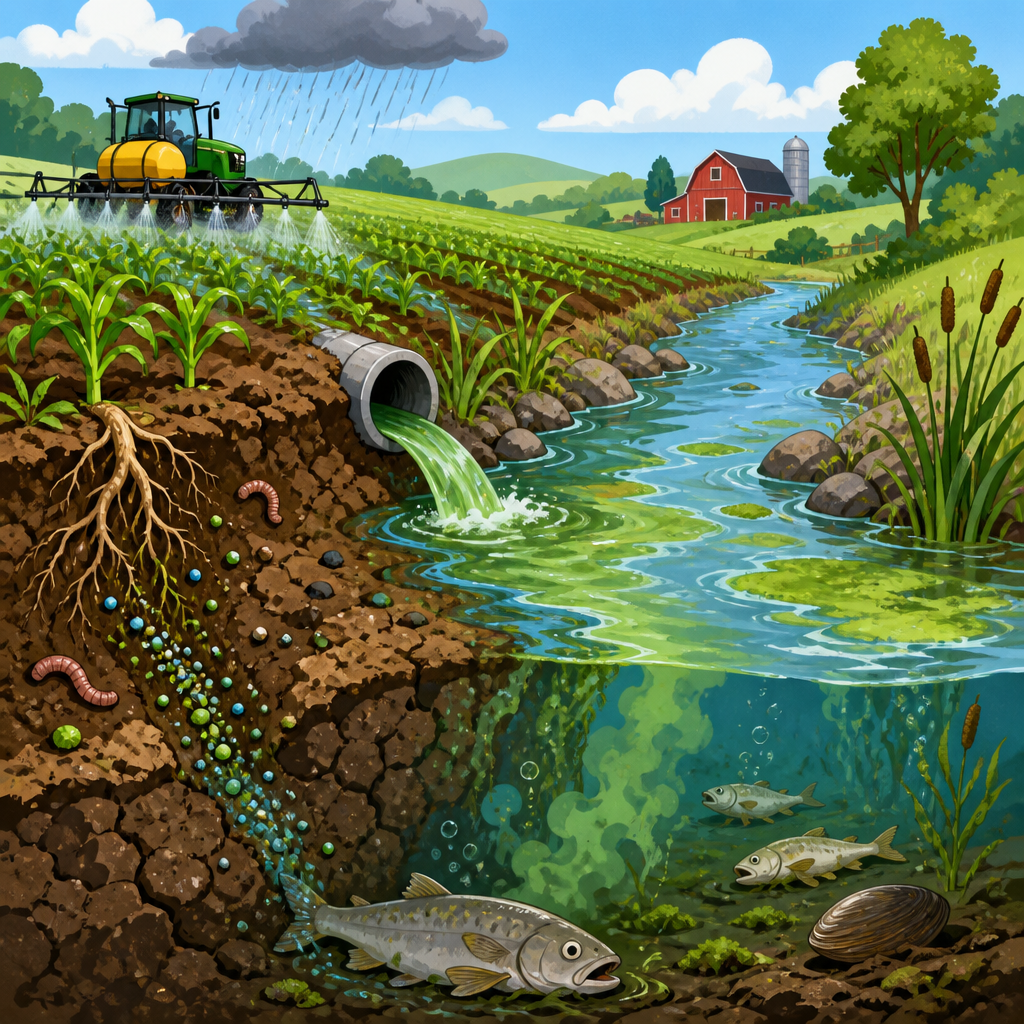
Rare earth extraction can impose heavy environmental costs if poorly governed. Mining disturbs land, removes vegetation, generates dust, and changes local hydrology. Processing can require strong acids, large volumes of water, and complex waste management. Tailings may contain residual chemicals and naturally occurring radioactive materials, especially where monazite-bearing ores are involved. If tailings storage is inadequate, contaminants can enter soil and water. These impacts are not unique to rare earths, but the separation stage makes the sector particularly sensitive.
From an environmental science perspective, the central issue is impact intensity per functional unit. Rare earths are usually used in small masses, but the upstream footprint per kilogram can be substantial. That means a product marketed as green may carry hidden burdens unless manufacturers manage sourcing carefully. Life cycle assessment helps quantify tradeoffs: a permanent magnet motor may improve energy efficiency during use, but the gains should be weighed against mining emissions, chemical consumption, and waste handling. In many cases the use-phase benefit still dominates, especially in long-lived clean energy systems, yet that conclusion depends on responsible production practices rather than assumptions.
Examples from mining regions show both risk and improvement potential. Operations with modern liners, closed-loop water systems, radiation monitoring, and audited waste controls perform very differently from informal or weakly regulated sites. Policy therefore matters. Strong permitting, transparent reporting, independent environmental review, and financial assurance for closure reduce long-term harm. The lesson for the renewable versus nonrenewable resources debate is clear: shifting away from fossil fuels does not eliminate environmental extraction impacts; it changes their profile and location.
Ethics, Labor, Communities, and Global Justice
The ethics of rare earth elements extend beyond pollution. Mining projects affect land rights, Indigenous communities, labor conditions, revenue distribution, and intergenerational justice. A government may promote a project as essential for clean technology, while nearby residents bear the immediate burden of dust, truck traffic, water competition, or waste storage risk. Ethical resource management asks who benefits, who pays, and who gets to decide. Free, prior, and informed consent is especially important where Indigenous territories are involved, and community consultation must be more than a formality.
Labor ethics also matter throughout the supply chain. Formal rare earth mining is generally more mechanized than artisanal cobalt mining, but workers still face hazards from chemical exposure, heavy equipment, and insufficient safeguards if standards are weak. Downstream manufacturers increasingly use OECD due diligence guidance, supplier codes of conduct, third-party audits, and traceability platforms to screen risks. These tools help, but they are not foolproof. Audits can miss subcontracting, records can be incomplete, and social conditions can shift quickly when commodity prices move.
There is also a justice question between high-consuming and producing countries. Wealthier economies often want electric vehicles, wind farms, and advanced electronics, yet resist the mining needed within their own borders. That can externalize environmental and social burdens to regions with lower political power or weaker regulation. A credible ethics framework does not simply demand more minerals for decarbonization. It combines responsible domestic permitting, higher recycling, lower material intensity, transparent sourcing, and serious engagement with affected communities.
Reducing Dependence: Recycling, Substitution, and Better Design
The most effective way to reduce pressure on nonrenewable resources is to use them more intelligently. For rare earth elements, that means improving recycling, designing products for disassembly, reducing manufacturing scrap, and developing substitutes where performance allows. Magnet recycling is a high-potential pathway because neodymium and dysprosium are concentrated in a form that can retain value. Methods include direct reuse, hydrogen decrepitation, and hydrometallurgical recovery. However, collection remains difficult because magnets are dispersed across products, often glued in place, miniaturized, or mixed with other components.
Substitution is possible in some applications but not all. Electric motors can use induction or switched reluctance designs to avoid rare earth magnets. Ferrite magnets work in lower-performance settings. In lighting and displays, technology shifts can reduce dependence on specific phosphors. Yet substitution usually involves tradeoffs in efficiency, weight, cost, heat tolerance, or product size. Engineers therefore evaluate total system performance rather than replacing one element mechanically with another.
Better design often delivers the fastest gains. Manufacturers can reduce dysprosium content through grain boundary diffusion, optimize magnet geometry, and improve motor control software to get more output from less material. They can also recover offcuts from magnet fabrication, which is often easier than extracting rare earths from end-of-life products. Circular economy strategies are not optional extras here. They are the practical bridge between renewable energy goals and the finite nature of mineral resources.
What Rare Earths Teach About Renewable and Nonrenewable Resource Management
Rare earth elements show why the renewable versus nonrenewable resources discussion must move beyond simple labels. Renewable systems still depend on finite materials, and sustainability depends on how those materials are sourced, processed, used, and recovered. Good resource management follows a hierarchy: reduce demand where possible, improve efficiency, extend product life, recycle strategically, diversify supply, and enforce strong environmental and social standards. That hierarchy applies not only to rare earths but to lithium, cobalt, copper, phosphate, and many other materials central to environmental science.
The broader lesson is that sustainability is a systems challenge. Decarbonization, biodiversity protection, water stewardship, industrial policy, and community rights must be considered together. A wind turbine or electric vehicle should not be judged only by tailpipe or smokestack emissions. It should be evaluated across the full life cycle, from mine to manufacturing to use to end of life. That perspective produces better decisions and more resilient policy.
As a hub for this subtopic, this article should leave you with one clear idea: renewable energy technologies rely on nonrenewable resources, and rare earth elements are one of the best examples of that reality. Their scarcity is less about absolute disappearance than about concentrated supply, difficult processing, and rising demand. Their ethics are less about slogans than about measurable impacts on land, labor, and communities. If you want to understand environmental science at a practical level, follow the materials as closely as the energy. Explore the linked topics in this resource hub, compare life cycles, and use that fuller picture to judge what truly makes a resource system sustainable.
Frequently Asked Questions
What are rare earth elements, and why are they so important in modern environmental science?
Rare earth elements, often abbreviated as REEs, usually refer to the fifteen lanthanides on the periodic table, and in many practical discussions they also include scandium and yttrium because these elements occur in similar ore systems and have related industrial uses. They matter enormously in environmental science because they sit at the intersection of low-carbon technology, resource extraction, global supply chains, and environmental risk. Rare earths are used in high-performance magnets, batteries, catalysts, wind turbines, electric vehicles, energy-efficient lighting, electronics, medical devices, and a range of defense technologies. In other words, they help enable many of the systems associated with decarbonization and advanced manufacturing.
What makes them especially significant is that they expose a central tension in sustainability: technologies designed to reduce emissions still depend on intensive mining and chemical processing. Environmental science does not just ask whether a technology is “green” at the point of use; it also asks what ecological costs are embedded in the materials that make the technology possible. Rare earth elements are a textbook example. Their extraction can involve land disturbance, large waste streams, acid use, radioactive byproducts in some deposits, and water contamination risks if poorly managed. So while they are essential to many clean energy systems, they also force policymakers, industry leaders, and researchers to confront difficult questions about how to secure materials responsibly.
Are rare earth elements actually rare, or is the name misleading?
The name is somewhat misleading. Most rare earth elements are not especially rare in terms of total crustal abundance. Some are more common than familiar industrial metals such as copper or lead. The real issue is not absolute geological scarcity, but the relative scarcity of concentrated, economically viable, and environmentally manageable deposits. Rare earths tend to be dispersed rather than clustered in high-grade ore bodies, which means that finding deposits that can be mined profitably and processed efficiently is much harder than the name alone suggests.
Another reason the term persists is historical. Early chemists found these elements in unusual mineral samples and called their oxides “earths,” while the deposits themselves seemed uncommon and difficult to isolate. That terminology stuck, even though modern geology paints a more nuanced picture. From a supply perspective, the challenge is that rare earth extraction and separation are technically demanding. The elements have very similar chemical properties, so separating them into pure forms requires multiple processing steps, specialized knowledge, and significant infrastructure. As a result, scarcity in the rare earth sector is often better understood as a problem of processing capacity, investment, environmental regulation, and geopolitical concentration rather than simple physical absence in the Earth’s crust.
Why is rare earth supply considered vulnerable if these elements are used so widely?
Rare earth supply is considered vulnerable because mining, refining, and separation are heavily concentrated in a limited number of countries and facilities. Even when deposits exist elsewhere, developing a new mine and building the downstream chemical processing needed to turn ore into usable materials can take many years, major capital investment, and a stable regulatory environment. This creates a supply chain that is vulnerable to trade disputes, export controls, price shocks, political tensions, environmental crackdowns, and operational disruptions.
Demand growth adds another layer of pressure. As electric vehicles, wind power, advanced electronics, and strategic technologies expand, certain rare earths such as neodymium, praseodymium, dysprosium, and terbium are seeing especially strong demand because of their role in permanent magnets. That demand is not always easy to meet quickly, particularly when new projects face financing uncertainty or local opposition over environmental concerns. The result is a structurally fragile market in which supply can be tight even when the elements themselves are not geologically scarce. For environmental scientists and energy planners, this matters because the pace of the clean energy transition can be shaped not just by innovation and policy, but by access to critical materials and the resilience of the supply chains behind them.
What are the main environmental and ethical concerns linked to rare earth mining and processing?
The environmental concerns begin with the physical footprint of extraction. Mining can lead to habitat destruction, soil erosion, dust generation, and significant land-use change. Processing is often even more challenging than mining because it can require crushing, flotation, roasting, solvent extraction, and large volumes of water and chemicals. If these steps are not managed carefully, they can create air emissions, acidic wastewater, tailings contamination, and long-term waste management problems. Some rare earth ores also contain thorium or uranium, which means radioactive residues can become part of the waste stream and require strict monitoring and disposal practices.
The ethical concerns are equally serious. Communities near extraction and processing sites may face pollution burdens while receiving limited economic benefits, especially where governance is weak or environmental enforcement is inconsistent. There are also labor rights concerns in some mining regions, including worker safety, inadequate protective standards, and limited local consultation. In broader ethical terms, rare earths highlight a justice question at the heart of green development: who bears the environmental and social costs of producing materials that enable cleaner technologies elsewhere? A renewable energy system is not automatically ethical simply because it reduces carbon emissions. A truly responsible system also requires transparent sourcing, rigorous environmental safeguards, fair labor conditions, community participation, and credible remediation plans for mine closure and waste management.
Can the world reduce rare earth risks through recycling, substitution, or better policy?
Yes, but none of these solutions is a complete fix on its own. Recycling can help recover rare earths from magnets, electronics, batteries, and industrial scrap, reducing pressure on primary mining over time. However, recycling rare earths is technically difficult because they are often used in small quantities, mixed into complex products, or embedded in components that are not designed for easy disassembly. Collection systems are also uneven, and the economics of recovery do not always compete with newly mined material. Still, better product design, stronger e-waste systems, and investment in recovery technologies could make recycling a much more meaningful part of supply in the future.
Substitution is another promising strategy, especially in applications where engineers can redesign products to use less of the most supply-sensitive elements or switch to alternative materials. That said, rare earths are often used precisely because they deliver exceptional performance, so substitutes may involve tradeoffs in efficiency, durability, size, or cost. Policy therefore plays a critical balancing role. Governments can diversify supply by supporting responsible domestic production, permitting reform that does not weaken environmental standards, strategic stockpiles, research into alternative materials, and international partnerships with higher transparency requirements. Stronger traceability rules and environmental reporting can also push the market toward more ethical sourcing. In practice, the most effective path is a portfolio approach: mine more responsibly where necessary, process more cleanly, recycle more efficiently, design products more intelligently, and govern global supply chains with greater accountability.