
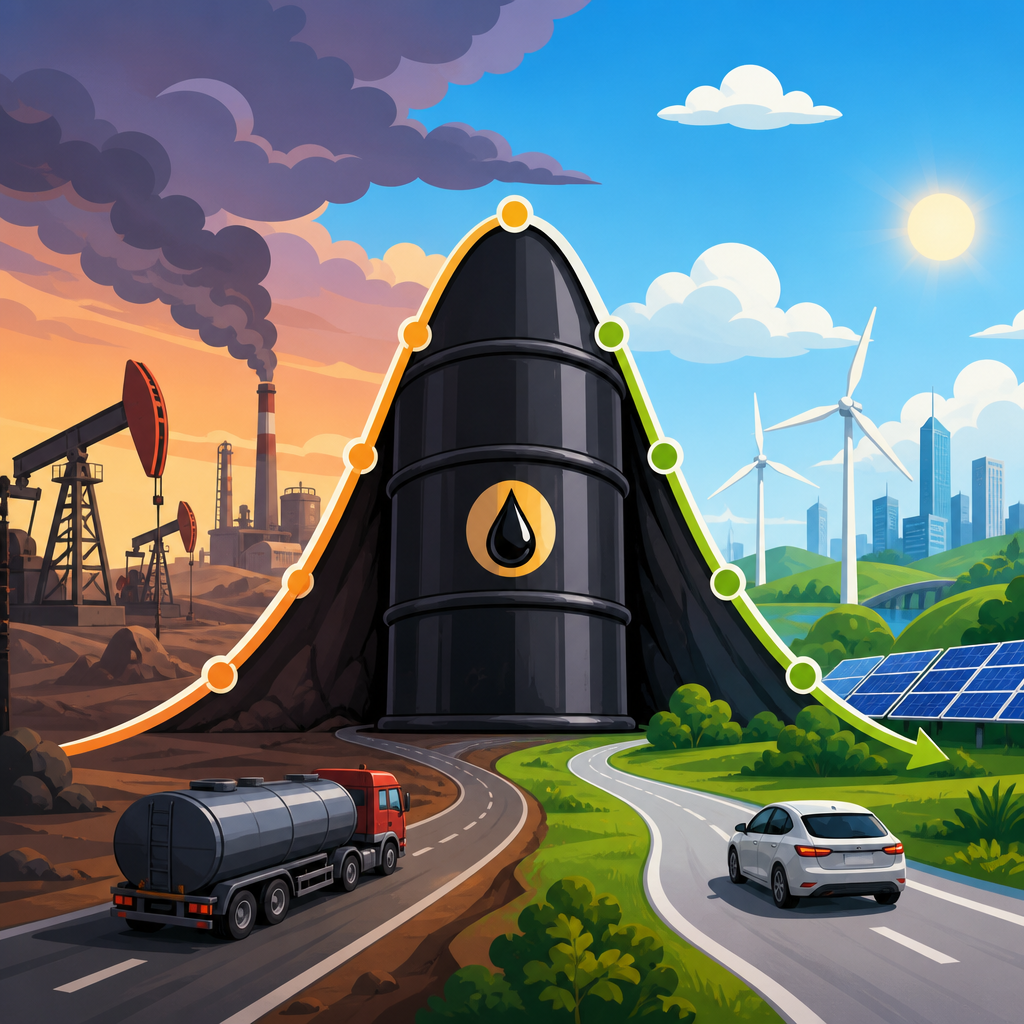
Peak oil describes the point at which global petroleum production reaches its highest rate and begins an irreversible decline. The term does not mean the world has run out of oil, and it does not predict that every well or country peaks at the same time. It refers to a production curve shaped by geology, investment, technology, politics, and demand. I have worked with energy datasets and resource planning models, and the first lesson is always the same: production limits matter because modern economies still depend on liquid fuels for transport, petrochemicals, agriculture, and heavy industry.
To understand peak oil, readers also need a clear view of renewable vs. nonrenewable resources. Nonrenewable resources, including oil, coal, natural gas, and uranium, exist in finite geological stocks formed over millions of years. Renewable resources, such as solar, wind, hydropower, geothermal energy, and sustainably managed biomass, are replenished on human timescales, although they still face limits of land, materials, ecosystems, and infrastructure. This distinction matters because the future of energy is not only about how much fuel remains underground. It is about how quickly societies can replace declining or volatile fossil resources with reliable low-carbon systems.
Peak oil became widely discussed after geologist M. King Hubbert proposed in 1956 that oil production in a region tends to rise, crest, and fall. His model correctly anticipated that conventional crude production in the contiguous United States would peak around 1970. Since then, the concept has evolved. Analysts now separate conventional oil from tight oil, deepwater oil, natural gas liquids, and biofuels because each has different costs, decline rates, and technical constraints. That nuance is important. Broad claims that peak oil was disproved by shale drilling miss the fact that geology still imposes limits; technology can delay, reshape, or shift a peak, but not eliminate finite resource depletion.
Why does this matter for the future? Because energy transitions take decades, capital assets last for years, and policy mistakes can lock in vulnerability. A world facing plateauing oil supply, price spikes, or declining net energy must make better decisions about transport, electricity, buildings, industrial heat, and resource efficiency. Peak oil also intersects with climate science. Burning remaining fossil reserves at scale would worsen warming, yet moving away from them too slowly creates economic and geopolitical risk. The central question is no longer simply whether oil peaks. It is how societies manage the shift from nonrenewable resources toward renewable energy, efficiency, electrification, and resilient supply chains.
How Peak Oil Works in Practice
Peak oil happens because individual oil fields usually follow a life cycle. Output rises after discovery and development, stabilizes for a period, then declines as reservoir pressure drops and remaining oil becomes harder and more expensive to extract. Enhanced recovery methods, such as water flooding, carbon dioxide injection, and horizontal drilling, can improve recovery factors, but they do not change the finite nature of the reservoir. Scale that field-level pattern across a basin, a country, or the world, and the production curve becomes a strategic issue rather than a local engineering detail.
In practice, the peak is shaped by more than geology. Prices influence drilling activity. Interest rates affect project finance. Export restrictions, sanctions, wars, refinery capacity, and environmental regulation can all alter supply. Demand matters too. If electric vehicle adoption grows quickly, oil demand can flatten before geology forces a supply peak. That is why experts often distinguish peak supply from peak demand. Both are important, and they can occur at different times. For planners, the more useful question is how much affordable oil can be delivered consistently, at what emissions cost, and with what exposure to disruption.
The idea of net energy also belongs in this discussion. Early conventional oil often had a high energy return on energy invested, meaning producers spent relatively little energy to extract a great deal. As resources become more difficult, more energy, water, steel, and capital are required per barrel. That reduces the surplus energy available to the broader economy. A barrel is not just a barrel if one source requires extensive drilling, processing, and transport while another flows easily. This is one reason societies look beyond simple reserve numbers when evaluating energy security.
Conventional and Unconventional Oil: Why the Difference Matters
Conventional oil usually refers to crude that can be extracted from porous rock with relatively standard drilling and pumping methods. Unconventional oil includes tight oil from shale formations, oil sands, extra-heavy crude, and some deepwater resources that require more complex technology and larger energy inputs. The United States shale boom illustrates how unconventional production can change national output dramatically. Hydraulic fracturing and horizontal drilling unlocked formations such as the Permian Basin and Bakken, lifting U.S. crude production to record levels in the late 2010s and early 2020s.
But unconventional growth came with tradeoffs. Tight oil wells typically decline much faster than many conventional fields, so operators must keep drilling to maintain output. Oil sands require energy-intensive processing and have significant land and water impacts. Deepwater projects demand long lead times and substantial capital. These differences matter when discussing peak oil because a temporary surge from unconventional sources may mask underlying depletion elsewhere. It can also create a supply system that is more sensitive to financing conditions, service costs, and environmental constraints.
Reserve reporting adds another layer of complexity. Proved reserves are not the same as total resources. Proved reserves are volumes considered recoverable under existing economic and operating conditions with reasonable certainty. Change the oil price, tax policy, or technology, and reserve estimates change as well. That does not mean the oil suddenly appeared. It means the threshold for profitable extraction moved. For anyone comparing renewable vs. nonrenewable resources, this distinction is vital. Finite fuels can become more or less economically accessible, but they are still finite and ultimately depleted by use.
Renewable vs. Nonrenewable Resources: The Core Energy Divide
Nonrenewable resources are energy sources and materials consumed faster than natural processes can replace them on human timescales. Oil is the clearest example because each barrel burned is gone forever. Coal and natural gas work the same way. Uranium is also finite, though nuclear power differs from fossil fuels because it generates electricity without combustion emissions during operation. Renewable resources, by contrast, are replenished continually or can be sustained when managed properly. Sunlight and wind are flow resources. Rivers are renewable within hydrological limits. Forest biomass can be renewable only if harvest does not exceed regrowth and ecosystem health is protected.
The practical difference is not just renewability; it is system design. Fossil fuels store concentrated energy and are easy to transport, which made them ideal for twentieth-century industrial growth. Renewables often produce variable electricity tied to weather or geography, so they depend on transmission, storage, demand response, forecasting, and flexible grids. After years reviewing decarbonization plans, I have found that many public debates stall because they compare fuels rather than systems. The better comparison asks which full system delivers reliable energy, stable costs, lower pollution, and lower long-term risk.
| Resource type | Examples | Main advantage | Main limitation |
|---|---|---|---|
| Nonrenewable | Oil, coal, natural gas, uranium | High energy density, established infrastructure | Finite supply; pollution, waste, or carbon risk |
| Renewable | Solar, wind, hydro, geothermal, sustainable biomass | Replenished on human timescales; low operating emissions | Variability, siting constraints, grid and storage needs |
That comparison explains why peak oil has broad significance. If oil supply becomes constrained, economies with efficient transit, electrified vehicles, robust power grids, and diversified renewable generation are better positioned than economies locked into long-distance trucking, sprawling land use, and oil-dependent power or heating. The issue is not choosing one energy source in isolation. It is managing a transition from a depleting, carbon-intensive foundation toward a more resilient mix.
What Peak Oil Means for the Economy, Environment, and Security
Oil affects nearly every sector, so changes in supply or price ripple quickly. Transport is the most visible example because gasoline, diesel, marine fuel, and jet fuel still dominate. Agriculture also depends heavily on petroleum for machinery, irrigation, food processing, and freight. Petrochemicals matter as well; plastics, solvents, fertilizers, synthetic fibers, and countless industrial products begin with hydrocarbon feedstocks. When oil prices surge, households feel it at the pump, but businesses also face higher logistics and input costs. Inflation can follow, especially where alternatives are weak.
History offers several examples. The 1973 oil embargo and the 1979 Iranian Revolution triggered severe price shocks and recessionary pressure in many importing nations. More recently, the 2022 energy crisis showed how geopolitical disruption can tighten fuel markets and expose countries dependent on imported fossil energy. Peak oil does not guarantee a single dramatic collapse. More often, it raises the risk of recurring volatility, regional shortages, and expensive adaptation if planning lags behind physical and economic realities.
Environmental consequences are equally important. As easy oil declines, producers may turn to heavier, deeper, or more carbon-intensive sources. That can increase upstream emissions, methane leakage, water use, habitat fragmentation, and spill risks. At the same time, reducing oil dependence brings benefits beyond climate mitigation. Cleaner air lowers health burdens from particulates, nitrogen oxides, and ozone precursors. Urban design that reduces driving can cut congestion and improve public health. Energy transitions are never impact-free, but the external costs of fossil systems are well documented by the International Energy Agency, Intergovernmental Panel on Climate Change, and World Health Organization.
Security concerns often receive less attention than climate debates, yet they are central. Oil supply chains cross chokepoints such as the Strait of Hormuz and rely on shipping, pipelines, refineries, and strategic reserves. Import dependence can shape foreign policy and military commitments. Renewable electricity is not immune to risk, but it is geographically broader and less vulnerable to a small set of export routes. Distributed solar, storage, grid interconnections, and domestic manufacturing can reduce exposure to external fuel shocks, even though they introduce new dependencies on critical minerals and advanced equipment.
Can Renewable Energy Replace Oil?
Renewable energy does not replace oil barrel for barrel because oil is used primarily as a liquid fuel and petrochemical feedstock, while most renewables generate electricity. The replacement happens through electrification and substitution. Electric vehicles displace gasoline and diesel in passenger transport. Heat pumps reduce fuel use in buildings. Rail electrification and battery or hydrogen options can cut fossil fuel use in freight and industry. In aviation, shipping, and some chemical processes, substitution is harder, so efficiency, sustainable fuels, and demand management become more important.
Cost trends have made this transition far more plausible than it was two decades ago. Utility-scale solar and onshore wind have fallen sharply in cost, and lithium-ion battery prices declined dramatically before recent mineral and supply-chain fluctuations. In many regions, new solar or wind projects now compete directly with fossil generation on price. That does not mean the transition is automatic. Permitting delays, transmission bottlenecks, interconnection queues, and local opposition can slow deployment. Still, the direction is clear: renewable electricity is no longer a niche supplement but a central replacement pathway for many oil-linked end uses.
There are limits. Heavy trucks, aviation, petrochemicals, and remote industrial operations remain difficult to decarbonize quickly. Mining, steel, cement, and fertilizer also need major process changes. Biofuels can help in some sectors, but land use, food competition, and lifecycle emissions must be evaluated carefully. Hydrogen can support refining, steelmaking, and some transport applications, yet it is energy intensive and should be targeted where direct electrification is not practical. The future will likely be mixed: more electrification where efficient, more efficiency everywhere, and selective use of low-carbon fuels where electricity alone is insufficient.
How Societies Should Prepare for a Post-Peak Oil Future
Preparation starts with reducing oil intensity, not waiting for scarcity to force abrupt change. Governments can improve fuel economy standards, expand public transit, support compact development, modernize freight rail, and accelerate charging infrastructure. Utilities and regulators can invest in grid upgrades, storage, and demand flexibility so rising electricity demand from vehicles and buildings remains reliable. Businesses can shorten supply chains, electrify fleets, hedge fuel exposure, and redesign products around circular material use. Households can benefit from efficient cars, better insulation, heat pumps, and fewer mandatory car trips.
Good policy also recognizes equity. Low-income households are often hit hardest by fuel spikes because energy and transport consume a larger share of income. Rural regions may have fewer alternatives to driving. Workers in fossil fuel industries need credible transition planning, including retraining, pension protection, and regional investment. I have seen energy strategies fail when they treat the transition as only a technology problem. Durable progress requires institutions, labor policy, land-use reform, and public trust.
The future implied by peak oil is not a single forecast. It is a planning lens. It tells us that nonrenewable resources carry depletion and volatility risks that compound climate risk. It also highlights why renewable vs. nonrenewable resources is a foundational environmental science topic. Renewable systems are not limitless, but they align better with long-term stability because they draw on ongoing natural flows instead of one-time geological stocks. The practical goal is not perfection. It is building an energy system that is cleaner, more secure, less price-shocked, and more adaptable than the one oil created. To move forward, evaluate where oil dependence is highest, prioritize efficient electrification, and use this hub as your starting point for deeper study across the full renewable and nonrenewable resource landscape.
Frequently Asked Questions
What is peak oil, exactly?
Peak oil is the point at which petroleum production reaches its maximum rate and then begins a long-term decline. It does not mean the world has suddenly run out of oil, and it does not mean every oil field, company, or country peaks at the same time. Instead, it describes a production pattern: output rises as resources are discovered and developed, eventually levels off, and later falls as the easiest and most productive reserves are depleted. That curve is shaped by more than geology alone. Investment levels, drilling technology, access to capital, government policy, conflict, infrastructure, and consumer demand all influence when production peaks and how steep the decline becomes.
In practical terms, peak oil is about flow rates, not just total resources underground. A country may still have substantial oil left in place, but if it becomes harder, slower, or more expensive to extract, total production can still fall. That distinction matters because modern economies depend on reliable, affordable energy flows. Transportation, manufacturing, agriculture, shipping, and many petrochemical industries are built around the assumption that liquid fuels will be available at scale. Peak oil raises questions not only about how much oil exists, but about how much can be produced, at what cost, and for how long.
Does peak oil mean we are about to run out of oil?
No. One of the most common misunderstandings is that peak oil means the last barrel is near. That is not what the term means. Peak oil refers to the highest sustainable rate of production, after which output declines. There can still be a great deal of oil remaining underground after the peak. The issue is that what remains is often harder to access, lower in quality, more energy-intensive to produce, or more expensive to bring to market. In other words, supply can become constrained even while resources still exist on paper.
This is why discussions about peak oil often focus on affordability and extraction difficulty rather than absolute scarcity. A resource can be geologically present but economically marginal. Deepwater projects, ultra-heavy crude, Arctic drilling, and politically unstable producing regions may all add barrels, but often with greater cost and risk. As the easiest oil is depleted, maintaining or increasing production requires more capital, more technology, and more effort. So the future challenge is not simply whether there is oil left, but whether enough can be produced consistently to meet demand without causing severe price volatility or economic strain.
What causes oil production to peak?
Oil production peaks because resource extraction tends to follow physical and economic limits. In the early stages of development, producers target the largest, easiest, and most productive reservoirs. Output grows quickly as infrastructure expands and investment pours in. Over time, however, fields mature. Pressure declines, water cut rises, production becomes more complex, and new discoveries may be smaller or more difficult to exploit. Even when technology improves recovery, it often slows decline rather than eliminating it entirely. The result is that production eventually stops growing and begins to fall.
That said, geology is only part of the story. Peak timing can be accelerated or delayed by politics, sanctions, war, regulation, taxation, market prices, and technological breakthroughs such as horizontal drilling or enhanced recovery methods. Demand also matters. If oil prices rise too high, consumers and industries may reduce use or switch fuels, which can flatten production growth. If prices fall too low, producers may cut investment, leading to future supply shortfalls. This is why peak oil should be understood as a system-level outcome. It is shaped by the interaction between finite resources and the economic, technological, and political framework needed to turn those resources into usable fuel.
How could peak oil affect the economy and everyday life?
Peak oil matters because modern economies are deeply dependent on abundant liquid fuels. Oil powers most global transportation directly and supports agriculture, mining, freight, aviation, construction, and emergency services. It is also a feedstock for plastics, chemicals, fertilizers, synthetic materials, and countless industrial products. If oil production becomes harder to expand or begins to decline, the effects can show up through higher prices, tighter supply, increased volatility, and pressure on sectors that rely heavily on diesel, gasoline, jet fuel, and petrochemical inputs.
For households, the impact may be indirect but meaningful: more expensive commuting, higher shipping costs embedded in consumer goods, rising food prices linked to fuel and fertilizer costs, and greater vulnerability during supply disruptions. For businesses and governments, peak oil can influence long-term planning, infrastructure investment, trade balances, and national security strategy. Countries that rely heavily on oil imports may become more exposed to geopolitical shocks, while exporters may face revenue instability if production declines or demand patterns shift. The broader point is that production limits matter because economic systems are built around throughput. When a key input becomes less scalable, adaptation becomes necessary across transportation, energy policy, land use, manufacturing, and supply chains.
What does peak oil mean for the future of energy?
Peak oil does not automatically mean collapse, but it does mean transition. If global petroleum production becomes harder to grow or enters decline, societies will need to replace oil-dependent services with alternatives that are more efficient, diverse, and resilient. That includes expanding public transit, electrifying vehicles where practical, improving freight efficiency, redesigning cities to reduce transport demand, and accelerating non-oil energy sources. It also means paying attention to sectors that are harder to substitute, such as aviation, heavy trucking, shipping, and petrochemicals, where the transition may be slower and require multiple solutions rather than a single substitute.
In the long run, peak oil can act as a forcing mechanism that pushes economies toward efficiency and innovation. But the timing and smoothness of that transition matter. A gradual, well-planned shift allows infrastructure, industry, and consumers to adapt. A disorderly adjustment, especially if supply constraints appear before alternatives are widely deployed, can create inflation, economic stress, and political tension. The most realistic takeaway is that peak oil is not a one-sentence prediction; it is a strategic warning about dependence on a finite, complex, and increasingly costly resource base. Preparing for the future means reducing vulnerability to oil supply limits while building energy systems that are cleaner, more flexible, and less exposed to geological and geopolitical bottlenecks.